Educational content only — not medical advice. See our full Medical Disclaimer and Affiliate Disclosure below.
Boswellia and collagen are two of the most common names on joint-supplement labels — and this manual starts by reframing both. The first “supplement” for a joint is not a pill but movement itself, because the joint’s own lubricant, synovial fluid, is produced only under load[1]. Around that mechanism, the source library behind this guide supports exactly three pillars: load-driven lubrication, the collagen structure of cartilage, tendons and ligaments, and a 10-minute morning protocol that puts the first two to work. Everything else — the supplement reality check, the herb contraindications, and one unusual act of honesty about boswellia itself — follows from those pillars.
The scale of the problem explains why the topic is worth a manual at all. Citing WHO-scale figures, Platonov’s musculoskeletal-system text reports that every seventh person on the planet suffers joint pain, that rheumatoid arthritis affects about 58,000,000 people, and that rheumatic diseases account for 15-20% of all disability[3]. What the library offers in return is refreshingly concrete: mechanics, structure, a routine, and honest limits — with the standing rule, repeated early because it matters everywhere, that nothing here replaces a treating physician[10].
Key Takeaways
- Synovial fluid — the joint’s lubricant — is produced only under load: walking, running, moving the knee; a cast halts production entirely[1].
- Collagen gives cartilage, tendons and ligaments their structure, and the body’s own synthesis deteriorates after age 30-40 — but no collagen peptide dosage exists anywhere in the source base[1].
- Even chronic tendinopathy collagen can be remodeled by specially dosed, rhythmic high-force loads — which is why the morning protocol is a ramped series, not random stretching[1].
- Pills have honest limits: glucosamine sulfate in large doses long-term helps chronic pain but does not restore cartilage; no drug reliably restores the cartilage surface[1].
- Boswellia is the one thing this library cannot vouch for at all: three targeted queries and a whole-base control across 140,675 indexed points found zero boswellia content — so this manual makes no medical, mechanism or dosing claim about it.
Why Joints Need Load: Synovial Fluid Is Produced Only Under Movement
Begin with the counterintuitive mechanism that justifies everything else in this manual. In Demchenko’s Sea to the Knee, the joint’s lubricant — synovial fluid — is produced only under load: when we walk, run, or simply move the knees, lubrication is produced[1]. Remove the load and the system idles: with age, production worsens and the fluid becomes more viscous, and immobilization in a cast halts production entirely[1]. The cartilage you are trying to support is, in a literal sense, fed by the very movement that seems to spend it.
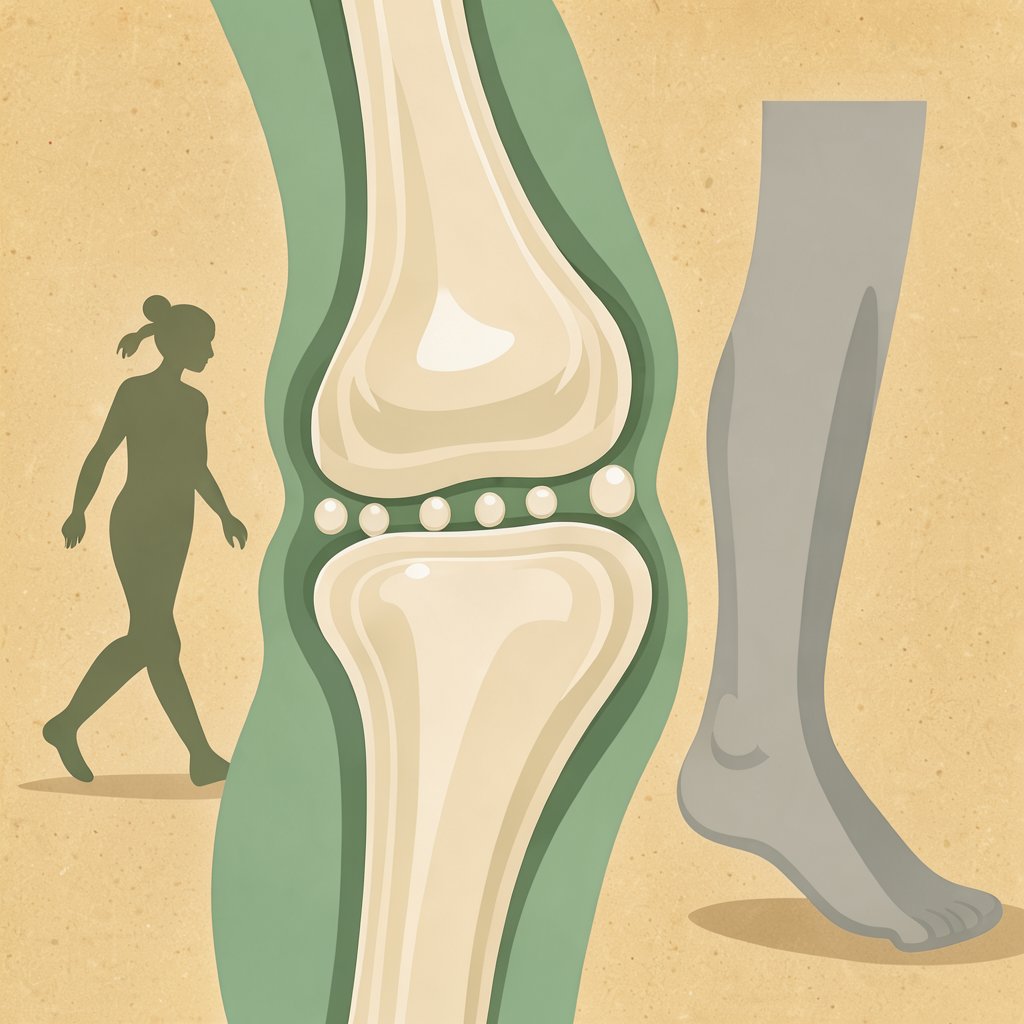
A second voice sharpens the same point into a rule of life. Shtippler and Regitnig-Tillian’s muscle book is blunt: “lying and sitting are poison for the joints”[2]. Movement makes the cells of the synovial membrane secrete more lubricant and feed the cartilage; inactivity causes cartilage atrophy; and myokines — messenger molecules released by working muscles — protect cartilage[2]. In other words, the muscular system is not just the joint’s engine; it is part of the joint’s supply line.
The numbers above give the stakes: every seventh person with joint pain, roughly 58,000,000 people with rheumatoid arthritis, rheumatic disease behind 15-20% of all disability[3]. This manual’s job is narrower and more useful than those statistics: to walk the reader through the three pillars the library can actually support — load-driven lubrication, collagen structure, and a 10-minute morning protocol — while saying plainly where the evidence stops. The fluid is the first pillar; what it bathes is the second.
Collagen: The Protein That Holds Cartilage, Tendons and Ligaments Together
The second pillar is structural. Collagen gives connective tissue its structure and density — cartilage, tendons, ligaments — and the body’s own collagen synthesis deteriorates after age 30-40[1]. That age line is the honest reason collagen supplements exist as a category, and it is also where the honesty must begin: the source base contains no collagen peptide dosage — no grams per day, no timing — anywhere, and this manual will not invent one.
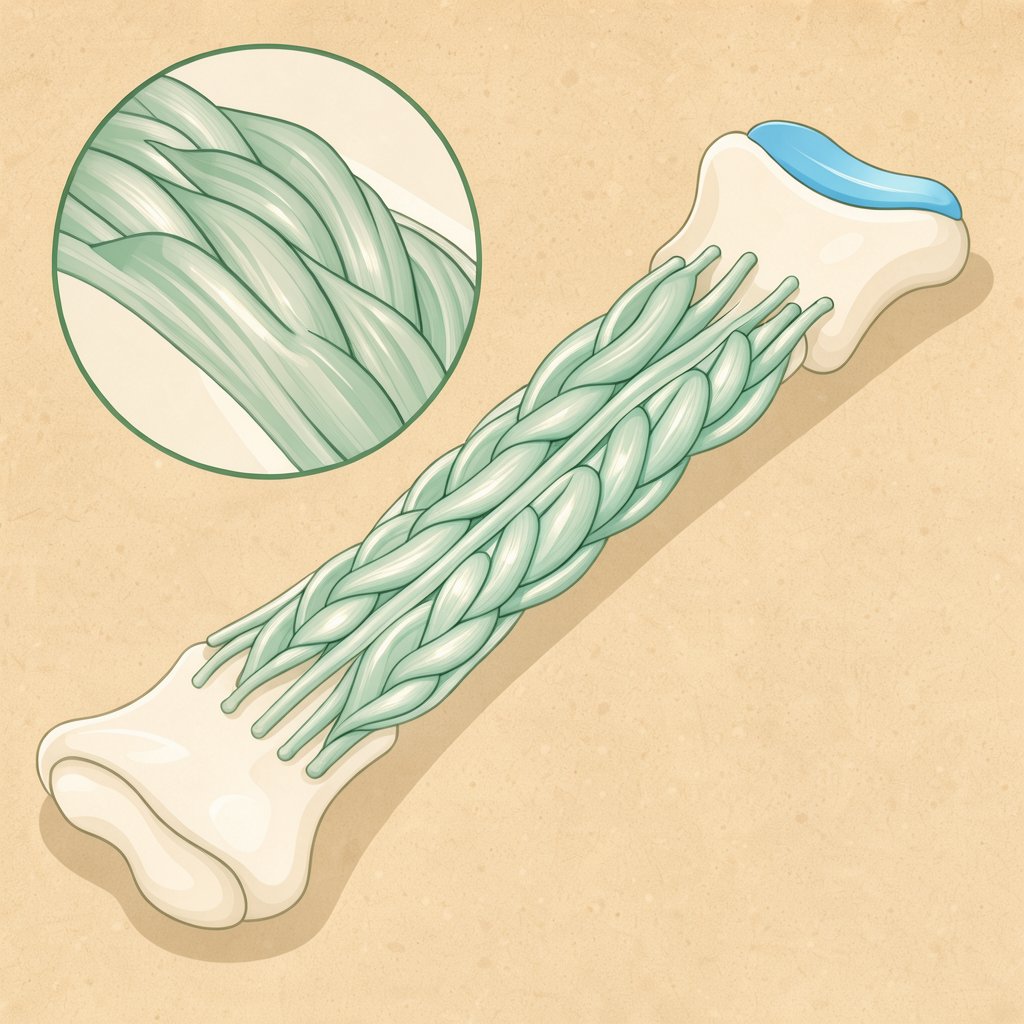
Neumann’s kinesiology text gives the protein its biomechanical texture. The anterior cruciate ligament is strained about 4% during an isometric quadriceps contraction with the knee flexed 15 degrees — a calibrated spring, not a rope[4]. Collagen fibers are crimped in the “toe” region, and healthy young ligaments return to their original length within the elastic zone[4]. Cartilage, for its part, stiffens as the compression rate rises — as in running — to protect the bone underneath[4]. The design lesson is load-rate: the tissue answers differently to a slow squeeze and a fast impact, which is one more argument for controlled movement.
The bone side of the same chemistry comes from Purisov’s Healthy Spine: bone mass is roughly 60-70% mineral (hydroxyapatite) and 30-40% organic, the organic fraction being mainly collagen; 90% of the body’s calcium lives in skeletal tissue; and vitamin C participates in more than 300 biological processes[5]. One boundary must be drawn exactly here, because the temptation is universal: the retrieved chunks never state that vitamin C is required for collagen synthesis, and the 300+ processes figure must not be stretched into that claim[5]. What the sources give is composition, not a recipe.
So the structure frays with age and answers to load-rate — which raises the practical question this manual exists to answer: can load do more than spend the structure? Can it repair it?
What Movement Can Remodel: Chronic Tendons and the Load-Dosing Evidence
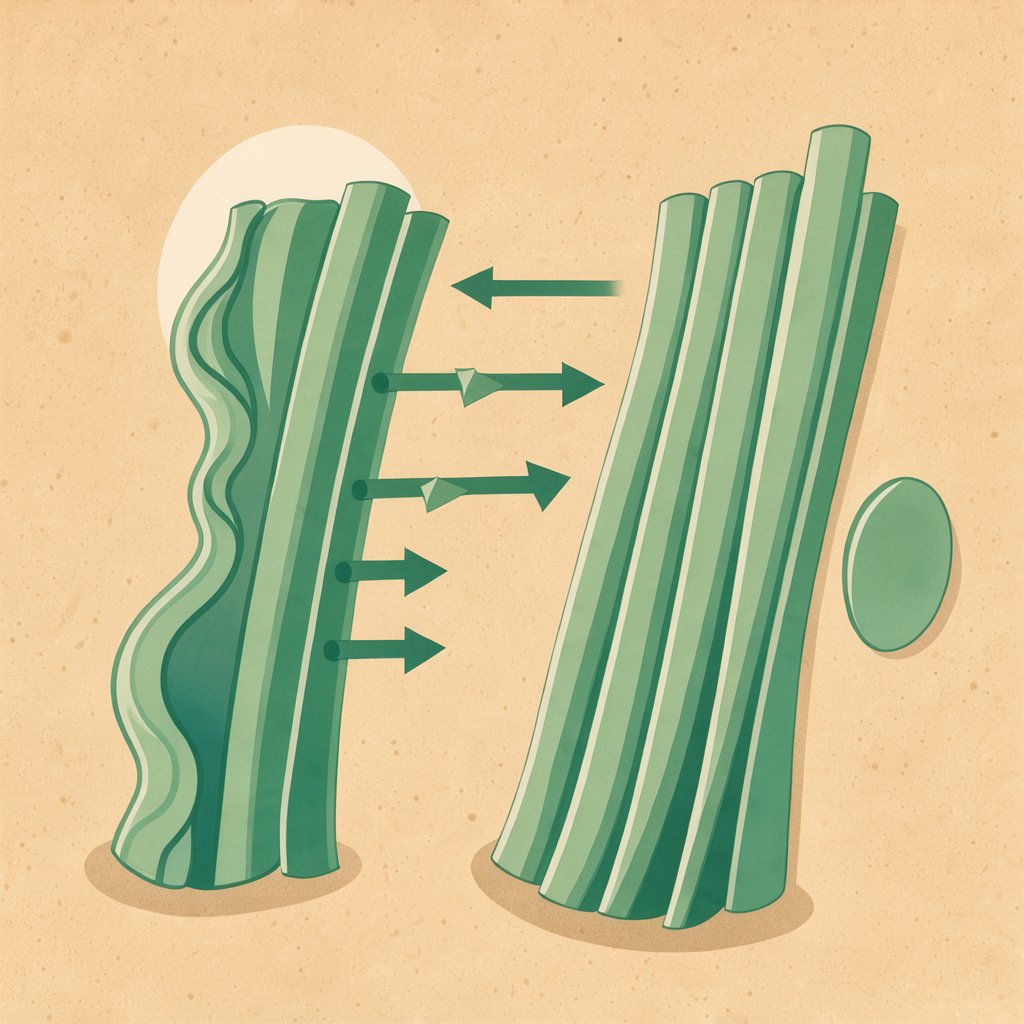
The third finding is the hopeful one, and it is the reason this is a manual rather than a warning label. In Demchenko’s collagen-restructuring account, even in chronic tendinopathy — tendon pain that has settled in for the long stay — specially dosed high-force loads applied in a certain rhythm remodel collagen whose structure is disturbed[1]. The tissue is not condemned. The catch is in the phrasing: the load must be dosed, and it must be rhythmic. Random effort is not the protocol; rhythm is.
At the elite end of the same story, Demchenko reports that the International Olympic Committee includes collagen supplements in its list for athletes — for the prevention of injuries and cartilage micro-cracks, and for less pain during movement[1]. The claim is kept strictly at the level the base carries: this is a committee position as reported by one source, not a dose recommendation. No grams, no brands, no study citations accompany it in the retrieved material, and none will be attached here.
Two gaps belong on the record in the same breath: the base holds no collagen peptide dosage of any kind, and it offers no per-study evidence for the IOC listing[1]. What the section still establishes is the principle that organizes everything that follows: tendon and ligament collagen responds to load that arrives in a dosed rhythm. The morning protocol in Sections 5-7 is exactly that — but before the routine, the pills deserve their honest paragraph.
The Supplement Reality Check: What Helps Pain and What Cannot Regrow Cartilage
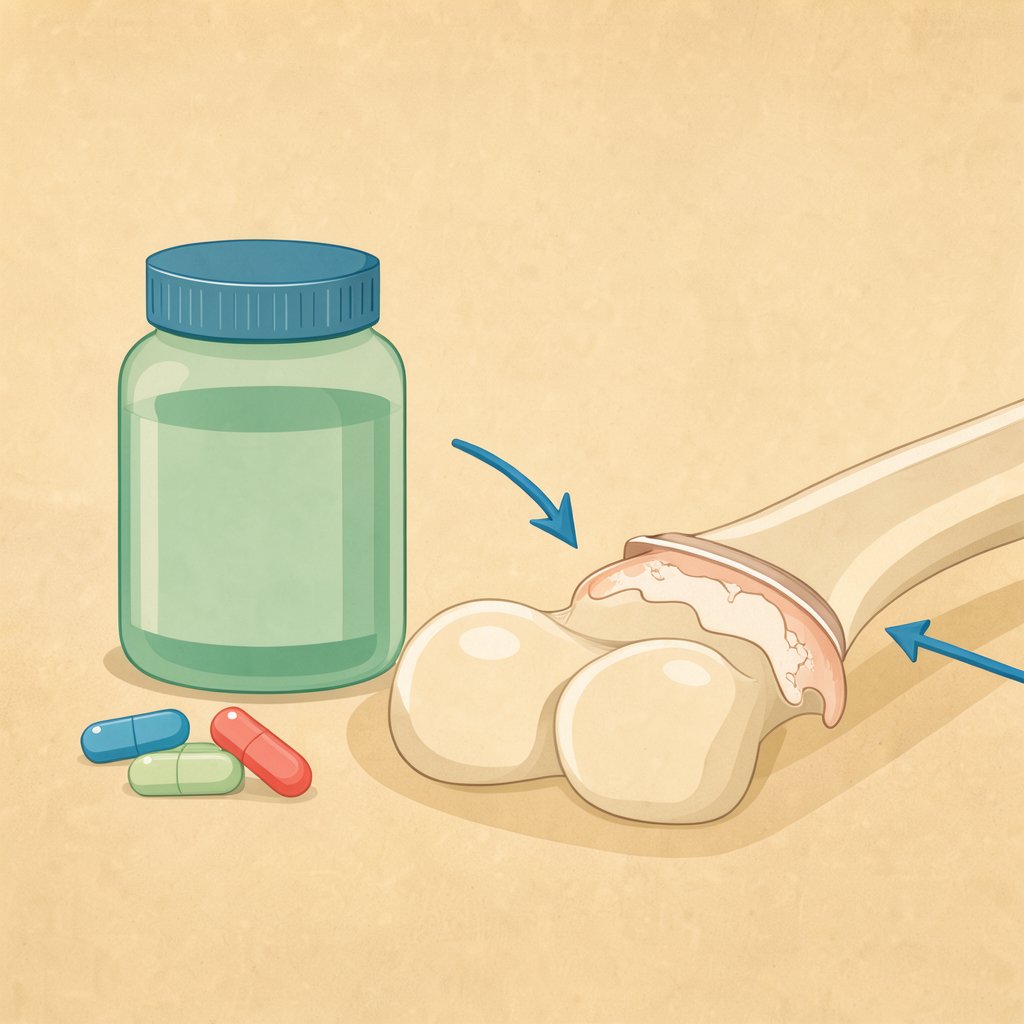
Set expectations for the supplement aisle honestly. On Demchenko’s evidence, glucosamine sulfate — the sulfate form specifically, and explicitly not chondroitin — taken in large doses over the long term helps chronic joint pain and reduces infarct and stroke risk through an anti-inflammatory effect, without the side effects of NSAIDs[1]. Two sentences later comes the boundary the whole category must live inside: glucosamine does not restore cartilage, and no drug that reliably restores the cartilage surface exists[1]. Pain support, yes; rebuilding, no — and the base contains no grams-per-day figure and no definition of “long-term”, so none appears here[1].
Injections have the same shape of honesty. Hyaluronic acid injections, per Demchenko, only substitute for the body’s own lubrication when that lubrication has failed — in the elderly or after prolonged immobilization — and they carry a mis-injection risk[1]. They replace fluid; they do not rebuild surfaces. And the same author’s mechanical rule of thumb is worth carrying into any joint routine: any joint must flex and extend through its full amplitude without pain, and the mechanical component of pain — a disrupted glide or a subluxation — must be identified rather than swallowed with a pill[1].
The analgesic fine print comes from Borenstein’s The Spine: aspirin and NSAIDs irritate the stomach, can cause bleeding ulcers, and can damage the kidneys at toxic doses — and long-term use above the 81 mg baby-aspirin threshold means see a doctor[6]. The 81 mg figure is quoted exactly as the source gives it[6]. One standing gap closes the section: the base holds no blood-thinner interaction data for any supplement discussed in this manual — an absence stated plainly rather than filled.
That is the pill ledger: real pain help with real limits, and no rebuilders anywhere. What the library supports best is not on a shelf — it is the ten minutes that begin before the feet touch the floor.
Morning Step One: The Ankle Spin-Up in Bed
The morning protocol opens where you wake up. In Bubnovsky’s Health Code for Heart and Vessels, the first move of the day is the ankles’: about 20 slow rotations per direction, with the big toes drawing maximum circles — as if tracing the widest circle possible on the ceiling — followed by knee and hip flexion with the soles sliding along the bed[7]. The whole spin-up lives on a scale of roughly ten minutes and belongs to the morning’s first quiet stretch of time, still lying down.
The sensations deserve honest normalization, because they frighten beginners away from a good routine: joint cracking and mild soreness during the spin-up are normal, and the endpoint to aim for is warmth in the joint[7]. Warmth is the marker that circulation and lubrication have answered the circles — which, after Section 1, is no metaphor: movement is what makes the synovial membrane secrete[1][7].
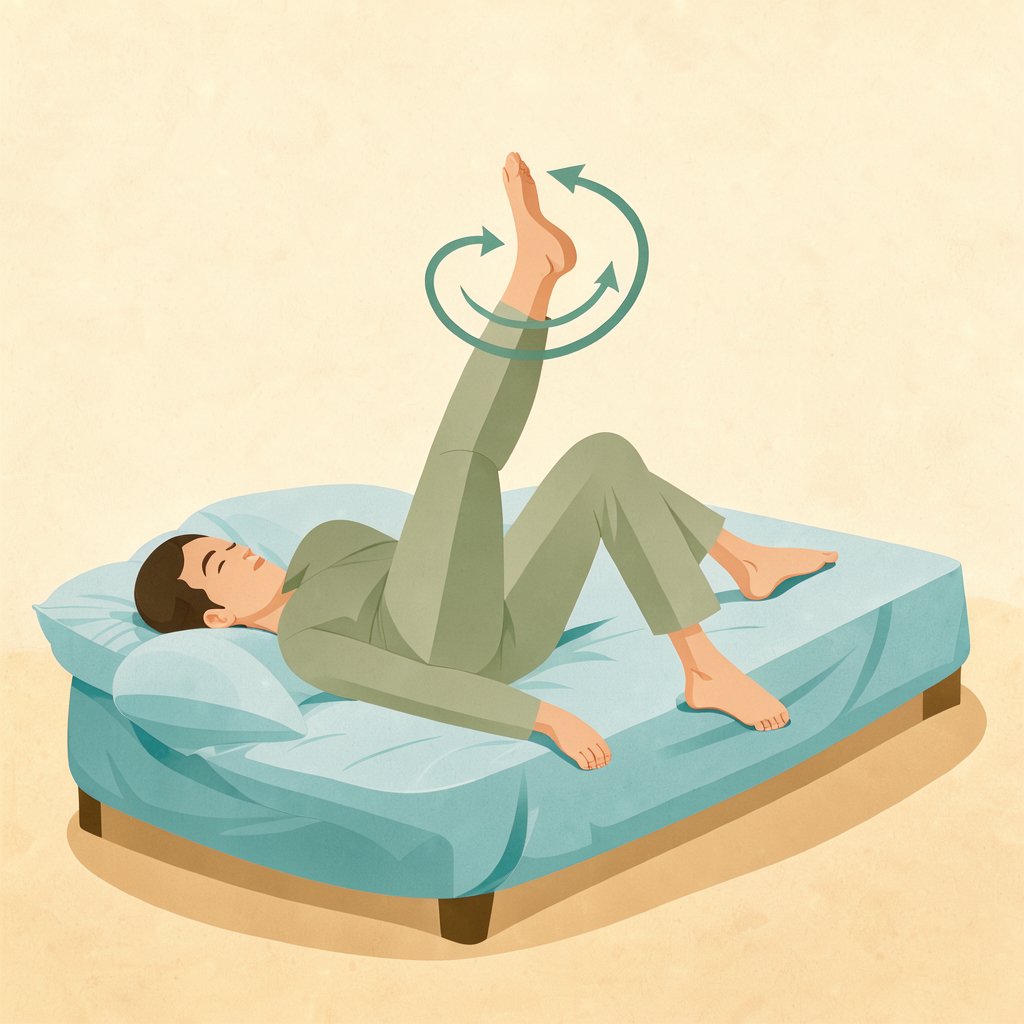
In movement order, the spin-up runs as follows[7]. The documented dose is about twenty slow circles per direction, the big toes drawing maximum circles, soles sliding along the bed[7]. Cracking and mild soreness count as normal signals, and warmth at the joint is the documented endpoint to stop at[7]:
- Ankle rotations: about 20 slow circles per direction, big toes drawing maximum circles.
- Knee and hip flexion: soles sliding along the bed, drawing the knees up gently.
Presented, deliberately, as step one of a morning protocol — not as therapy for any diagnosed condition; that boundary belongs to Section 8 and to your physician. One gap for the record: the retrieved chunks give no repetition table beyond the “about 20 slow rotations per direction” and no per-movement timings[7], so the ten-minute scale is the only clock offered.
With the ankles warm, the rest of the body is invited to follow — through a series that walks every joint from the fingertips and toes inward to the spine. The seventeen movements keep that order exactly, wrists and ankles before the spine, limbs before the trunk, and the source presents them as movements in that order and nothing more[8]. The walk inward is the intelligence of the series rather than a stylistic choice, since the spine has the least tolerance for a cold start[8].
Morning Step Two: The 17-Exercise Amosov Morning Joint Series
The centerpiece of the morning is the joint series recorded in Tsatsouline’s Super Joints — the morning routine of Academician Amosov, a prevention series that moves from the extremities toward the center: wrists and ankles before spine, limbs before trunk[8]. The seventeen movements, in order[8]:
- Neck in 3 planes (tilt, turn, circle). The series opens at the neck because the documented order walks from the extremities toward the center, wrists and ankles before the spine and limbs before the trunk[8]. The three planes run one after another, each circle controlled and never bounced[8].
- Shoulder circles.
- Fist (open and close the hands).
- Wrist rotations.
- Elbow circles.
- The Egyptian (forward-and-back arm swings from the shoulders). Named movements keep the book names the source gives them, and the swings stay controlled through the whole arc[8]. The slow-down rule still applies at the end of the set: the last ten repetitions are performed deliberately slowly, since that is where a real stretch lives[8].
- Russian pool (alternating arm swings front to back).
- Arm circles.
- Ankle circles. The same ankles open the morning in step one, where the in-bed spin-up runs about twenty slow circles per direction, worked until the joints feel warm[7]. Cracking and mild soreness there count as normal signals rather than alarms[7].
- Knee circles.
- Squat. Repetition guidance for the whole series is general rather than per-exercise: match the repetitions to your age, with twenty repetitions per joint as the prevention norm until about age thirty[8]. No exact reps-by-age table exists in the source, so none is invented here[8].
- Hula hoop (hip circles).
- Belly dance (front-to-back hip swings).
- The Cossack (side-to-side hip swings).
- Split switches.
- Spine flexion and extension. The spine comes last on purpose: it is the structure with the least tolerance for a cold start, and the extremities-to-center order warms the chain before the spine takes its turn[8].
- Spine rotation.
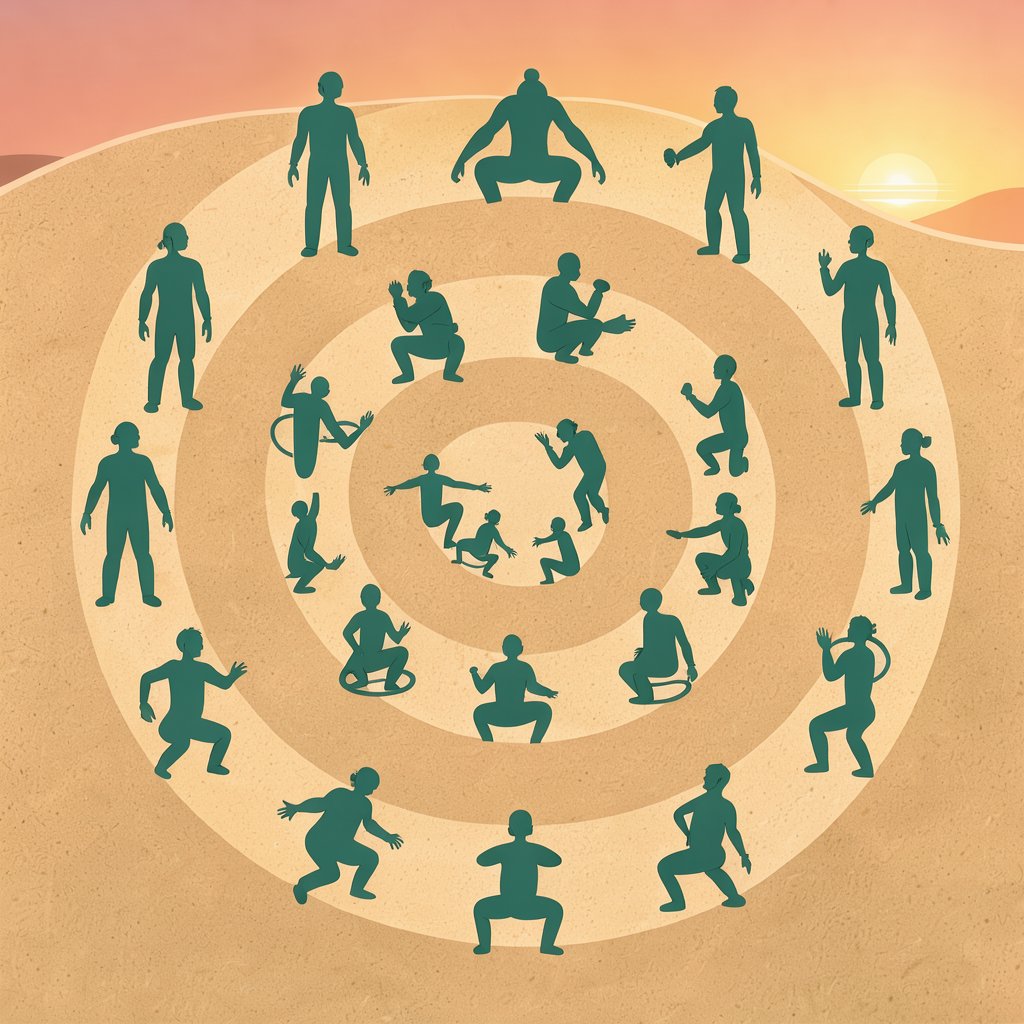
The ordering is the intelligence of the series. By spinning the small peripheral joints first — wrists, ankles, elbows, knees — the body warms the chain before the spine, the structure with the least tolerance for a cold start, takes its turn last[8]. And the series is honest about what it is: a prevention protocol for keeping joints moving, not a rehabilitation program — the distinction matters and returns in Section 8.
What the retrieved chunks deliberately do not provide is a counted workout: no per-exercise repetition counts beyond the general scaling rules, and no timings[8]. The list is presented, as the source presents it, as movements in an order — the numbers that do exist belong to the next section, which answers the question every reader now has: how much, how fast?
How to Scale the Series: Ten Movements First, Ten More Each Week
The dosing rules that turn seventeen movements into a sustainable habit come from the same book[8]. Start with 10 movements and add 10 per week — or, gentler, 5 per week during the first month — until the full series is yours. Match the repetitions to your age; as the prevention norm, 20 reps per joint carries you until about age 30[8]. No exact reps-by-age table exists in the retrieved chunks — only those two rules — so no table will be invented here, and no session-length number is attached to the series: the roughly ten-minute figure belongs to the Bubnovsky spin-up of Section 5, not to this series[7][8].
Technique carries two rules and one discipline. No bouncing: every movement is controlled, circle by deliberate circle. And slow down the last 10 reps of a set — that is where a real stretch lives[8]. The discipline is the tie back to Section 3: remodeling responds to rhythmically dosed load[1], and a series climbed by rule — ten movements, ten more each week, no bouncing — is precisely rhythm; a weekend burst of all seventeen at full speed is precisely not.
Scaled this way, the morning asks little and returns much: a warm chain of joints, a dosed load on the collagen that holds them, and lubrication produced on the spot. What every honest routine still owes its reader is the fine print — the plants, the pills, and the physicians — which is next.
Herbs and Supplements: Contraindications and the Consult-a-Doctor Rule
Joint folklore leans heavily on herbs, and the source base answers with explicit stop-signs rather than endorsements. From Shelest’s Help Yourself: Cleansing the Joints, herb by herb[9]:
- Nettle infusion — 3 tablespoons of herb per 2 cups, half a cup 4 times a day — is contraindicated in hypertension, atherosclerosis, pregnancy, and elevated clotting.
- Tansy is poisonous: contraindicated outright in pregnancy, and exact dosing is mandatory wherever it is used at all.
- St. John’s wort can cause liver discomfort, constipation, and raised blood pressure.
- Meadowsweet is contraindicated in ulcer disease and pregnancy.

None of these is a quick fix for joints being withheld; they are plants with pharmacology, and the base treats them as such[9]. The universal rule sits above the whole list, from Pankov: never take dietary supplements without consulting the treating physician — unsystematic antioxidant and vitamin use may simply harm[10]. Recall from Section 4 the same rule in analgesic form: long-term aspirin above the 81 mg baby-aspirin threshold means a doctor’s supervision[6].
One absence must be named rather than papered over, because readers on anticoagulants will ask: the base contains no blood-thinner interaction data for any herb or supplement in this manual — not for nettle with its clotting caution, not for the rest[9]. The honest instruction for that reader is not a guess; it is the consult-a-physician rule itself[10]. Diagnosed joint disease, pregnancy, ulcer disease, hypertension — each is a reason to put the physician first, before the first cup or capsule.
Which leaves the ingredient this manual is named for — and the most unusual section of the guide. Boswellia is the one thing the retrieved library cannot vouch for, and the section ahead says so in full rather than borrowing credibility it has not earned[11]. The folk name “earth incense” was audited against the whole base and resolves to valerian in a 1988 wild-plants handbook, not to frankincense and not to boswellia[11].
Boswellia: The One Thing Our Library Cannot Vouch For
The title names boswellia — the frankincense resin whose acids fill the joint-supplement shelves — so the final section belongs to it, and the honest answer is structural: the book base behind this manual contains zero boswellia content[11]. Three targeted retrieval queries against the joint-mobility collection and one whole-base control query across all 140,675 indexed points found no boswellia, no frankincense, no boswellic acids in any retrieved chunk[11]. The single keyword hit the audit surfaced was a false positive: the folk name “earth incense”, logged in a 1988 wild-plants handbook (Kharchenko et al.), refers to valerian — not to frankincense and not to boswellia[11].
The consequence is stated once, plainly. This manual makes no medical claim, no mechanism claim, no dosing claim and no contraindication claim about boswellia — any such sentence would be uncited invention, and this library’s whole method is that nothing goes on the page without a citation. Boswellia is, exactly and only, the one thing our library cannot vouch for.

Set against that silence, what the library does vouch for is the manual you have just read: load-made synovial fluid (Demchenko; Shtippler and Regitnig-Tillian)[1][2], collagen structure and remodeling (Demchenko; Neumann)[1][4], the ten-minute morning protocol (Bubnovsky; Tsatsouline)[7][8], the supplement reality check (Demchenko; Borenstein)[1][6], and the herb warnings (Shelest; Pankov)[9][10]. If boswellia someday earns its citation here, it will arrive the honest way — from a book, with a page. Until then the closing rule is Pankov’s, unchanged: never take dietary supplements — boswellia included — without consulting the treating physician[10].
Natural support for joints and ligaments turns out to be mostly movement with numbers attached: fluid produced only under load, collagen that answers to rhythm, ten morning minutes scaled by rule — and pills, plants and resins kept inside the honest limits of what the sources actually say[1][7][8]. Walk first, spin the ankles before the spine, add ten movements a week, and let the physician own every diagnosis, interaction and threshold[10].
FAQ: Movement, Supplements, and the Honest Gaps
Can the morning series rebuild worn cartilage?
No, and the sources are explicit about the boundary: glucosamine helps chronic joint pain but does not restore cartilage, and no drug that reliably restores the cartilage surface exists[1]. What movement can remodel is the tendon and the load-dosed joint, under the rhythm the scaling rules produce[1][8]. Read the series as prevention that keeps joints moving, not as a rehabilitation program[8].
How many movements should a beginner start with?
Ten movements make the first week, and ten more join each week after that; the gentler variant adds five per week during the first month[8]. Repetitions follow the age rule rather than a table: match them to your age, with twenty repetitions per joint as the prevention norm until about thirty[8]. No exact reps-by-age table exists in the source, so this manual does not invent one[8].
Is cracking or soreness during the spin-up a warning sign?
In the documented in-bed spin-up, cracking and mild soreness count as normal signals, and warmth at the joint is the endpoint to stop at[7]. The roughly ten-minute scale belongs to that spin-up alone, not to the seventeen-movement series that follows[7][8]. Anything beyond mild soreness falls outside what the sources describe, and the physician owns every diagnosis and threshold[10].
What does the base actually say about glucosamine and hyaluronic acid?
Glucosamine sulfate — the sulfate form, explicitly not chondroitin — helps chronic joint pain in large doses over the long term through an anti-inflammatory effect, without the side effects of NSAIDs[1]. Hyaluronic acid injections only substitute for the body’s own lubrication when that lubrication has failed, and they carry a mis-injection risk[1]. Neither restores the cartilage surface, and the base holds no grams-per-day figure, so none appears in this manual[1].
Who should talk to a doctor before starting?
The standing rule of the source base is Pankov’s: never take dietary supplements — boswellia included — without consulting the treating physician[10]. The herb section adds its own stop-signs, and the physician owns every diagnosis, interaction and threshold[9][10]. The series itself is a prevention protocol, which means it stands alongside professional care rather than in place of it[8].
Sources
- [1] V. S. Demchenko — Sea to the Knee (2024) — source of the load-only synovial-fluid mechanism, the collagen structure and 30-40 synthesis line, the rhythmic-load remodeling finding, the IOC athlete-list note, the glucosamine-sulfate and hyaluronic-acid reality check, and the full-amplitude rule.
- [2] A. Shtippler, N. Regitnig-Tillian — Muscles: How Are You Doing (2020) — source of “lying and sitting are poison for the joints”, the synovial-membrane secretion and cartilage-feeding mechanism, cartilage atrophy from inactivity, and myokine protection.
- [3] I. N. Platonov — Muscles and Joints: Musculoskeletal System (2012) — source of the WHO-scale numbers: every seventh person with joint pain, about 58,000,000 with rheumatoid arthritis, rheumatic diseases at 15-20% of all disability.
- [4] Donald A. Neumann — Kinesiology of the Musculoskeletal System — source of the ~4% ACL strain at 15 degrees knee flexion, the crimped toe region with elastic-zone return, and rate-dependent cartilage stiffening.
- [5] I. A. Purisov — Healthy Spine: Musculoskeletal System (2013) — source of the bone-composition numbers (60-70% mineral, 30-40% organic, 90% of calcium) and the vitamin C 300+ processes figure.
- [6] D. Borenstein — The Spine: Key to Health (2006) — source of the aspirin/NSAID fine print: stomach irritation, bleeding ulcers, kidney damage at toxic doses, and the 81 mg long-term see-a-doctor threshold.
- [7] S. M. Bubnovsky — The Health Code for Heart and Vessels (2012) — source of the in-bed ankle spin-up: about 20 slow rotations per direction, soles sliding, cracking and mild soreness as normal, warmth as the endpoint, on a roughly ten-minute scale.
- [8] Pavel Tsatsouline — Super Joints — source of the 17-exercise Amosov morning series with its extremities-to-center order, the 10-movements-plus-10-per-week scaling, the match-reps-to-age and 20-reps-until-30 norms, and the no-bouncing, slow-last-10 technique rules.
- [9] O. N. Shelest — Help Yourself: Cleansing the Joints (2019) — source of the herb-by-herb contraindication list: nettle (with its infusion doses), tansy, St. John’s wort, meadowsweet.
- [10] O. Pankov — Training and Games for Eye Muscles (2011) — source of the universal rule: never take dietary supplements without consulting the treating physician; unsystematic antioxidant and vitamin use may harm.
- [11] RAG reconnaissance log — whole-base control query over 140,675 indexed points plus three targeted queries (verification, not a book claim) — the zero-boswellia finding and the false-positive audit of the folk name “earth incense” (Kharchenko et al., 1988: valerian).
Where to go next: the manuals library collects the complete routines. The taiji joint-mobility routine is a slower sibling of the morning series from the same site, the mobility, posture and vitality category gathers the neighboring movement guides, and the Joint Genesis review takes a criteria-based look at a popular hyaluronan-focused joint offer.
How we researched this: this manual was built from a local library of 1,137 wellness books, indexed and searched offline with no internet sources. Retrieval ran three targeted queries against the joint-mobility collection — mechanisms, collagen, synovial fluid, protocols, dose and safety — plus one whole-base control query across all 140,675 indexed points to verify the boswellia verdict. Every statement above was checked against the cited book passages before publication; the two verification statements in Section 9 are the reconnaissance log’s own, not medical claims from any book.
Sources & References
V. S. Demchenko — Sea to the Knee (2024); A. Shtippler, N. Regitnig-Tillian — Muscles: How Are You Doing (2020); I. N. Platonov — Muscles and Joints: Musculoskeletal System (2012); Donald A. Neumann — Kinesiology of the Musculoskeletal System; I. A. Purisov — Healthy Spine: Musculoskeletal System (2013); D. Borenstein — The Spine: Key to Health (2006); S. M. Bubnovsky — The Health Code for Heart and Vessels (2012); Pavel Tsatsouline — Super Joints; O. N. Shelest — Help Yourself: Cleansing the Joints (2019); O. Pankov — Training and Games for Eye Muscles (2011); RAG reconnaissance log — whole-base control query over 140,675 indexed points, incl. the Kharchenko et al. (1988) false-positive audit