Educational content only — not medical advice. See our full Medical Disclaimer and Affiliate Disclosure below.
Key Takeaways
- Abhyanga is the Ayurvedic self-massage with warm oil, traditionally practiced daily — usually in the morning before a bath.[7][1]
- Classical texts frame the ritual around settling vata: warm oil, whole-palm strokes, and extra time on the head, ears, and feet.[7][2]
- The full sequence takes about five to ten minutes; a head, hands, and feet shortcut covers the essentials on busy mornings.[2][1]
- Stroke direction follows the body hair — with it to soothe vata and pitta, against it for kapha, which also gets dry powder rubs instead of heavy oil.[1][7]
- Classical contraindications are explicit: skip abhyanga with ama, fever, acute infection, anemia, or indigestion, and right after a cleansing procedure.[1][7]
Abhyanga self-massage — massaging the body with warm oil — belongs to the daily self-care discipline of the Ayurvedic tradition of India.[7] The classical canon Ashtanga Hridaya Samhita (Vagbhata) already treats abhyanga as a daily routine — oil massage and oil bath[7] — while the details that make it work at home (warm oil, a set order of strokes, a warm shower afterward) are laid out by the modern practice manuals: Practical Ayurveda, Chopra, and Morningstar.[1][2][4] A Tamil proverb quoted in Practical Ayurveda sums up the traditional attitude: “Pay your oil man and save your doctor fees.”[1] This manual reconstructs the practice exactly as the source literature describes it — what to do, which oil to choose, how long it takes, and when to skip it. Pair the ritual with a gentle morning set such as our Ba Duan Jin (Eight Pieces of Brocade) guide.
Science and tradition: what the sources say
What the tradition claims. The Ashtanga Hridaya Samhita recommends abhyanga — oil massage and oil bath — daily, and says it is traditionally used to help prevent premature aging, tension, and vata imbalance, and to support vision, sound sleep, and healthy skin; it singles out the head, ears, and feet for extra attention.[7] Deepak Chopra’s practical manual describes the daily oil massage as balancing vata — the dosha whose qualities are light, cold, and dry — with warm oil acting as softening and calming, and adds that the routine traditionally stimulates circulation and helps clear impurities from the body’s systems.[2] The benefit list in Practical Ayurveda reads in the same key: nourishing the body’s tissues (dhatus), easing fatigue, promoting restful sleep, relieving muscle tension, supporting blood circulation, and pacifying the doshas.[1]
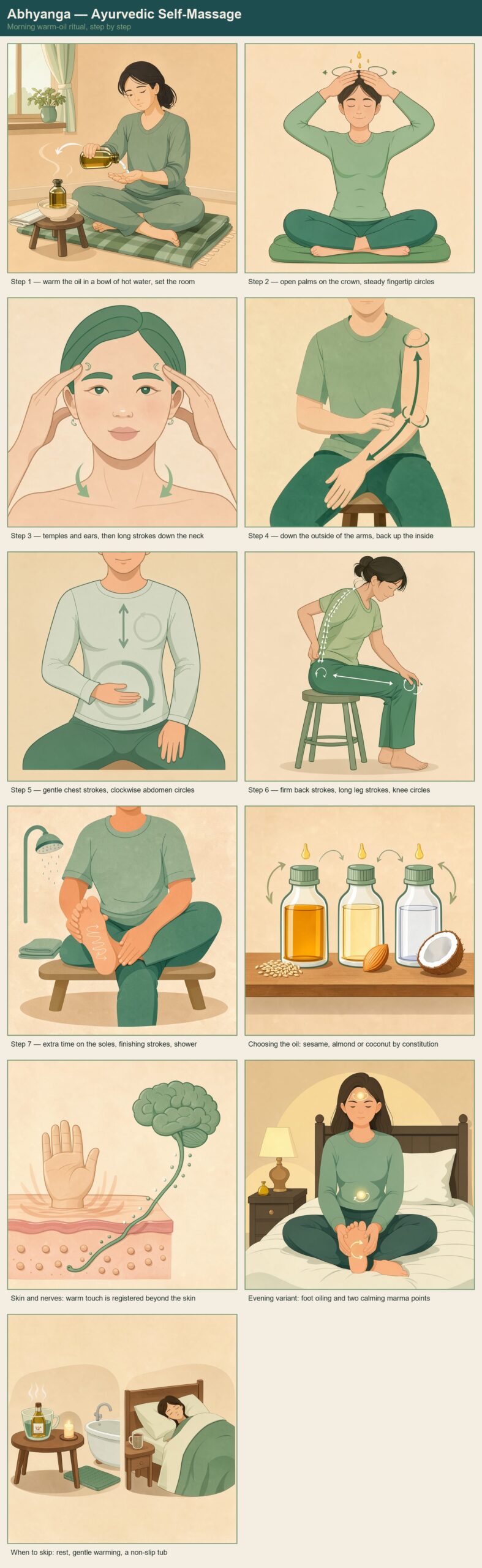
What can be said in modern terms. The skin is a densely innervated organ, and the touch it registers is not merely local: Chopra’s sleep manual points out that skin and nervous system develop from the same embryonic layer (neuroectoderm), which is why steady, warm contact has such a direct effect on how settled we feel.[3] Beyond that shared physiology, the honest status is this: the books behind this manual are traditional and general-wellness literature, not controlled clinical trials, so abhyanga is best framed as a calming daily ritual that may support rest and unwinding — not as a treatment for any condition. It is not intended to cure, treat, or diagnose any disease.
Abhyanga self-massage: choosing your oil
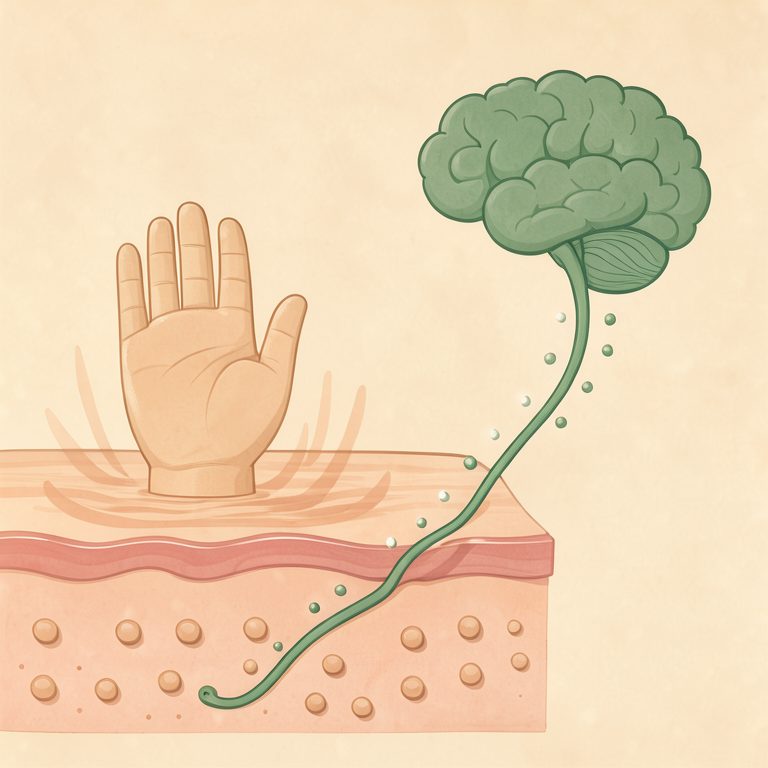
The sources agree on the principle: the more natural the oil, the better, and the oil should match your constitution.[1][4] Cold-pressed sesame is the classical all-rounder; ghee, cold-pressed olive, sweet almond, coconut, and castor oils are all named as suitable for massage.[4] The table below combines the constitution logic from Practical Ayurveda with the stroke rules the same books give:[1]
| Constitution (dosha) | Oils traditionally recommended | Stroke emphasis |
|---|---|---|
| Vata (air) | Plain sesame (heating), almond (warming and soothing), olive (heating) | Long strokes along the lines of the body hair |
| Pitta (fire) | Coconut (cooling), almond (warming and soothing) | Long strokes along the lines of the body hair |
| Kapha (earth & water) | Smaller amounts of oil — or dry herbal powder rubs (udvartana) | Emphasize strokes against the lines of the body hair |
Two classical notes: strokes along the lines of the body hair are said to soothe vata and pitta, while kapha benefits from emphasis on strokes against the body hair,[1] and powder massage (udvartana) is the traditional answer when oil feels too heavy — the canon says it balances kapha.[7] Practical setup from the sources: keep the oil in a plastic squeeze bottle in the bathroom and warm the day’s portion for a few minutes in a cup of hot water;[1] Chopra’s manual specifies unrefined cold-pressed sesame oil and notes that brief warming is traditionally said to improve skin absorption.[2]
The morning protocol, step by step
The daily oil massage takes about five to ten minutes, and even two or three minutes count on busy days.[2] The classical placement is the morning before a bath;[1] Practical Ayurveda adds that a massage is best performed in the morning or late afternoon, your stomach should be neither too full nor too empty, and the room should be warm — around 77°F (25°C).[1]
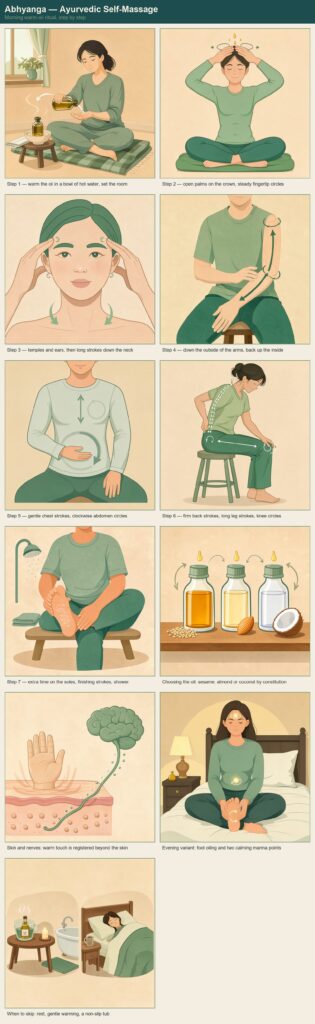
Warm the oil and set the room
Sit on a warm, stable surface in a warm room (around 77°F / 25°C). Warm the oil gently and keep the bottle within reach to add more between steps.Head and scalp
Take a handful of oil in each hand and massage the top of the head with open palms, then fingertips, in steady circles. Spend longer on the head than on any other area (Chopra).Face, ears, and neck
Lighter touch, fresh oil: horizontal strokes on the forehead, gentle circles on the temples and cheeks, horizontal strokes on the chin; then up and down strokes on throat, neck, and shoulders.Arms and shoulders
Stroke down the outside of the arms from the shoulders and back up the inside; circle the shoulders and elbows. Whole palm, moderate pressure — circles on joints, long strokes on long bones.Chest and abdomen
Gentle strokes over the breastbone and very light circles over the heart area; abdomen clockwise from the lower right toward the lower left.Back, hips, and legs
Firm up-and-down strokes on the back and buttocks; long strokes on thighs and calves; clockwise circles around hips, knees, and ankles.Soles, finishing strokes, and a warm shower
Extra time on the soles with vigorous palm massage; finish with a long stroke from the heart to each hand and from each hip to each foot; then a warm shower or bath with mild soap.
Short on time — and the evening variant
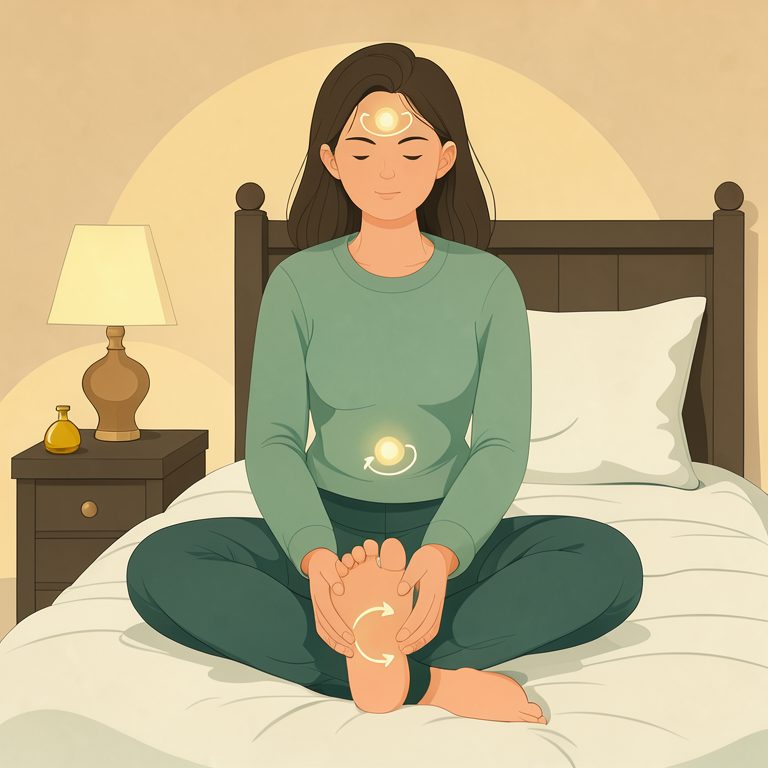
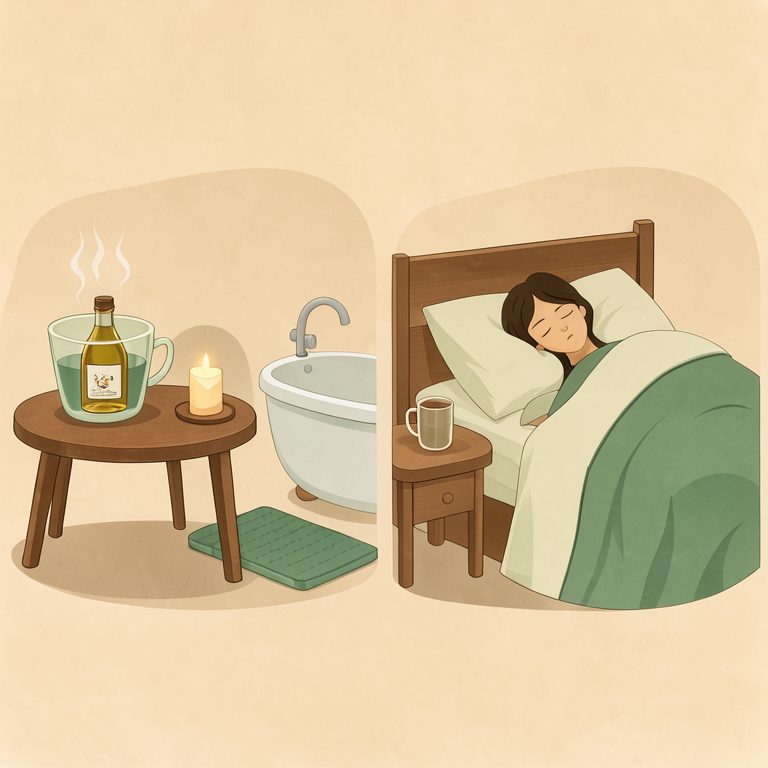
If you can only spare a few minutes, Practical Ayurveda offers a simple alternative: do just the head step plus the hands and feet.[1] And the sleep-focused variant comes from Chopra’s sleep manual: when restlessness runs high, move the massage to the evening and follow it immediately with a warm bath — a traditional preparation for deep sleep.[3] A lighter substitute is a foot massage with warm oil before bed (coconut oil for pitta constitutions, sesame otherwise),[3] since the feet are classically mapped with points related to balancing the nervous system.[3] Two sleep-related marma points get special mention: the center of the forehead and the lower abdomen just below the navel — a gentle clockwise massage with a little oil, no more than a minute.[3] Point-finding basics overlap with acupressure — see our Zusanli (ST36) acupressure guide. If long sitting leaves the front of the hips stiff, our Unlock Your Hip Flexors review covers the movement side of that problem.
Safety and contraindications
The classical sources are explicit about when not to oil-massage. Do not perform abhyanga if you have ama (undigested food), fever, acute infection, or anemia;[1] avoid it with increased kapha and with indigestion, and right after a cleansing procedure;[7] skip massage during high fever, constipation, or vomiting, and while taking laxatives or doing basti cleansing practices.[5][6] Dry powder massage is out with skin irritation or rashes.[1] Johari’s massage manual frames the whole practice as preventive and regular — disease-specific therapeutic protocols belong under an Ayurvedic physician’s supervision, not in a home routine.[5] Two practical cautions: warming oil is flammable, so heat it gently and never leave it unattended,[2] and oiled skin makes the tub slippery.[2] Abhyanga is a wellness ritual, not medical care: it does not replace care from a qualified clinician, and it is not intended to cure, treat, or diagnose any disease. If you are pregnant, managing a chronic condition, or recovering from injury, consult your physician before starting.
Frequently asked questions
How often should I practice abhyanga self-massage?
The classical canon recommends it as a daily routine,[7] and the practical manuals place it in the morning before a bath — about five to ten minutes for the full sequence, or two to three minutes on busy days.[1][2]
Which oil is best for abhyanga?
Cold-pressed sesame is the classical all-rounder, and the general rule from the sources is that the more natural the oil, the better; ideally the oil matches your constitution — coconut for pitta, sesame or almond for vata, and smaller amounts of oil for kapha.[4][1]
When should I skip abhyanga?
Skip it with ama (undigested food), fever, acute infection, or anemia, with indigestion or increased kapha, and right after a cleansing procedure; dry powder massage is also out with skin irritation or rashes.[1][7]
Sources
- [1] Dorling Kindersley — Practical Ayurveda (2018)
- [2] Deepak Chopra — Perfect Health
- [3] Deepak Chopra — Restful Sleep
- [4] Morningstar — Ayurveda and Polarity Therapy (2007)
- [5] Harish Johari — Ayurvedic Massage (2008)
- [6] Harish Johari — Dhanvantari (2000)
- [7] Vagbhata — Ashtanga Hridaya Samhita
How we researched this
This article is based entirely on our local library of 1,137 books, queried through an offline retrieval system — the open internet was not used at any point. Every factual statement above was checked against the source excerpts and carries a numbered citation to the book it was taken from.
Sources & References
Dorling Kindersley — Practical Ayurveda (2018); Deepak Chopra — Perfect Health; Deepak Chopra — Restful Sleep; Morningstar — Ayurveda and Polarity Therapy (2007); Harish Johari — Ayurvedic Massage (2008); Harish Johari — Dhanvantari (2000); Vagbhata — Ashtanga Hridaya Samhita