Educational content only — not medical advice. See our full Medical Disclaimer and Affiliate Disclosure below.
Every Ayurvedic routine you will ever meet stands on one map: vata, pitta, kapha — the three doshas. Learn to read the map and the routines assemble themselves: when to eat, which tastes to favor, when to wake, how the seasons tilt the whole system[1]. Skip the map and Ayurveda collapses into a list of dos and don’ts nobody can explain. This beginner’s manual builds the map from the source books — the element equation, the qualities, the fixed blueprint each person carries — then turns it into five practical steps, and closes with the fence every honest guide owes you: a quiz is not a diagnosis[1].
Key Takeaways
- The five great elements combine into three energies: ether and air form vata, fire and water form pitta, water and earth form kapha — movement, digestion-metabolism, and lubrication-structure respectively[1].
- Your constitution (prakruti) is set at conception and does not change in a lifetime; your current state (vikruti) drifts with weather, diet, fatigue, stress and exercise — healing means returning to your own original balance, not to equal thirds[1].
- The working rule is two laws: like increases like, and opposites decrease each other — the logic behind every favor-and-avoid list in this manual[1].
- Five daily levers: all six tastes at each meal, favor-and-avoid by constitution, sweet first and bitter last on the plate, the dosha clock (kapha 6–10, pitta 10–14, vata 14 to sunset), and the six-season rotation[3][2][8].
What Is a Dosha? Five Elements, Three Energies
A dosha is one of three energies made from the five great elements, and together they run everything the body does: ether and air combine into vata, fire and water into pitta, water and earth into kapha — the movement, the transformation and the structure of a living person, present in everyone in their own proportion[1]. That is the definition Vasant Lad opens his home-remedies book with, and the wider corpus agrees: vata is “that which moves”, the moving force of the other two[10], and “the five elements assume the form of the three doshas”[9]. The same element-to-dosha mapping recurs in three further books of the base[15][16][13].
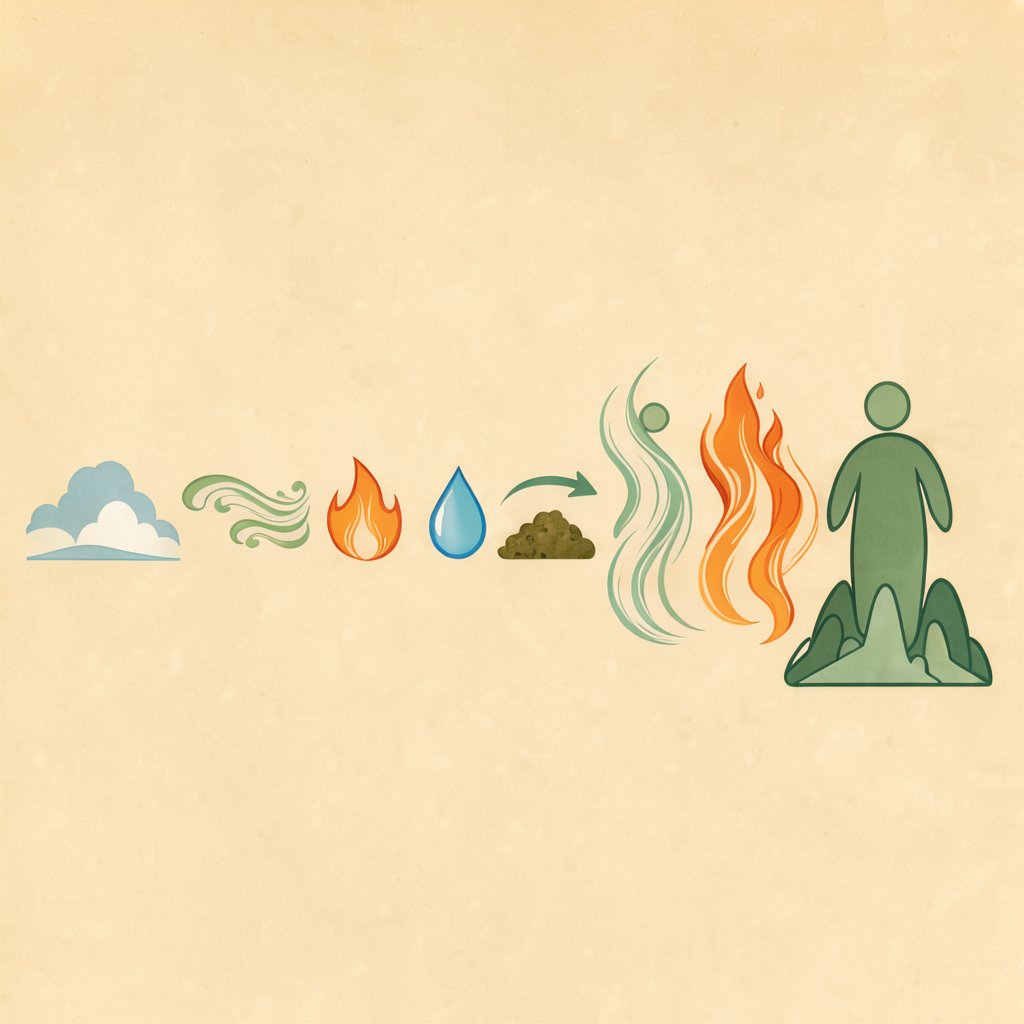
Each dosha has a one-line job. Vata is the energy of movement — breathing, blinking, the heartbeat, nerve impulses[1]. Pitta is the energy of digestion and metabolism — digestion, absorption, assimilation, body temperature[1]. Kapha is the energy of lubrication and structure — the joints, the moisture of the skin, immunity, strength[1]. Lad adds a metabolic translation that fixes the trio in a modern mind: kapha promotes anabolism, the building up of the body; pitta governs metabolism proper; vata governs catabolism, the tearing down[1].
One pivot line deserves the last word of the section, because the whole tradition leans on it: “the majority of illnesses have aggravated vata at their source” — vata, the principle of movement, moves the other two doshas, which are themselves immobile[1]. Names and jobs, though, are only labels; the tradition reads each dosha through its qualities, and the qualities carry the two laws that make the system usable.
Dosha Qualities and the Two Laws of Healing
Lad’s quality lists are the grammar of the map. Vata is dry, light, cold, subtle, clear, mobile, dispersing. Pitta is hot, sharp, light, oily, liquid, pungent, sour, spreading. Kapha is heavy, slow, cool, oily, damp, smooth, soft, static, viscous, sweet[1]. Behind the lists stands a larger structure: twenty qualities arranged in ten opposite pairs — heavy and light, oily and dry, stable and mobile, down to cloudy and clear — and this paired vocabulary is what Ayurvedic healing actually speaks[1].
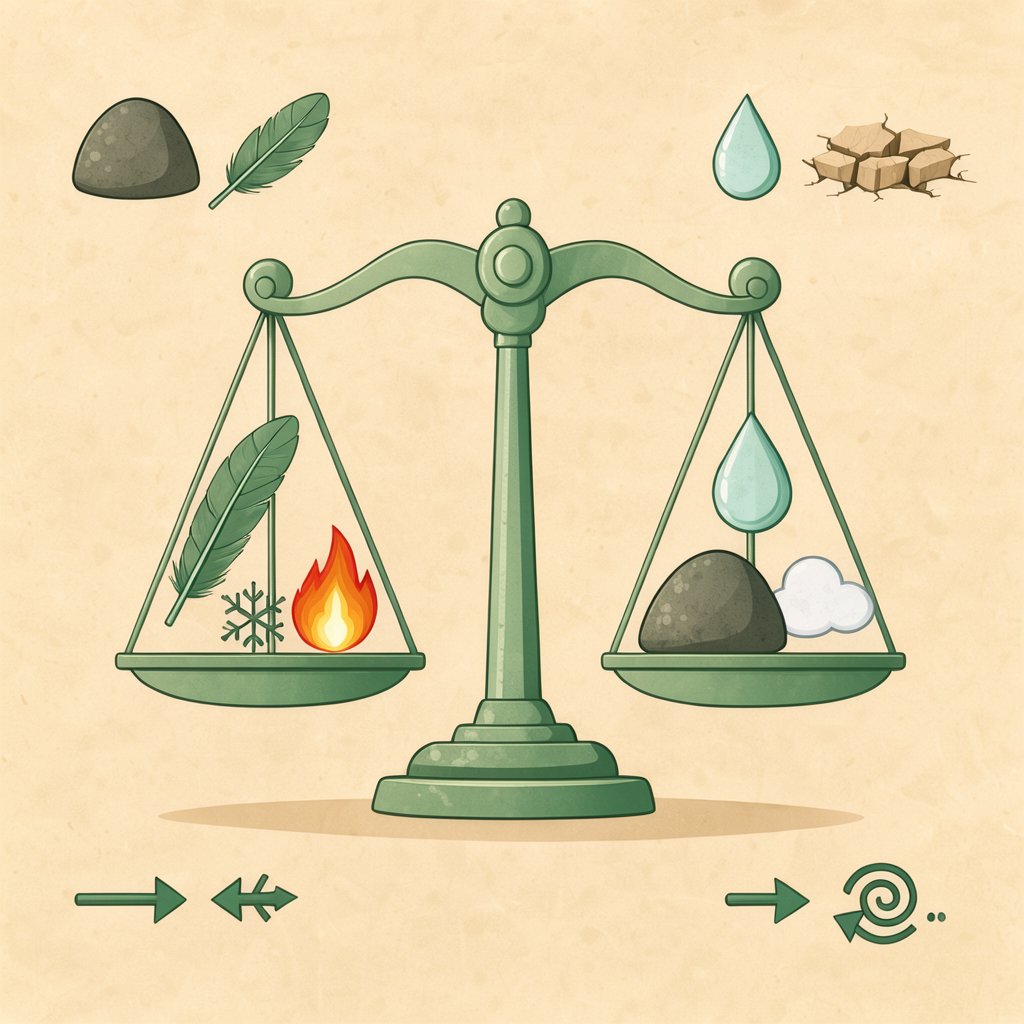
From the pairs come the two laws of healing, quoted exactly: “1. Like increases like.” and “opposites decrease each other” — treatment, in Lad’s phrasing, means increasing the qualities opposite to the imbalance[1]. The weather makes the laws visible: cold, wind and dryness aggravate vata; hot and humid conditions aggravate pitta; cloudy, rainy weather aggravates kapha[1]. Same logic, one scale of application.
The qualities extend to mind and to lifetime. In balance, vata gives creativity, flexibility and joy; out of balance, fear, anxiety and tremors. Balanced pitta reads as intelligence and understanding; imbalanced pitta as anger, hatred, jealousy. Balanced kapha shows as love, calmness, forgiveness; imbalanced kapha as attachment, greed, envy[1]. And life itself runs in dosha phases: ages 0 to 16 belong to kapha, the era of growth with its colds and congestion; 16 to 50 to pitta, the active years; 50 to 100 to vata, with its tremors, emaciation, arthritis and memory loss — a frame the Dorling Kindersley manual echoes in calling adulthood the pitta period of life[1][3].
Prakruti vs. Vikruti: Your Blueprint and Your Current State
All three doshas are present in every person — there are seven main body types — and your constitution is the particular proportion you carry: one primary dosha, one secondary, one least prominent[1]. That proportion is prakruti, Sanskrit for “nature”, your psychobiological temperament; Lad likens it to a fingerprint, an “energy print” unique to each person[1]. It is set at the moment of conception by the parents’ genetics, diet, lifestyle and emotions — Lad’s example is a pitta-predominant baby conceived on a hot summer night after a spicy meal — and it does not change during a person’s lifetime[1]. It can be notated: V2P3K1 means predominantly pitta, vata secondary, a little kapha[1].
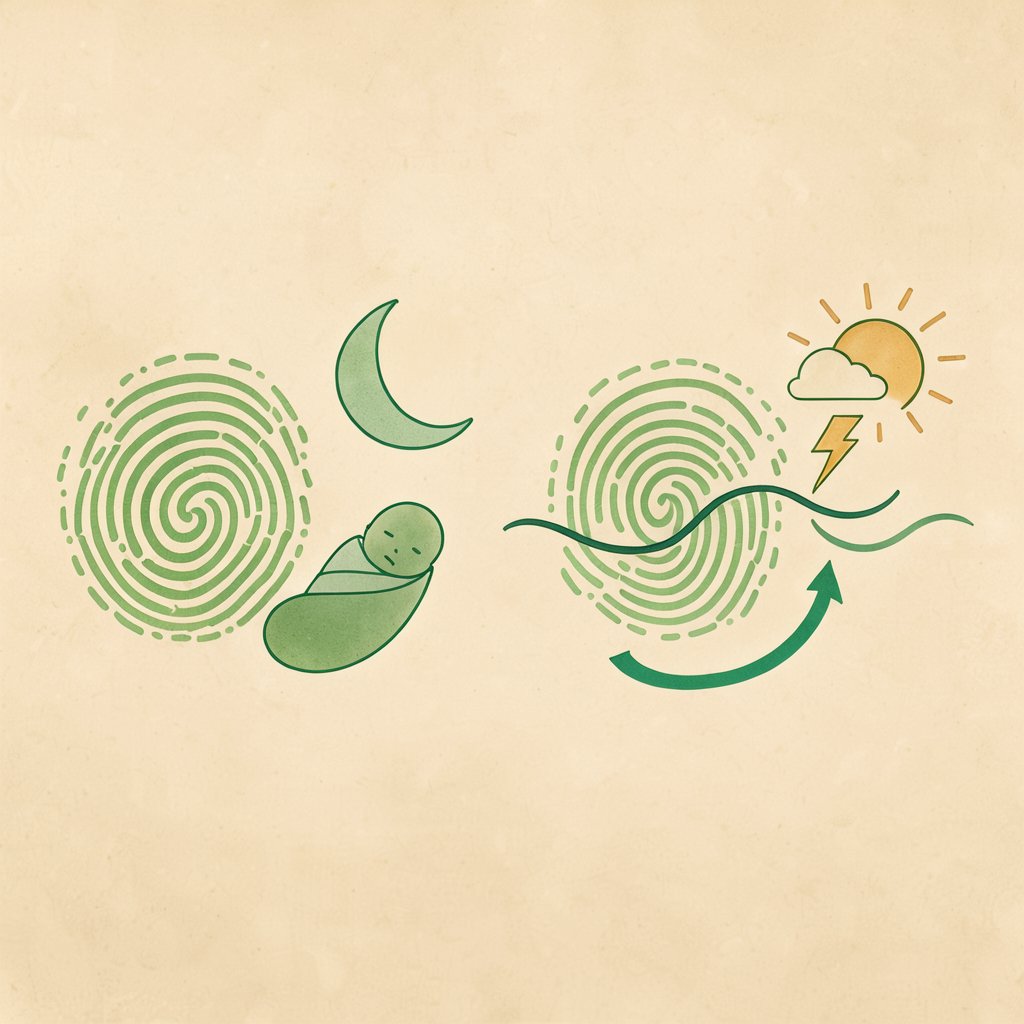
Here is the fence this manual will carry to its last page. Balancing your doshas does not mean achieving equal amounts of vata, pitta and kapha — it means “maintaining the balance with which you were conceived”; moving a V2P3K1 person toward equal thirds would not be healthy, and Lad says so in a labeled note[1]. A rare few are indeed born with all three equal[1] — the exception, not the goal.
Vikruti is the other half of the pair: the altered current state of the doshas, shifting with weather, dietary choices, fatigue, stress, emotional state, exercise or the lack of it[1]. If your health is excellent, vikruti equals prakruti; more often there is a discrepancy, and that difference is what gives direction for healing — the aim being to reestablish the balance your prakruti indicates[1]. The proportion is fixed; the daily nudges are practical. But first, a word about where this map came from, because it was written down in named texts a very long time ago.
The Tradition Behind the Map: Charaka, Sushruta, and Taxila
The dosha map is not a modern synthesis — it is a written tradition with names and dates. The Charaka Samhita appeared around the turn of the first millennium BC and is called “the first and still most important of all Ayurvedic texts”; the Sushruta Samhita, the surgical classic, was compiled around the same time — its surgery spurred by the need to treat injuries sustained in warfare — though the received version dates from much later[6]. By the 6th century BC a “university” stood at Takshashila (Taxila) near modern Rawalpindi, and one of its products was Jivaka, royal physician to King Bimbisara of Magadha[6].
The third great text closed the classical trio. Vagbhata restated the thoughts of Charaka and Sushruta in poetic form; David Frawley, quoted in the preface to the Ashtanga Hridaya Samhita, places him as one “who was a Buddhist and lived in the lower Indus around 500 AD”[7]. The lineage claims run older still: knowledge of Ayurveda is said to have come to the sage Atreya from the gods, with the tradition traced back to Lord Brahma[12]; the ancient seers-rishis are described as receiving it “directly from the gods”[13]; and Sushruta’s text, with the Sharangadhara Samhita, is credited as “used by Indian physicians for thousands of years”[14]. Taken together, the history is an anchor, not a proof — the practices that follow stand on their sources either way. With the map, the blueprint and the lineage in hand, the manual now turns to the five steps that put them to work.
Step 1 – All Six Tastes at Every Meal
The first daily lever is already on your plate. Ayurveda counts six tastes — sweet, sour, salty, pungent, bitter, astringent — and holds that “every food or substance has at least one of the six tastes … a full meal should include all six tastes”[3]. Each taste forms from two elements, and many foods carry two or three at once: celery, the manual’s example, is bitter, pungent and salty in one stalk[3].
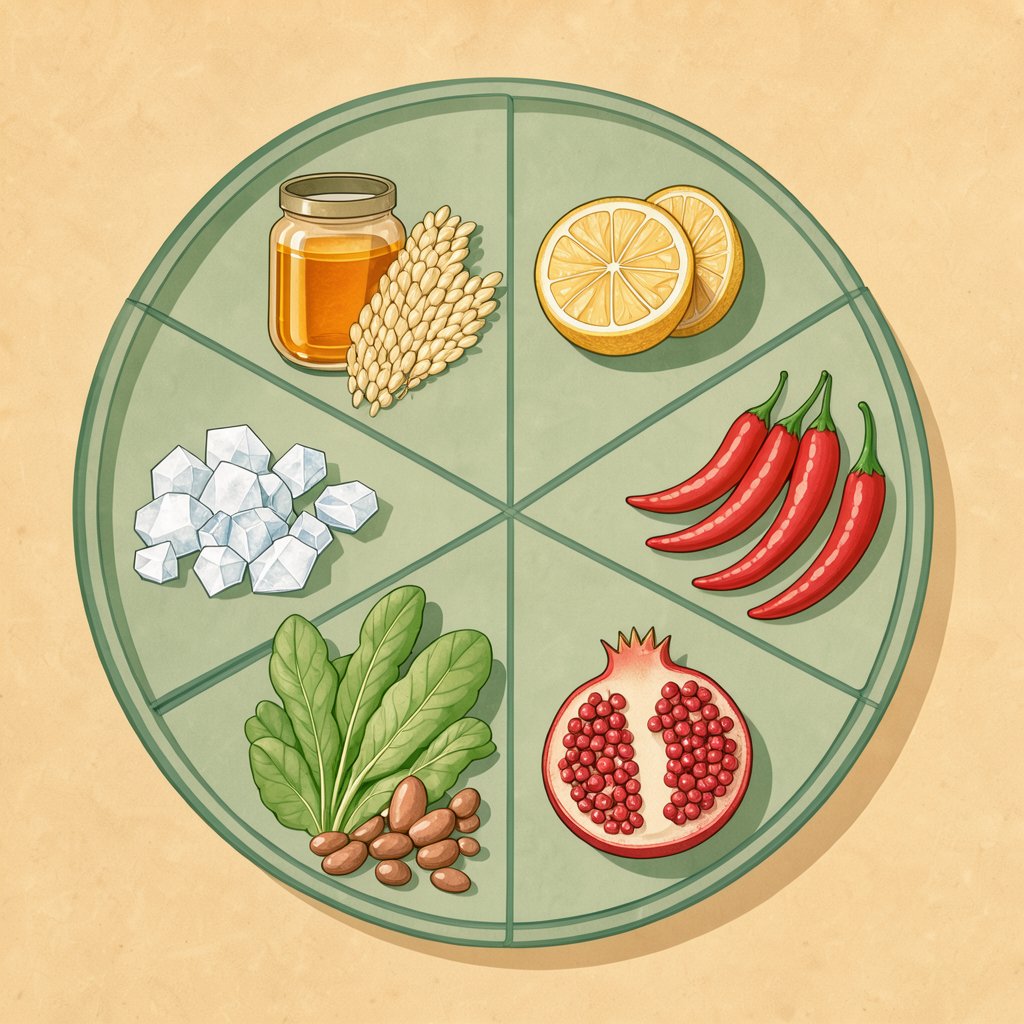
Why all six? Because “every taste is a dosha stimulator” — skip one long enough and the system drifts out of balance; the instruction is to experience all six daily, ideally at each meal, with the reassurance that there is “no need to follow too strictly”[4]. Chopra’s food examples make the list kitchen-ready: sweet covers sugar, milk, butter, rice, bread, pasta; pungent covers ginger and chili; bitter covers spinach, leafy greens and turmeric; astringent covers beans, lentils and pomegranates[4].
One piece of theory completes the step. In Lad’s beginner phrasing, taste works in three stages: rasa, the taste on the tongue; virya, the heating or cooling energy of the food; and vipaka, its post-digestive effect[2]. The six-taste plate is the constant half of the rule — which tastes to lean on is the personal half, and that is Step 2.
Step 2 – Favor and Avoid by Constitution
Here the favor-and-avoid lists arrive, straight from Lad’s beginner manual. Vata types favor sweet, sour and salty — and note the trap Lad flags: vata types are drawn to astringent salads, which is precisely the taste they do not need[2]. Pitta should avoid sour, salty and pungent, because they increase body fire, and favor sweet, bitter and astringent[2]. Kapha should avoid sweet, sour and salty, because they increase body water, and favor pungent, bitter and astringent[2].
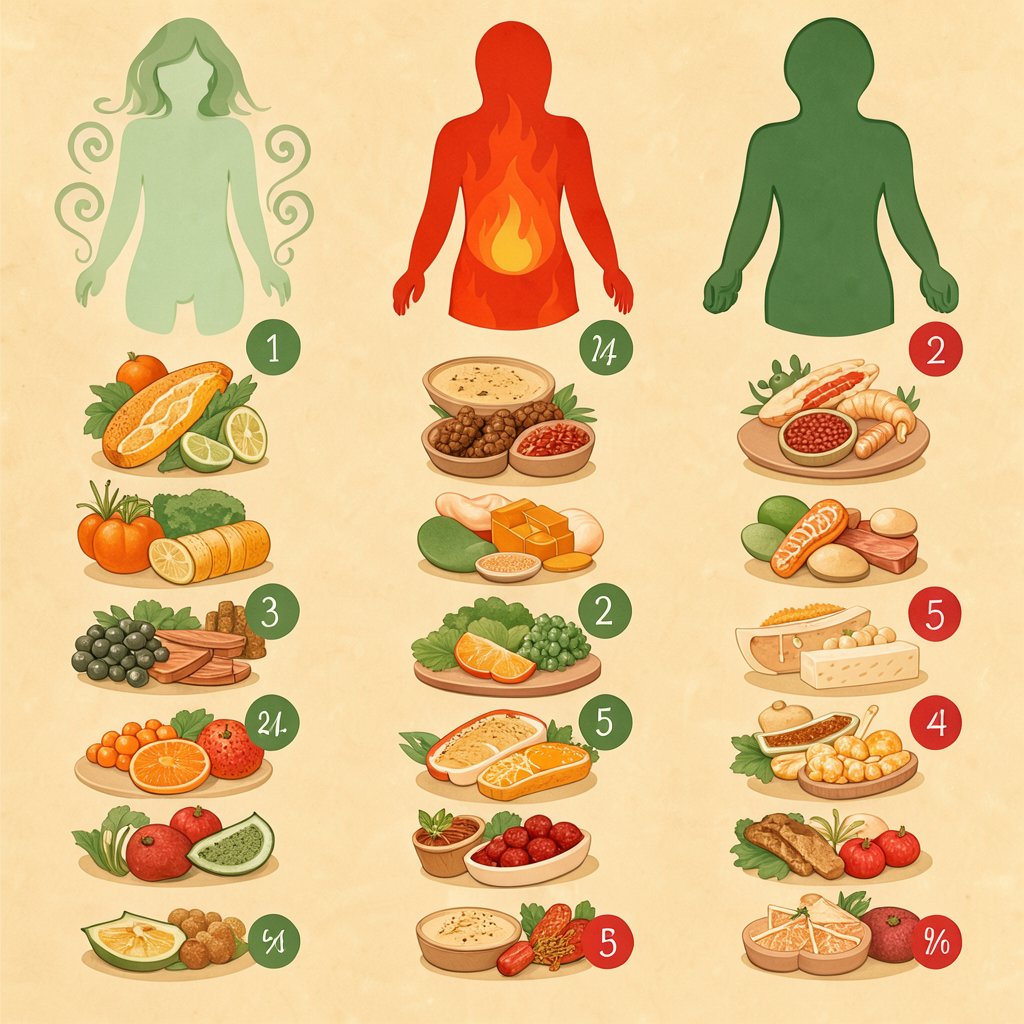
The Dorling Kindersley manual supplies the mechanics behind the lists: “the tastes sour and pungent stimulate agni; the tastes bitter and astringent reduce tissue” — and, in its effect-on-vata table, vata is made from ether and air, and the sweet, sour and salty tastes soothe it[3]. Notice that the lists are mirror images: each constitution avoids the very trio another one needs, which is why Ayurveda never issues diet rules for “everyone”.
Which list is yours is a constitution question — the prakruti concept of the earlier sections — and the honest way to find out is the fill-twice chart described in the Safety section, not a glance in the mirror. With the foods chosen, one question remains before the first bite: in what order should the plate be eaten? The tradition is exact about that too.
Step 3 – Sequence the Plate: Sweet First, Bitter Last
An Ayurvedic meal has an order, and it is the reverse of the Western dessert habit. In the Dorling Kindersley account of the three phases of digestion, the meal starts with the sweet kapha phase, when the elements water and earth are digested: foods with a sweet taste — grains, and dessert too — are eaten first, because they need a strong agni, the digestive fire, at its opening peak; the manual admits this “may be new to the Western palate”[3].
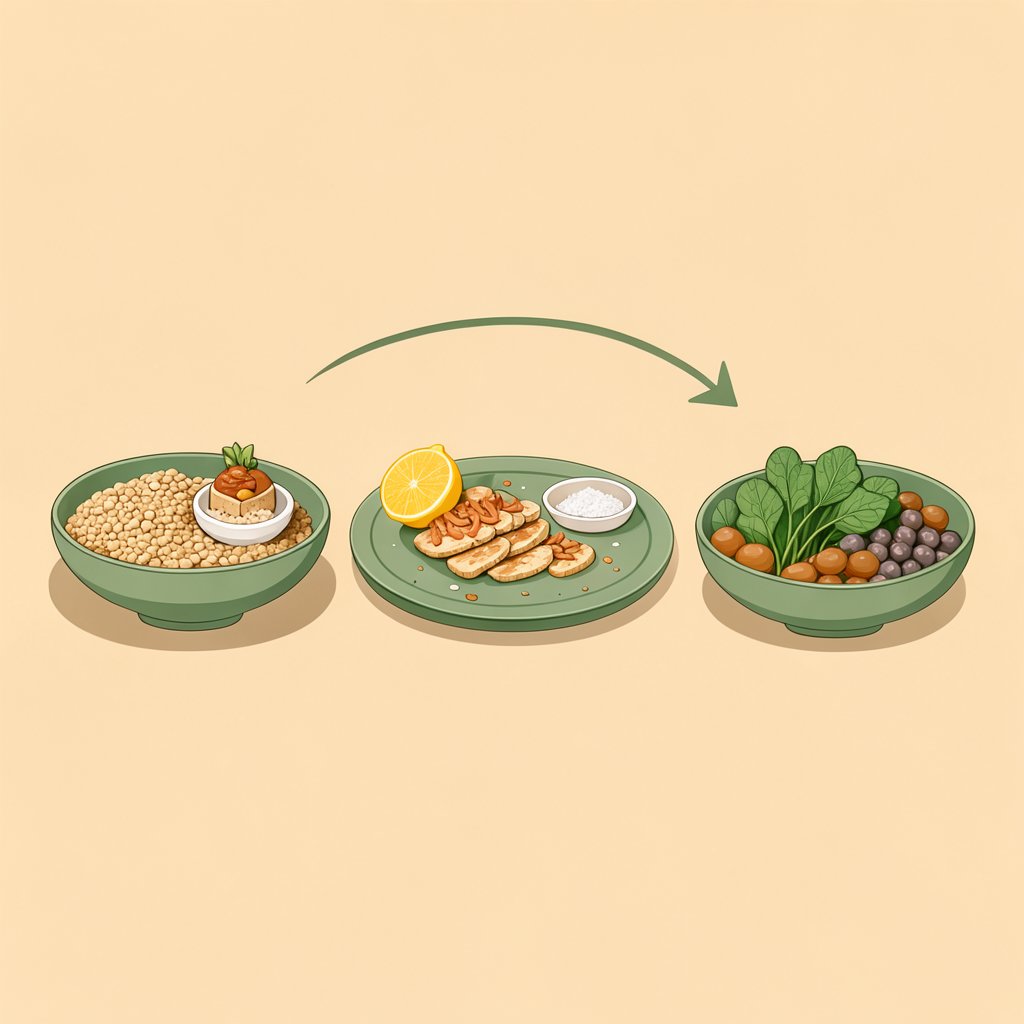
Sour and salty foods come next, in the middle stretch of the meal — “these support agni”, the manual notes, keeping the digestive fire working through the main course[3]. Finally arrives the vata phase, which digests air and ether: bitter and astringent foods close the meal, and “these support the vata phase and reduce kapha” — the green, beany, drying end of the plate as a deliberate finish, not an afterthought[3].
Three phases, one fixed sequence, and not a single portion size or gram count anywhere in the source — the base gives the order only, and this manual invents no quantities to fill it[3]. Meals are the first daily lever; the second is the clock the meals sit on, and the doshas keep strict hours.
Step 4 – Follow the Dosha Clock
The same three energies take turns running the day. Morning, 6 to 10 a.m., is kapha — energy and freshness with a slight heaviness; 10:00 to 14:00 is pitta — hunger, lightness, warmth; 14:00 to sunset is vata — active, light, flexible[2]. Evening kapha runs 18:00 to 22:00, with cold air, inertia and low energy; pitta peaks 22:00 to 02:00, when food is digested; and vata rules the hours before dawn, governing waking and elimination[2]. Chopra names the same 24-hour cycle in Perfect Health: kapha dominates 6 to 10 a.m., pitta carries to midday when the digestive fire is most intense, vata runs from 2 p.m. to sunset, and the cycle repeats[4].

Three clock rules make the cycle practical. Breakfast: early, 7 to 8 a.m., suits pitta and vata constitutions — while kapha constitutions should not eat then, a detail that only makes sense with the kapha morning behind it[2]. Rotation: dosha predominance changes every four hours along with the elements, kapha rising after dawn and again after sunset — Baranov’s frame, whose simplified dinacharya sets wake at 05:30–06:00 and reserves 06:00–09:00 for hygiene, oil self-massage and yoga, a schedule he calls “by itself a strong healing tool”[8]. And the wake rule from Restful Sleep: rise at the vata/kapha junction, dawn around 6:00 — waking before it keeps vata’s alertness and lightness, sleeping past it drags kapha heaviness into mind and body; the book adds that “clinical studies have shown that early rising helps soften depression”, a claim it cites without study references, so it is reported here as the book’s statement, not as established science[5].
Day to day, the clock is the most immediately usable lever in this manual — it asks only that meals and sleep keep company with the right hours. The day rotates every four hours; the year rotates far more slowly, and it has six positions.
Step 5 – Adjust with the Six Seasons
The seasonal regimen has a classical name — ritucharya — and a classical clock of its own. In the Ashtanga Hridaya Samhita’s chapter on the subject, six seasons rotate every two months, starting with Magha, mid-January to mid-February: shishira, vasanta, grishma, varsha, sharad, hima[7]. The three seasons from shishira belong to the northern solstice: the sun and wind become strong and dry, bitter, astringent and pungent tastes become most prominent, Fire dominates — and these seasons “daily take away strength” of people[7].
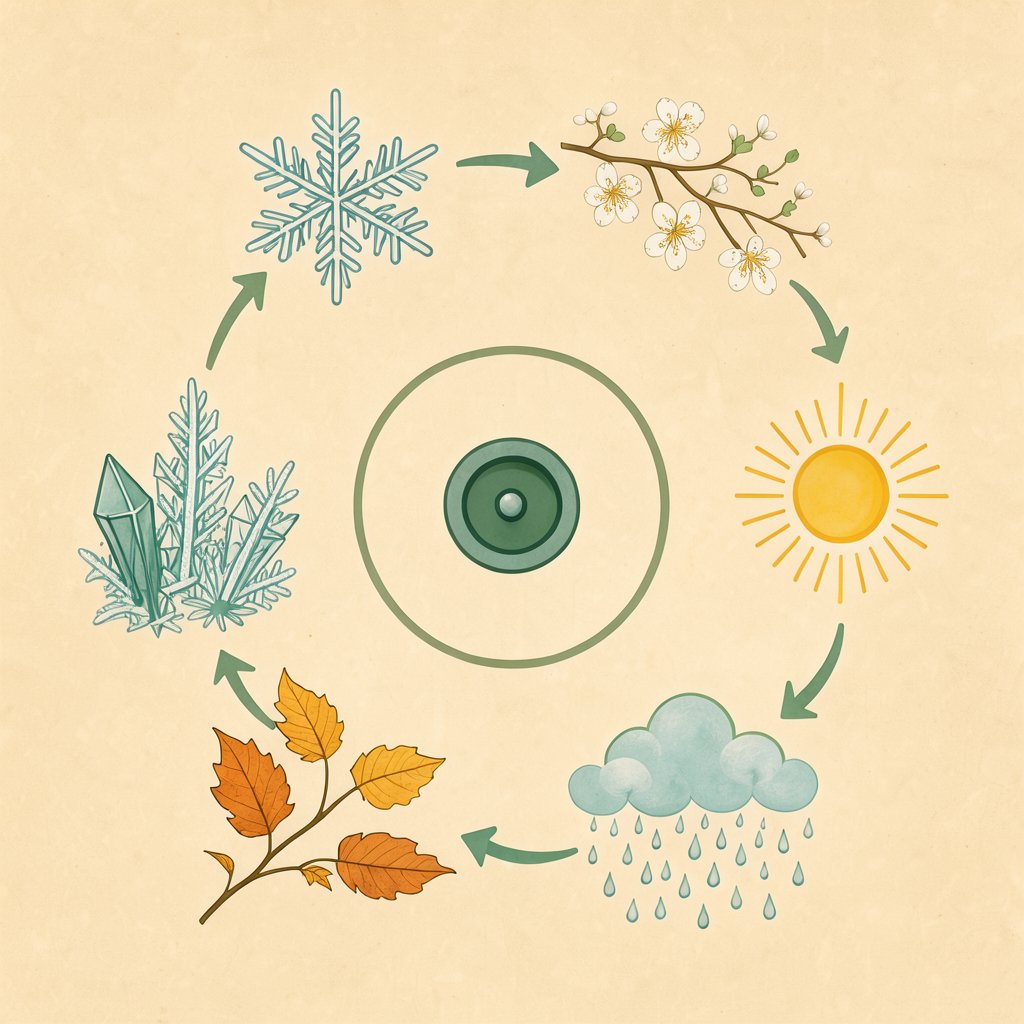
The counterweight is the southern half. The three seasons from varsha belong to the southern solstice, and there “the Sun gives its strength to people” — the draining half of the year hands over to the restoring half, in the text’s own image[7]. For the cold, rainy stretch of the cycle the same source gives a compact diet note: favor warming foods, and avoid curds, heavy fats, the direct midday sun, day sleep, the east wind and alcohol[7].
That is the whole seasonal protocol the base provides — no month-by-month recipes exist in the retrieved sources, and none are invented here. Two positions per year, one compass: strength drains through the northern seasons and returns through the southern ones, and the plate warms when the rains come. Which leaves the one thing every map of the body owes its reader — an honest boundary.
Safety: A Quiz Is Not a Diagnosis
The hard label first, because a beginner’s guide to health topics owes it: a quiz is not a diagnosis. Lad’s own caution, quoted exactly: the self-assessment “can provide only a rough guideline. The subtleties of each person’s mental, emotional, and physical makeup are manifold and can be accurately assessed only by a physician thoroughly trained and experienced in Ayurvedic diagnosis. So please do not draw any absolute conclusions about yourself based on the self-assessment or the descriptions of the doshas.”[1]
What the books do offer in place of a quiz is a protocol — the fill-twice chart. Fill the self-evaluation chart twice: once for what is most consistently true about your life as a whole, over many years — that reading is prakruti — and once for how you have been feeling recently, in the last month or two — that reading is vikruti[1]. Have a spouse or good friend verify the answers; they often see what the questionnaire’s subject misses[1]. Then tally the vata, pitta and kapha marks into a ratio with 3 as the highest number: V = 10, P = 6, K = 3 becomes V3P2K1[1]. Most people come out one-dosha predominant, a few with two approximately equal, and even fewer with all three equal[1].
The tradition itself sets the fence posts. The classical standard of physician conduct Svoboda transmits is stark — better to suffer snake venom or hot iron than to abandon a patient — care was never meant to be casual[6]. Vinod scopes self-care honestly: Ayurveda teaches self-diagnosis and treatment of minor ailments plus prevention — minor complaints, not disease[12]. And the gaps are stated plainly: the retrieved sources contain no herb–drug interaction lists, no emergency red-flag symptom lists, and no age- or pregnancy-specific dosha cautions[1]. Any online dosha quiz without a physician behind it stays inside Lad’s “rough guideline” label — and anything beyond minor, persistent or worrying belongs with your healthcare provider, not with a chart.
FAQ: Dosha Questions the Books Actually Answer
What are vata, pitta and kapha made of?
The five great elements, paired: ether and air form vata, the energy of movement — breathing, blinking, heartbeat, nerve impulses; fire and water form pitta, the energy of digestion and metabolism; water and earth form kapha, the energy of lubrication and structure[1]. In Lad’s metabolic phrasing: kapha builds (anabolism), pitta transforms, vata tears down (catabolism)[1]. Start with our Ayurvedic daily routine manual to see the map in action.
Does my dosha ever change?
Your prakruti — the constitution fixed at conception by the parents’ genetics, diet, lifestyle and emotions — does not change during your lifetime[1]. What shifts is vikruti, the current state, which drifts with weather, dietary choices, fatigue, stress, emotional state and exercise or its lack[1]. The aim of practice is to bring vikruti back into line with prakruti. See also the abhyanga self-massage guide for one steadying habit.
What does “balancing” mean, if not equal thirds?
It means “maintaining the balance with which you were conceived”, in Lad’s words — not moving toward equal amounts of the three doshas, which would not be healthy for anyone whose blueprint is unequal[1]. Balance is fidelity to your own proportion, not symmetry. Browse the Ayurveda and Tibetan traditions category for the surrounding framework.
Which tastes should each constitution favor or avoid?
Vata favors sweet, sour and salty — despite the pull toward astringent salads; pitta avoids sour, salty and pungent, which increase body fire, and favors sweet, bitter and astringent; kapha avoids sweet, sour and salty, which increase body water, and favors pungent, bitter and astringent[2]. All six tastes still belong at every meal[3]. The wider taste doctrine is in Step 1 of this manual.
When should I eat and sleep by the dosha clock?
Kapha rules 6 to 10 a.m., pitta 10:00 to 14:00 — the strongest digestive window — and vata 14:00 to sunset; evening kapha runs 18:00 to 22:00 and pitta peaks 22:00 to 02:00[2]. Breakfast at 7 to 8 a.m. suits pitta and vata types, kapha types skip it; rise near the dawn junction around 6:00[2][5]. The full clock is Step 4, and the manuals library builds routines on it.
Can a quiz tell me my constitution?
Only as a rough guideline — a quiz is not a diagnosis. The sourced method is Lad’s fill-twice chart: once for your whole life (prakruti), once for the last month or two (vikruti), verified by someone who knows you, tallied to a ratio like V3P2K1[1]. Assessment in full belongs to a physician trained in Ayurvedic diagnosis[1]. Our medical disclaimer applies to everything on this site.
Vata, pitta, kapha: three energies from five elements, a blueprint fixed at conception, and a set of daily levers — six tastes, favor-and-avoid, plate order, the dosha clock, six seasons — that ask for attention rather than purchases[1][3]. That is the beginner’s whole map, and it is enough to start: fill the chart twice, keep the rough-guideline fence, and let small opposites do their quiet work.
Sources
- [1] Vasant Lad — The Complete Book of Ayurvedic Home Remedies (2012) — the backbone of this manual: the element equation, the quality lists, the two laws of healing, prakruti and vikruti, the fill-twice chart with its V3P2K1 tally, and the verbatim self-assessment caution.
- [2] Vasant Lad — Ayurveda for Beginners — the dosha clock with its six slots, the breakfast rule with the kapha exception, the favor-and-avoid taste lists, and the rasa-virya-vipaka frame.
- [3] Dorling Kindersley — Practical Ayurveda (2018) — the six-taste doctrine, the celery example, the agni and tissue taste-actions, the three digestion phases with the sweet-first meal order, and the pitta-period framing of adulthood.
- [4] Deepak Chopra — Perfect Health — the Daily Energy Cycles naming of the 24-hour dosha rotation and the six-taste food examples with the “no need to follow too strictly” note.
- [5] Deepak Chopra — Restful Sleep: Complete Program for Overcoming Insomnia — the dawn-junction wake rule and the early-rising line, reported as the book’s citation.
- [6] Robert E. Svoboda — Ayurveda (2015) — the Charaka and Sushruta dating, the war-surgery origin, the Taxila university and Jivaka, and the physician-conduct standard.
- [7] Vagbhata — Ashtanga Hridaya Samhita (Ancient Ayurvedic Canon) — the ritucharya chapter: the six two-month seasons from Magha, the solstice halves, and the cold-season diet note; plus the Frawley preface on Vagbhata.
- [8] Mikhail Baranov — Yogic Nutrition in the Middle Belt (2014) — the four-hour dosha rotation, kapha after dawn and sunset, and the simplified dinacharya block with its “strong healing tool” line.
- [9] Harish Johari — Ayurvedic Healing Cuisine (2000) — “the five elements assume the form of the three doshas.”
- [10] L. Miller — Ayurveda for the Whole Family (2005) — vata as “that which moves”, the moving force of the other two doshas.
- [11] Swami Sadashiva Tirtha — The Ayurveda Encyclopedia (2007) — healing framed as monitoring and balancing nutrition and lifestyle habits.
- [12] Vinod — Ayurveda: Science of Life (2000) — the Atreya lineage and the minor-ailments scope of self-care.
- [13] A.G. Klyuev — Ayurveda: Unity of Philosophy and Practice in Vedic Knowledge (1999) — the rishis receiving Ayurveda directly from the gods; also corroborates the element map.
- [14] Maharishi Mahesh Yogi — Maharishi Ayurveda — Sushruta and the Sharangadhara Samhita used by Indian physicians for thousands of years.
- [15] Morningstar — Ayurveda and Polar Therapy (2007) — corroboration of the element-to-dosha mapping.
- [16] B.K.S. Iyengar — Tree of Yoga — further corroboration of the element-to-dosha mapping.
Where to go next: the dinacharya daily routine manual turns the dosha clock into a full day’s schedule, and the abhyanga self-massage guide adds the morning oil ritual that belongs to the 06:00–09:00 block. The wider terrain is in the Ayurveda and Tibetan traditions category, including the Tibetan longevity practices overview.
How we researched this: built from a local library of 1,137 wellness books through an offline retrieval system with no internet sources. Every factual claim was checked against the cited passages, and the knowledge base was searched exhaustively — all 140,675 chunks — before any topic was declared a gap. Where the books are silent, this manual says so instead of filling the space.
Sources & References
Vasant Lad — The Complete Book of Ayurvedic Home Remedies (2012); Vasant Lad — Ayurveda for Beginners; Dorling Kindersley — Practical Ayurveda (2018); Deepak Chopra — Perfect Health; Deepak Chopra — Restful Sleep: Complete Program for Overcoming Insomnia; Robert E. Svoboda — Ayurveda (2015); Vagbhata — Ashtanga Hridaya Samhita (Ancient Ayurvedic Canon); Mikhail Baranov — Yogic Nutrition in the Middle Belt (2014); Harish Johari — Ayurvedic Healing Cuisine (2000); L. Miller — Ayurveda for the Whole Family (2005); Swami Sadashiva Tirtha — The Ayurveda Encyclopedia (2007); Vinod — Ayurveda: Science of Life (2000); A.G. Klyuev — Ayurveda: Unity of Philosophy and Practice in Vedic Knowledge (1999); Maharishi Mahesh Yogi — Maharishi Ayurveda; Morningstar — Ayurveda and Polar Therapy (2007); B.K.S. Iyengar — Tree of Yoga