Educational content only — not medical advice. See our full Medical Disclaimer and Affiliate Disclosure below.
Earthing and grounding, as the internet sells them, come with mats, electron-transfer promises, and cortisol-reset claims. This manual comes from a different place: a local library of walking-science, foot-care, and diabetes books, indexed and searched offline — and that library contains not one earthing or grounding title. A systematic probe of the whole base returned only off-topic neighbors (best relevance score 0.025 or lower), so the electrical claims are labeled here as unverified, outside the source base, and are not repeated as fact. What the books do carry is enough to build a real practice on: a ten-thousand-year story of the human foot, walking-load science with hard numbers, and a strict safety tradition around the diabetic foot — and this barefoot walking manual is assembled from exactly that.
The route below has ten steps, in order: fence the expectations (Step 1), clear the feet through a safety gate (Step 2), choose even ground (Step 3) and the right hour (Step 4), warm up for five to seven minutes (Step 5), run a timed set-distance walk (Step 6), build from 10 to 30 minutes (Step 7), cool down and read the signals (Step 8), track the week rather than the day (Step 9), and care for the feet and their shoes on shod days (Step 10). Every number in the manual is transcribed from a cited book, and every place where this guide constructs a ladder the books do not contain is labeled as a construction on the page.
Key Takeaways
- The electron-transfer, cortisol, and circadian claims of popular earthing — and every grounding mat or product — are absent from the source base and labeled unverified; this manual rests only on what the walking, foot, and diabetes books actually say.
- The safety gate comes first and is absolute: with diabetes or any open foot wound, a scratch can become a non-healing wound and gangrene is the main cause of limb amputation in diabetes — barefoot practice is off, and a clinician comes first[4][5].
- Surfaces: smooth, even ground — grass, soil or sand, a cinder track — because the lower limbs are adapted to soft surfaces; hills and rough trails are a later, harder level[6][7].
- The 10-to-30-minute barefoot ladder is this guide’s construction from Milner’s threshold-to-optimal load logic — the base holds no barefoot dose; Milner’s own numbers are shod-walking figures and are labeled as such[8].
- 10,000 steps a day is a globally accepted benchmark with no scientific backing — the walking book itself says so[7].
Step 1: Set Expectations — What Barefoot Practice Really Rests On
Start with the fence, because it decides what the next nine steps are allowed to promise. The book base behind this manual contains no earthing or grounding study — no electron-transfer data, no cortisol measurements, no circadian results, and nothing about grounding mats or any other product. When the base was probed specifically for earthing mechanisms, retrieval returned only unrelated neighbors; the best relevance score anywhere in the global probe was 0.025 or lower. So the popular electrical claims are filed here as unverified — not covered by our source base — and the practice below stands on walking and foot science instead.
What the base does carry in the tradition slot is older and better grounded. In Health of Your Feet, A.V. Vasilyeva tells the story of “the foot through ten thousand years”: per Darwin’s theory, ancient humans climbed trees like apes and gripped branches with their toes; with upright walking the foot gradually changed into the flattened, springy structure that carries body weight without help from the hands[1]. The foot is still changing: the hard asphalt and coverings of modern cities make feet longer and wider — each generation measurably bigger than the last, a larger sole area carrying weight more easily — and Vasilyeva’s chapter closes on the image of a foot not fully adapted to the loads we impose: love and spare your feet[1].
The same author’s companion book adds the sole’s traditional map: the sole carries many bioactive points — acting on them is said to treat internal organs — and points sensitive to a magnetic field have also been described there, alongside the ancient symbolism of washing feet (slaves washed guests’ feet; Christ washed his disciples’ feet before the Last Supper as an expression of humility)[2]. Honesty note, stated on the page: the bioactive and magnetic-point claims are the author’s statements without trial data in the base, and they are tradition — they are not an earthing mechanism and must not be read as one. The evolutionary frame of Muscles: How Are You Doing? completes the picture: muscles and bones still function essentially as in the first fish (a genetic plan as cited from Detlev Ganten’s Stone Age Speaks Up), and ten hours of sitting is a marathon for the spine[3]. A body built for movement over soft ground is the honest foundation — and the ten steps ahead organize exactly that, beginning with the feet themselves.
Step 2: Check Your Feet First — the Safety Gate
Before any barefoot minute, the state of the feet decides whether today’s session happens barefoot, in shoes, or not at all — and for one large group the answer is fixed in advance. In Your Spine, Z.Sh. Arabuli spells out the risk: for a person with diabetes, even a scratch on the sole can grow into a non-healing wound, and gangrene is the main cause of limb amputation in diabetes[4]. Why the foot and not the working hand: the foot is often immobilized around the clock, with blood stagnation, disturbed metabolism, and disturbed lymph outflow — the quiet escalation a small wound never needed[4].
A. Vasilyeva’s Flat Feet explains the vascular core of the same danger. Diabetic foot angiopathy shows the “end arteries” phenomenon: damaged arterioles — the smallest arterial vessels, with only capillaries below them — lose their interconnections, and the soft tissues of the foot stop receiving blood; the result is tissue death and breakdown up to gangrene of one or several toes. Atherosclerotic narrowing of the large arteries can produce the same endpoint, dry gangrene can turn wet, and six types of diabetic foot lesions are distinguished in all — the most malignant requiring urgent amputation of the shin or the whole leg[5].
The protection rules come from T.V. Ivanova’s Gymnastics for Diabetics, and they double as the general foot-care ethic of this manual: shoes must never pinch or rub; socks must be sturdy, without holes or folds; never train alone — family at home, people nearby away from home, able to help if an attack begins; dress so as neither to overheat nor to freeze; and during and after sessions, inspect the feet for wounds, calluses, and blisters — until any such damage has resolved, training is contraindicated[5]. One more boundary from the running-and-walking manual: running loads are contraindicated in diabetes (as in heart defects, chronic inflammation, and high blood pressure), while walking remains a well-tolerated training stimulus[6]. The gate’s verdict, stated plainly: with diabetes or any open foot wound, barefoot practice is off — a matter for your clinician, not for a wellness manual; and nothing in the base claims earthing mends wounds. The base also holds no barefoot-specific infection statistics and no numeric risk cutoffs, so none are invented here.

Step 3: Choose Even Ground
Feet cleared, the practice stands on actual ground — and for barefoot minutes, evenness comes first. The running-and-walking manual is direct: smooth, even ground is markedly safer, because the lower limbs are adapted to soft surfaces; its surface list runs grass, asphalt, artificial surface, cinder track[6]. For barefoot work this guide keeps the soft half of that list — even grass, soil or sand, a cinder track — and leaves hard asphalt to the shod hours, on the strength of Vasilyeva’s evolution chapter: the foot is not fully adapted to the hard coverings of modern cities, and the soft earth is what it was built for[1].
Rougher ground is not forbidden — it is later. Barough’s Walking For Fitness observes that dirt tracks and hills give a different, possibly harder workout than flat, even surfaces, and that hills and uneven paths make the muscles work harder[7]: progression material, not beginner material. The base holds no surface-comparison study (grass versus sand versus cinder has been measured by no one in it), so the choice above is reasoned from adaptation, not from trials.
Technique belongs to the surface step, because barefoot feet need it even more than shod ones. Milner’s walking-technique chapter — written for shod health walking and labeled as such — warns against the heel “stop”: striking the edge of the heel into the ground sends a shock wave along the leg’s axis up to the joints and spine and sharply kills speed. The foot should land on the middle of the heel with a soft roll onto the toes, and the feet stay parallel — habitual toe-out walking chronically traumatizes the ankles. His training goal — a health-walking pace of 6 to 6.5 km per hour without much strain — is the shod benchmark the barefoot stroll deliberately sits below[8].
Step 4: Pick the Right Hour
The same ground changes character with the sun, and the books rule out one part of the day absolutely: midday. The running-and-walking manual is blunt — do not exercise at noon — and dismantles the folk alternative too: the old belief that early morning is best is “not quite right”, because a just-woken body is better not overloaded. Between morning and evening, choose by your own chronotype — lark or owl — by how you feel after waking, and by your lifestyle; no universal best hour is claimed, because none is claimed in the base[6]. The same source adds the meal rule that pairs with timing: do not eat for at least one hour before the session[6].
The hour and the route are chosen together. Barough’s route-safety note belongs in the timing decision: recreational paths can be shared with fast-moving cyclists, and uneven paths demand more from the muscles over the whole route — so the quiet, even, scouted loop at a calm hour beats the busy shared lane at the wrong one[7]. The working rule this manual takes from the pair: morning or evening, on even ground, roughly an hour after eating, on a route you know.
Step 5: Warm Up for 5–7 Minutes
Right ground, right hour — and the session still opens not with the walk but with the heart’s entry ramp. I.N. Platonov’s Muscles and Joints structures every workout in three stages, each with its own purpose, and stage one is the cardio warm-up: 5 to 7 minutes at medium pulse intensity — 50 to 70 percent of your maximum pulse — preparing the heart for sustained load[9]. An adaptation label goes with the number: Platonov prescribes that warm-up for machine cardio in a gym; applying it to an outdoor barefoot walk is this guide’s move, and it is made because the physiology (a heart eased into load) does not care about the machine. The base gives no heart-rate formula, so none is offered here — “50 to 70 percent of your maximum pulse” is quoted exactly as the book words it[9].
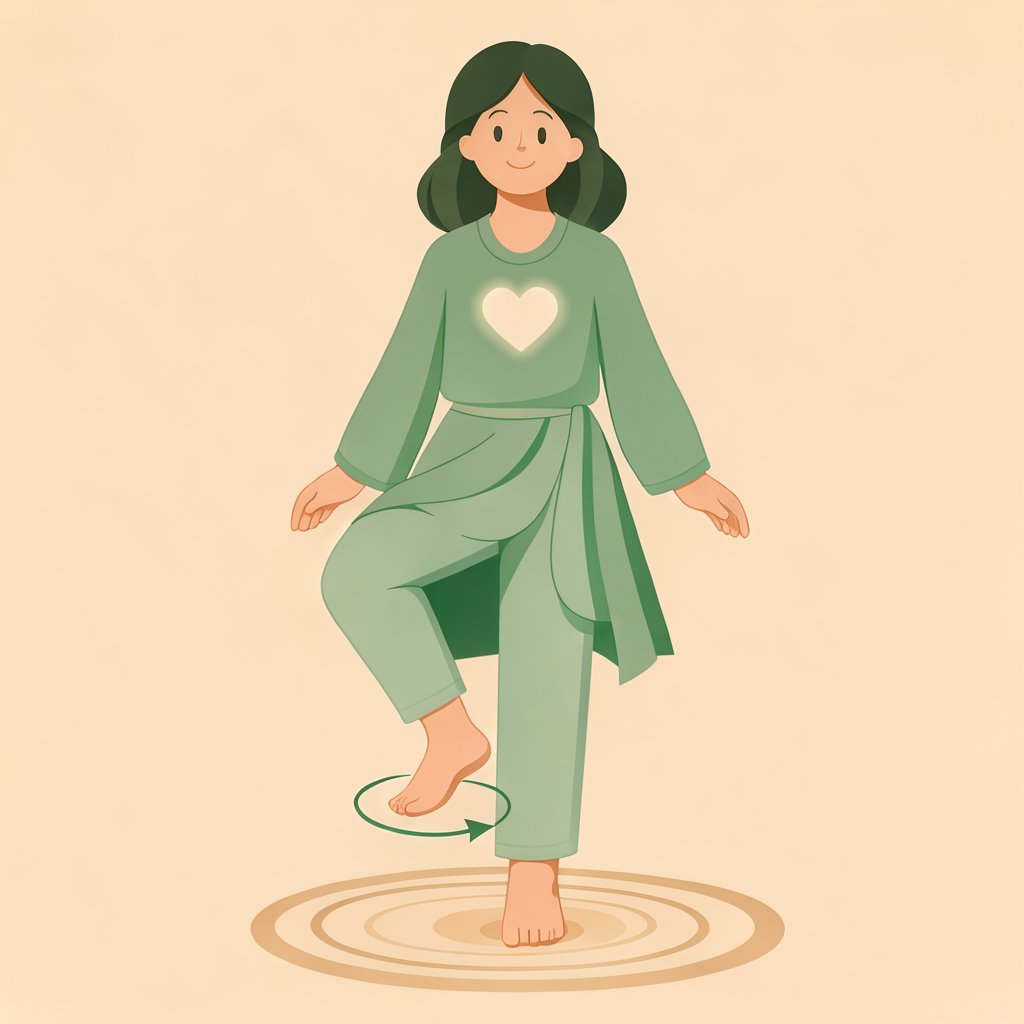
The walking books make the ramp mandatory and give it feet. Barough’s core routine — the timed set-distance walk of Step 6 — is wrapped in a warm-up and a cool-down described as mandatory, not optional[7]. And the running-and-walking manual supplies the concrete moves: repeated ankle and foot work of about 8 repetitions, then walking in place or on the toes, then slow circular movements in each ankle joint, about 4 in each direction — with shins and thighs strengthened alongside the feet[6]. For a barefoot session those ankle circles are the closest thing to a safety inspection in motion: joints, soles, and ground introduced to each other before any distance.
Step 6: Walk a Timed Set Distance
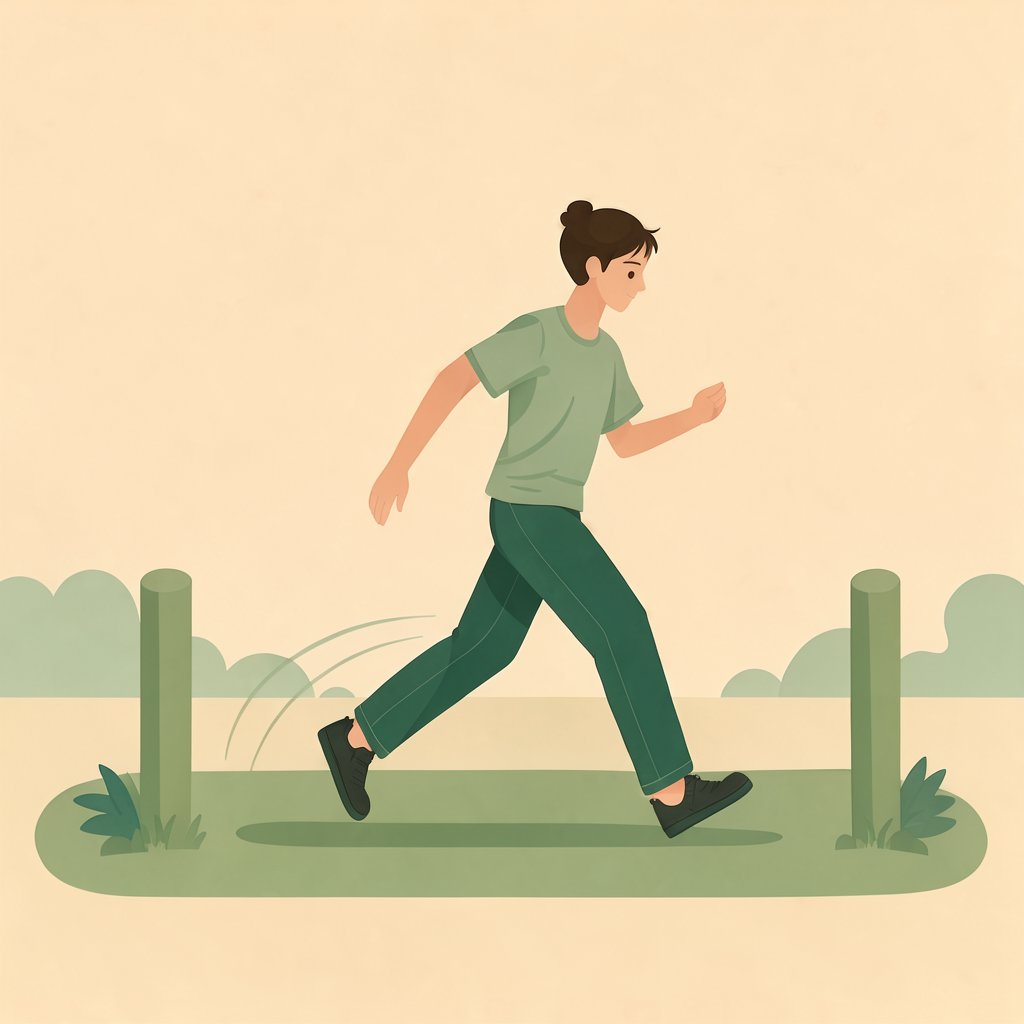
Warmed up, the main stage is deliberately simple: one distance, one comfortable-fast pace, one stopwatch. Barough’s protocol: pick a set distance, walk it from home at your fastest pace but without straining, and time how long the distance takes[7]. The honest expectation comes with it — it may take 15 minutes, it may take 30 minutes or more, or perhaps you will need to stop before the end; all three are data, not verdicts[7]. A labeling note: this is the book’s shod power-walking protocol, used here as the readiness test that calibrates the barefoot ladder of Step 7.
The protocol’s second half is the self-assessment, and it is the manual’s autoregulation engine. When finished, ask honestly: could you have kept on walking? Did your legs ache? Was it a struggle — were you out of breath? The answers help decide the next move[7]. Two readiness markers complete the step: if you can walk 1 mile (1.6 km) easily, the book considers you ready to begin a structured program; and the test is worth revisiting after a few weeks to monitor progress, switching levels whenever the regimen feels too easy or too hard[7]. The stopwatch reading now feeds the only question left — how much, how fast — which Step 7 answers with a ladder and a fence.
Step 7: Build From 10 to 30 Minutes
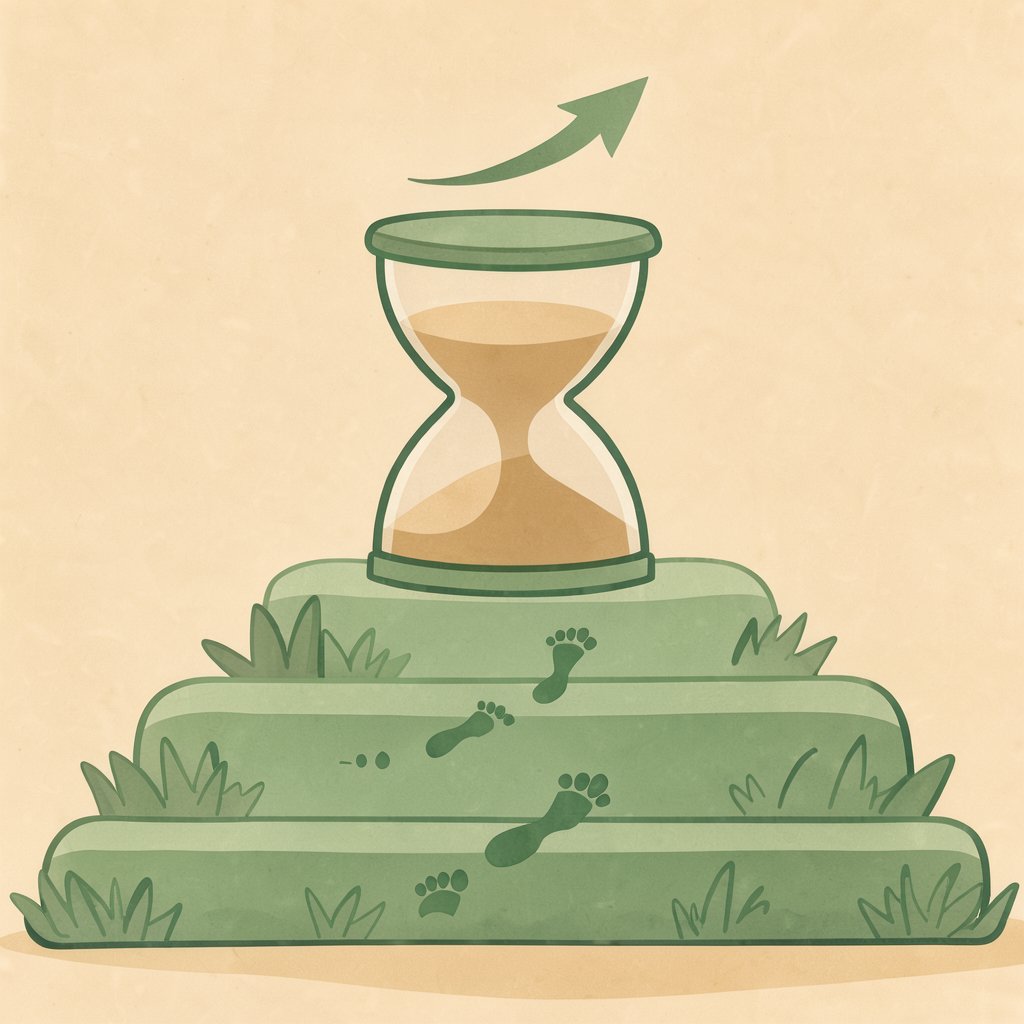
The dose logic comes from E. Milner’s Walking Instead of Medicines and its load taxonomy. By degree of effect on the body, health exercise distinguishes threshold, optimal, and overload. Threshold load is the minimum above your habitual activity that already gives the health effect — compensating missing energy expenditure, raising aerobic capacity, lowering cardiovascular risk; from the energy-compensation viewpoint it is about 2,000 kcal per week. Optimal load is the volume giving the maximum health effect for this individual, bounded below by threshold and above by maximal. Overload exceeds functional capacity — and is individual: for a beginner walker, even a continuous one-hour walk counts; overloads depress working capacity for a long time and can trigger disease up to acute myocardial infarction[8].
Milner’s numbers, transcribed exactly — and every one of them a shod accelerated-walking figure: the beginner threshold is 5 walks a week of 30 to 40 minutes; a five-continent population survey found infarct mortality four times lower in regular walkers and runners at comparable energy expenditure (about 2,000 kcal per week); risk-factor reduction — a clear blood-pressure drop and full lipid normalization — required at least 3 hours a week (six 30-minute walks); aerobic capacity rose after 12 weeks of five 40-minute walks a week (VO2max up 14 percent, in Dr. Cooper’s walking system and Japanese researchers’ data, independently); 30-minute bouts raised myocardial capillary density and coronary blood flow where 15-minute bouts did not (French research cited in the book); and for seasoned walkers the optimum sits at about 5 hours a week of accelerated walking — beyond which further gain is absent and the heart takes the risk[8]. Barough’s side of the progression is simpler: gently build up the distances, and pick the level that matches how the walk feels[7].
Now the fence, in the text where it belongs. The barefoot ladder of this manual — week one around 10 minutes on even ground, minutes added only while recovery stays clean, a cap near 30 — is this guide’s construction from Milner’s threshold-to-optimal logic and Barough’s build-up advice; the base contains no barefoot dose and no earthing dose at all, and the 15-to-30-minute figure floating around walking books is Barough’s shod time-trial observation, not a prescription for bare feet[7][8]. Two dose notes travel with the ladder: sessions below threshold still beat nothing — but by Milner’s evidence the measurable health effect starts at threshold volume; and because a barefoot minute loads skin and joints that a shoe usually pads, the ladder deliberately starts below the shod numbers and climbs only on clean recovery.
Step 8: Cool Down and Read the Signals
Whatever the dose, every session ends identically: slow down, then listen. In Platonov’s three-stage structure the final stage is the cool-down — a cardio stage carrying its own purpose, the mirror of Step 5’s ramp[9]. Barough makes it mandatory around the timed walk[7]; the base does not quantify cool-down minutes, so this manual says only what the books say: finish at an easy pace and let the system wind down, without inventing a number.
Then the same four questions as after the timed test, now as the session’s debrief: could you have kept walking, did the legs ache, was it a struggle, were you out of breath — the answers decide the next move, up the ladder or down it[7]. The final signal-check is physical. Ivanova’s rule — written for diabetics and extended here, with the extension labeled, to every barefoot practitioner — is to check the feet after sessions and in the evening for wounds, calluses, blisters, and other damage; until such damage has resolved, training is contraindicated[5]. Log what the body said; single sessions read properly only in the week’s context, which is exactly where Step 9 takes over.
Step 9: Track the Week, Not Just the Day
The practice is daily, so the honest ruler is the week — and the walking book hands over its favorite ruler with a confession attached. The 10,000-step daily challenge — approximately 5 miles — was dreamt up many years ago; there appears to be no scientific backing for why this distance is better than any other, yet it has stuck globally as the magic daily distance for good health and fitness[7]. This manual repeats the book’s honesty: 10,000 steps is a globally accepted benchmark, not a proven threshold.
The reference points around it are still useful for scale. The average person takes about 2,000 steps to walk a mile, while a sedentary person may average only 1,000 to 3,000 steps a day; a daily step counter shows what you achieve and makes you aware of what you skip, can vibrate each hour as a signal to get up and move, and pairs with goals and friendly comparison to keep motivation running[7]. The sedentary context deserves its own line: by the evolutionary-medicine frame of Muscles: How Are You Doing?, ten hours in a sitting position is a marathon for the spine — the hourly buzz is a small antidote[3]. Log weekly step totals and barefoot minutes together: the barefoot walk is the sharp end of the daily movement budget, not a separate currency. No data in the base connects step counts to barefoot minutes — the weekly log is a practice device, not a studied protocol, and it is labeled as one.
Step 10: Foot Care and Shoes on Shod Days
The barefoot minutes are planned; the other hours of the day decide whether the feet arrive at tomorrow’s session intact. Barough’s shoe checklist for power walking is the shod standard: the shoe must be light and flexible, mimicking the foot’s range of movement; the toe box roomy, deep, and rounded — tapered boxes avoided unless the feet are very slender — with at least a two-finger width between the longest toe and the shoe’s end for the push-off; good arch support and insole; as light as possible, preferably waterproof; cushioning at the heel and under the ball of the foot; a low-cut heel profile to protect the Achilles tendon; and heel stability whether you pronate or supinate[7].
Orthotics get their own paragraph. They are corrective insoles designed to change foot motion, relieve excessive pronation, and stop further deterioration in flat feet or bunions; preformed orthotics sit in retail stores, while custom orthotics are made after a biomechanical assessment by a qualified podiatrist or chiropodist and may include heel lifts. Shopping rules with them: buy in the afternoon, when feet are largest; take your walking socks and your existing orthotics to match; and remember that expensive is not necessarily best[7]. Ivanova’s diabetic rules fold into the same shelf — shoes that never pinch or rub, socks sturdy and without holes or folds[5] — and Vasilyeva’s foot-care book adds that arch-supporting insoles are the indispensable part of orthopedic footwear, custom-made possible, with orthopedic shoes especially indicated for the diabetic foot: low heel, wide toe box, flexible leather sole[2]. The running manual’s baseline belongs here too — light, non-slip, easily rolling from heel to toe, well ventilated, with orthopedic insoles for flat feet before walking turns painful[6]. No brands and no prices exist in the base, so none are named.
The manual closes where the foot’s story began. Vasilyeva’s tradition note — the washing of feet carrying symbolic weight since antiquity — and her evolution chapter’s moral are the same instruction from two directions: feet deserve deliberate care[1][2]. Barefoot on even ground at the right hour, dosed up a conservative ladder, checked after every session, and shod in the right shoe otherwise — that is the whole practice, honestly bounded: expectation fenced, feet checked, ground and hour chosen, warmed up, walked, dosed, cooled, tracked, and cared for[1][4][7][8].
Frequently Asked Questions About Barefoot Walking
Does earthing really transfer electrons into the body?
That claim cannot be assessed from this manual’s source base, because the base holds no earthing or grounding book at all — a global probe of the library returned only off-topic neighbors, with the best relevance score at or below 0.025. Electron-transfer, cortisol, and circadian claims, and grounding mats as products, are therefore labeled unverified here, not repeated as fact. The practice this manual teaches stands on walking and foot-care books instead[7][8].
How long should a beginner walk barefoot?
Around 10 minutes on even ground in week one, built toward a 30-minute cap — and an honest label: that ladder is this guide’s construction from Milner’s threshold-to-optimal load logic, not a quoted earthing dose; the base contains no barefoot dose. The familiar 15-to-30-minute figure is Barough’s shod time-trial observation. Add minutes only while recovery stays clean[7][8]. Browse the mobility and vitality category for more.
Is barefoot walking safe with diabetes?
No — the safety gate closes first. For a person with diabetes, even a scratch on the sole can grow into a non-healing wound, and gangrene is the main cause of limb amputation in diabetes; diabetic foot angiopathy means damaged arterioles can stop feeding the soft tissues entirely. With diabetes or any open foot wound, speak with your clinician before any barefoot practice — this is medical territory, not a wellness call[4][5]. Read our medical disclaimer.
Which surface is best for barefoot walking?
Smooth, even, soft ground: grass, soil or sand, or a cinder track — the soft half of the running manual’s surface list, matched to Vasilyeva’s point that the foot was built for soft earth, not city asphalt. Hills, dirt tracks, and uneven paths make the muscles work harder and belong to later progression. The base holds no surface-comparison study, so the ranking is reasoned from adaptation rather than measured[1][6][7]. See the manuals library for companion practices.
Is 10,000 steps a day a proven target?
No — and the walking book says so itself: the 10,000-step challenge was dreamt up many years ago and has no scientific backing for why that distance beats any other, even though it has stuck globally as the magic daily number. The honest reference points: roughly 2,000 steps per mile, and 1,000 to 3,000 steps a day for a sedentary person. Treat 10,000 as a benchmark and log the week, not just the day[7].
Earthing, as the internet sells it, promised electrons; the books behind this manual deliver something quieter and better documented — a foot ten thousand years in the making, a load ladder with threshold numbers, a safety gate that protects the feet most at risk, and shoes that do their job on the shod days[1][4][7][8]. Walk barefoot on even ground at a sane hour, climb from ten minutes toward thirty on clean recovery, and check your soles after every session — and let the unverified claims stay exactly that[5][6].
Sources
- [1] A.V. Vasilyeva — Health of Your Feet: The Most Effective Treatments (2009) — the ten-thousand-year foot evolution chapter (Darwin’s tree-climbers, the flattened springy foot, feet still growing on hard city coverings), the soft-earth framing, and the “love and spare your feet” ethic.
- [2] A. Vasilyeva — Flat Feet: The Most Effective Treatments (2011) — sole bioactive and magnetic-field-sensitive points (author statement, labeled as tradition), the “end arteries” diabetic foot angiopathy, the six lesion types, arch-support insoles and orthopedic footwear, and the foot-washing symbolism.
- [3] A. Shtippler, N. Regitnig-Tillian — Muscles: How Are You Doing? (2020) — the evolutionary-medicine frame (first-fish programs as cited from Detlev Ganten’s Stone Age Speaks Up) and “ten hours sitting is a marathon for the spine”.
- [4] Z.Sh. Arabuli — Your Spine (2015) — the diabetic scratch-to-non-healing-wound risk, gangrene as the main cause of limb amputation in diabetes, and the immobilized foot’s stagnation.
- [5] T.V. Ivanova — Gymnastics for Diabetics (2016) — the foot-protection rules: shoes that never pinch or rub, sturdy socks, no solo training, weather-wise dress, post-session foot inspection, and the until-healed training pause.
- [6] Unknown Author — Health Running and Walking: A Practical Guide (n.d.) — the even-surface list, the midday ban and chronotype guidance, the one-hour meal rule, the ankle warm-up moves, and running contraindicated in diabetes while walking is tolerated.
- [7] Barough N. — Walking For Fitness (2017) — the timed set-distance walk with its self-assessment questions, mandatory warm-up and cool-down, the 10,000-step history, step reference points, and the complete shoe and orthotics criteria.
- [8] E. Milner — Walking Instead of Medicines (2010) — the threshold/optimal/overload load taxonomy and every dose number in Step 7, all of them shod accelerated-walking figures.
- [9] I.N. Platonov — Muscles and Joints: The Musculoskeletal System (2012) — the three-stage session structure and the 5-to-7-minute warm-up at 50 to 70 percent of maximum pulse (prescribed for machine cardio; adapted here with the label).
Where to go next: the manuals library collects complete step-by-step practices. For the shod side of walking culture, the traditional mobility versus modern programs guide compares approaches, and the mobility and vitality category holds the neighboring ground. Read the medical disclaimer before starting any new practice.
How we researched this: this article was built from a local library of 1,137 wellness books, indexed and searched offline with no internet sources. Retrieval focused on the walking, foot-care, and diabetes collections of that library — and a deliberate global probe confirmed that no earthing or grounding title exists in the base, which is why the electrical claims are fenced as unverified on the page. Every statement above was checked against the cited book passages before publication.
Sources & References
A.V. Vasilyeva — Health of Your Feet: The Most Effective Treatments (2009); A. Vasilyeva — Flat Feet: The Most Effective Treatments (2011); A. Shtippler, N. Regitnig-Tillian — Muscles: How Are You Doing? (2020); Z.Sh. Arabuli — Your Spine (2015); T.V. Ivanova — Gymnastics for Diabetics (2016); Unknown Author — Health Running and Walking: A Practical Guide (n.d.); Barough N. — Walking For Fitness (2017); E. Milner — Walking Instead of Medicines (2010); I.N. Platonov — Muscles and Joints: The Musculoskeletal System (2012)