Educational content only — not medical advice. See our full Medical Disclaimer and Affiliate Disclosure below.
Key Takeaways
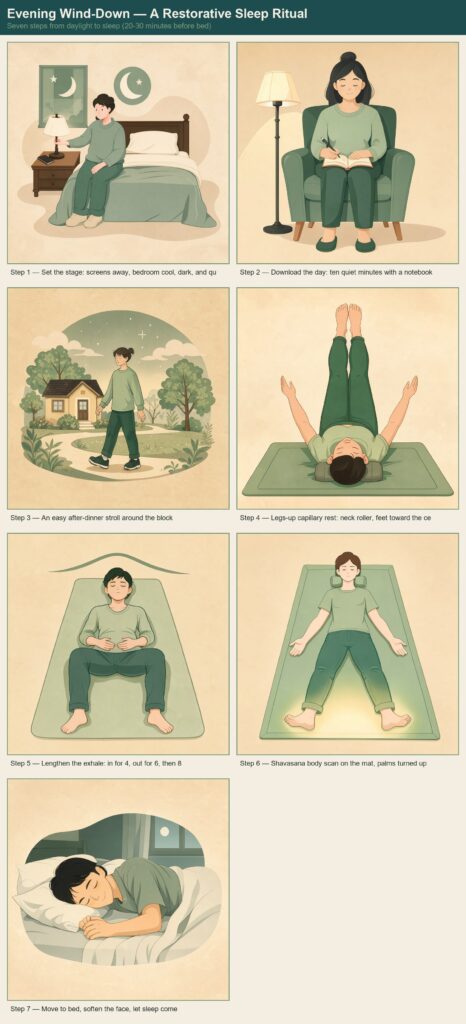
- An evening wind-down ritual is a fixed 20-30 minute sequence – screen curfew, day review, an easy stroll, legs-up rest, extended-exhale breathing, a shavasana body scan, and a gentle hand-over to sleep.
- Physicians quoted in a home-medicine handbook say trying too hard to fall asleep backfires; relaxation is a skill that, “like a diet,” rewards regular practice.[1]
- Tradition supplies the shapes: shavasana as yoga’s pose of complete rest,[6] the Nishi capillary exercise for the legs,[4] and a longer exhale as the calming half of the breath.[3]
- The full protocol needs no equipment beyond a mat and a small roller, and suits complete beginners.
An evening wind-down ritual is a deliberate descent toward sleep: instead of switching from full-speed day to lights-out, you close the day in stages. This manual assembles one concrete version from traditional practice literature and physicians’ sleep advice – seven steps, twenty to thirty minutes, nothing to buy. It pairs naturally with the breath-focused practices in our library of free practice manuals.
Why a wind-down ritual matters
The strongest argument for a ritual comes from what happens without one. “The problem with insomnia is that people try too hard to fall asleep,” a sleep specialist explains in a home-medicine handbook; the harder the effort, the more elusive the result.[1] Relaxation – deep breathing, muscle relaxation, or yoga – is offered as the practical counter, with a caveat: it works “like a diet,” meaning regular practice over weeks, not a one-night fix.[1]
Traditional sources describe the same shift in calmer language. An evening relaxation practice releases tension from the body, calms the psyche, and slows the inner rhythm before sleep.[10] Before bed, one collected health manual advises, free yourself from the day’s stirring experiences – settle, contemplate, and set yourself up for the kind of sleep that restores strength.[5]
The seven-step evening wind-down ritual
Set the stage (60 minutes out)
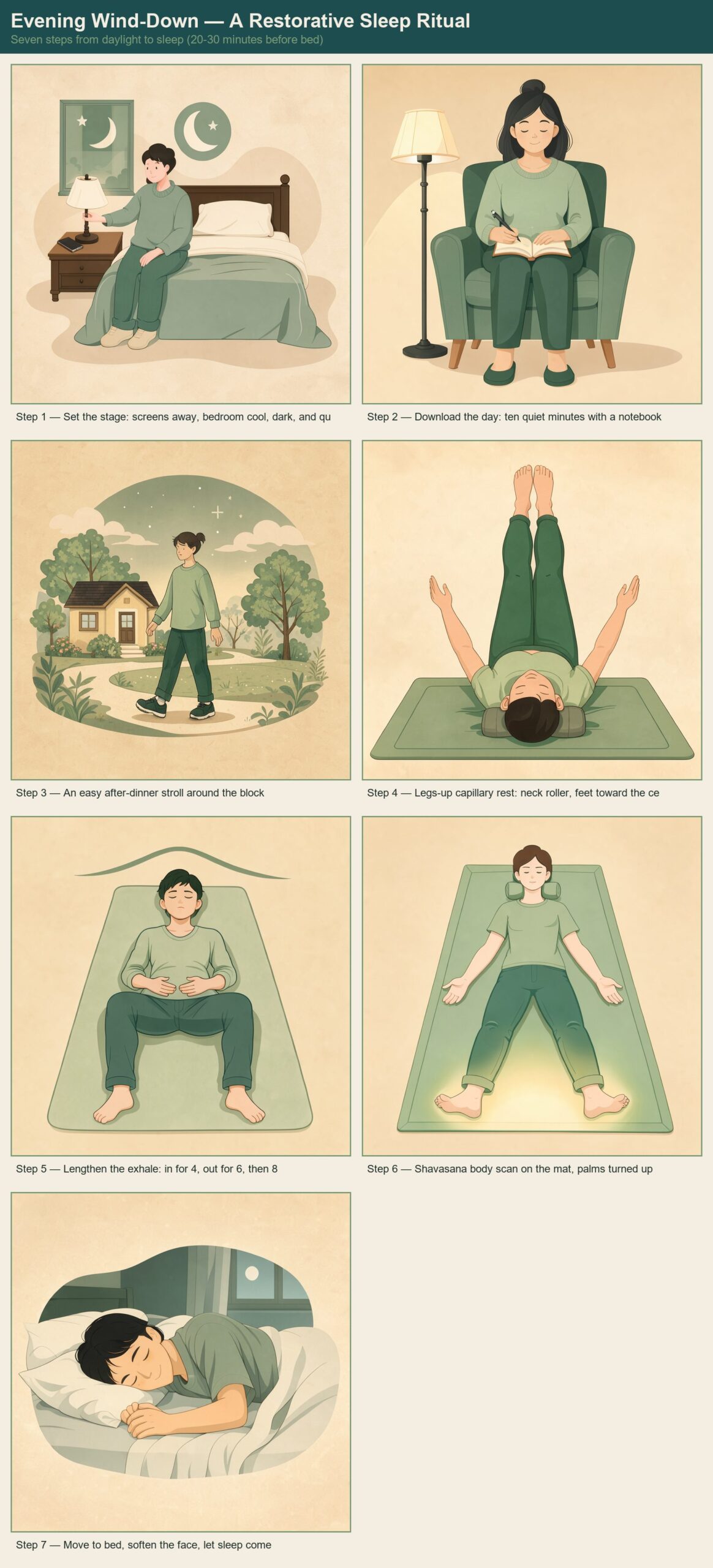
Put screens away at least an hour before bed. Make the bedroom dark, quiet, and cool - about 61-64 F (16-18 C). Keep coffee, cola, and chocolate out of the late afternoon and evening, skip the nightcap, and eat light in the evening.Download the day (10 minutes)
An hour or two before bed, sit for at least ten minutes and review the day: what stressed you, what went well, and what you will do tomorrow. If the day intrudes again at lights-out, answer it: 'I have already thought this through.'Take an easy stroll
End the day with light movement - a walk around the block after dinner is enough. The muscles tire, body temperature rises, and as it begins to fall, sleepiness can follow. Skip intense training in the last two to three hours before bed.Rest your legs up (1-3 minutes)
Lie on your back on a mat or firm bed, place a small firm roller under the neck, and lift both legs and arms so the feet are parallel to the ceiling - the Nishi capillary exercise. If the legs feel heavy, bend the knees and draw them to the chest instead.Lengthen the exhale (about 5 minutes)
Inhale through the nose for a silent count of 4, then exhale 6; when that is easy, exhale 8 - lengthening only while comfortable. With palms on the belly, let the breath smooth out like water in a river, without jerks.Scan and release in shavasana (5-10 minutes)
On a mat on the floor, lie on your back, feet about 8-12 in (20-30 cm) apart, arms alongside, palms up, small rollers under neck and lower back. Either follow a wave of relaxation from the toes upward with calm imagery, or tense and release each muscle group from the toes up.Move to bed and let go
Exit gently: wiggle fingers and toes, stretch, one deep breath, open the eyes, roll onto your side, then get into bed. Sweep through the body once and soften the face. If you are still awake after about 15 minutes, get up and return only when sleepy.
- Set the stage – 60 minutes out. Put the phone and screens away at least an hour before bed.[2] Make the bedroom dark, quiet, and cool – around 61-64 °F (16-18 °C).[2] Keep coffee, cola, and chocolate out of the second half of the day: physicians quoted in a home-medicine handbook advise no caffeine after about 4 p.m., and no bedtime drink – alcohol may ease you under early, but it wears off around the middle of the night and wakes you.[1] A light evening meal and no daytime naps longer than half an hour round out the setup.[2]
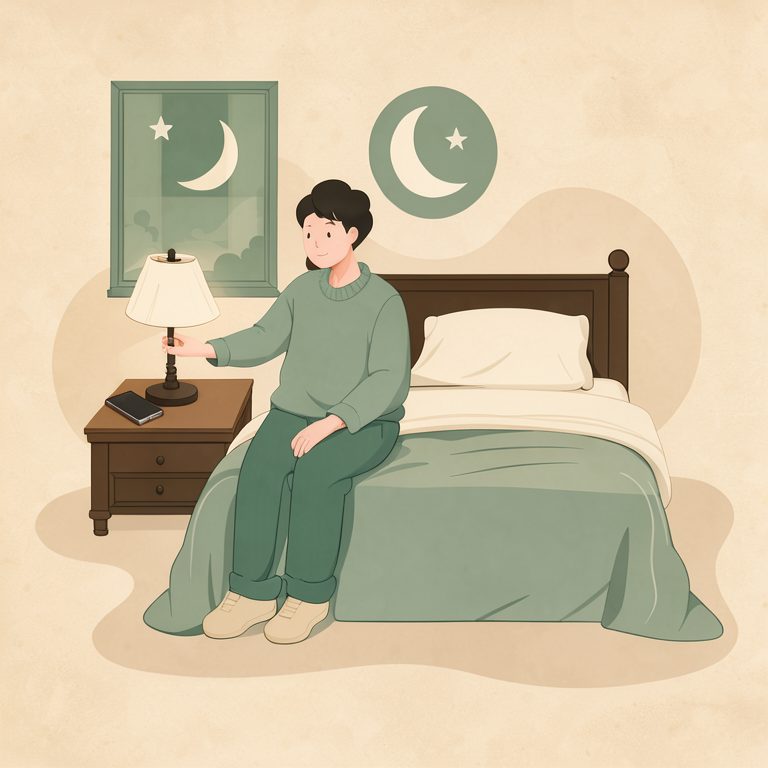
Step 1 — Set the stage: screens away, bedroom cool, dark, and quiet - Download the day – 10 minutes. An hour or two before bed, sit for at least ten minutes and review the day: what stressed you, what went well, and what you will do about it tomorrow. The practice is described as clearing the mind of the irritations that otherwise surface the moment you pull up the blanket; if the day intrudes again, answer it with “I have already thought this through.”[1] Keep the bedroom itself for sleep only – no television, phone calls, arguments, or work in bed.[1][8]
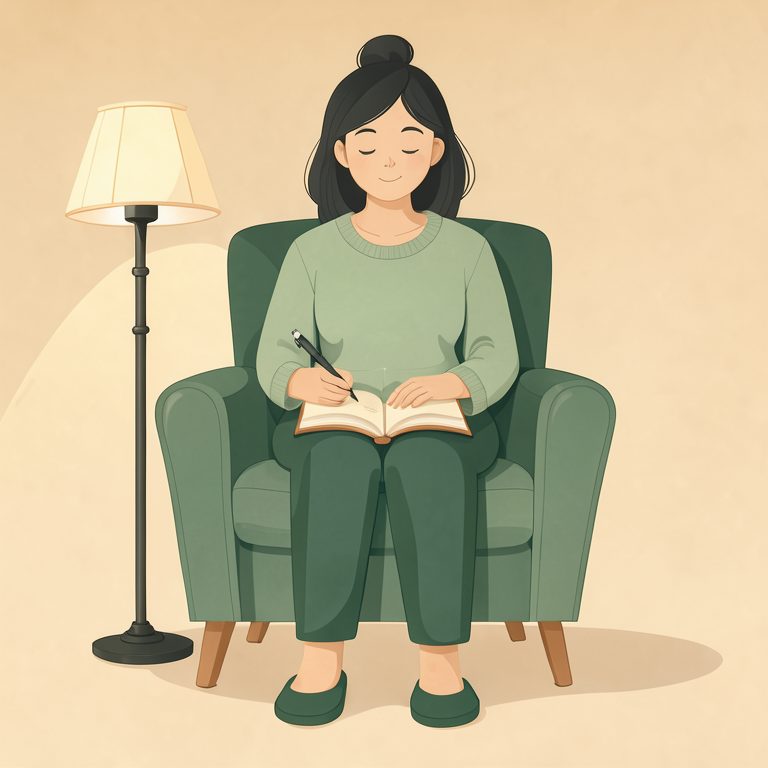
Step 2 — Download the day: ten quiet minutes with a notebook - Take an easy stroll. End the day with light movement – a walk around the block after dinner is enough. The muscles tire, body temperature rises, and as it begins to fall, sleepiness can follow.[1] Keep it gentle: intense training in the last two to three hours before bed is discouraged, while unhurried walks in the fresh air are called very beneficial, with an after-dinner outing suggested as a rule of thumb.[5]
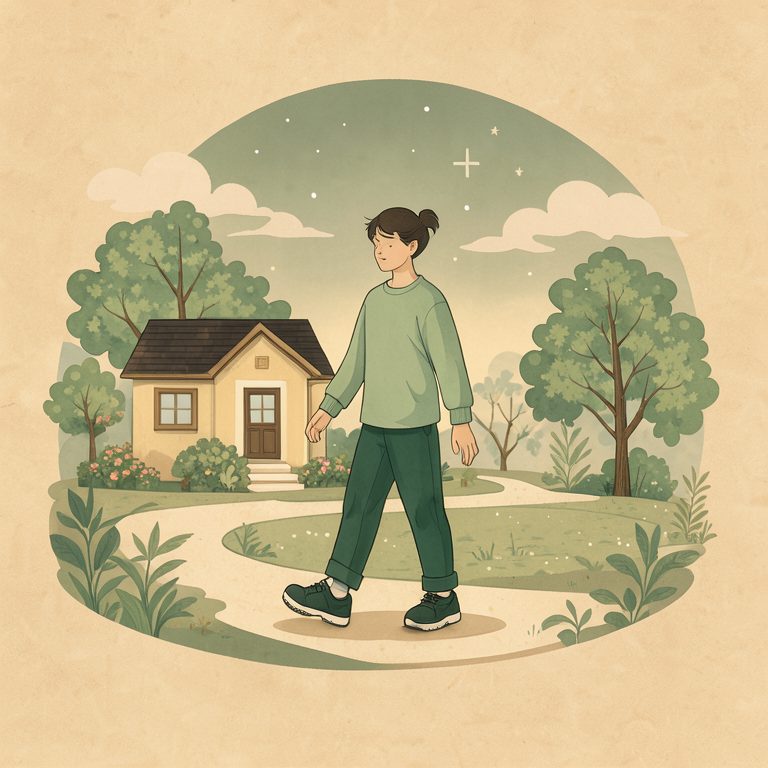
Step 3 — An easy after-dinner stroll around the block - Rest your legs up – 1 to 3 minutes. Lie on your back on the floor or a firm bed, place a firm small pillow or roller under the neck, and lift both legs (and arms) so the feet are parallel to the ceiling. This is the capillary exercise – a “rule of health” in Nishi’s system, practiced morning and evening to support circulation in the limbs.[4] If the legs feel heavy at the end of the day, bend the knees and draw them to the chest instead: this position rests the leg veins and eases the work of the heart.[5]
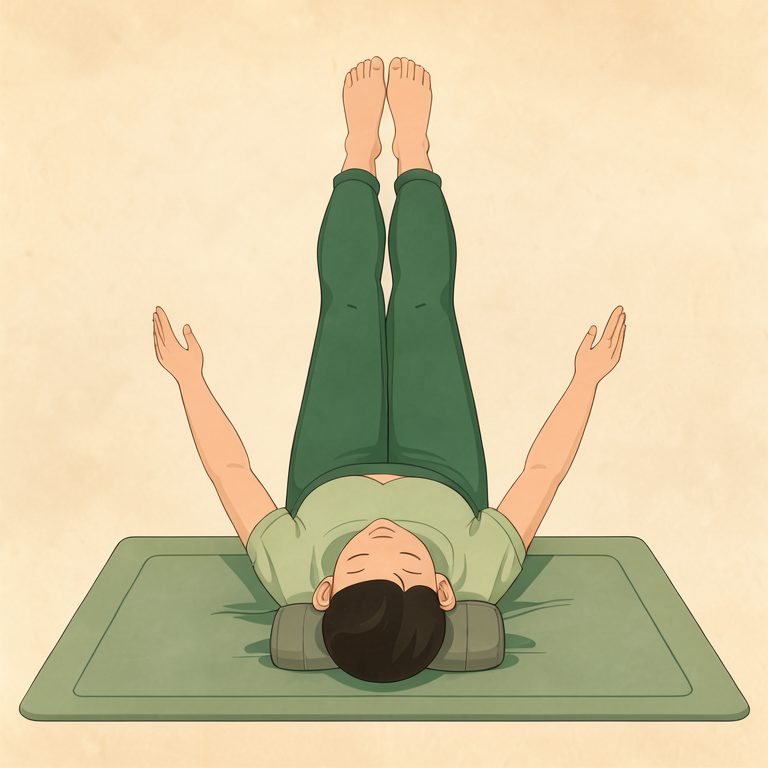
Step 4 — Legs-up capillary rest: neck roller, feet toward the ceiling - Lengthen the exhale – about 5 minutes. Sit or lie comfortably with the spine relaxed and tall. Inhale through the nose for a silent count of 4, then exhale for 6; when that feels easy, exhale for 8 – growing the exhale only as long as it stays comfortable. A longer exhale than inhale is described as the relaxation half of the breath cycle, settling both body and thoughts, a technique worth using in the evening before sleep.[3] With palms resting on the belly, watch the belly wall rise and fall, and let the breath flow smoothly – with no distinct point where a cycle begins or ends; the pauses after the exhale hold a distinct feeling of quiet and peace.[3]
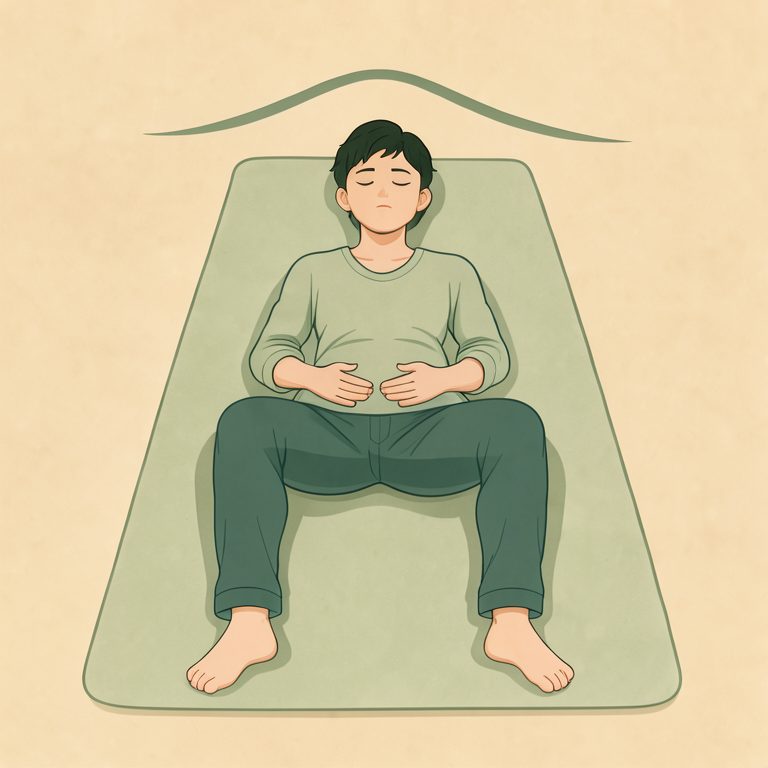
Step 5 — Lengthen the exhale: in for 4, out for 6, then 8 - Scan and release in shavasana – 5 to 10 minutes. Move to a mat on the floor rather than the bed.[5] Lie on your back, feet about 8-12 in (20-30 cm) apart, arms alongside with palms up;[6][7] small rollers under the neck and lower back keep the spine’s natural curves.[7] Choose one path: follow a wave of relaxation from the toes upward while holding calm imagery – a cloudless sky, a mountain lake;[6] or work progressively, briefly tensing and then releasing each muscle group from the big toes upward – feet, calves, thighs, belly, shoulders, arms, hands.[8] Wherever attention rests, warmth and release follow.[7]
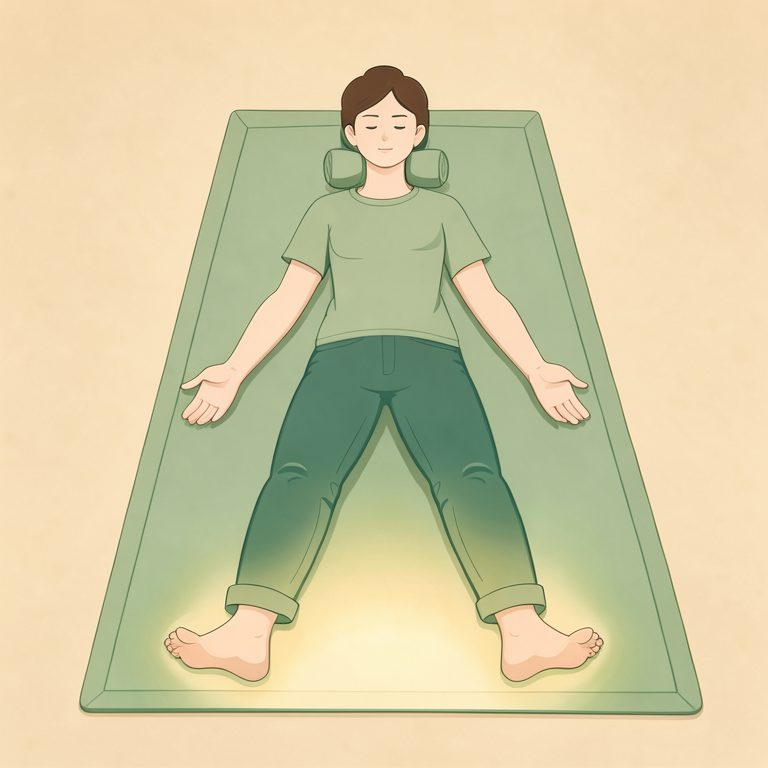
Step 6 — Shavasana body scan on the mat, palms turned up - Move to bed and let go. Come out gently: wiggle fingers and toes, stretch softly, take one deep breath, open the eyes, roll onto your side, rest a moment, and only then rise and get into bed.[9] In bed, do not repeat the full scan – simply sweep through the body once and soften the face, especially the jaw.[5] Do not chase sleep; trying too hard backfires.[1] If you are still awake after about 15 minutes, get up, do something quiet, and return only when sleepy.[8]
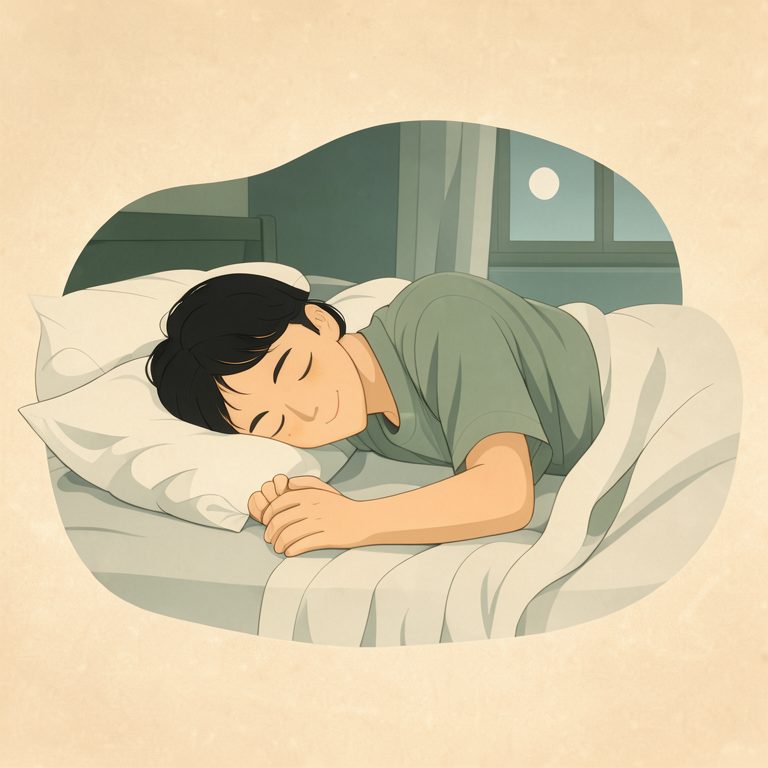
Step 7 — Move to bed, soften the face, let sleep come
Science and tradition, side by side
What tradition holds. Traditional yoga teaching counts shavasana – the corpse pose – as its pose of complete relaxation and peace, taken lying down with the breathing slowed as far as comfortable and a wave of release guided upward from the toes.[6] Breathing gymnastics places the calming effect on the exhale: lengthening it relative to the inhale settles body and mind, which is why the technique is recommended for the evening or after heavy loads.[3] The Nishi system of “rules of health” includes a daily capillary exercise with the legs raised, morning and evening.[4] One Eastern-practice teacher assigns static poses – the quiet, held kind – to evening gymnastics rather than the morning.[9] And a relaxation pose borrowed from yoga comes with housekeeping instructions of its own: practice at least an hour after eating, in a ventilated room without drafts, on a soft mat on the floor.[7]
What modern practice observations add. The advice-givers quoted in the home-medicine handbook point to the body-temperature curve: a modest evening walk raises it, and the fall that follows can invite sleepiness.[1] The same source is blunt about alcohol – a nightcap depresses the nervous system at first, then wears off around midnight and wakes you[1] – and about caffeine after about 4 p.m.[1] A contemporary health handbook stacks the environment: screens off an hour before bed, stimulants four hours before, a dark, quiet, cool room at 16-18 °C (61-64 °F), a constant bedtime, and breathing exercises directly before sleep.[2] For the nights the ritual cannot save, behavioral sleep advice contributes stimulus control: bed only for sleep, a 15-minute rule, no clock-watching, one fixed wake-up time.[8] The same handbook cites a 2015 study in which people with insomnia received weekly palm-reflexology sessions for four weeks and reported better sleep quality with less fatigue.[2]
Wind-down timing at a glance
| When (before bed) | What you do | Source |
|---|---|---|
| 4+ hours | Last coffee, cola, or chocolate; no nicotine; no nightcap at dinner or after | [1][2] |
| 2-3 hours | Finish any intense training; light dinner; unhurried after-dinner stroll | [5][1] |
| 60 minutes | Screens off; lights low; ten-minute day review and tomorrow-plan | [2][1] |
| 15-20 minutes | Legs-up capillary rest, or knees to chest for tired legs | [4][5] |
| 10-15 minutes | Extended-exhale breathing (4 in, 6-8 out), palms on the belly | [3] |
| Last 5-10 minutes | Shavasana body scan on the mat, palms up, warm imagery | [6][7] |
| Lights out | One quick body sweep, soften the face; if awake after ~15 minutes, get up | [5][8] |
Frequently asked questions
How long does an evening wind-down ritual take?
The quiet part on the mat takes 20-30 minutes; the habits around it start earlier – the last coffee in the early afternoon,[1] screens off an hour before bed,[2] then the ten-minute day review, the stroll, legs-up rest, extended-exhale breathing, and the body scan.
Can I do the whole ritual in bed?
No – do the full relaxation on a mat on the floor, then move to bed. A full-length shavasana in bed, under a blanket, is described as able to interfere with sleep; in bed, keep only the quick body sweep and a soft face.[5]
What if I am still awake after the ritual?
Do not keep trying harder – effort backfires.[1] Behavioral sleep advice gives the 15-minute rule: if sleep has not come, get up, do something quiet, and return to bed only when sleepy; no clock-watching, and one fixed wake-up time whatever the night.[8]
Safety and contraindications
Timing and setting matter more than they seem. Practice at least an hour after eating, in a ventilated room without drafts – a relaxed body cools quickly and is more sensitive to chill than you expect.[7] The full shavasana belongs on a mat on the floor; taken to its full length in bed, under a blanket, it is described as able to interfere with sleep – in bed, keep only the quick sweep and the soft face.[5]
Respect the breath. Lengthen the exhale only while it stays comfortable; at any sign of dizziness, air hunger, or strain, return to your natural breathing and rest.[3] Skip or shorten the legs-raised position if you are pregnant, or if you live with uncontrolled high blood pressure, a heart condition, raised eye pressure, or are recovering from surgery – ask your clinician first. This ritual is general wellness education, not a treatment for insomnia or any other condition; if poor sleep is persistent or affecting your health, see a qualified healthcare provider. Not intended to cure, treat, or prevent any disease.
Sources
- [1] Unknown Author — Domashniy Doktor. Sovety Amerikanskikh Vrachey (Home Doctor: Advice from American Physicians) (2007)
- [2] E. Persilie — Zdorove v Tvoikh Rukakh (Health in Your Hands) (2025)
- [3] V. Smirnov — Zaryadis dlya Effektivnoy Zhizni (Charge Up for an Effective Life) (2015)
- [4] G. Malakhov — Razvitiye Sobstvennoy Programmy Ozdorovleniya (Building Your Own Health-Recovery Program)
- [5] V. I. Gromov, G. Vasilyev — Zdorovaya Zhizn (Healthy Life, collected volume)
- [6] E. A. Polyakova — Masterskaya Zdorovya. Ozdorovitelnye Praktiki Vostoka (Workshop of Health: Eastern Health Practices) (2015)
- [7] G. Efimov — Ty — Zhivoy Istochnik Energii (You Are a Living Source of Energy)
- [8] L. Berezhkova — Kak Izbavitsya ot Bessonitsy (How to Overcome Sleeplessness)
- [9] O. Torsunov — Rezhim Dnya (The Daily Regimen)
- [10] M. Ya. Kelmovich — Klyuch k Zhizni (The Key to Life)
How we researched this
This manual is based on our local library of 1,137 traditional wellness books; no internet sources were used. Every statement above was checked against the cited source passages.
Related reading
If joint discomfort is part of what keeps you tossing at night, see our Joint Genesis review. Tight hips make floor positions harder – the Unlock Your Hip Flexors program review covers a mobility routine for that. And for more step-by-step guides like this one, browse all free practice manuals.
Sources & References
Unknown Author - Domashniy Doktor. Sovety Amerikanskikh Vrachey (Home Doctor: Advice from American Physicians) (2007); E. Persilie - Zdorove v Tvoikh Rukakh (Health in Your Hands) (2025); V. Smirnov - Zaryadis dlya Effektivnoy Zhizni (Charge Up for an Effective Life) (2015); G. Malakhov - Razvitiye Sobstvennoy Programmy Ozdorovleniya (Building Your Own Health-Recovery Program); V. I. Gromov, G. Vasilyev - Zdorovaya Zhizn (Healthy Life, collected volume); E. A. Polyakova - Masterskaya Zdorovya. Ozdorovitelnye Praktiki Vostoka (Workshop of Health: Eastern Health Practices) (2015); G. Efimov - Ty - Zhivoy Istochnik Energii (You Are a Living Source of Energy); L. Berezhkova - Kak Izbavitsya ot Bessonitsy (How to Overcome Sleeplessness); O. Torsunov - Rezhim Dnya (The Daily Regimen); M. Ya. Kelmovich - Klyuch k Zhizni (The Key to Life)