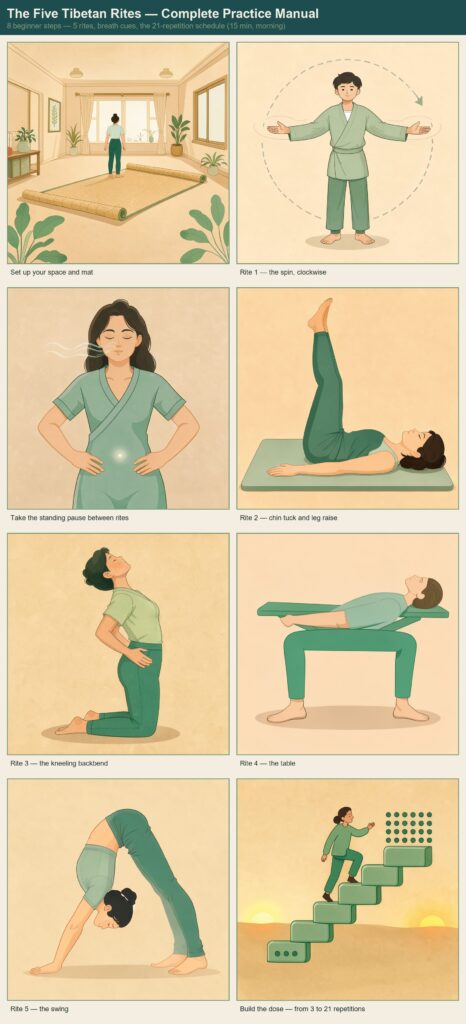
Educational content only — not medical advice. See our full Medical Disclaimer and Affiliate Disclosure below.
Key Takeaways
- The Five Tibetan Rites are five short movement practices — a spin, a lying leg raise, a kneeling backbend, a table lift, and a swing — first made public in Peter Kelder’s 1938 book[3].
- In the source tradition the rites act on seven rotating “vortices” of the subtle body: the spin speeds them up, the second rite stabilizes them[1].
- Beginners start at three repetitions of each rite once a day and add two per week until reaching twenty-one — with all five rites kept in strict order in every series[1].
- The source text’s main safety rule: stop the spin before dizziness turns strong, and never practice to exhaustion[1].
The Five Tibetan Rites — sometimes called the Five Rites of Rejuvenation — are five short movement practices: an upright spin, a lying leg raise with a chin tuck, a kneeling backbend, a “table” lift, and a swing between two supported positions[1]. This complete practice manual collects what the classic instructional literature actually says: where the rites come from, the vortex framework behind them, an eight-step beginner protocol with breathing cues, the classic 21-repetition schedule, and the safety notes that go with it. It sits alongside our other traditional-practice walkthroughs in the manuals library.
The Five Tibetan Rites Step by Step
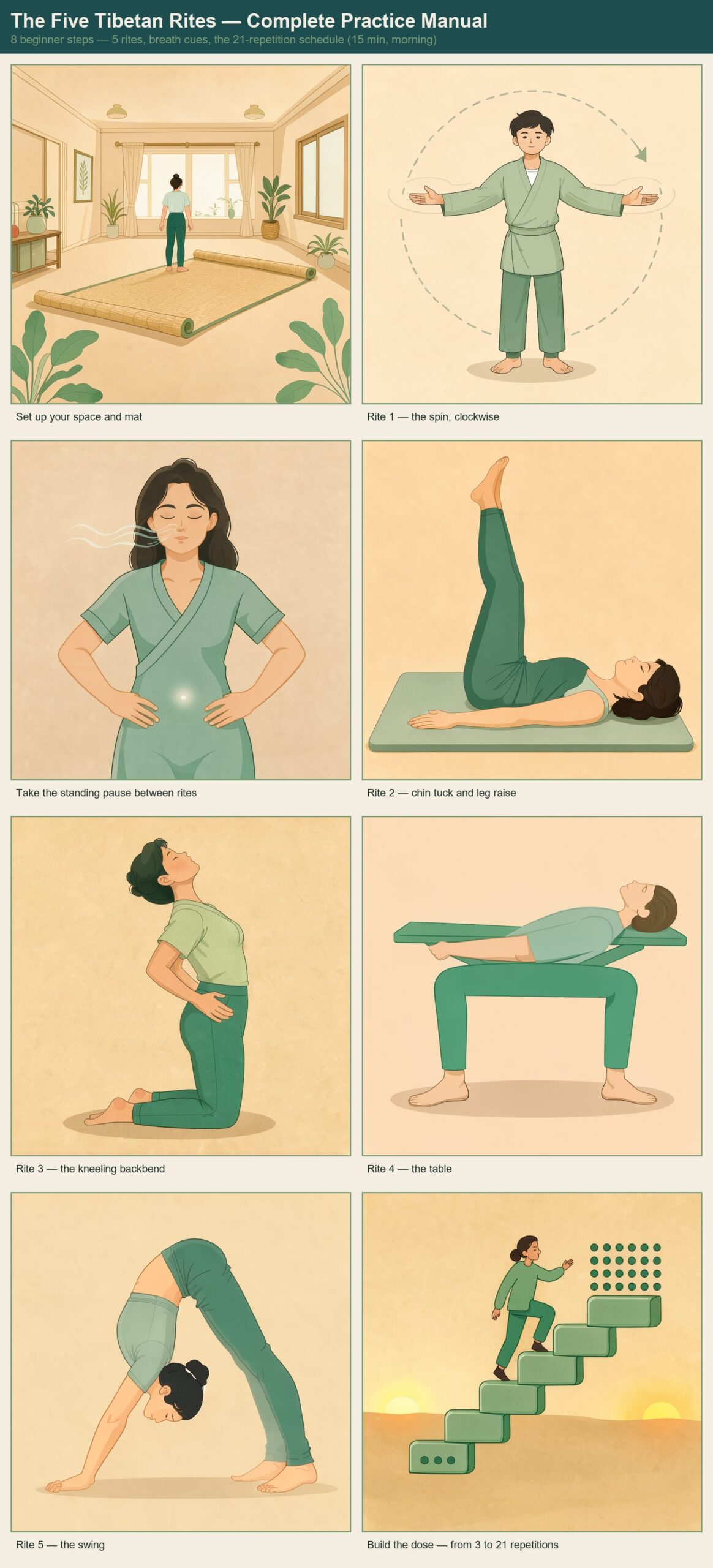
Set up your space and mat
Find enough open floor to spin with your arms fully outstretched without touching anything. Lay a thick carpet or soft warm mat — its main job is to insulate your body from the cold floor; the lamas in the source text used a thick mat woven from coarse plant fibers and yak wool.Rite 1 — the spin, clockwise
Stand erect with arms stretched horizontally to the sides at shoulder height and rotate around your own axis left to right — clockwise, as if standing at the center of a clock face lying on the floor. Beginners start with three turns and stop at light dizziness; sit or lie down if the body asks for it. A figure-skater trick — fixing your gaze on one point and snapping the head around ahead of the body — delays dizziness.Take the standing pause between rites
Between one rite and the next, stand straight with hands on the waist and take several smooth, full breaths, resting your attention inside the abdomen at navel level and relaxing fully on each exhale. Between repetitions of the same rite no pause is needed — they form one continuous series.Rite 2 — chin tuck and leg raise
Lie on your back with arms alongside the body and palms, fingers together, pressed to the floor. Empty the lungs; on a smooth, deep inhale lift your head with the chin pressed firmly to the sternum and your straight legs toward vertical; lower head and legs with the same full exhale. Knees never bend, and the pelvis stays on the floor.Rite 3 — the kneeling backbend
Kneel with knees pelvis-width apart so the thighs stay vertical, palms resting on the backs of the thighs just under the buttocks. Exhale fully and drop the chin to the sternum; then, throwing the head back-up, push the chest out and arch the spine backward, leaning lightly on the hands; return to the chin-tucked start on the exhale.Rite 4 — the table
Sit on the floor with legs straight, feet about shoulder-width; palms beside the hips, fingers pointing forward; chin to sternum. Exhale, then on a deep smooth inhale throw the head back-up and lift the torso to horizontal — thighs and torso in one flat plane, shins and arms vertical like table legs. Tense every muscle for a few seconds with a full exhale, then relax and return, chin to chest.Rite 5 — the swing
Support yourself on palms and toes with the body arched — pelvis and knees never touch the floor. Begin with a full exhale; on a deep inhale fold at the hips into an inverted-V; return to the arched support on a full exhale. Hold the breath for a few seconds at each extreme with all muscles tensed; the arch comes from opening the chest and shoulders, not from over-bending the lower back.Build the dose — from 3 to 21 repetitions
Week one: three repetitions of each rite, once a day. Add two repetitions each week until you reach twenty-one. Every series must contain all five rites in strict order, though a day's count may be split into two or three sessions. The classic times are sunrise and sunset, with the morning series finished before noon.
Where the Five Tibetan Rites Come From
The rites were first made public in 1938, when Peter Kelder’s book saw print[3]. The preface to the widely read Russian edition presents them as the secret of monks of a remote mountain monastery, kept private for a very long time before that[3]. Kelder’s own account is unstuffy about their place: the lamas treated the rites as a support practice — a way to keep the body in order and supply it with the energy needed for the contemplative training they considered the real work[1]. Nearly fifty lamas could practice the rites together, and all except the first rite were performed with closed eyes, so that attention would stay with inner sensations rather than the room[1]. Wherever the system was taught in the West, the source notes, people first called the rites “isometric exercises” — and there is truth in that label, since they stretch the body, add elasticity, and raise muscle tone[1]. Later retellings have grown around the original: one modern Russian book expands the sequence to seven “pearls” with names like “Energy Rotation,” “Return of Strength,” and “Body-Mind Connection”[2].
The Vortex Framework Behind the Practice
The tradition the source describes is a vortex model. A young, healthy person has seven main “vortices” of the subtle body all spinning at the same high rate, in harmony with the many secondary vortices; in the average middle-aged body the seven spin at different speeds, and the tradition holds that this discord underlies disturbed metabolism, salt imbalance, and joint trouble, with further slowdown and energy loss leading to more serious, age-related change[1]. Each rite has a job in this picture: the spin gives the vortex rotation speed and stability — extra “moment of inertia,” in the text’s phrasing[1] — and the second rite is said to fill the vortices with etheric force[1]. The whirling dervishes of the same region, the source adds, work the same spin principle to excess: their hours-long rotation amounts to hyperstimulation that ends in a serious imbalance, which they read as religious illumination. The lamas never spin to exhaustion — typically ten to twelve turns, and at most twenty-one in a single session[1].
The Classic 21-Repetition Schedule
The source builds the dose on a simple weekly ladder[1]:
| Week | Repetitions of each rite per day |
|---|---|
| Week 1 | 3 — one series a day[1] |
| Week 2 | 5[1] |
| Weeks 3–9 | Add two per week: 7, 9, 11, 13, 15, 17, 19[1] |
| Week 10 | 21 — the full daily count[1] |
Four schedule rules travel with the ladder. First, order is fixed: every series contains all five rites in sequence, and splitting the daily count into two or three sessions is fine, mixing the order is not[1]. Second, timing is flexible but anchored: sunrise and sunset are the classic slots, and the morning series should happen before noon[1]. Third, a second daily series is a later addition — only after at least four months of steady twenty-one-repetition practice, and then built up again from three repetitions, adding two per week[1]. Fourth, going beyond twenty-one repetitions (to thirty-six, seventy-two, or one hundred and eight) is described as spiritual development rather than health practice, and the source advises against it without a weighty reason[1].
Traditional View vs Modern Physiology
What the tradition says. The rites are framed as an “etheric training” system: the vortices must be spun up and stabilized, and the breath is the binding link between physical movement and the management of etheric force — which is why the source repeats that breathing must be as full and deep as possible, with the fullness of the exhale the key to the fullness of the inhale[1].
What a modern reader should know. The literature behind this manual is instructional and traditional; it reports no clinical trials of the Five Tibetan Rites, and we will not invent any. What can be said plainly is mechanical: the set combines vestibular stimulation (the spin), hip-flexor and abdominal work (the leg raise), spinal extension (the backbend and the table), and supported shoulder and core stability (the swing), paced by slow full breathing — everyday mobility work that fits into fifteen minutes of a morning routine. Where the tradition speaks of vortices and etheric force, modern physiology speaks of the vestibular system, respiration, and muscle tone; the vocabulary differs, while the choreography both describe is the same.
Safety and Contraindications
The source text’s cautions are specific. Never cross the line where light dizziness becomes strong and accompanied by mild nausea — continuing into the following rites in that state can end in vomiting[1]. If you feel the need to sit or lie down after the spin, do it; the author reports doing exactly that at first[1]. If the vestibular system is extremely weak and you cannot spin at all, skip Rite 1 entirely for four to six months and practice Rites 2 through 5; introduce the spin gradually afterward[1]. Never practice to exhaustion or overstrain — the source is blunt that pushing through only leads to negative results, and that time and patience are the allies[1]. If an injury or the loss of a limb makes a rite impossible, practice what is accessible: even parts of the system are held to be beneficial, and best-effort form counts[1]. Stay in a pain-free range, keep the neck long rather than collapsed in the backbend and table, and stop any session that feels wrong. This manual is educational and is not intended to diagnose, treat, cure, or prevent any disease; if you are pregnant, managing a chronic condition, or living with vertigo, heart, or spinal concerns, talk with your physician before starting any new movement practice.
Frequently Asked Questions
How many repetitions should a beginner do?
Three of each rite, once a day, for the first week — then add two per week until twenty-one[1]. If the full count is too much on a given day, split it into two or three sessions that each keep all five rites in order[1].
When should I practice the Five Tibetan Rites?
The classic slots are sunrise and sunset; a morning series can be moved later, before noon[1]. One full series a day is the starting dose, and a second series belongs to practitioners with at least four months of steady twenty-one-repetition days behind them[1].
What if I cannot do one of the rites?
Approximate it. The author’s elderly students began Rite 4 barely able to lift their hips off the floor; a month of best-effort practice brought the full form[1]. With a very weak vestibular system, practice Rites 2–5 only for the first months[1], and with a spine injury or limb difference, do the parts that are accessible — the source holds that even fragments of the practice can be beneficial[1].
Related reading from our review desk: for hip-flexor mobility that pairs well with Rite 2, see our Unlock Your Hip Flexors review; for a joint-support formula we examined, see the Joint Genesis review. All of our step-by-step guides live in the manuals library.
Sources
- [1] Peter Kelder — The Eye of Rejuvenation: Ancient Secret of the Tibetan Lamas (Oko Vozrozhdeniya, Russian edition; the book first appeared in 1938)
- [2] P. Levin — The Eye of True Rejuvenation: All Seven Tibetan Pearls in One Book (Oko Nastoyashchego Vozrozhdeniya) (2010)
- [3] Peter Kelder, Andrey Sidersky — The Eye of Rejuvenation (Video Course and Books, Russian edition) (1994)
How we researched this
This article is based entirely on our local library of 1,137 books on traditional wellness practices, consulted offline with no internet sources. Every claim in the text was checked against the cited source passages before publication.
Sources & References
Peter Kelder — The Eye of Rejuvenation: Ancient Secret of the Tibetan Lamas (Oko Vozrozhdeniya, Russian edition; the book first appeared in 1938); P. Levin — The Eye of True Rejuvenation: All Seven Tibetan Pearls in One Book (2010); Peter Kelder & Andrey Sidersky — The Eye of Rejuvenation (Video Course and Books edition, 1994)