
Educational content only — not medical advice. See our full Medical Disclaimer and Affiliate Disclosure below.
By mid-afternoon most desk workers know the feeling: heavy lids, sandy aching eyes, and a hand drifting up to rub them. Acupressure for tired eyes is the classical answer to exactly that instinct — slow finger pressure on mapped points around the eye socket, paired with a few distal points on the hand and leg, applied gently with closed lids. It comes from pre-digital source books: a reference manual of acupuncture points, practical Russian-language self-massage handbooks, and qigong and shiatsu texts that worked tired, swollen eyes long before anyone had a display on the desk[3][4]. Eye strain acupressure, as this guide uses the phrase, is simply that classical toolkit translated to a desk day.
This guide translates that record to the desk, honestly: none of these books discusses screens, so nothing here puts words in their mouths. What follows is a definition and a short history of the method, the classical reason nearly every channel meets at the orbit, a point map with exact locations, and a five-minute routine assembled strictly from the documented dosages of the cited manuals — the assembly is ours, every component is footnoted. A full safety section closes the guide, because gentle is not the same as unconditional.
Key Takeaways
- Acupressure for tired eyes is finger pressure on eight mapped points around the orbit plus distal allies on the hand and leg — a traditional-use practice documented across pre-digital classics[1][4].
- Jingming BL-1 is the meeting point of five channels and three vessels, which is the classical rationale for working tired eyes both locally at the orbit and distally on the limbs[4].
- The desk routine is an honest assembly: every count in it — two rotations per second, eight sets of eight, ten-second press-and-vibrate — comes from a cited manual[1][10][11].
- Safety is a gate, not a footnote: press the socket bone with closed lids, never the eyeball; the numbered contraindication list and the glaucoma-class red flags come first[4][10].
What Is Acupressure for Tired Eyes?
Acupressure for tired eyes is the classical practice of applying finger pressure to defined points around the eye socket and to distal points on the hand and leg, in order to refresh heavy, overworked eyes. It is self-care for fatigue, not a therapy for eye disease. Everything it offers lives in the register of traditional use, documented across classical manuals.
The method has a long paper trail. The acupressure principle is described as unchanged for roughly 5,000 years, with more than 1,030 known points; Chinese experts handed the knowledge to American and European physicians, and in China even children self-administer point massage[1]. After about thirty years of institutional study, Chinese research institutes summarized their position bluntly: “We do not know why acupressure works. We only know that it works.”[1] A point-therapy manual calls point massage the “younger sister” of acupuncture and reports that some scholars believe hands worked the points before needles, with 900 to 1,500 points counted depending on the source[2].
One modern-physiology reading frames the mechanism as cutaneous-visceral reflexes laid down in embryogenesis, with a local reaction of raised skin temperature and changed electrical potential at the point[2]. In Zen shiatsu the same territory reads more simply: Bl 1, the “bright light” point at the inner corner of the eye, is the point applied to tired and swollen eyes, after which inner calm returns[3]. The sources for this guide are exactly these kinds of books — Deadman’s reference atlas, practical self-massage handbooks, qigong and shiatsu texts — and one caveat belongs up front: they predate screens, so this article translates their protocols to the desk rather than quoting them about monitors.
How Does Eye Acupressure Work? Every Channel Meets at the Orbit
Eye acupressure works a crossroads. In the classical anatomy of A Manual of Acupuncture, nearly every major channel in the body touches the eye region, which is why the orbit is treated from so many angles at once[4]. The manual’s survey of the areas reached by the channels reads like a timetable of arrivals at one small station, and it is worth walking through channel by channel before you place a finger anywhere.
- Bladder: the primary channel originates at the inner canthus — at Jingming BL-1 itself — and its sinew channel circles the eye as the “upper net”[4].
- Stomach: the primary channel ascends to the inner canthus and descends along the infraorbital ridge; its sinew channel forms the eye’s “lower net” together with the Bladder’s upper net[4].
- Gall Bladder: the channel originates at the outer canthus, at Tongziliao GB-1[4].
- Sanjiao: the channel terminates at the outer end of the eyebrow, at Sizhukong SJ-23[4].
- Small Intestine and Heart: the Small Intestine channel reaches the inner and outer canthi, and the Heart luo channel connects to the eye[4].
- Liver: the primary channel links with the tissues surrounding the eye[4].
- Extraordinary vessels: the Governing vessel emerges at BL-1, the Conception vessel terminates at ST-1, and the Yin and Yang Motility vessels meet at the inner canthus[4].
The convergence point of all this traffic is Jingming BL-1 — the meeting point of the Bladder, Small Intestine, Stomach, Gall Bladder and Sanjiao channels with the Governing, Yin Motility and Yang Motility vessels[4]. The classical verdict quoted in the manual calls it the primary local point for virtually any eye problem of exterior origin[4]. That single sentence is the rationale for this whole guide: tired eyes are addressed both at the orbit and, through the channels, at distant points on the limbs.
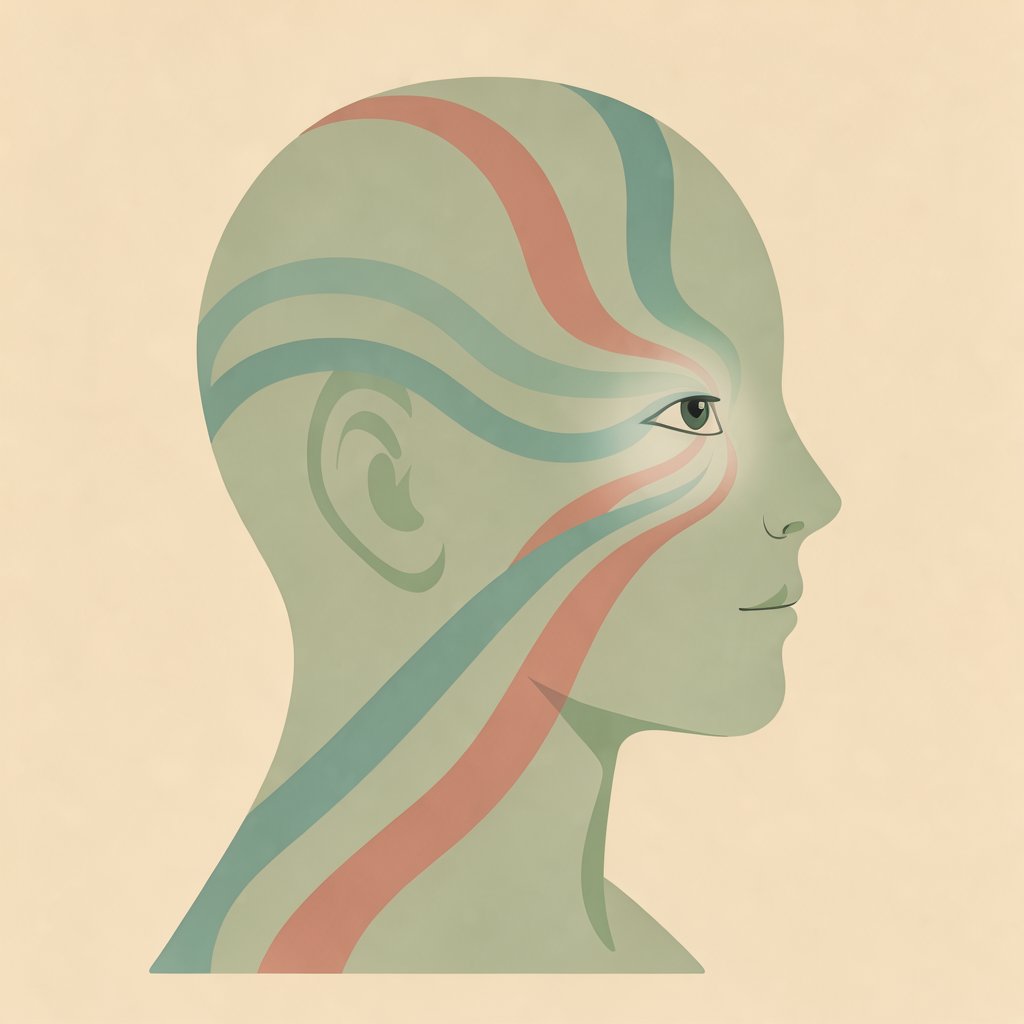
Shiatsu adds the anatomical hint that shapes the routine’s finish. In Masunaga’s handbook the Bladder meridian “runs from the eyes sideways of the midline over head and back”, so the same line that begins at the eye also carries the neck[3]. His Bl 10 point at the occiput serves occipital pressure and neck tension — exactly where a desk routine should end[3]. The channels explain where classical practice works; why the eyes tire at all is the next question, and the classical answer runs through the Liver.
Why Do Eyes Tire? The Liver-Eye Connection
Classical theory gives tired eyes an organ to answer to. The Spiritual Pivot, quoted in A Manual of Acupuncture, states that “Liver qi opens into the eyes; when the Liver is in harmony, the eyes are able to distinguish the five colours”[4]. The Essential Questions compresses the same idea further: “The Liver receives blood so there is sight.”[4] In this reading, heavy and blurry eyes are a Liver question first — a framing the pre-digital sources built without any reference to screens.
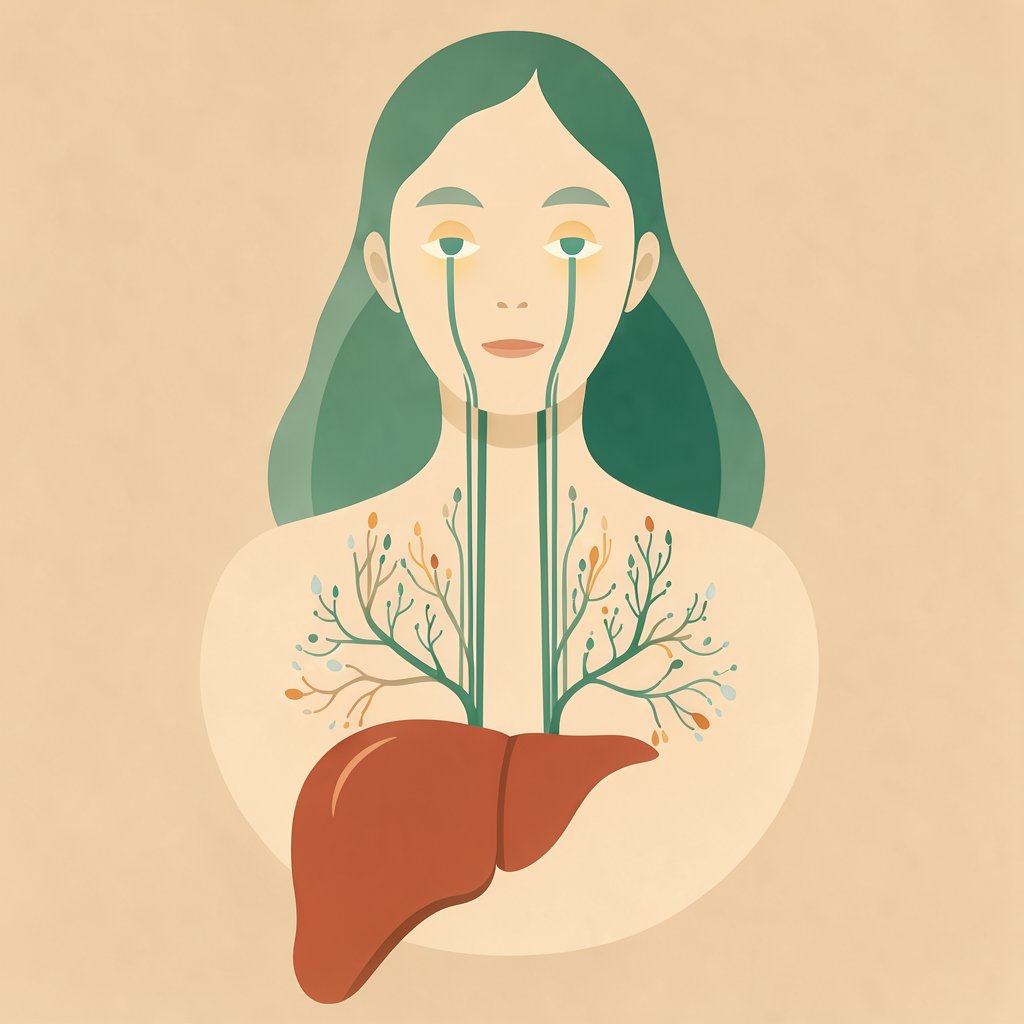
The manual sorts eye complaints into two opposing patterns, and the pair explains why the routine in this guide stays gentle. Liver blood or yin deficiency shows as blurred vision, night blindness, lacrimation and dizziness; Liver fire rising shows as red, itching, painful eyes[4]. Those are two different kinds of tired eyes, and forceful pressing suits neither. Back-shu points along the spine are said to nourish their corresponding sense organ, and Ganshu BL-18, the back-shu point of the Liver, is indicated for “all diseases of the eyes pertaining to the Liver”[4].
Eastern reflexotherapy renders the same link physiologically: the liver is the body’s blood depot, and its meridian passes through the eye, affecting vision and oculomotor function — which is why eye disorders are addressed on the liver meridian[5]. A clinical table of meridian activity places the liver channel’s maximum at 1 to 3 AM, the gallbladder at 11 PM to 1 AM, and the triple burner at 9 to 11 PM, with eye disease listed on the liver meridian’s pathology row[7]. The food tradition agrees: Henry C. Lu’s compendium notes that “the eyes are connected with the liver”, and that seventh-century Chinese night-blindness recipes are still in use[6].
For the desk worker, the most useful bridge comes from a self-massage author who observed that mental overwork tenses the neck and shoulder muscles in a self-reinforcing loop — and that massage breaks the loop[8]. That is the second axis of the routine below: after the orbit, the hands travel to the temples and the base of the skull. One honest limit must stay in view: everything above is classical mechanism language. No randomized clinical trial numbers for eye acupressure appear anywhere in these sources, and this article does not add any.
The Eight Orbital Points: Exact Locations Around the Eye
One eye, eight classical addresses — each located against a landmark you can feel through closed lids. The eye pressure points below come from the “Major Points of the Eye Region” plate of A Manual of Acupuncture, with two practical sets from clinical atlases added at the end[4]. Locations are given in cun, the proportional unit of the classical point manuals, measured against the bony rim of the orbit.

Jingming BL-1, “Bright Eyes”
Jingming sits 0.1 cun medial and superior to the inner canthus, near the medial border of the orbit — where the bridge of the nose meets the socket’s rim[4]. Tradition lists redness, swelling, pain, lacrimation, itching and blurred vision among its indications[4]. The modern clinical list around it — glaucoma, optic nerve atrophy, pterygium, astigmatism, optic neuritis, retinal haemorrhage, early cataract — marks the zone as a physician’s territory, and moxibustion is contraindicated here[4].
Zanzhu BL-2
Zanzhu lies in a small depression close to the medial end of the eyebrow, directly superior to BL-1[4]. It is easiest to find by sliding a fingertip from the top of the inner canthus straight up into the brow’s inner notch. With the eyes closed, the pad of the index finger lands on it naturally.
Yuyao
Yuyao sits directly above the pupil, in the centre of the eyebrow[4]. With a forward gaze the pupil sits mid-face, so the point is simply the midpoint of the brow arch. A finger resting along the closed brow feels it as the highest point of the curve.
Sizhukong SJ-23
Sizhukong occupies the depression at the lateral end of the eyebrow, where the brow dissolves toward the temple[4]. This is the termination of the Sanjiao primary channel[4]. It shares its work with the temple zone: a Chinese self-massage sequence presses it ten times with small circular massage[12].
Tongziliao GB-1
Tongziliao sits on the lateral side of the orbit, 0.5 cun lateral to the outer canthus[4]. The Medvedevs’ 25 Magic Points makes GB-1 its dedicated point for improving vision — located 0.5 cm lateral to the outer eye corner and used, as traditional use, for reduced visual acuity and various eye complaints[10]. Their protocol works both sides simultaneously with the eyes closed, while you hold a mental image of the eyes relaxing; the felt relaxation around the eyes is the marker of the correct dose[10].
Chengqi ST-1
Chengqi sits directly below the pupil, between the eyeball and the infraorbital ridge[4]. It is the termination of the Conception vessel[4]. Feel for the bone just under the centre of the lower lid margin — the point lies along that rim, which is why pressure here stays feather-light and on the bone.
Sibai ST-2
Sibai lies 1 cun below the pupil, in the depression at the infraorbital foramen[4]. The practical self-massage manual gives it a precise protocol: moderate pressure with the index fingers of both hands, thumbs bracing the chin, and sixty-four circular movements counted as eight sets of eight[1]. It is the workhorse of the lower orbit in the desk routine below.
Qiuhou
Qiuhou marks the junction of the lateral quarter and the medial three-quarters of the infraorbital border — a fine gradation for point purists[4]. It completes the lower-rim set together with ST-1 and ST-2. Beginners can treat the three as one gentle line along the lower socket rather than three separate targets.
Two clinical sets bookend the classical map. An illustrated atlas of healing points lists the eye region’s working set as Yangbai (GB-14) above the brow, Sizhukong (TE-23), Tongziliao (GB-1), Chengqi (ST-1), Sibai (ST-2) and Yintang between the brows, with the temple zone Touwei (ST-8) and Taiyang listed for migraine and reduced vision[9]. Yintang, between the eyebrows, earns its place in the routine through a qigong press-and-vibrate dosage given below[11]. Together the sets draw one picture: a ring of points around the orbit, worked gently, bone by bone.
Distal Points for the Eyes: Support from Hand and Leg
Classical physicians did not stop at the socket. The Ode of Xi-hong, quoted in the BL-1 entry of A Manual of Acupuncture, gives the rule in one line: when Jingming BL-1 alone is ineffective for the eye, combine it with Hegu L.I.-4 and Guangming GB-37[4]. One point on the hand, one on the leg — the same eye addressed from far away, which is the whole logic of distal point work.
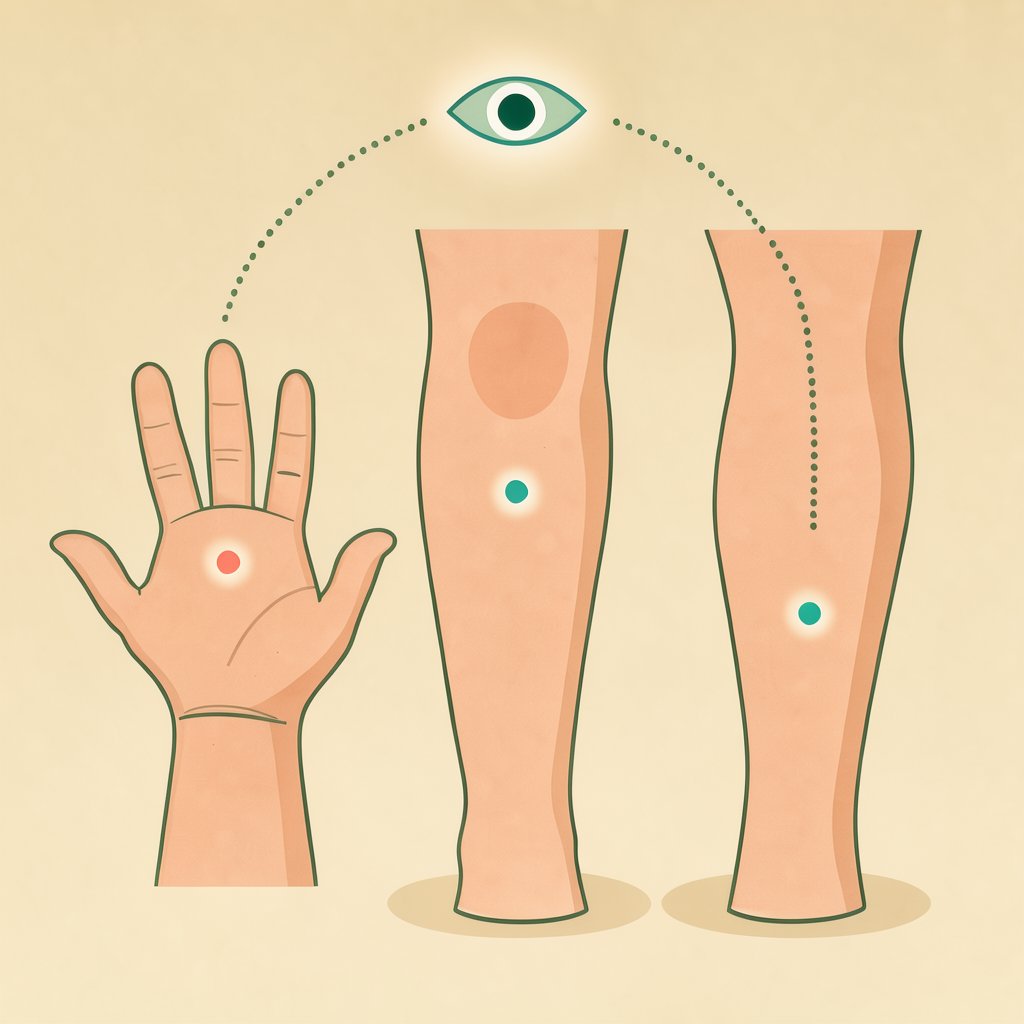
The same entry preserves further combinations from the classical anthologies. The Great Compendium pairs BL-1 with Tongziliao GB-1, Hegu L.I.-4 and Zulinqi GB-41 for internal eye obstruction, and with L.I.-4 plus Sibai ST-2 for superficial visual obstruction[4]. The One Hundred Symptoms adds Jingming BL-1 with Xingjian LIV-2 for Liver-qi night blindness[4]. And the Song of the Jade Dragon rules that for Liver blood deficiency with cloudy vision one should reinforce Ganshu BL-18 and reduce Zusanli ST-36 — a professional needle distinction, kept here as tradition rather than instruction[4].
The Medvedevs bring ST-36, below the knee, into self-massage reach, noting that Zusanli work also improves the state of the eyes, stomach and intestines — again as traditional use[10]. Their protocol rules are unusually specific. ST-36 responds best in the morning hours, ideally at sunrise, and pressing it before sleep may cause insomnia; healthy people work it every one to three days, with a break of one to two weeks after every three weeks, and long-term ST-36 work carries a caution about raised blood pressure[10].
Two smaller notes and one honest gap complete the distal map. Xiaxi GB-43 improves vision and hearing in the same guide, and the kidney channel carries eye indications through the water-element pairing with the liver, while Touwei ST-8 at the temple is indicated for conjunctivitis, lacrimation and reduced acuity in Luvsan’s reflexotherapy essays[10][5]. As for Guangming GB-37, the “Bright Light” of the Ode — the source base names it only inside that classical combination, so this article deliberately gives no location for it. What the sources do not say, we do not invent.
The 5-Minute Desk-Side Routine, Step by Step
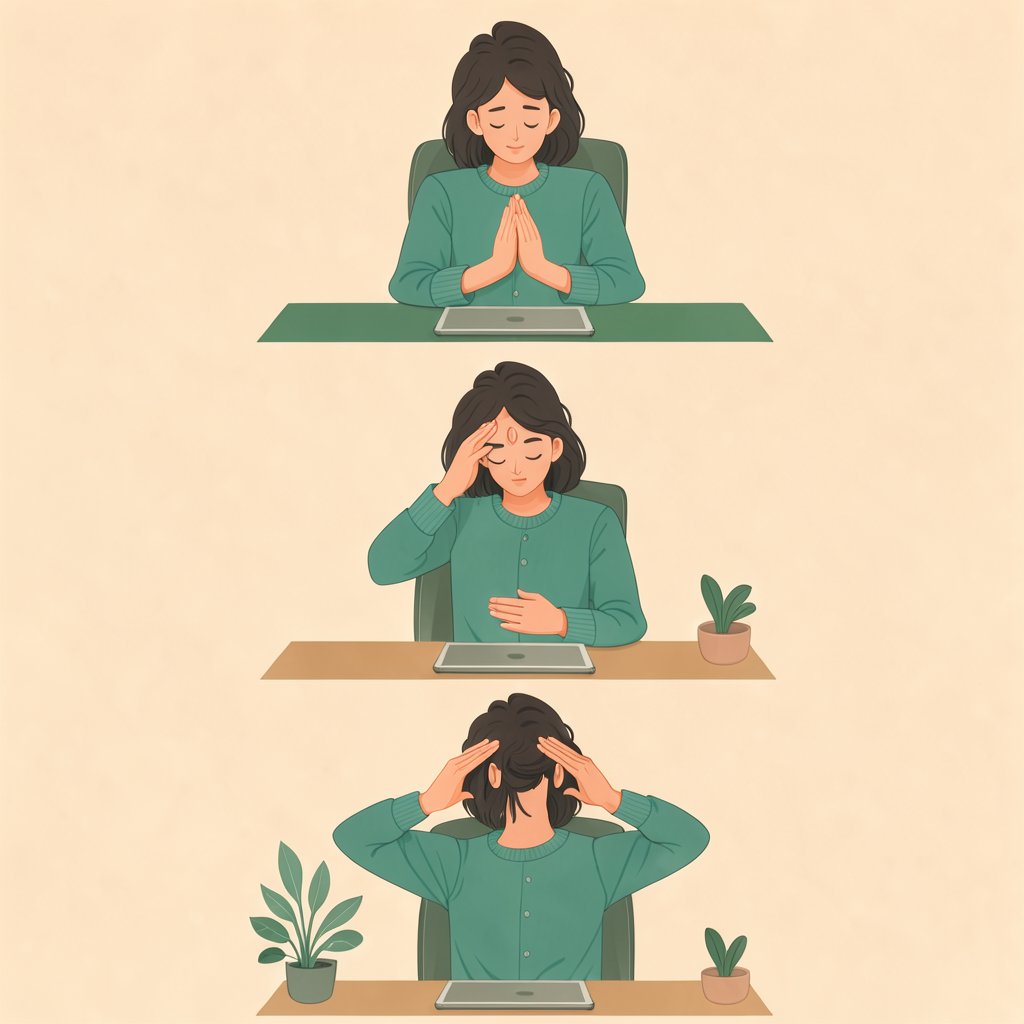
Everything before this section was map and logic; here is the five-minute walk over that map, between two meetings. An honesty note first: no book in the source set prints a ready-made routine for screen-age eye strain — the sequence below is an assembly, built strictly from the documented dosages of the cited manuals and presented as such. Every count, speed and duration in it is footnoted to its source.
Step 1: Prepare
Wash and warm the hands before any point work — a rule the clinical manuals repeat[13]. Sit upright or lean back relaxed, close your eyes, and remove distractions; the practical manual wants the body calm before the fingers arrive[1]. Let the shoulders drop before the first touch — this round opens with stillness rather than speed.
Step 2: Circle the orbit rim
With the eyes closed, run light acupressure of the eye socket — the orbit bone, never the eyeball — in the numbered sequence the source protocol calls for[1]. The protocol denotes that sequence with numbers rather than spelling it out in running text, so the concrete route here is this guide’s assembly choice: from the inner corner under the start of the brow, up and outward along the brow to its tip, down to the outer corner of the eye, and back along the lower rim to where the lap began. The technique is precise: touch lightly, make circular movements at about two rotations per second, and keep the finger on the point, moving the skin over the underlying tissue rather than gliding across it[1]. One slow lap around each eye takes well under a minute.
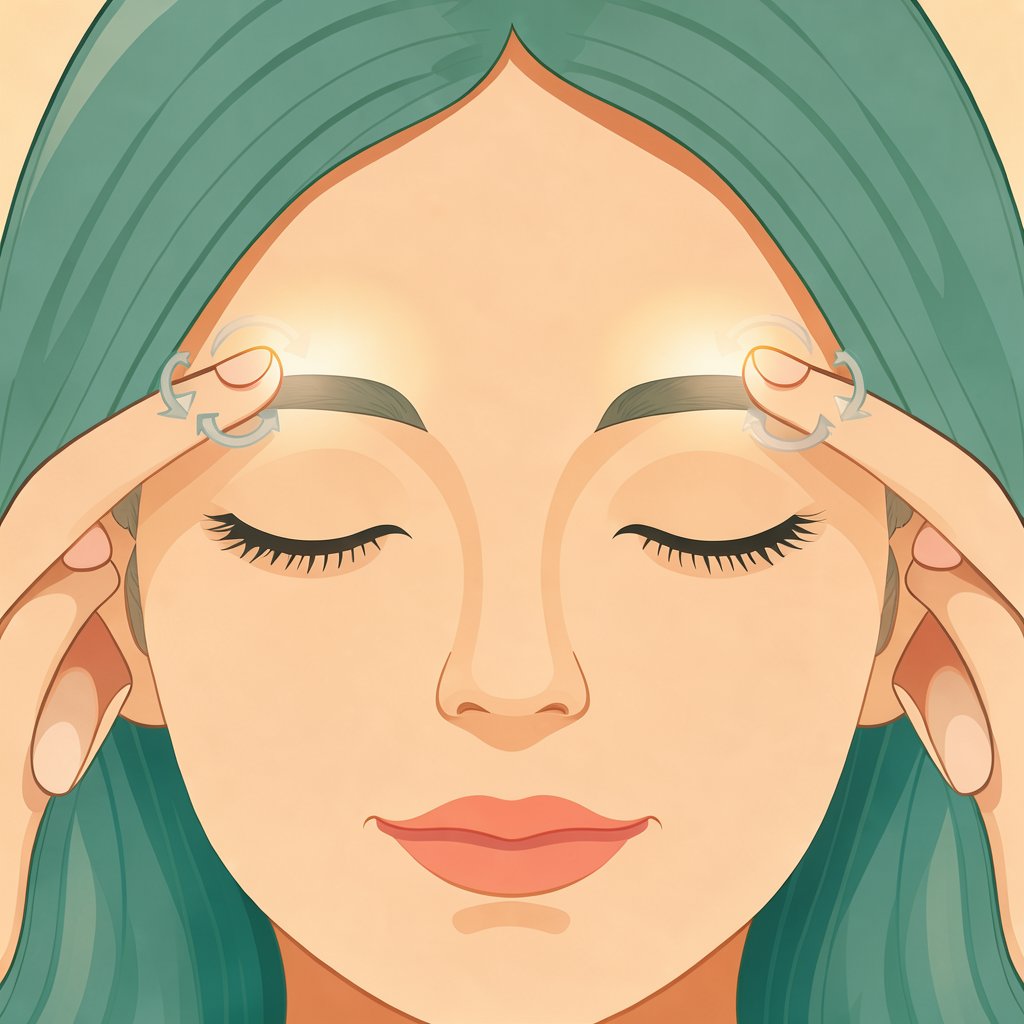
Step 3: Work Sibai ST-2 in eight sets of eight
Sit calmly with the eyes closed, index fingers of both hands on Sibai below each eye, thumbs bracing the chin for control[1]. Use moderate pressure — firmer than the orbit rim, still comfortable — and count sixty-four circular movements as eight sets of eight[1]. The count is the classical dosage for this point, and at the two-rotations-per-second tempo it takes roughly half a minute.
Step 4: Press and vibrate Yintang
Move to Yintang, between the eyebrows, and switch techniques: press and vibrate for ten seconds, release, and repeat[11]. Then make ten small circles in each direction over the same point[11]. The qigong manual that gives this dosage lists swollen, red eyes among the complaints it serves — as traditional use, matched here to the gentle end of the pressure range[11].
Step 5: Balance both sides at Tongziliao GB-1
Place an index finger at GB-1 beside each outer eye corner and work both sides simultaneously, eyes still closed[10]. Massage only — never moxibustion on the eye points — while you hold a mental image of the eyes relaxing[10]. Stop when that relaxation arrives around the eyes: in the Medvedevs’ protocol, the felt release is the marker of the correct dose[10].
Step 6: Release the temples and brow ends
Finish the face with the sequence of the Chinese self-massage tradition: Taiyang at each temple and Sizhukong SJ-23 at each brow tip, ten presses each, combined with small circular massage[12]. The tempo stays slow, because this is a calming round. If a point feels tender, lighten rather than push.
Step 7: Close at the occiput
Both hands reach behind the skull: ten presses at Fengchi GB-20, ten at Fengfu GV-16, and ten at Dazhui GV-14 at the neck’s base[12]. Optionally, pat the head lightly ten to one hundred times, and start with fewer points rather than more on your first rounds, expanding with experience[12]. Masunaga’s Bl 10 at the occiput is the shiatsu counterpart of this finish, used for occipital pressure and neck tension — this is where the overwork-to-neck loop gets interrupted[3][8].
Cap the whole round at half a minute to five minutes and repeat it as needed — the practical manual’s promise is that “action comes quickly and is felt for a long time”, and its permission is many rounds a day[1]. Two to three rounds a day is the steady cadence when the routine is paired with the eye gymnastics below[13]. The steps fix where and how long; how hard to press is its own discipline.
Pressure, Speed, and Dose: How Hard and How Often to Press
Same points, different hands: classical dosage numbers separate a refreshing round from a bruising one. The Medvedevs sort point pressure into three method families, each with its own numbers, and the choice between them is not cosmetic[10]. For tired eyes the family is fixed in advance — calming-dominant work, light to medium and slow.
- Tonifying stimulates: quick strong presses up to 50 per minute, light stroking at 50 to 100 per minute, and light patting at 100 to 200 per minute[10].
- Sedating (calming) deepens: longer exposure with pressure rising gradually “from pleasant to strong and deep”, reaching the subcutaneous tissue, muscle or periosteum, to a sensation of distension and warmth on the verge of pain[10].
- Harmonizing balances: medium force with a pleasant soft warmth[10].
The practical self-massage manual translates the families into schedules. For acute complaints or a first treatment, use light circular massage for one to five minutes; for chronic complaints, medium force in short rounds of up to about thirty seconds each, repeated several times a day[1]. Strong acupressure, where it is used at all, is done mainly with the thumb[1]. Tired-eye work lives almost entirely at the light end of that scale, because the orbital bone answers to fingertips, not force.
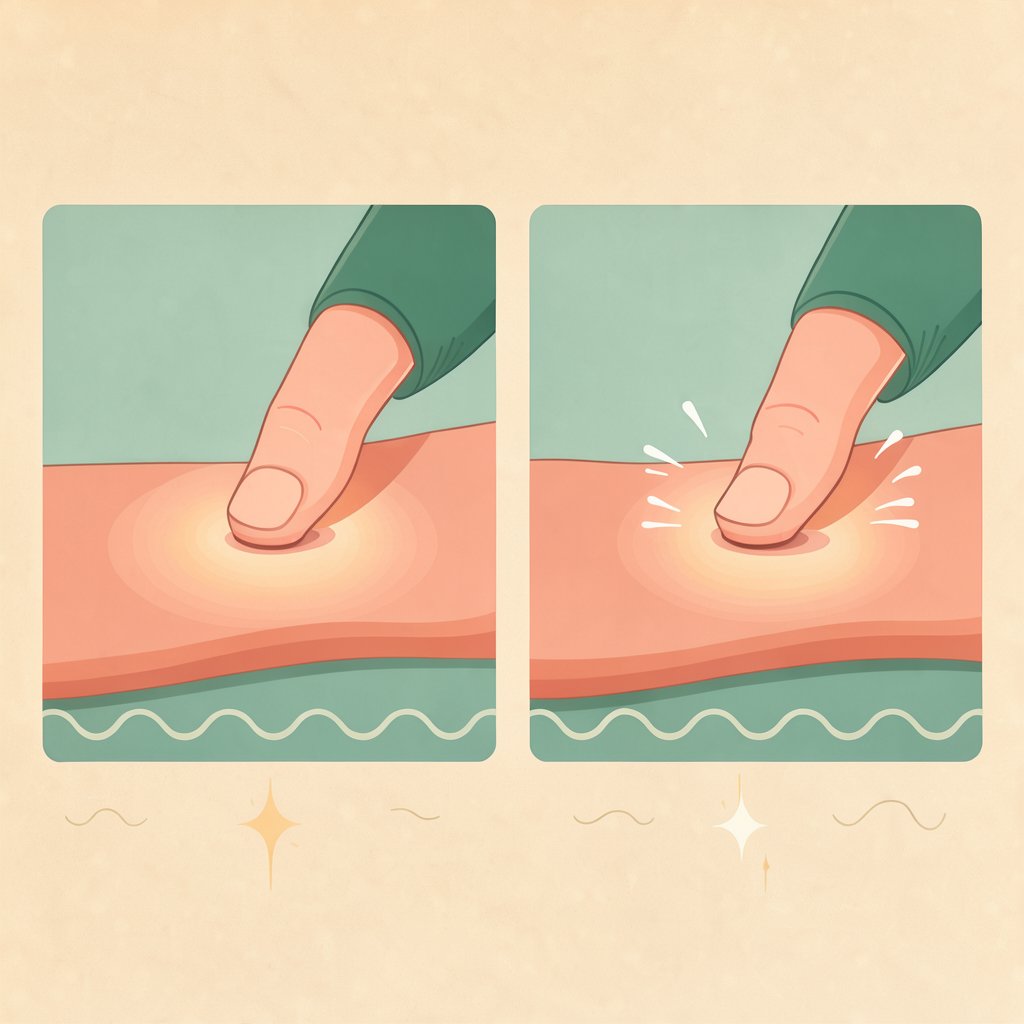
Three refinements tune the dose further. Massage along the direction of the meridian tonifies and massage against it calms — one reason the desk routine’s strokes run slow and deliberate[9]. Force must be individualized, because athletic bodies need stronger work and beginners should use simplified techniques until their hands learn the points[10]. And on the worst days, let comfort lead: a manual of point therapy observes that strong fatigue dulls the sensitivity of points, so a tired evening is not the moment for deep work[2]. The classical frequency frame for massage paired with gymnastics is two to three sessions per day[13].
Eye Gymnastics to Pair with Point Work
The classics did not only press around the eyes — they moved the eyes themselves, with exact repetition counts. Ermakova’s manual pairs point work with facial and eye gymnastics: frown and squint, close and open the eyes, and rotate the eyes following a moving finger[13]. Each exercise gets four to five repetitions, the eye exercises run in two to three sets, and the combined session lasts five to twelve minutes, performed two to three times per day[13].
For readers who go deeper, the same manual gives course rules: about two weeks of daily practice or ten to fifteen procedures per course, with at least a thirty-day gap between courses — daily for acute complaints, every other day for chronic ones[13]. The pairing of massage and eye gymnastics is also used clinically for facial nerve conditions, a fact worth knowing as context and never as a claim[13]. The practical order is simple: the point round first, the gymnastics after.
A modern cousin of the same move-the-gaze idea appears in Gary Craig’s Emotional Freedom Technique. Its 9-gamut procedure includes six eye-movement steps — closing and opening the eyes, looking down-right and down-left, and rolling the eyes in both directions — performed while tapping a point[14]. Different lineage, same instinct: the eyes themselves are part of eye care, not just the skin around them.
Safety and Contraindications for Eye Acupressure
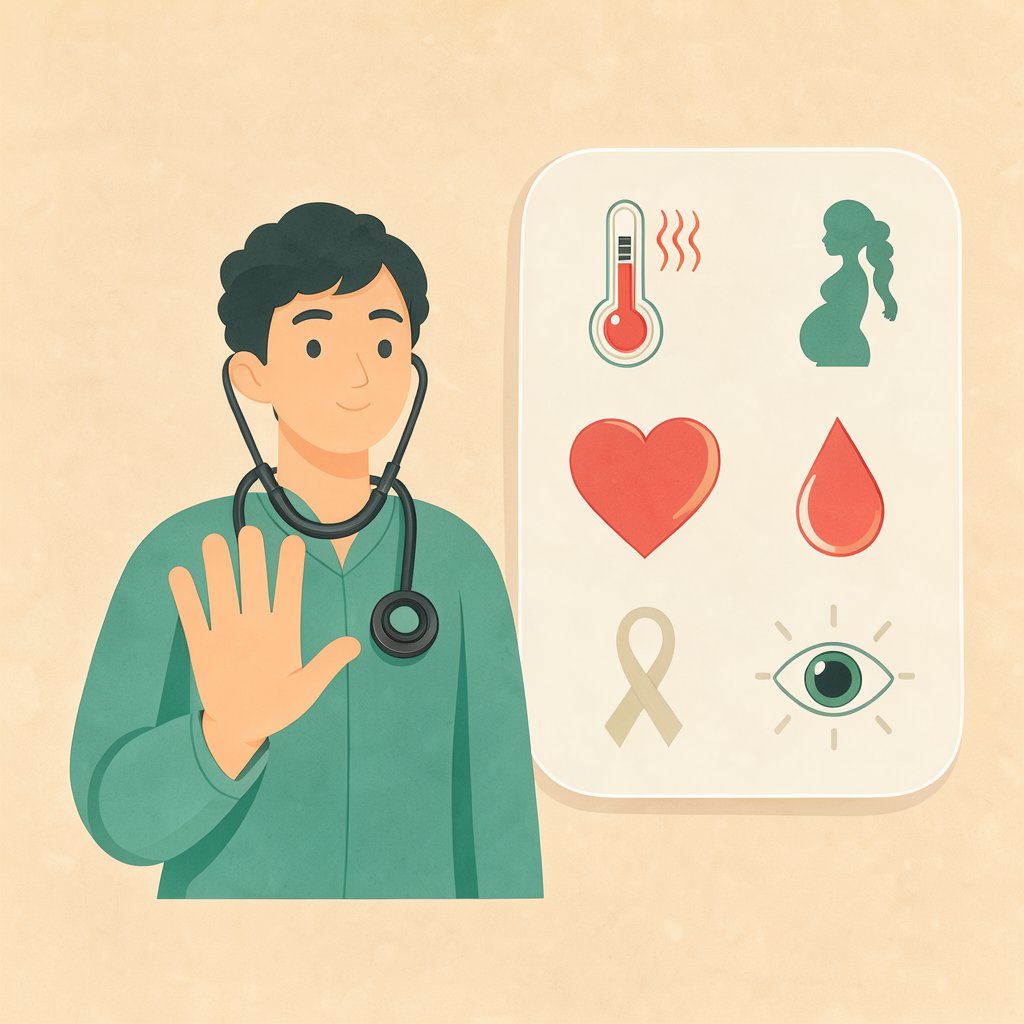
The routine is gentle, but gentle is not the same as unconditional — the sources open with who must not do it. The Medvedevs number nine groups for whom point massage is contraindicated outright, and the list deserves to be read in full before a first round[10]. The same book adds timing rules that are easy to forget at a desk.
- (1) benign or malignant tumors of any location;
- (2) inflammatory disease with high fever;
- (3) blood diseases;
- (4) active tuberculosis;
- (5) organic heart and kidney disease;
- (6) acute mental excitement;
- (7) pregnancy;
- (8) infectious diseases;
- (9) age under 2 and over 75.[10]
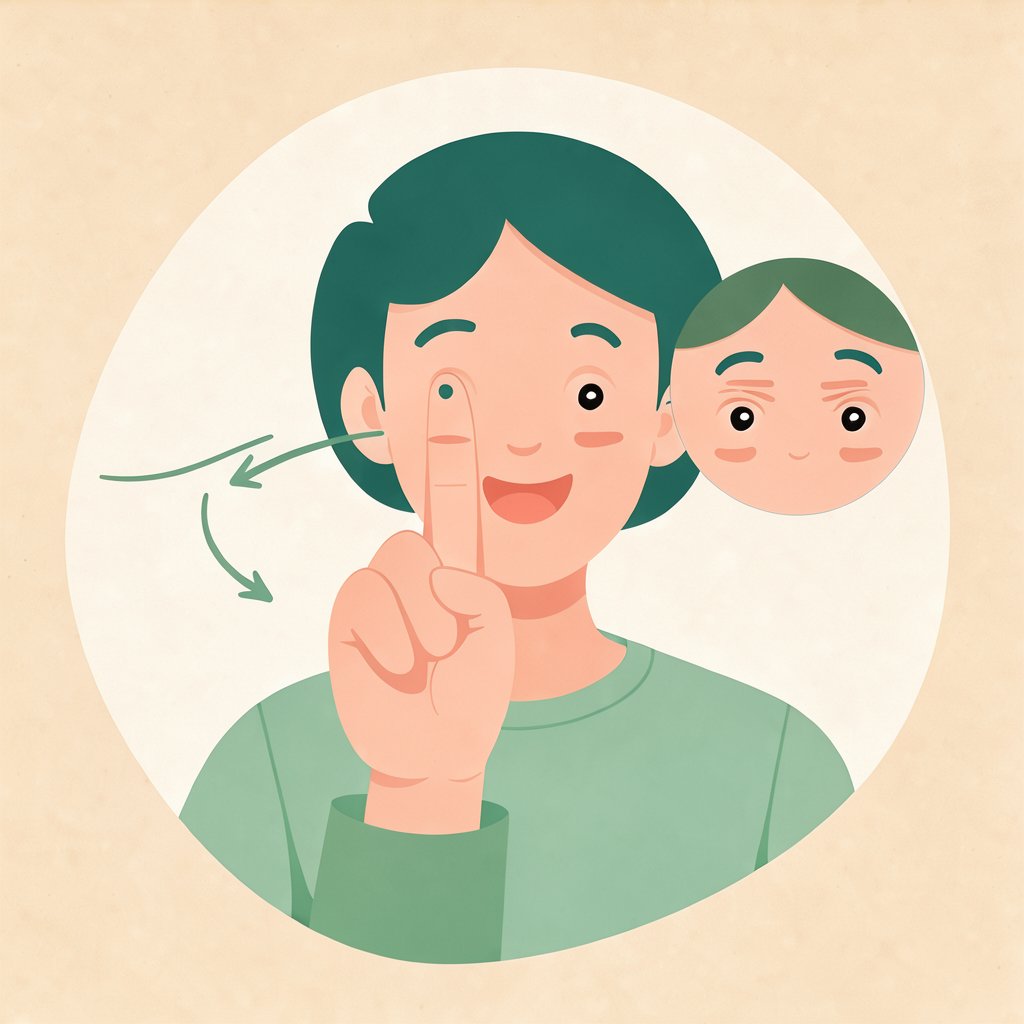
Never work points within an hour after a meal or on an empty stomach, not when intoxicated, and never over moles, warts, growths, pustules, wounds or burns — with individual contraindications checked with a physician first[10]. The practical manual adds severe organic heart or circulation disease, pregnancy and severe exhaustion, directs you to skip locally damaged skin until it recovers, and tells you to stop immediately if your condition changes mid-session[1]. Ermakova forbids point massage over the breasts, groin, armpits, large blood vessels and lymph nodes, and requires washed, warmed hands plus a physician consultation for any illness[13]. An eastern-massage compendium extends the list with bleeding tendency, varicose veins and thrombosis, unexplained severe pain, pulmonary or cardiac failure, and hypertensive or hypotensive crises — and asks that any acute or chronic condition be discussed with a doctor[15].
The eye-specific rules deserve their own paragraph. All the retrieved eye protocols work the eye socket with the eyes closed — “acupressure of the eye socket… eyes closed” is the recurring formula — and the eyeball itself is never the target[1]. The caution is anatomical: A Manual of Acupuncture notes that even needling BL-1 requires displacing the eyeball aside, and that moxibustion is contraindicated at BL-1[4]. Press the bone, gently, through closed lids — nothing harder, nothing on the globe.
Finally, the red flags. Glaucoma, optic nerve atrophy, retinal haemorrhage and the rest of the modern clinical list around BL-1 are physician-domain conditions: self-acupressure is not their therapy, and an eye doctor comes first[4]. Nothing in this guide is a treatment for eye disease — it documents a traditional-use practice, and no randomized trial numbers for it exist in the cited sources. Any diagnosed eye condition is a reason to see an eye doctor before your first round.
Frequently Asked Questions About Acupressure for Tired Eyes
How quickly does eye acupressure act?
The practical manual behind this routine gives a calm expectation: with point work, “action comes quickly and is felt for a long time”[1]. In practice that means rounds of half a minute to five minutes, repeated as needed through the day, with felt relaxation around the eyes as your only yardstick[1]. The claim is the tradition’s own, offered as traditional use. For the neighboring protocol, see our guide to acupressure for head and neck tension.
How often can you repeat the eye routine?
Classical dosage rules are generous: a session runs from thirty seconds to five minutes and can be repeated many times a day[1]. The steadier frame from the gymnastics manual is two to three rounds per day when point work is paired with the eye exercises[13]. Deeper courses run about two weeks daily with a break of at least thirty days between them[13]. More complete routines live in our manuals library.
Should you press on the eyeball itself?
No. Every eye protocol in the sources works the eye socket — the bone rim of the orbit — with the eyes closed, and none directs pressure at the globe[1]. The reference manual’s note that even needling BL-1 requires displacing the eyeball aside underlines how delicate the zone is[4]. Light fingertip circles on the bone are the whole of it. Browse the acupressure and meridians category for neighboring guides.
Which distal points pair with the eye points?
The classical rule comes from the Ode of Xi-hong: when Jingming BL-1 alone is ineffective, combine it with Hegu L.I.-4 on the hand and Guangming GB-37 on the leg[4]. Other combinations from the same entry add Zulinqi GB-41, Sibai ST-2 and the liver points of the back and leg[4]. Our dedicated Hegu L.I.-4 guide covers the hand point in depth.
Is eye acupressure safe with diagnosed glaucoma?
No. Glaucoma sits on the red-flag list together with optic nerve atrophy and retinal haemorrhage: conditions named around BL-1’s modern clinical indications that belong to an eye doctor, not to self-massage[4]. The general contraindication list — from tumors to pregnancy — applies on top of it[10]. Read our medical disclaimer before any first round.
How hard should the pressure be for tired eyes?
Calming-dominant: light to medium, slow, and gentle on purpose. For a first session or acute discomfort, the manual prescribes light circular massage for one to five minutes; chronic complaints move to medium force in short rounds of up to thirty seconds[1]. The dose marker is felt relaxation around the eyes, not discomfort[10]. The Zusanli ST-36 manual shows the same technique standard applied to a leg point.
Acupressure for tired eyes asks for very little: warm hands, closed lids, five unhurried minutes, and a map that physicians have refined for centuries[1]. The eight orbital points and their distal allies are all reachable from a desk chair, and every count in the routine — two rotations per second, eight sets of eight, ten-second vibrations — comes from a cited manual rather than from improvisation[1][11]. Start light, stop at relaxation, respect the contraindication list, and let an eye doctor own anything beyond ordinary fatigue[4][10]. The classical answer to the mid-afternoon ache in your eyes has been waiting at your fingertips all along.
Sources
- [1] Unknown Author — A Practical Guide to Point Self-Massage (Acupressure) (1992) — unattributed practical manual; the source of the eye-socket protocol, the two-rotations-per-second technique, the eight-by-eight Sibai count and the session caps used throughout the desk routine.
- [2] S. A. Miroshnichenko — Healing Points on the Human Body (2013)
- [3] Shizuto Masunaga — Zen Shiatsu Handbook (Handbuch Zen-Shiatsu) (2002)
- [4] Peter Deadman — A Manual of Acupuncture (2007) — the reference atlas behind every point location, the channel-pathway map to the eye, and the classical combinations quoted in this guide.
- [5] Gavaa Luvsan — Essays on the Methods of Eastern Reflexotherapy (1991)
- [6] Henry C. Lu — Chinese System of Healing Foods (2007)
- [7] Unknown Author — Reflexotherapy in Obstetrics and Gynecology (unattributed clinical manual)
- [8] L. Lyubimova — Healing Self-Massage for Cheer of Spirit and Joy of Body (2009)
- [9] V. I. Vasichkin — Healing Points: An Illustrated Atlas (2020)
- [10] Alexander N. Medvedev, Irina B. Medvedeva — 25 Magic Points for Mind and Health (2008) — source of the numbered contraindication list, the tonifying, sedating and harmonizing dosage families, the GB-1 vision protocol and the ST-36 rules.
- [11] Yang Jwing-Ming — Meridian Qigong Exercises: Combining Qigong, Yoga, Acupressure (2016)
- [12] Unknown Author — Chinese Self-Massage (unattributed classical manual)
- [13] S. O. Ermakova — Head and Auricle Massage: The Path to Health and Longevity (2010) — source of the eye-gymnastics counts, the course rules, and the hand-washing and forbidden-zones safety instructions.
- [14] Gary Craig — The Emotional Freedom Technique (2011)
- [15] Lao Min — Techniques and Methods of Eastern Massage (2022)
Where to go next: the manuals library builds out complete practice routines step by step. The sibling acupressure for head and neck tension guide covers the neighboring protocol that shares this routine’s occiput finish. If chronic neck and shoulder tightness rides along with your eye fatigue, the Joint Genesis review and the Unlock Your Hip Flexors review take an honest, criteria-based look at two popular movement programs.
How we researched this: this article was built from a local library of 1,137 wellness books, indexed and searched offline with no internet sources. Retrieval focused on the acupressure, reflexology and meridian-care collection of that library. Every statement above was checked against the cited book passages before publication.
