
Educational content only — not medical advice. See our full Medical Disclaimer and Affiliate Disclosure below.
Key Takeaways
- ST36 (Zusanli) sits below the knee on the stomach meridian — one of the most-used points in classical practice.
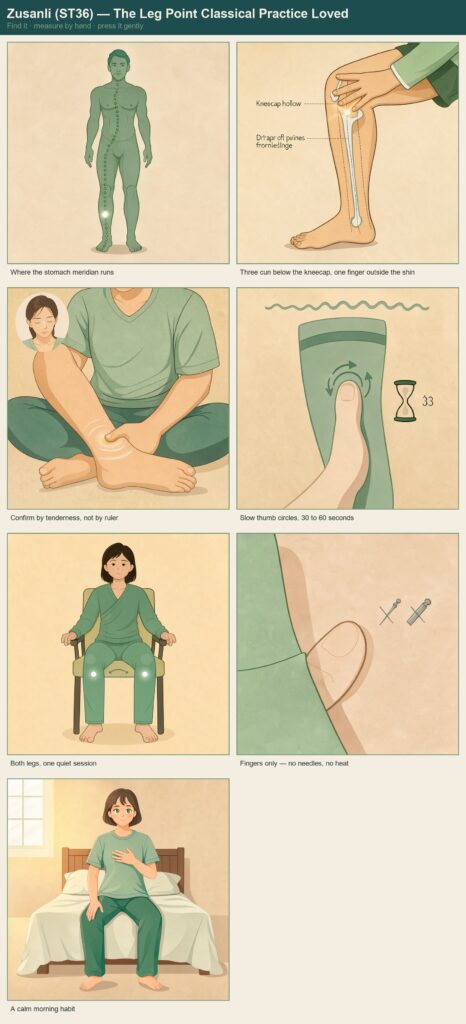
- Classical atlases fix it three cun below the kneecap hollow, one finger-breadth outside the crest of the shin bone.
- Classical guides locate points partly by tenderness on pressure, not by ruler alone.
- Self-acupressure is gentle manual pressure — never needles or heat at home.
Zusanli (ST36) is one of the best-known points of the stomach meridian in traditional Chinese medicine, and classical manuals give it a reputation as a point of unusually broad use. This guide explains where the meridian runs, how to find the point on your own leg, and how to work it with simple manual pressure — with the safety rules classical texts insist on. We translate the traditional map into plain anatomical language so you can follow along without special training. See more in our acupressure guides.
Everything below is educational: we describe how classical books locate and press the point, not what outcomes to expect from it. If you already keep a daily wellness routine, this practice pairs naturally with our slow breathing reset or a morning movement set such as Ba Duan Jin. Keep the pressure comfortable, and stay inside the safety rules near the end of the article.
The Stomach Meridian: Traditional View vs Modern Physiology
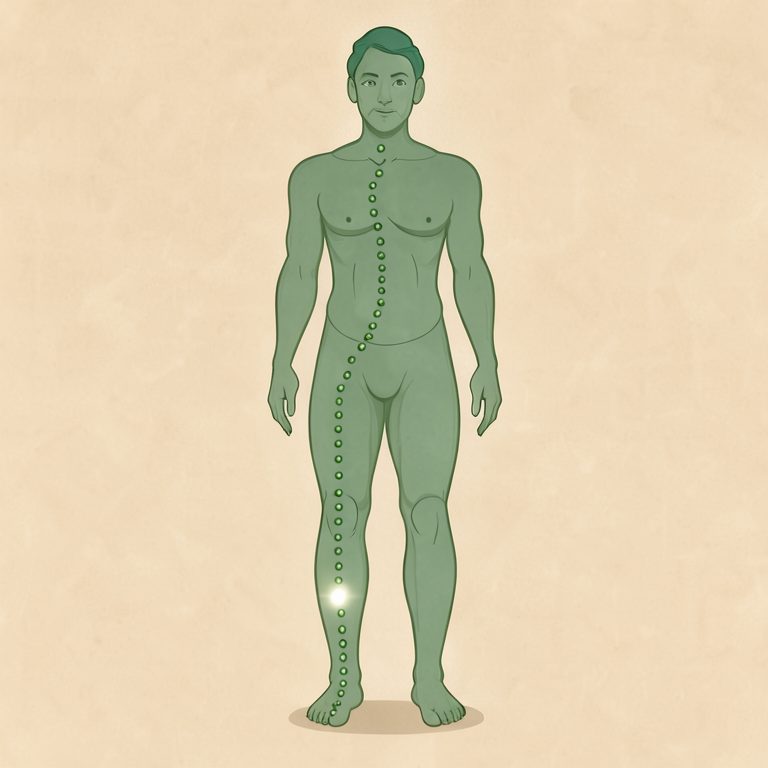
Classical texts describe the stomach meridian as a long pathway: from the infraclavicular region it descends along the mid-clavicular line, crosses the knee, runs down the front-outside of the lower leg, and ends at the second toe[1]. Points along it are grouped by classical function — calming, stimulating, harmonizing, signal, and special points[2]. The thirty-sixth point on this pathway, Zusanli, sits on the lower leg close to the surface, right beside a clear bony landmark — which is exactly why home guides favor it.
In the classical arts, finger pressure on such spots is called dian xue — literally “pointing at cavities” — and modern English books render it simply as acupressure[3]. Master teachers of this craft were expected to know roughly one hundred and eight of the more than seven hundred cavities described on the body[3]. Modern readers can think of each point as an anatomically defined site where steady manual pressure affects local tissue tone and comfort — the traditional map and the modern anatomy describe the same landmarks. For self-practice, leg points are especially convenient: they are easy to reach, and the sharp front edge of the shin gives your fingers an unmistakable reference[4].
Where Exactly Is Zusanli ST36 Located?
Classical texts measure in cun — finger-width units relative to your own body — and ST36 is described below the knee, on the outer front edge of the lower leg. Modern English atlases fix the coordinates more precisely: Zusanli ST-36 lies three cun below Dubi ST-35 — the small hollow right under the kneecap, lateral to the patellar ligament — and one finger-breadth lateral to the crest of the tibia, the sharp front edge of the shin bone[5]. The Russian school of reflexotherapy measures the same spot from a different landmark: three cun below the upper edge of the lateral condyle of the tibia, at the anterior edge of the tibialis anterior muscle[1]. Both descriptions put your thumb on the same patch of leg.
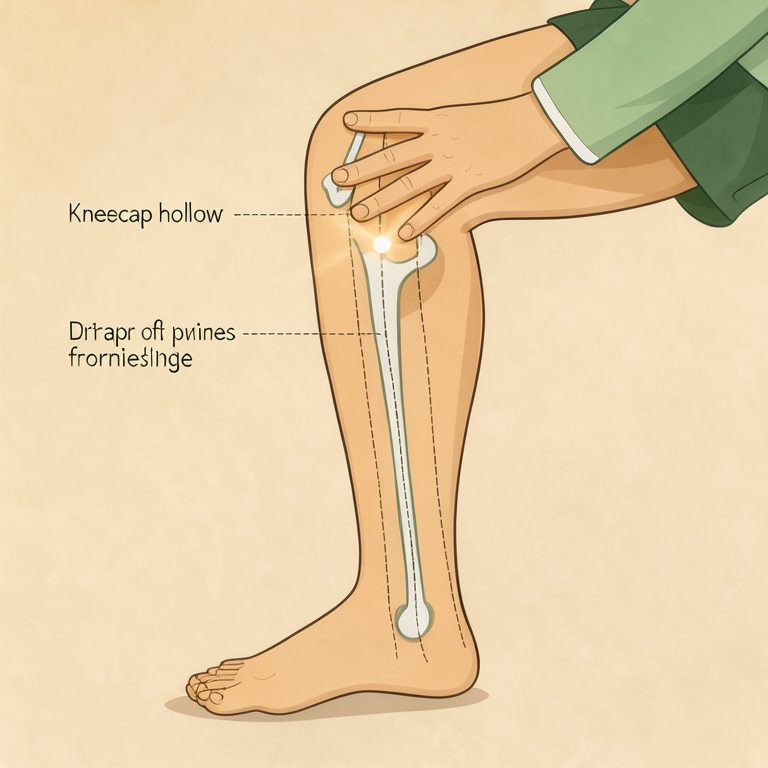
The cun is deliberately personal. Locating manuals teach proportional measurement along the channels and recommend two simple techniques for the leg: find the point at the border of a bone, or measure it with finger-breadths of your own hand[4]. Four fingers laid sideways across the leg just below the kneecap give a workable three-cun estimate for most adults, and the tenderness test in the next section corrects any individual difference. That is the quiet genius of the classical system — it was designed for hands, not rulers.
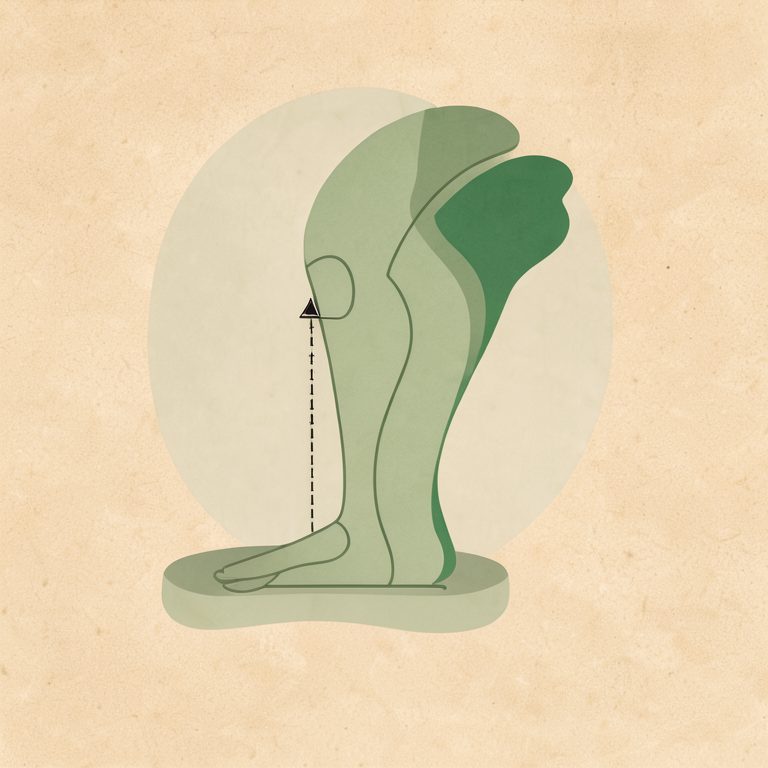
The table below condenses everything you need to locate and press the point before we walk through the full protocol. Each row is expanded with sources in the sections that follow. Skim it now, then return to it after your first practice session.
| Aspect | Practical summary |
|---|---|
| Point | Zusanli, ST36 — the 36th point of the stomach meridian |
| Location | 3 cun below the kneecap hollow, one finger-breadth lateral to the shin crest |
| Confirmation | Local soreness under firm thumb pressure |
| Technique | Slow circular thumb pressure, skin pressed not sliding |
| Duration | 30–60 seconds per point |
| Frequency | Once or twice daily; mornings fit best |
| Symmetry | Both legs within one session |
| Home rule | Fingers only — no needles, no moxibustion heat |
How to Find and Press ST36: A Step-by-Step Protocol
This protocol keeps the classical sequence — settle, measure, confirm, press — and expands it with details from the massage manuals cited below. Read it once from end to end before you try it on your own leg. The whole routine takes about two minutes per leg.
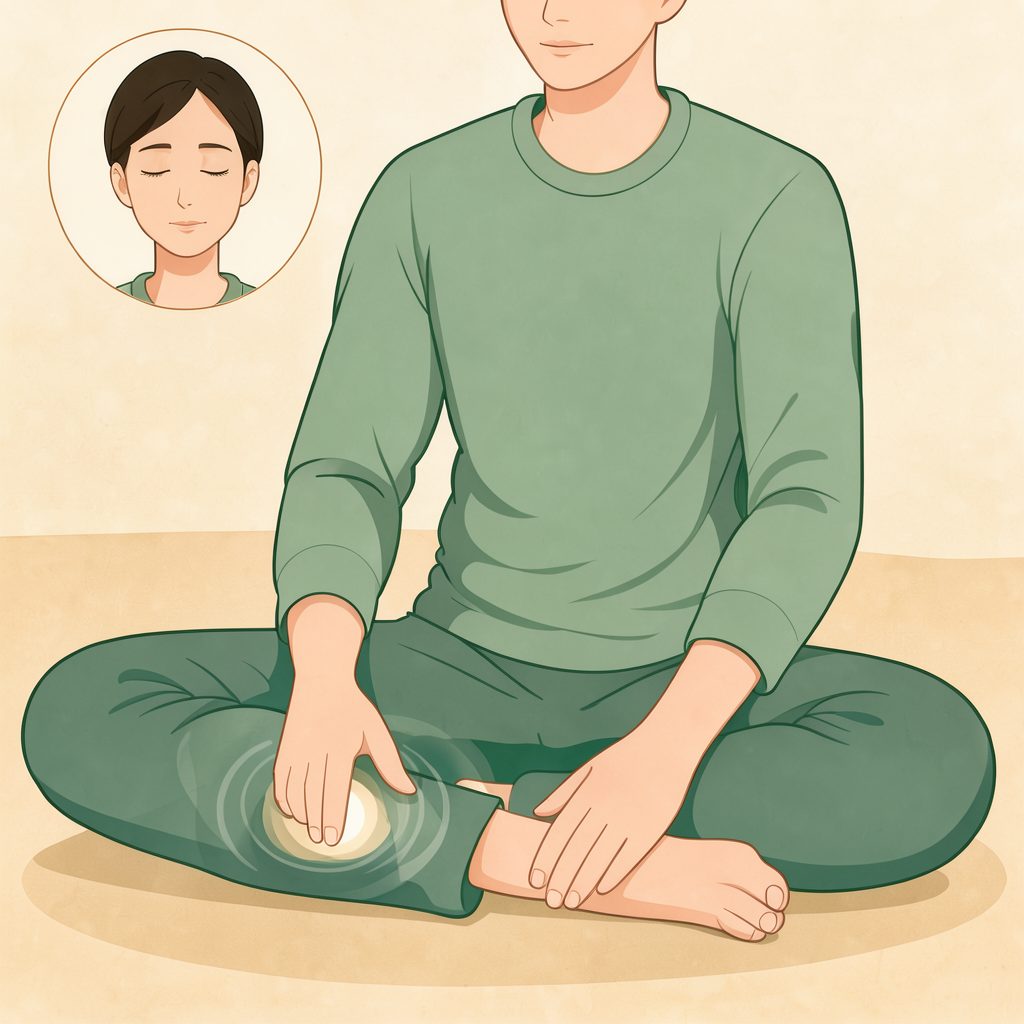
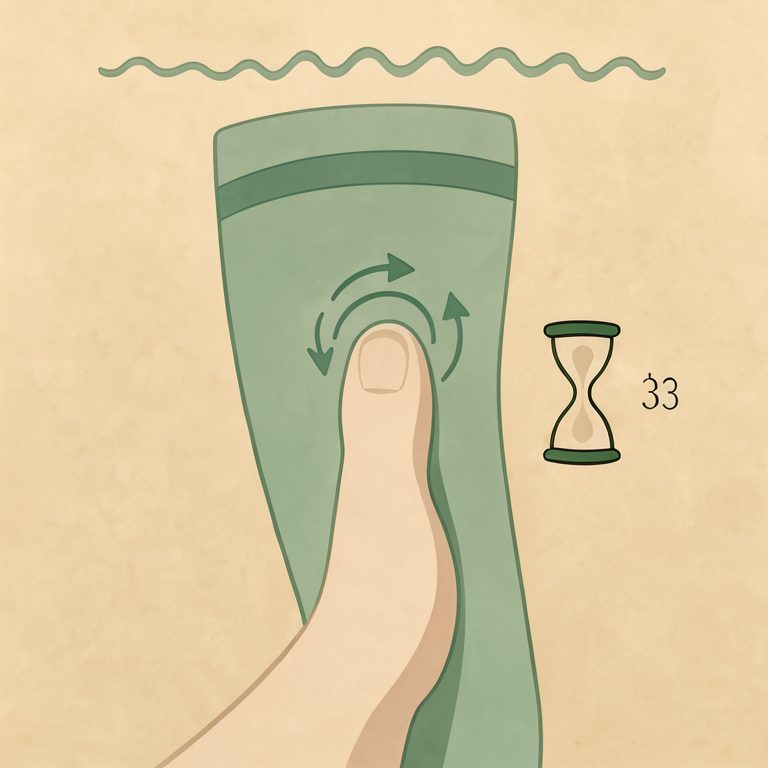
Two common beginner mistakes are worth naming. The first is pressing too hard in pursuit of a strong sensation — manuals are unanimous that the intensity should stay comfortable[2]. The second is hunting the point with a ruler mindset: the tenderness response is the classical locating instrument, and it works better than any measurement[7]. And if your schedule feels crowded, qigong teachers suggest alternating movement days and massage days rather than abandoning either practice[3].
Why Classical Practice Values This Point
In Luvsan’s reference book, ST36 carries the annotation “a point of broad-spectrum action” with a general tonifying direction[1]. Medvedev’s popular guide files Zu-san-li among points that raise the overall tone of the body[8]. We quote these as historical descriptions of the tradition, not as promises about what the point will do for you.
Classical sources also show how the point was used in combination rather than alone. Point-selection rules pair zusanli with hand points such as hegu, and work it symmetrically on both legs when the stomach channel is the focus[7]. Yang Jwing-Ming frames cavity press as a way to regulate the circulation of qi in the twelve primary channels — and describes self-massage as the first step by which a student learns the craft on their own body[3].
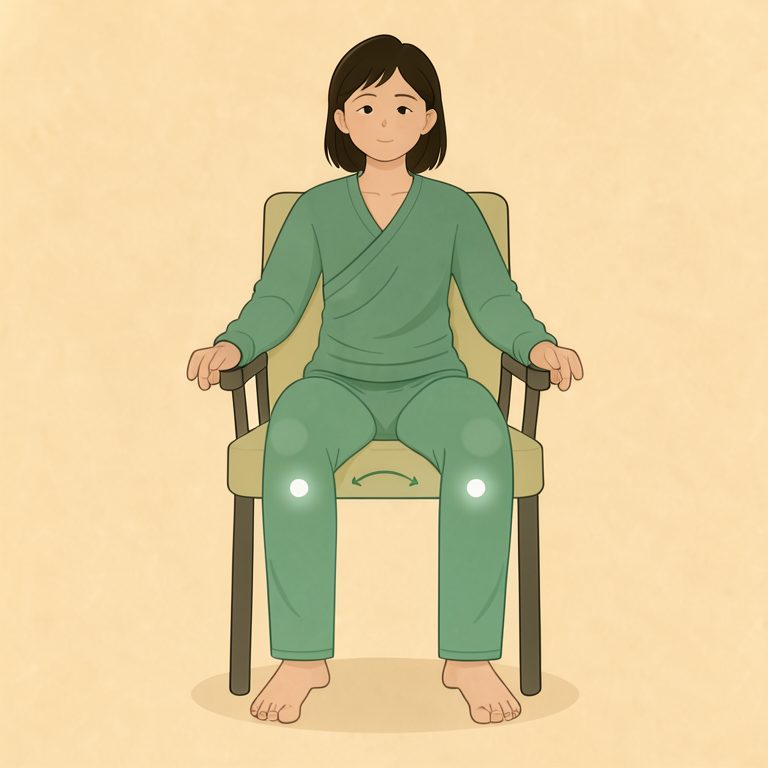
What can a modern reader reasonably take from all this? A short window of quiet attention, local warmth in the pressed tissue, and a moment of structured rest in a busy day — that is the honest size of the claim. If you want a fuller daily container, pair the point with our Ba Duan Jin practice guide and the slow breathing reset.
Safety and Contraindications
Self-acupressure means fingers only. Classical technique chapters mark many points as unsuitable for needling or heat (moxibustion) in specific situations — those cautions are exactly why home practice stays with gentle manual pressure[1]. Avoid pressing on swollen, injured, or inflamed skin; during pregnancy, consult your physician before working on leg points. This is educational content, not medical advice (medical disclaimer).
One caution is specific to this point. Medvedev’s guide warns that long, regularly repeated work on Zu-san-li can raise blood pressure in some people, and that readers with already elevated pressure should be careful with this point[8]. If that describes you, show this article to your physician before making the point a daily habit.
General self-massage contraindications from the Soviet school apply here as well: feverish states, acute inflammation, a tendency to bleeding, skin disease or damaged skin, inflamed or varicose veins, and cardiovascular conditions without a physician’s sign-off[9]. The same tradition sets two hard quality rules: pressure should never cause sharp pain, and a session should never leave bruises on the skin[6]. If either happens, stop, and use less intensity next time.
Frequently Asked Questions
What does it mean if Zusanli ST36 feels tender?
Local soreness under firm thumb pressure is the classical confirmation that you have found the spot — the illustrated atlas describes heightened local tenderness as the practitioner’s tool for confirming the exact point[7]. The right intensity is a dull, comfortable ache you could hold for a full minute. Sharp, stabbing, or electric sensations are not part of the technique: manuals insist pressure must never cause sharp pain, so release and reposition[6].
How long and how often should I press it?
For home practice a comfortable range is 30–60 seconds per point, once or twice a day — the illustrated atlas allows home presses from thirty seconds up to a few minutes, up to twice daily[7]. For clinical work, practical manuals describe a wider range: from half a minute to five minutes, repeated several times a day[2]. Durations are meant to be adjusted, because sensitivity differs from person to person[3].
Should I press the point on both legs?
Classical selection rules often work paired points together, and zusanli is described as pressed symmetrically on both limbs in stomach-channel practice[7]. A simple approach is one minute per leg, alternating sides. If you are short of time, alternate legs across days rather than skipping sessions altogether.
Can I use this point during pregnancy?
The rule from the safety section applies: consult your physician before working on leg points during pregnancy[1]. Classical sources mark many points as unsuitable in specific situations, and sorting out which cautions apply to you takes professional judgment. Until you have that answer, keep to gentle, brief practice elsewhere or skip the point.
Is pressing ST36 the same as acupuncture?
No — acupuncture inserts needles, and Luvsan’s professional reference lists a needle depth and moxibustion time for this point that only a trained practitioner should apply[1]. Home acupressure is dian xue — finger pressure on the same mapped spots, without instruments[3]. Needles and heated moxa stay out of self-practice, full stop.
How We Researched This
This guide draws on our local research library of 1,137 digitized books on traditional and modern wellness practices, with no internet sources used at any stage. Every factual statement above is footnoted to a specific book from that collection, listed in the Sources section below.
Sources
- [1] Luvsan G. — Essays on Methods of Eastern Reflexotherapy (1991)
- [2] Editorial board — Practical Guide to Acupressure Self-Massage
- [3] Yang Jwing-Ming — Meridian Qigong Exercises: Combining Qigong, Yoga, Acupressure (2016)
- [4] Yang Jiasan — The Way to Locate Acupoints (1988)
- [5] Deadman P. — A Manual of Acupuncture (2007)
- [6] Biryukov A.A. — Self-Massage: A Source of Vigor, Strength, and Health (1972)
- [7] Vasichkin V. — Healing Points: An Illustrated Atlas (2020)
- [8] Medvedev A., Medvedeva I. — 25 Magic Points (2008)
- [9] Biryukov A.A. — Self-Massage for All and Everyone (1987)
