Educational content only — not medical advice. See our full Medical Disclaimer and Affiliate Disclosure below.
Copper tongue scraping is the two-minute act the Ayurvedic morning routine places in front of the toothbrush: a curved metal cleaner draws the overnight coating off the tongue in a few gentle passes, first thing, before anything else touches the mouth. The practice belongs to dinacharya — the classical daily routine — and the source books treat it not as a therapy but as hygiene with a tradition behind it: Practical Ayurveda, Morningstar’s Ayurveda and Polarity Therapy, Vostokov’s Secrets of Eastern Healers and Swami Satyananda’s kriya compendium all describe it, each with its own exact rules. Every one of the four books places the act in the same slot: first thing in the morning, before the toothbrush, while the night’s coating is still on the tongue.
This manual reconciles those books into one six-step morning protocol — when, where, which direction, how many passes, how long, and how to finish — and keeps their disagreements visible instead of averaging them away. It also keeps an honest box of gaps: the two-week rule you may have read about, copper-scraper care, and copper’s antimicrobial reputation have no support in the classical sources we hold, and we say so where they come up rather than inventing protocol.
What this guide covers:
- What is copper tongue scraping?
- How the nightly coating works
- Where scraping belongs in the dinacharya morning
- Why copper and metal
- Step 1: Scrape first, before brushing
- Step 2: Stand at the mirror, check the coating
- Step 3: Root to tip, never reverse
- Step 4: Count the passes
- Step 5: Rinse, and stay under two minutes
- Step 6: Lemon or oil, then the palate
- How often, and the two-week question
- Safety: the gag reflex and the toothbrush
- FAQ: scraper care and practical questions
What Is Copper Tongue Scraping?
Tongue scraping is the morning practice of wiping the coating that accumulates overnight off the tongue with a metal cleaner — silver, copper or steel, explicitly not plastic, per Practical Ayurveda (Dorling Kindersley, 2018), the modern manual that gives the practice its cleanest one-line definition. The cleaner is drawn along the tongue in a few gentle strokes; the coating comes away on the edge; the mouth starts the day clear. That is the whole practice, and everything else in this manual is detail the source books argue about.

The tradition has a taxonomy for it. Artyom Frolov’s Herbs for Yogis (2013) lists jihva-dhauti — tongue cleaning — among the standard dhauti cleansing practices of the shatkarma group, the yogic hygiene family that also counts nasal and stomach cleansing. Swami Satyananda Saraswati’s three-volume Ancient Tantric Techniques of Yoga and Kriyas teaches a variant named Jihva Mula Dhauti — jihva is tongue, mula is root — in which the finger works toward the tongue root and the whole cleaning takes just a few minutes. Morningstar’s Ayurveda and Polarity Therapy (2007) files it as a standard morning oral-hygiene act, done before brushing, with a metal teaspoon or a purpose-made horseshoe-shaped scraper.
Put the three shelves together and the promise of this manual follows: one reconciled six-step protocol, every number attributed to the book that printed it, plus an honest safety box at the end. Before the steps, two questions deserve their own sections — what that overnight coating actually is, and where in the morning the books put the scraper.
How the Nightly Coating Works: Ama, Toxins, and Bacteria
The books give the coating a name and a mechanism. Swami Satyananda’s account is the bluntest: the yellow film on the tongue consists of contaminants eliminated from the body — a sign of internal disorder or toxin accumulation — and left in place it aggravates digestive disorders and becomes a breeding ground for bacteria that can infect the food you eat. That is why the tradition removes it daily rather than occasionally: in this frame, the coating is yesterday’s waste, parked on the tongue overnight.
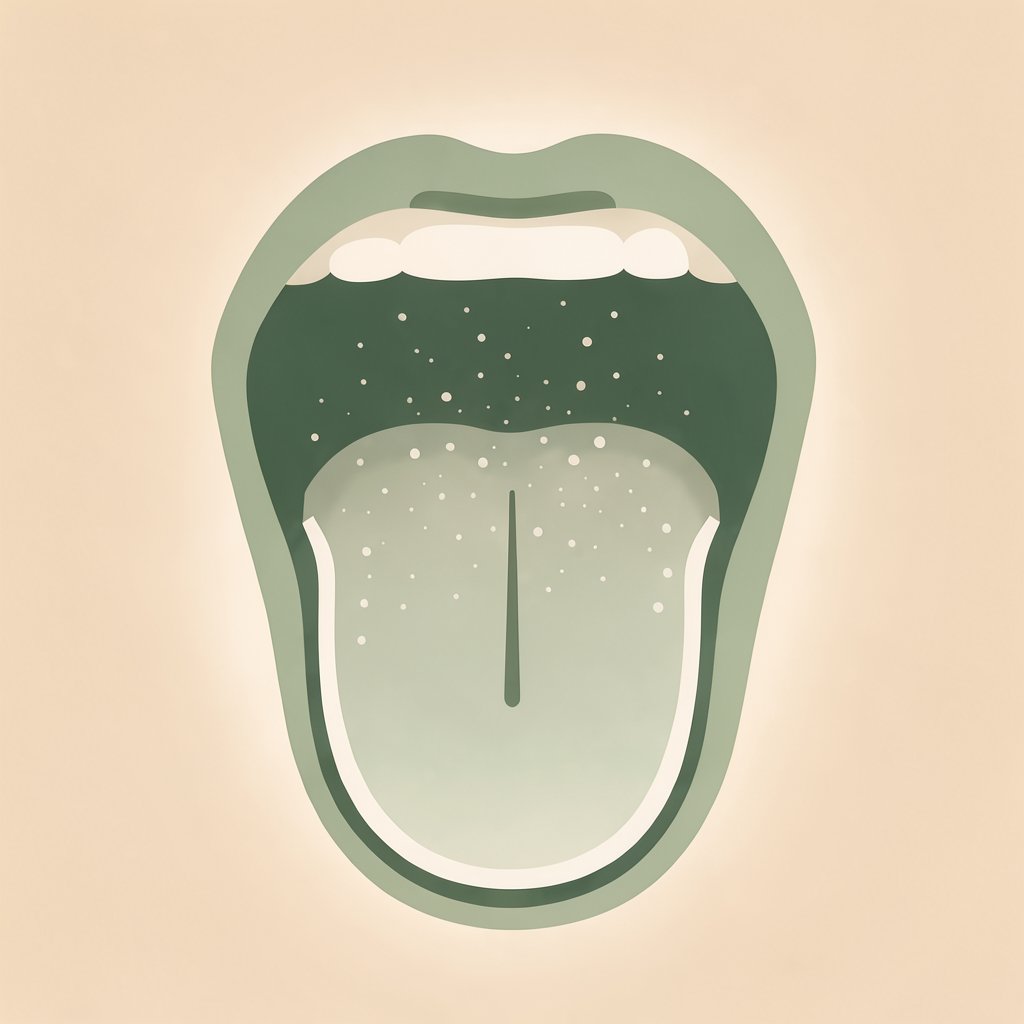
The Ayurvedic diagnostic layer reads the same film as information. Vasant Lad’s Ayurveda for Beginners teaches that a white coating indicates ama — and locates it: which tongue zone is coated tells whether the ama sits in the colon, the small intestine or the stomach. Deepak Chopra’s Perfect Health and Restful Sleep define ama as a sticky white residue of undigested food that clogs the body’s channels, caused by fatty, stale or heavy food. In other words: the morning tongue is, in this tradition, a daily readout of digestion, and scraping it clean resets the display.
Two further claims complete the mechanism map, each with its source named. Morningstar describes tongue cleaning as a reflex stimulus for cleansing the entire digestive tract — the reason the practice belongs to the morning routine and not to the evening one — and notes it freshens the breath. V. F. Vostokov’s Secrets of Eastern Healers agrees from the other end: bad breath arises from sediment collecting at the tongue root, a half-destroyed epithelial film spreading toward the tip, and the tongue is the most objective external indicator of the gastrointestinal tract. Practical Ayurveda adds the local payoff: scraping the nightly coating strengthens the gums and reduces bacteria in the mouth. One practical fact anchors all of it — per Morningstar, the coating is thickest at the root, which is exactly where the scraper’s work will begin.
Where Tongue Scraping Belongs in the Dinacharya Morning
The classical day has a schedule, and the scraper has a slot in it. Vagbhata’s Ashtanga Hridaya Samhita, Chapter 2 (Dinacharya Adhyaya, the daily-regimen chapter), sets the frame: a healthy person rises at Brahma muhurta — roughly 3 to 6 in the morning, depending on sunrise — and after bowel movement, urination and bathing comes oral care: the teeth cleaned with a chewed twig of bitter wood (the text names Terminalia arjuna, Calotropis procera, Acacia catechu, Pongamia glabra and Ficus, a twig pinky-thick and 23.5 cm long), followed by nasal drops, gargle, inhalation and betel.
An honesty line belongs right here, because internet versions of this chapter grow verses it does not contain: the retrieved passage of Vagbhata’s chapter carries no tongue-scraping verse at all. Vagbhata frames the morning slot — oral care sits early, after elimination and bathing — but the scraper instruction itself comes from the modern books. He is quoted here for the frame, never for a scraping verse.
The modern sources fix the position precisely. Morningstar’s instruction is the anchor: clean the tongue in the morning, before brushing the teeth. Yu. M. Ivanov’s Yoga and Health (1991) sets the cadence — every morning, cleaning the tongue of its food-particle and toxin coating. Mikhail Baranov’s Yogic Nutrition in the Central Belt (2014) compresses the classical clock for modern life: wake at 05:30-06:00, then 06:00-08:00-09:00 for hygiene, oil self-massage and yoga practice. Even the Tibetan tradition agrees on the slot: Terry Clifford’s Medicine and Psychiatry of Tibetan Buddhism records tooth cleaning and massage among the preventive hygiene of the classical Tibetan period. Morning, early, before the brush — that is the position. The next question is the instrument.
Why Copper and Metal: The Tool the Books Approve
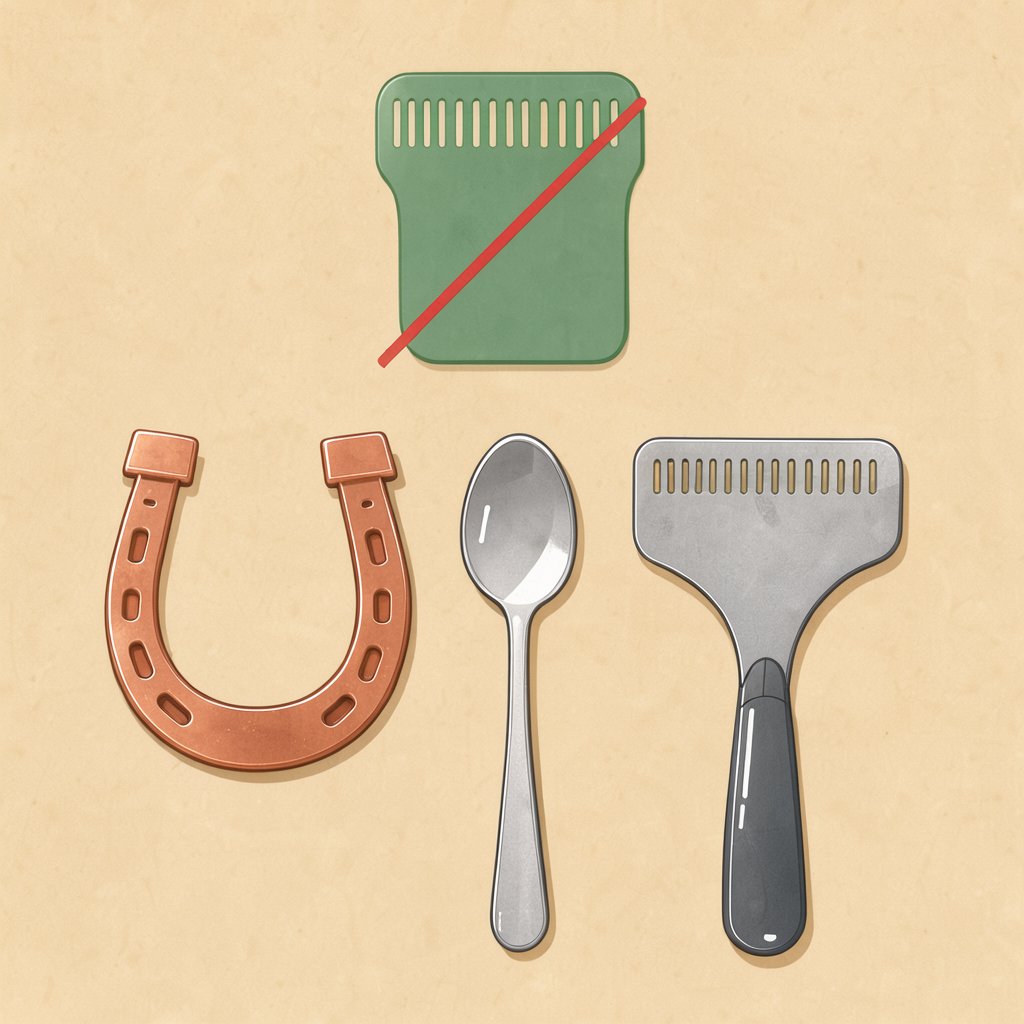
On the material, the books are nearly unanimous. Practical Ayurveda names the approved list — a silver, copper or steel tongue cleaner — and the one exclusion: not plastic. Morningstar adds reach: a metal teaspoon works, or a purpose-made horseshoe-shaped scraper, with a US street price of $3-20 for the same item; the book’s translator’s footnote is stricter still — silver, gilded, nickel-silver (melchior) or good steel, not aluminum. Not every author reaches for metal the same way: Vostokov’s own pick is a wooden spoon, and his hard ban is reserved for the toothbrush, which he says injures the tongue. Ivanov lists the right index finger or a silver teaspoon. The common floor under all of them: a firm, smooth, dedicated edge — never bristles, never plastic.
Why copper specifically? The Ayurvedic rationale comes from Vasant Lad’s The Complete Book of Ayurvedic Home Remedies (2012): copper alleviates excess kapha and reduces fat, is a good tonic for the liver, spleen and lymphatic system, and helps in curing anemia. Lad’s book also carries copper-water protocols — water boiled in a copper vessel to half volume, taken two teaspoons three times a day for a month, or water stood overnight in a copper glass and drunk in the morning — but note carefully: those are internal metal therapy, background for why Ayurveda favors the metal, not scraper care in any sense.
And one more honesty line, because copper marketing is loud: no copper-specific antimicrobial studies, no volatile-sulfur-compound breath trials, no clinical tongue-coating research exist anywhere in our source base. The case for copper here is traditional (Lad’s kapha logic) plus practical (the metal-not-plastic rule of Practical Ayurveda and Morningstar’s footnote). A copper scraper is the classic choice; silver and steel carry the same classical license.
Step 1: Scrape First Thing in the Morning, Before Brushing
The first rule is a clock rule, and Morningstar states it flatly: the tongue is cleaned in the morning, before brushing the teeth. That ordering — scraper first, brush second — is the anchor of this whole protocol, and it is not cosmetic: the coating you want to remove accumulated overnight, per Practical Ayurveda, and the morning pass takes away exactly what the night deposited. Brushing first would smear the night’s work across a clean mouth; scraping first removes it wholesale.
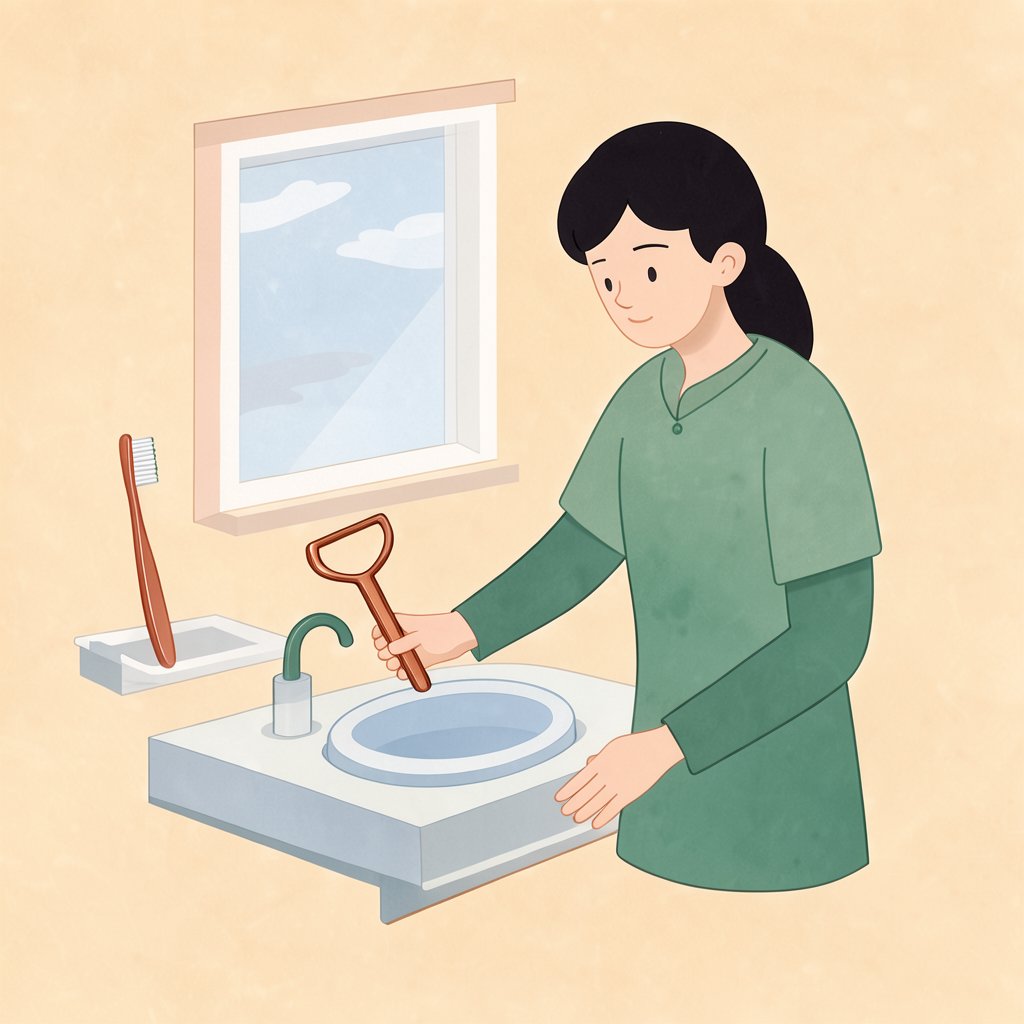
Ivanov’s Yoga and Health sets the frequency inside the same rule: every morning, without exception, the tongue is cleaned of its food-particle and toxin coating. And the classical frame agrees on the slot: Vagbhata’s rising sequence places oral care early — after bowel movement, urination and bathing, ahead of the nasal drops, gargle and the rest (recapped here; the full sequence is in the dinacharya section above).
- Wake and finish the morning’s elimination and washing first — the scraper comes at the bathroom stage of the routine, not in bed.
- Reach for the copper scraper before the toothbrush — the ordering is the rule, and the brush waits its turn.
- Treat it as a daily act, not an occasional one — every morning is the documented cadence.
Step 2: Stand Before the Mirror and Check the Coating
Vostokov’s procedure begins with a piece of furniture: stand before a mirror. His explicit setting instruction is easy to skip and worth keeping — you are about to inspect a surface, and inspection needs light and sight. Morningstar supplies what the inspection is for: the coating is thickest at the tongue root, so the look starts at the back of the tongue, and the goal afterwards is to remove the coating carefully from the whole surface. Practical Ayurveda names the target again: the film that accumulates nightly.

Open the mouth, extend the tongue, and look — root first, then the middle, then the tip. You are checking where the night left its deposit and how thick it sits. In Lad’s diagnostic frame this glance even carries information about digestion (a white coating marking ama and its zone) — though today’s look is for geography, not diagnosis. The safety section below will return to how far back you may work; for now, the look is free.
- Stand at the mirror with good light — Vostokov’s setting instruction, first move of the procedure.
- Inspect the root first — the thickest coating accumulates there, per Morningstar.
- Scan the whole surface before the first stroke — the plan is to clear everything, not just the back.
Step 3: Scrape From Root to Tip, Inside Out
Here is the spine of the whole protocol, and it comes from Vostokov as an exact rule: the strokes go from the root to the tip, from inside outward, never in the reverse direction. Not a preference — a one-way street. Practical Ayurveda phrases the same motion from the beginner’s side: start at the back and gently move to the front, with the gentleness built into the instruction. Morningstar completes the picture mechanically: with the teaspoon or the horseshoe scraper, move from the root toward the tip — the stroke drags the deposit forward and out, off the tongue entirely rather than deeper into it.
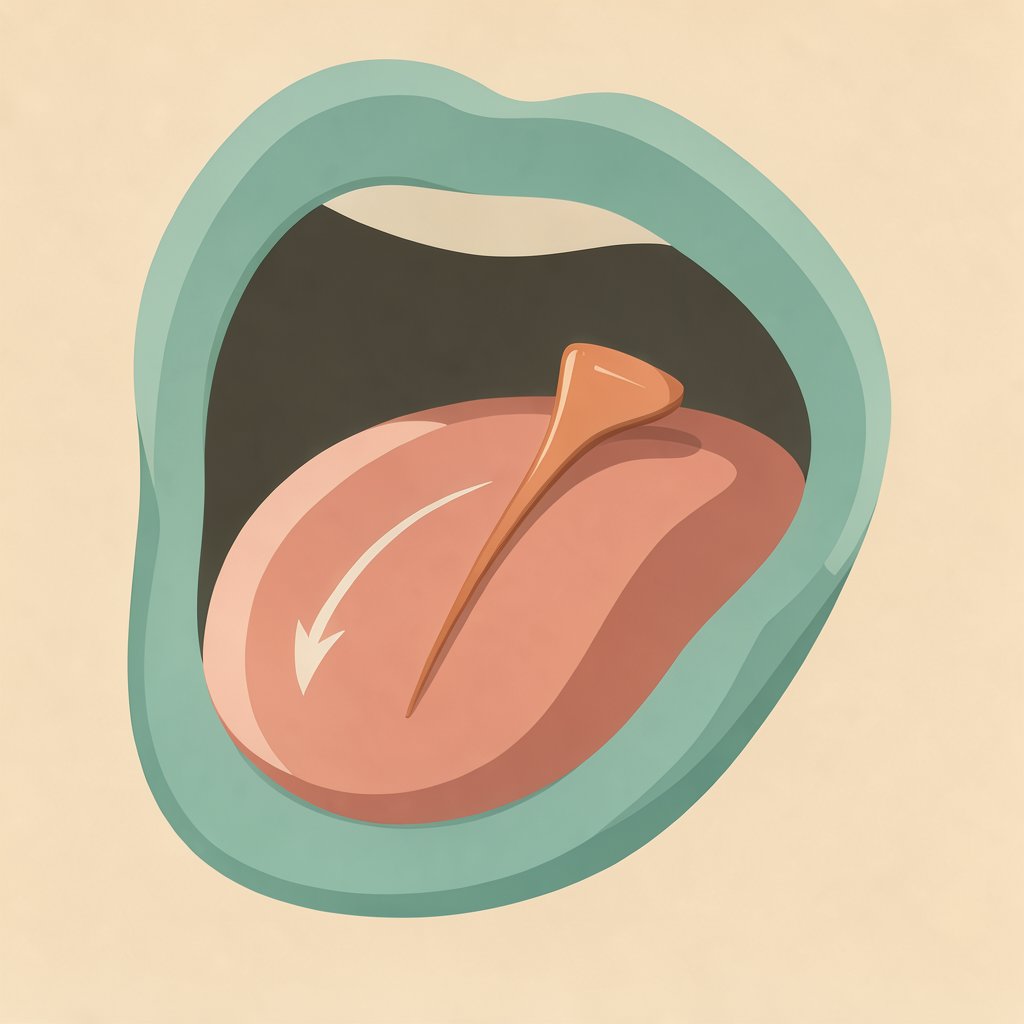
Why so strict about direction? Because the alternative — sawing back and forth — works the coating into the tongue instead of off it, and because the deposit itself waits at the root: a stroke that starts anywhere else leaves the heaviest layer (Morningstar’s thickest-at-the-root fact) for last instead of first. So the move is one slow, controlled draw: place the edge at the root, draw forward to the tip, lift, return.
- Place the scraper’s edge at the tongue root — as far back as is comfortable for you (the hard safety stop is the next-but-one section’s business).
- Draw one slow stroke from the root to the tip, inside out — one direction only, never in reverse, per Vostokov’s rule.
- Keep the pressure gentle — Practical Ayurveda’s word for the motion is exactly that.
Step 4: Count the Passes — Three to Four or Ten to Twelve
How many strokes? The books give two answers, and this manual prints both rather than averaging them. Practical Ayurveda: start at the back and gently move to the front, repeating three to four times. Morningstar: ten to twelve passes with the spoon from the root toward the tip, carefully clearing the whole surface. Three to four gentle passes is the conservative start; ten to twelve is the thorough version for a morning when the root coating is heavy. Both counts live inside one documented band, and no source in our library reconciles them into a single number — so none is invented here.
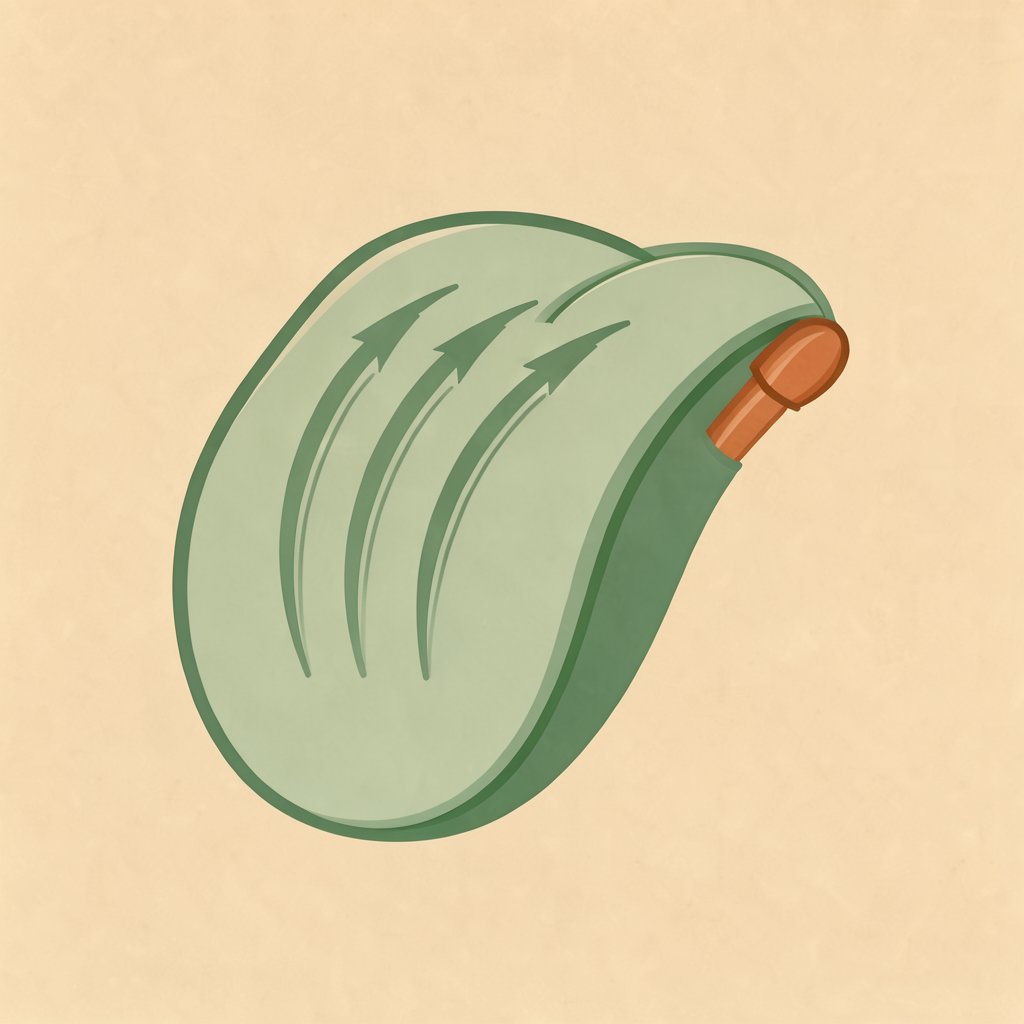
Calibrate inside the band by what you see: with each pass the coating should visibly diminish, and a clear tongue is the finish line regardless of which count you started from. If you are unsure where to begin, start at Practical Ayurveda’s three to four and add passes only if the root still carries its film. Satyananda’s compendium sets the overall frame as reassurance: the regular cleaning takes just a few minutes — this is not meant to become a project.
- Begin with three to four gentle passes — Practical Ayurveda’s count, the conservative start.
- Work up to ten to twelve only if the coating asks for it — Morningstar’s thorough version, still root to tip.
- Stop when the surface looks clear — within a few minutes total, per Satyananda’s frame.
Step 5: Rinse With Water and Keep It Under Two Minutes
Two limits govern the act itself, both from Vostokov. First, the water: rinse the mouth with plenty of water during the procedure — the rinse is concurrent, a swish between groups of strokes, not a single splash at the very end. Second, the clock: tongue cleaning takes no more than two minutes in total. Treat the two minutes as a stop rule, not a target — the passes from Step 4 usually finish well inside it, and the clock exists to prevent exactly the over-scraping the gentleness rule forbids.

Satyananda’s safety stop previews itself here and gets its full treatment in the safety section below: the finger technique (and by extension any root work) goes only as far as possible without provoking the gag reflex. Between the water and the clock, Step 5 is also where the whole practice stays honest — plenty of water, a firm ceiling, and nothing dramatic in between.
- Swish and spit between groups of passes — the rinse runs during the procedure, with plenty of water, per Vostokov.
- Watch the two-minute ceiling — the whole cleaning stops there, even if the count from Step 4 is unfinished.
- Let comfort set the depth — the gag reflex, not ambition, marks the working limit (full stop rule below).
Step 6: Finish With Lemon or Oil, Then Clean the Palate
Vostokov’s sequence gives the ritual a closing gesture: finish by rubbing the tongue with a squeezed piece of lemon or with oil, for freshness. It is a small flourish — the scraping is done, the rinsing is done — and it belongs to the classical procedure rather than to modern improvisation. And his ordering phrase matters for the last surface: after teeth and tongue, clean the palate. The palate is the final station of his oral care, which also confirms the whole morning’s architecture: scraper first, brush second, palate last.
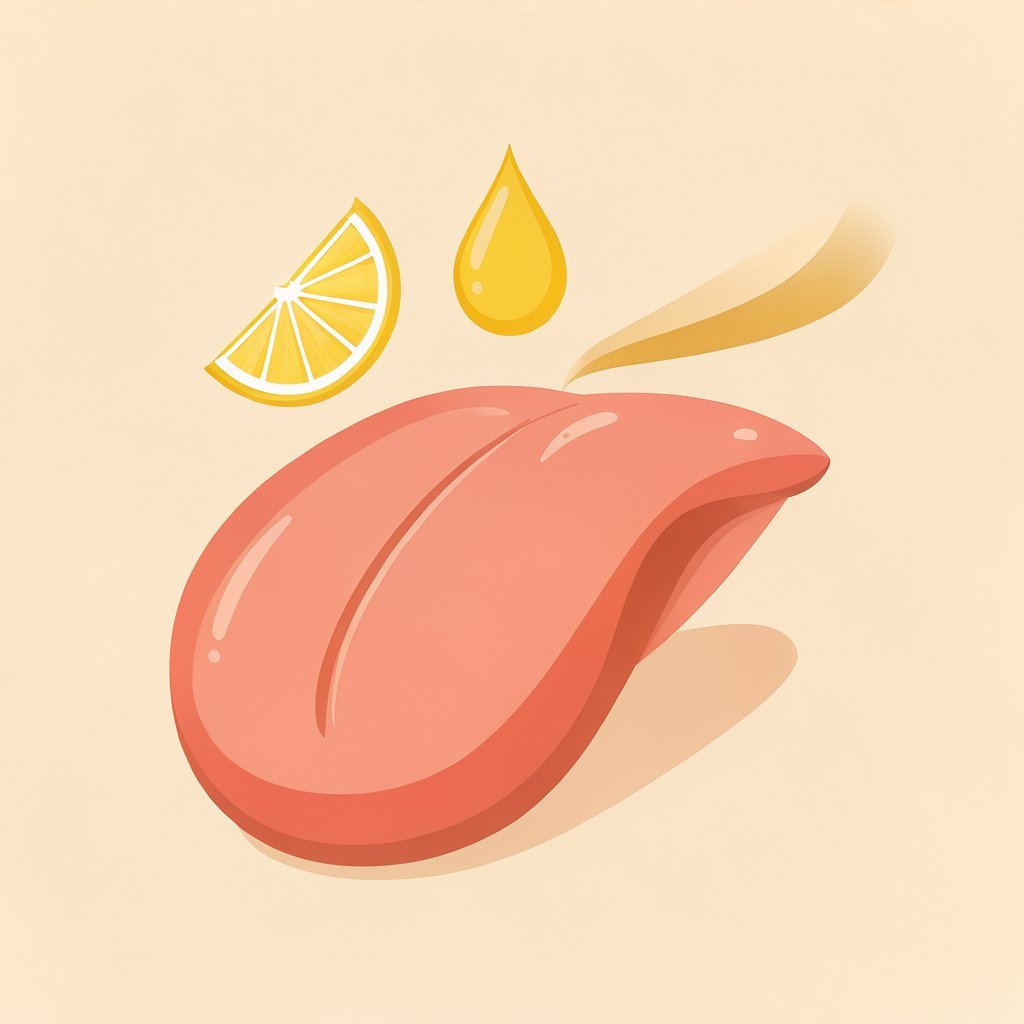
With Step 6 the morning protocol closes: copper edge, mirror, root-to-tip strokes, a counted band of passes, water and a clock, lemon or oil, palate. Six steps, two minutes, every morning — and one open question this manual refuses to paper over, which is how often and whether the internet’s two-week rule exists in any of these books. It does not, and the next section says so in as many words.
- Rub the tongue with a squeezed lemon piece or a little oil — Vostokov’s freshness finish.
- Give the palate its own cleaning pass — the last surface, after teeth and tongue, in his sequence.
- Close the ritual there — the mouth is done and the morning routine moves on.
How Often to Scrape and the Two-Week Question
The documented cadence is unanimous and simple: every morning. Ivanov’s Yoga and Health says every morning; Morningstar says morning, before brushing; Practical Ayurveda’s nightly-accumulation logic makes the daily morning pass the natural rhythm — the coating rebuilds each night, and the scraper answers each morning. Nothing in the classical sources suggests twice a day, and nothing suggests an occasional deep clean: the practice is daily or it is not this practice.
Now the honesty box, because a “rule of two weeks” circulates online — scrape for two weeks, rest, repeat, or similar. That rule has no passage behind it in the classical sources of our library: no text we hold ties a two-week period, or any multi-week interval, to tongue scraping. The only once-in-one-to-two-weeks intervals in our base belong to stomach cleansing — Varisara Dhauti — in Ivanov’s book, which is a different practice entirely. We state the gap plainly: not found in the classical sources we hold, and we will not invent an interval to fill it.
So the practical answer to “how often?” is the boring, documented one: once a day, in the morning, before brushing, for under two minutes. From cadence the manual turns to its last hard subject — what the books forbid.
Safety: Stop Before the Gag Reflex and Never a Toothbrush
The safety box is short because the classical stops are short, and it is honest for the same reason. Stop one, from Satyananda’s Jihva Mula Dhauti: work toward the tongue root only as far as possible without provoking the gag reflex — the reflex is the boundary, and it is your body’s, not the manual’s. Stop two, from Vostokov: never use a toothbrush on the tongue, it injures the tissue; and his two-minute ceiling from Step 5 completes the set. Gentle pressure is the standing rule underneath both.
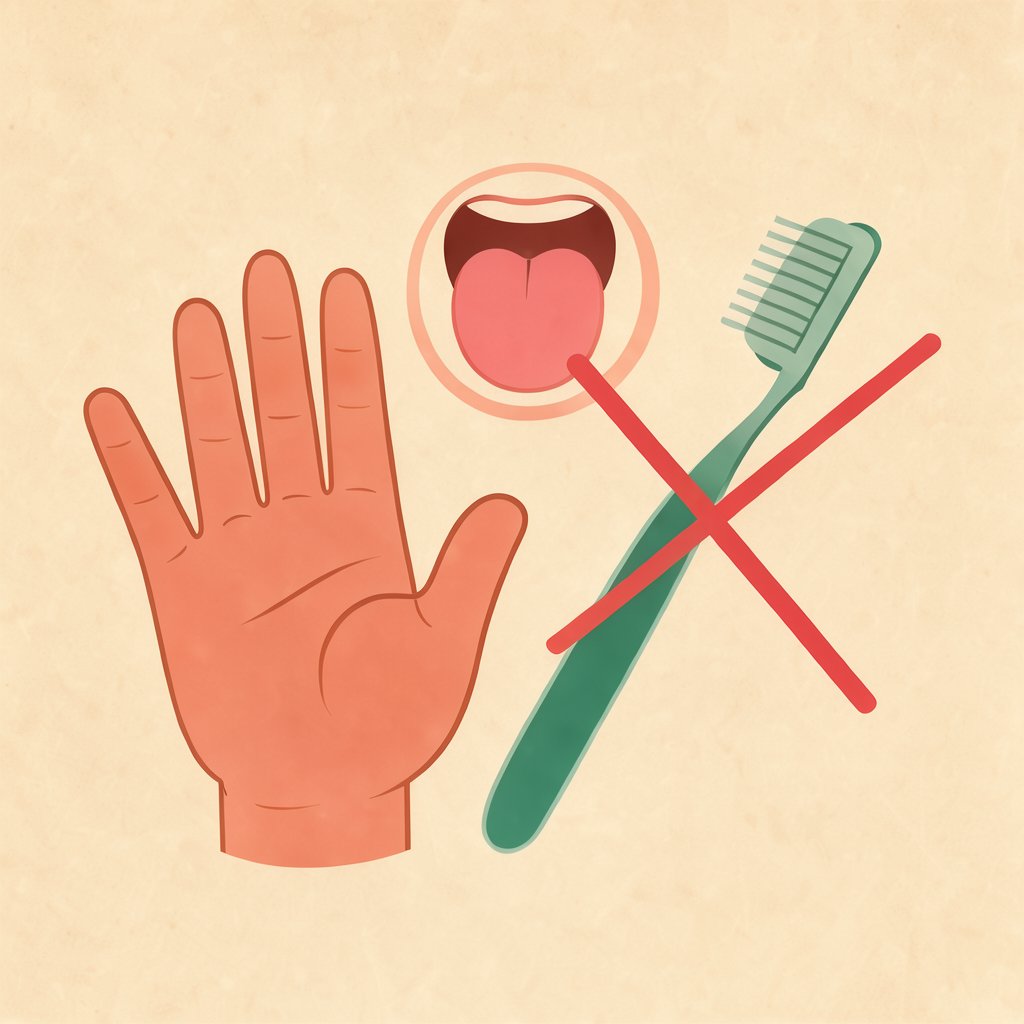
Two lists that look like contraindication lists circulate with this topic, and both must be labeled honestly. Ashtanga Hridaya verse 4 names conditions that must not use the bitter-wood twig — digestive disorders, vomiting, dyspnea, cough, fever, facial paralysis, thirst, mouth ulcers, and heart, eye, head and ear diseases — but that list belongs to the tooth-cleaning twig, not to the scraper, and is printed here only to un-hook it. Likewise Frolov’s explicit contraindication list in Herbs for Yogis — acute gastrointestinal inflammation, liver cirrhosis with esophageal varices, GI tumors, gallstone disease — applies to vamana-dhauti, a stomach-cleansing practice, not to tongue cleaning. Neither list is a scraper contraindication.
And the final gap, stated rather than padded: beyond the gag-reflex stop and the no-toothbrush warning, no dedicated tongue-scraping contraindication passage exists in the sources we hold. Persistent bad breath, a coating that never clears, pain, or any sore, patch or lump on the tongue lasting more than two weeks belongs with a dentist or physician — a scraper is hygiene, not a diagnostic instrument.
FAQ: Copper Scraper Care and Practical Questions
How much does a copper tongue scraper cost?
Morningstar’s Ayurveda and Polarity Therapy names a US street price of $3-20 for the same item — a purpose-made horseshoe-shaped scraper or the metal teaspoon it says works just as well. Price separates nothing in the classical sources; the metal rule does the sorting for you.
Can I use a spoon instead of a scraper?
Yes, and the books document each fallback. Morningstar approves a metal teaspoon; Ivanov names a silver teaspoon or the right index finger; Vostokov’s own choice is a wooden spoon. Whatever the edge, the rules hold: root to tip, never in reverse, gently, under two minutes.
How far back should I scrape?
Only as far as you can without provoking the gag reflex — Satyananda’s explicit safety stop. Morningstar’s root-first logic sends you to the back because that is where the coating is thickest; Vostokov’s direction rule then carries it out, one way, never sawed back and forth.
How do I care for a copper scraper?
Honestly: no cleaning, patina, disinfection or replacement guidance exists in the classical sources in our library — we state the gap rather than invent a regimen. And to un-hook a common confusion: Lad’s copper-water protocols are internal therapy, not scraper care in any sense.
Is there antibacterial science behind copper?
None in our source base: no copper-specific antimicrobial studies, breath trials or clinical coating research exist in the books we hold. The classical case is Lad’s — copper alleviates excess kapha, tonifies liver, spleen and lymph — plus the metal-not-plastic rule of Practical Ayurveda and Morningstar’s not-aluminum footnote.
What about the two-week rule?
It is not in the classical sources we hold — no passage ties a two-week period to tongue scraping. The only one-to-two-week intervals in our base belong to stomach cleansing (Varisara Dhauti) in Ivanov’s Yoga and Health, a different practice. The documented tongue cadence is simply every morning. See the how-often section above for the full honesty box.
Copper tongue scraping, read strictly from the books, turns out to be a modest and exact ritual: a metal edge — copper, silver or steel, never plastic — drawn root to tip in three to twelve gentle passes, before the toothbrush, under two minutes, finished with lemon or oil and a clean palate, every morning. For the full morning it belongs to, see our Dinacharya daily routine guide and the oil pulling manual; the rest of the tradition lives in the Ayurveda and Tibetan traditions category and the manuals library. The sources stop at the ritual itself; the care questions they leave open sit in the FAQ above, and the gaps stay marked as gaps.
Sources
- Practical Ayurveda (Dorling Kindersley, 2018) — the metal-not-plastic tool rule, the three-to-four-pass count, the nightly-coating logic, and the gum-and-bacteria effects.
- Morningstar — Ayurveda and Polarity Therapy (2007) — the before-brushing slot, the teaspoon and horseshoe scraper with the $3-20 price and the not-aluminum footnote, the ten-to-twelve-pass count, the reflex-stimulus mechanism, and the thickest-at-the-root fact.
- V. F. Vostokov — Secrets of Eastern Healers — the mirror setting, the root-to-tip never-reverse rule, the concurrent water rinse, the two-minute cap, the toothbrush ban, the tongue-root sediment account of bad breath, and the lemon-or-oil finish with palate cleaning.
- Swami Satyananda Saraswati — Ancient Tantric Techniques of Yoga and Kriyas (3 volumes) — the Jihva Mula Dhauti technique, the few-minutes frame, the contaminants-and-bacteria account of the coating, and the gag-reflex safety stop.
- Vasant Lad — The Complete Book of Ayurvedic Home Remedies (2012) — the copper-kapha rationale and the copper-water background protocols.
- Vasant Lad — Ayurveda for Beginners — the white-coating ama zones of tongue diagnosis.
- Deepak Chopra — Perfect Health; Restful Sleep — the definition of ama as residue of undigested food from fatty, stale or heavy food.
- Vagbhata — Ashtanga Hridaya Samhita, Ch. 2 Dinacharya Adhyaya — the Brahma muhurta rising time and the classical oral-care slot (quoted for the frame only; the retrieved passage contains no tongue-scraping verse).
- Yu. M. Ivanov — Yoga and Health (1991) — the every-morning cadence, the finger and silver-teaspoon tools, and the Varisara Dhauti intervals that are not a scraping rule.
- Artyom Frolov — Herbs for Yogis (2013) — the jihva-dhauti taxonomy; his contraindication list applies to vamana-dhauti, not tongue cleaning.
- Mikhail Baranov — Yogic Nutrition in the Central Belt (2014) — the simplified dinacharya clock.
- Terry Clifford — Medicine and Psychiatry of Tibetan Buddhism: Diamond of Healing (2003) — tooth cleaning and massage in classical Tibetan preventive hygiene.
Where to go next: the Dinacharya daily routine guide places this ritual in the full classical morning, and the oil pulling manual covers the neighboring oral practice in the same format. New to the tradition’s framework entirely? Start with our Ayurvedic doshas beginner’s guide.
How we researched this: this manual was built from a local library of 1,137 wellness books, indexed and searched offline with no internet sources. Retrieval focused on the Ayurvedic and Tibetan practices collection. Every instruction above is attributed to the book that printed it, every disagreement between books is shown as a disagreement, and every popular claim the sources do not carry — the two-week rule, scraper care, copper antimicrobial science — is reported as a gap.
Sources & References
Practical Ayurveda (Dorling Kindersley, 2018); Morningstar — Ayurveda and Polarity Therapy (2007); V. F. Vostokov — Secrets of Eastern Healers; Swami Satyananda Saraswati — Ancient Tantric Techniques of Yoga and Kriyas (3 volumes); Vasant Lad — The Complete Book of Ayurvedic Home Remedies (2012); Vasant Lad — Ayurveda for Beginners; Deepak Chopra — Perfect Health; Deepak Chopra — Restful Sleep; Vagbhata — Ashtanga Hridaya Samhita, Ch. 2 Dinacharya Adhyaya; Yu. M. Ivanov — Yoga and Health (1991); Artyom Frolov — Herbs for Yogis (2013); Mikhail Baranov — Yogic Nutrition in the Central Belt (2014); Terry Clifford — Medicine and Psychiatry of Tibetan Buddhism: Diamond of Healing (2003)