
Educational content only — not medical advice. See our full Medical Disclaimer and Affiliate Disclosure below.
Key Takeaways
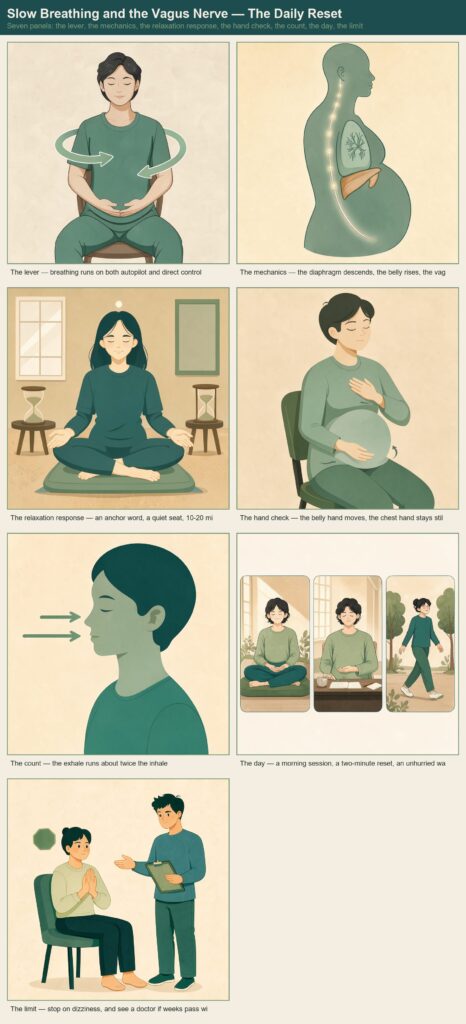
- Breathing runs on both autopilot and direct control, and that dual mode is what makes slow breathing a practical daily lever over the vagus nerve.
- Diaphragmatic breathing matters mechanically: shallow chest breathing reduces the lung-expansion signals the vagus nerve carries to the brain stem.
- The relaxation response technique asks for 10–20 quiet minutes a day, and regularity is what makes the response automatic over time.
- Therapeutic slow breathing literature favors an exhale longer than the inhale, and folk practice warns that energizing breathing done late in the evening can keep beginners awake during the first month.
Slow breathing is the most accessible lever you have over the vagus nerve, because breathing sits on the border between the automatic and the voluntary nervous system: you can hold your breath on purpose, but you never stop breathing when you stop thinking about it[2]. That border is exactly why breathwork is the simplest daily reset for stress — no equipment, no posture school, no app required. The technique is learned in minutes, yet it reaches the same autonomic machinery that chronic stress keeps in its busy mode. More practices live in our breathwork guides.
This article translates the physiology into plain language, then gives two techniques exactly as the source books teach them: the relaxation response anchored on a word, and slow breathing led by the diaphragm with a longer exhale. After that you get a daily schedule table, honest safety limits, and full citations for every factual claim. Nothing here asks you to buy anything — the practice is free, and the sources are printed books, not marketing pages.
Traditional view vs modern physiology
Breathing traditions — from pranayama to daoist breathwork — treat the breath as the bridge between body and mind. The Hatha Yoga Pradipika, as quoted in a modern restoration manual, measures the life of a practitioner “not in days but in breaths,” which is why classical training presets a rhythm of slow, deep breathing — patterns the tradition says strengthen the respiratory system and calm the nerves[9]. Pranayama teaching follows the same logic in a gentler key: if you want a calm mind, the sources say, first learn to govern the breath, because when the breath is under control the heart settles[9].
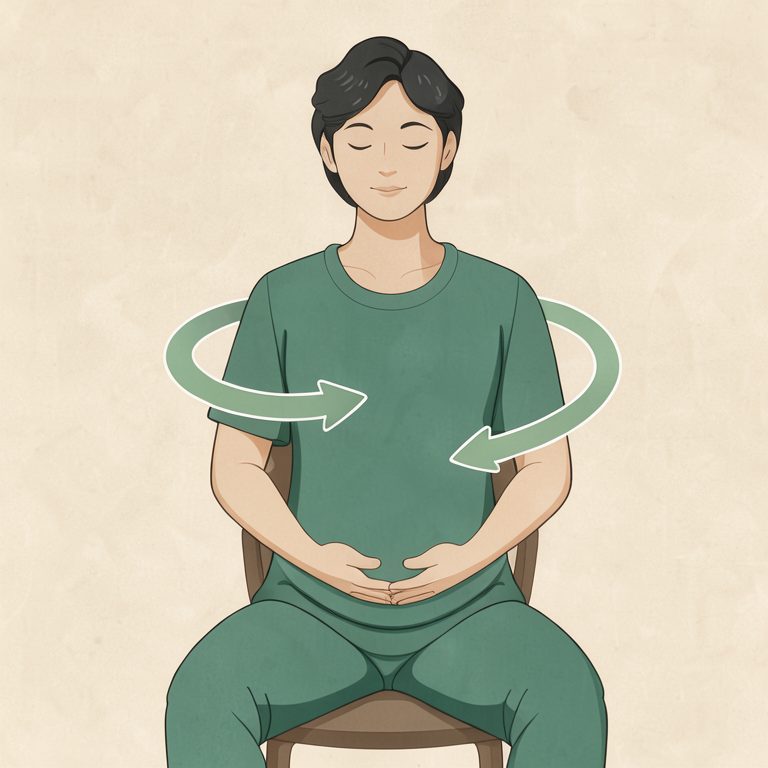
Modern stress literature frames the same bridge in terms of the autonomic nervous system, and the vagus nerve is its main cable. On every inhale the diaphragm contracts and creates a mild vacuum inside the chest, letting the lungs expand and draw air in; the vagus nerve reports that expansion to the brain stem, and on the exhale the diaphragm relaxes and pushes the air back out[1]. Watch a healthy baby breathe and you will see the pattern in its pure form: the belly rises on the inhale, because diaphragmatic breathing is the work of the primary breathing muscle rather than the accessory muscles of the chest and shoulders[1]. The practical point follows directly: when breathing turns shallow, the accessory muscles of the neck, shoulders, and chest take over the work, and the expansion signaling the vagus nerve carries shrinks with it[1].
Stress physiology closes the loop from the other side. In the model described in evidence-based psychosomatics, the recovery phase that follows a stressful episode is dominated by the vagus — a state of lowered heart rate, calm breathing, warm hands and feet, and relaxed blood vessels[4]. The same book adds that while some organs react during the stress itself, the larger part — roughly ninety percent — surface their symptoms only in the post-conflict phase, once the person has exhaled and the charge has let go[4]. Slow breathing, in this light, is best understood as a deliberate daily visit to the recovery state — not a trick that erases stress.
Technique 1 — The relaxation response
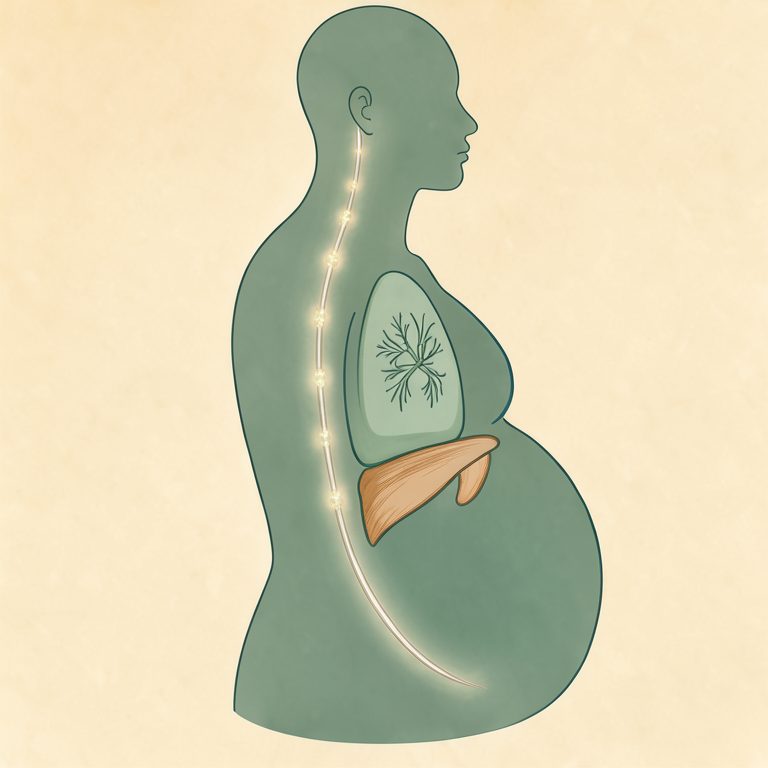
The relaxation response is the centerpiece of Claire Michaels Wheeler’s stress handbook, and she presents it among her four daily techniques as one that is easy to learn and apply[2]. The instruction is almost disarmingly simple: rest your attention on one anchor, return to it gently every time the mind wanders, and repeat daily. Wheeler’s framing is proportionate rather than dramatic — regular practice is described as leading to a less irritable nervous system across the whole day, gradually counteracting the negative influence of stress on health[2]. Here is the protocol exactly as the sources give it.
Expect the first sessions to feel noisy, and do not mistake noise for failure. Even B. K. S. Iyengar, writing about his own pranayama years, admitted he struggled for a long time without a guide, gasping after three or four cycles, and still devotes an hour a day to the practice, finding even that barely enough[8]. If the founder of a world school calls the breath a lifelong student’s subject, a noisy ten-minute session is not a verdict — it is a Tuesday.
Technique 2 — Diaphragmatic breathing
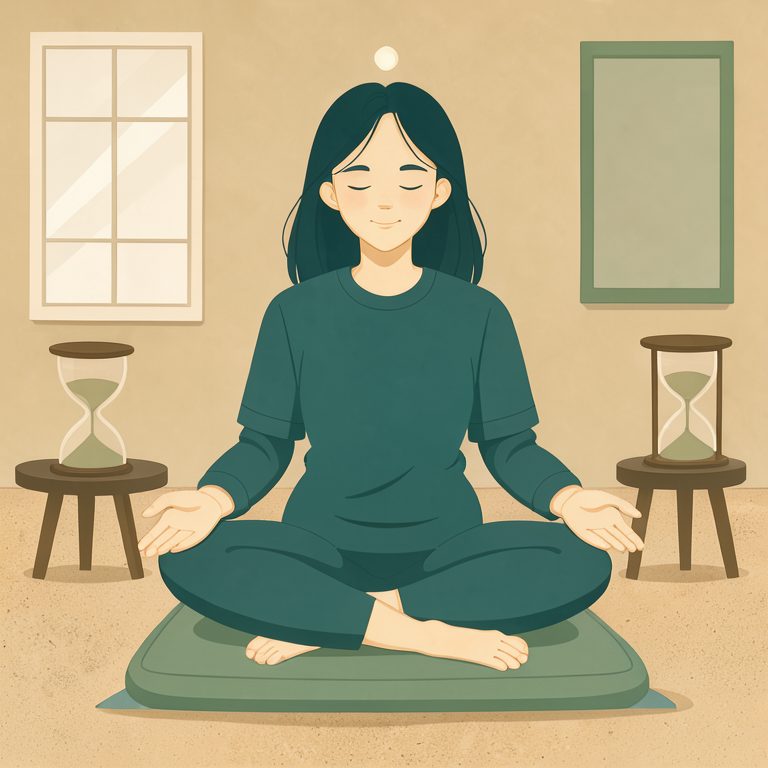
The mechanics come first: let the belly expand on the inhale rather than lifting the shoulders, so the diaphragm — the primary breathing muscle — does the work it is built for[1]. A hand on the chest and a hand on the belly make a simple feedback pair: the lower hand should move while the upper hand stays almost still. The vagus nerve responds to the mechanics of a full, slow breath; shallow chest breathing keeps the system in its busy mode[1].
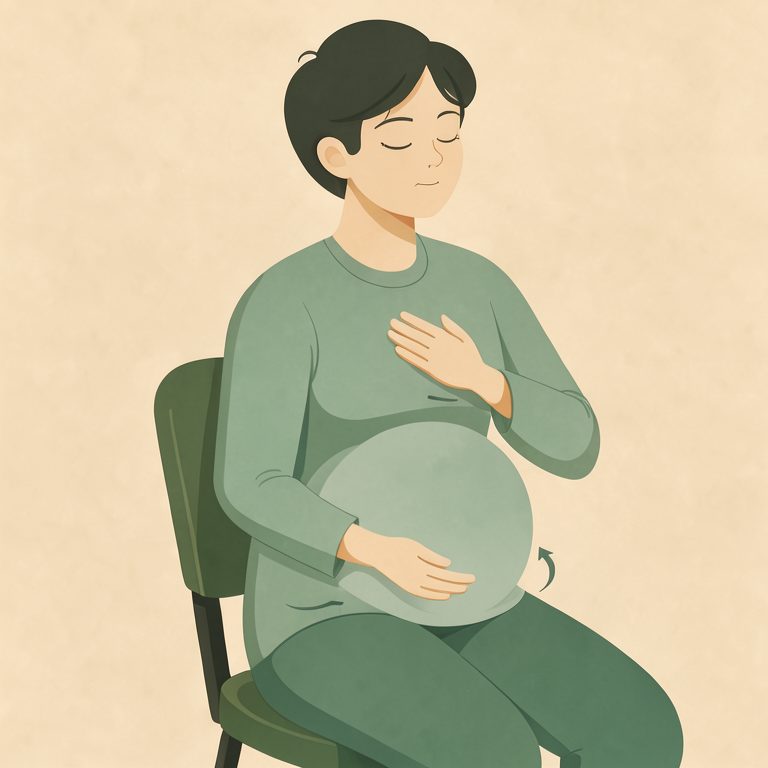
Therapeutic slow breathing systems give the same mechanics an explicit count. A therapeutic breathing manual opens its trainer practice — breathing on the Samozdrav device — with a first basic pattern: an inhale of 2–4 seconds and an exhale of 5–8 seconds, the exhale deliberately longer than the inhale[5]. A Frolov-method practitioner’s training diary records rhythmic breathing in a 7:3:7:3 pattern (seconds in, hold, out, hold) sustained over 20–30 minute sessions, alternating with single long cycles of 20–70 seconds, and links the routine to a progressively slower pulse and breathing rate[6]. These counts come from device-based training with its own progression rules and health screening, so the honest takeaway for unaided practice is the principle — exhale longer than you inhale — not the trainer numbers.
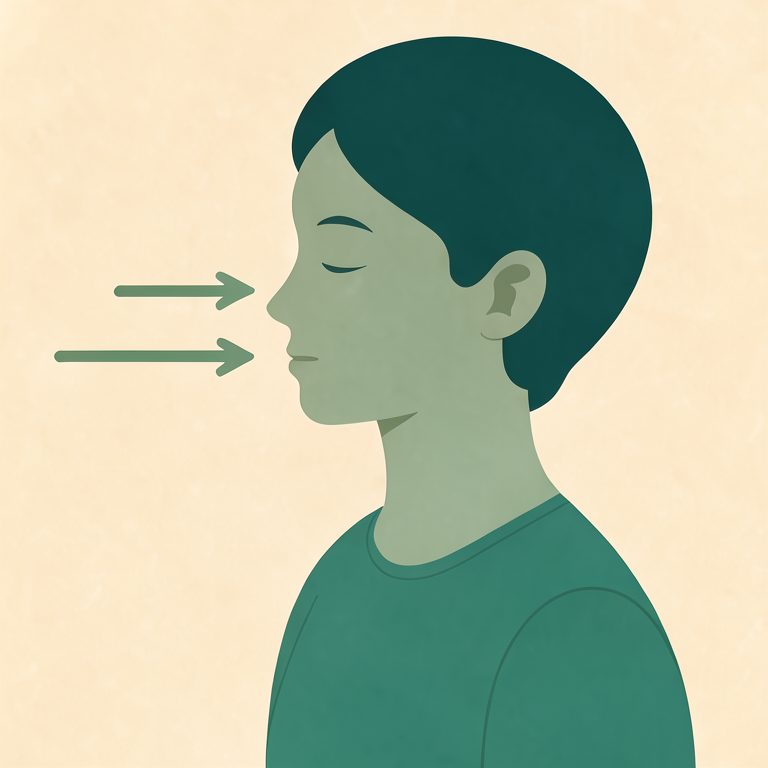
The micro-dose matters as much as the main practice. One or two minutes of slow breathing before a stressful task is a legitimate dose, and it fits inside any meeting-free gap in a calendar. During the dose, keep the rhythm boring on purpose: inhale the belly out, exhale the belly in, shoulders parked. Boring, repeated, and low — that is the whole signature of slow breathing the vagus nerve recognizes as safe[1].
A simple daily schedule for slow breathing
The two slow breathing techniques slot into a normal day without rearranging it. The table below arranges the doses suggested across the source books into one schedule, from the morning main session to the evening caution. Start with two rows, not five — the schedule is a menu, and the books agree that regularity beats ambition[2].
| When | Practice | Dose | Why this slot |
|---|---|---|---|
| Morning | Relaxation response with your anchor | 10–20 min | A fixed daily slot is what makes the response automatic over time[2] |
| Before a stressful task | Diaphragmatic breathing, belly first | 1–2 min | The vagus nerve reads the mechanics of a full, slow breath[1] |
| Quiet midday break | Slow rhythmic breathing with a longer exhale | 5–8 min | Trainer systems pace the exhale longer than the inhale[5] |
| Early evening (first month) | Keep energizing breathing out of the late evening | — | Beginners may stay wound up and take longer to fall asleep[7] |
| Weekend | Slow outdoor walk | 20–30 min | A slow walk is described as a fine way to calm down and restore breathing[3] |
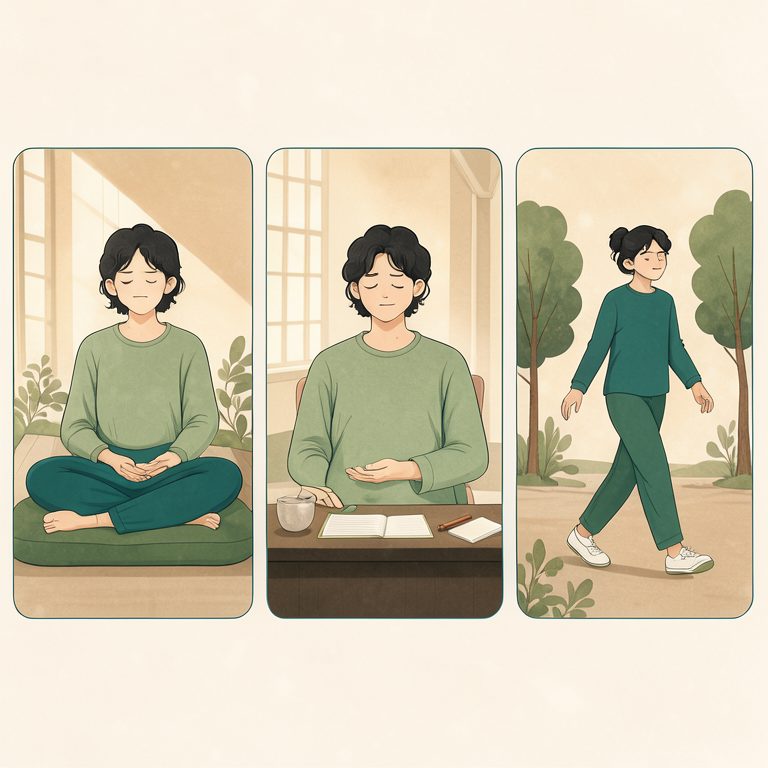
Two adaptation notes round out the schedule. Folk practice guidance warns that slow breathing exercises are stimulating at first, which is why beginners are told not to practice late in the evening during the first month, until the system settles[7]. The walk row is not decoration — the burnout-recovery literature lists unhurried outdoor walks among the concrete acts that help breathing and settle the system, alongside warm baths and calming rituals[3].
A note on stress and limits
Stress is not a character flaw. In the UK alone, 12.8 million working days were lost to stress, depression, and anxiety in 2019[3]. Recognizing your limits is emotional maturity, not weakness — and a society that loses that many working days to strain is describing a load problem, not a motivation problem.
The limits of self-help deserve the same honesty. If you have tried several options and nothing helps, that is the signal to see a doctor, not to push harder[3]. Stop any slow breathing practice that leaves you dizzy, lightheaded, or unwell, and speak with a qualified healthcare provider about those symptoms — this article is educational and is not intended to diagnose, treat, or replace care for any condition. See our medical disclaimer.
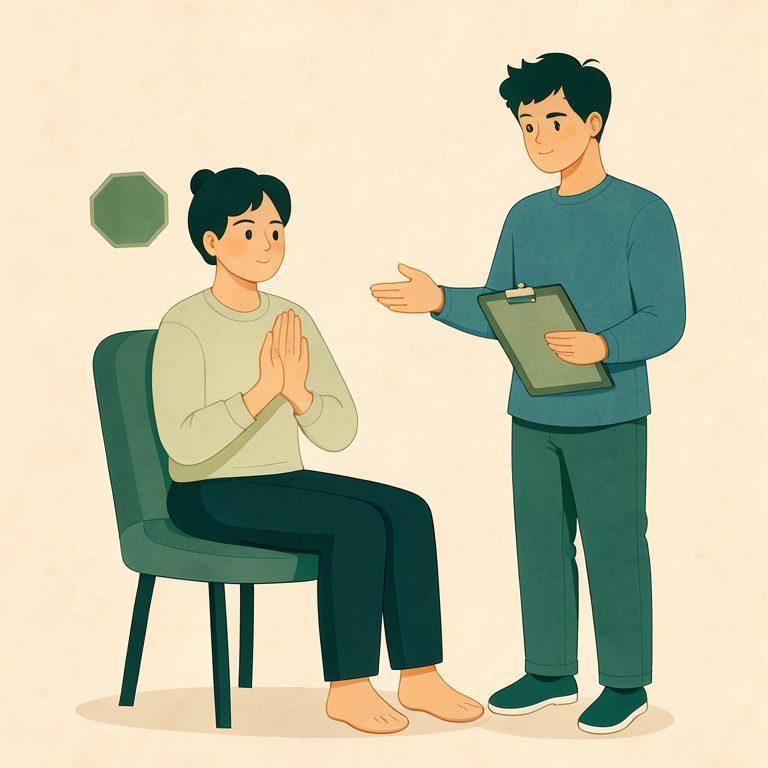
Structured systems screen strictly for a reason. The therapeutic manual behind the longer-exhale pattern restricts its device work for people with past cardiovascular problems — inhaling must be through the nose only, it warns, because improper technique can provoke a hypertensive crisis and arrhythmia — and those who have had a heart attack or stroke are allowed on the trainer only after months of gentler preparation[5]. The daily reset in this article is far gentler than trainer practice, but the same humility applies: when in doubt about your heart, blood pressure, or lungs, clear the practice with a doctor first.
How we researched this
This article is based on our local library of 1,137 traditional wellness and clinical-popular books; no internet sources were used. Every factual statement above was checked against the cited passage in the listed book before publication.
Frequently asked questions
How long before the relaxation response starts to work?
The sources frame the answer in terms of regularity, not speed: ten to twenty minutes of slow breathing daily, with the response becoming automatic only through regular practice[2]. Wheeler describes the payoff as a generally less irritable nervous system over the whole day, which readers usually notice as a background change rather than a single dramatic moment[2]. Iyengar’s decades-long arc is the honest long-term reference point — the breath rewards patience at every level[8].
Why does the exhale get so much attention in slow breathing?
The therapeutic literature gives the exhale the leading role by design: the basic trainer pattern cited above stretches the exhale to roughly twice the length of the inhale[5]. In the psychosomatic model, the calm state — slower heart rate, quiet breathing, warm extremities — is the vagus-dominated recovery state, and slow breathing with a long exhale is a deliberate visit to it[4]. The Frolov-method diary makes the same observation empirically, recording progressively slower pulse and breathing rates as the rhythmic practice deepens[6].
Can I practice late at night?
Not during the first month, according to the folk practice guidance: rhythmic breathing is initially stimulating, and a beginner who practices late may lie awake longer before falling asleep[7]. The same guidance starts with three ten-minute sessions a day kept earlier in the day, and allows practice at any time of day only by the end of the fourth week[7]. If evening slow breathing disturbs your sleep, move the session to the morning and reintroduce the evening only when it clearly settles you.
Is slow breathing a treatment for anxiety or depression?
No — and the sources never present it as one. This article is educational and is not intended to diagnose or treat any condition, and self-help techniques have a defined ceiling: if you have tried several options and nothing helps, the instruction is to make an appointment rather than push harder[3]. Persistent low mood, panic, or burnout symptoms deserve professional evaluation, full stop.
Do I need a special posture, word, or tradition?
No. Wheeler’s anchor is simply the phrase, sound, or word you settle on[2]. The traditional options — a mantra, a counted pranayama rhythm, a seated ritual — are framing, and the tradition itself says the calm mind follows the governed breath, not the props around it[9]. A chair, a quiet corner, and a word you like are enough to run the slow breathing protocol as written.
Sources
- [1] Habib N. — The Vagus Nerve (2021)
- [2] Wheeler C.M. — Stress (2021)
- [3] Dahl I. — From Burnout to Balance (2021)
- [4] Karmatskiy T. — Evidence-Based Psychosomatics (2023)
- [5] Dombrovsky-Shalagin V. — Breathing for Life (2010)
- [6] Stepanov A.A. — Breathing by the Frolov Method
- [7] Frolova N.A. — Secrets of Healing Magic and Folk Medicine
- [8] Iyengar B.K.S. — Pranayama: The Art of Breathing (1995)
- [9] Peichev N. — Complete Health Restoration System (2013)
