
Educational content only — not medical advice. See our full Medical Disclaimer and Affiliate Disclosure below.
Key Takeaways
- The classic diet-therapy literature converges on three moves at the heart of traditional diets for digestive ease: serve food warm, cook it simply, and keep it gentle.[1][2][3]
- Recorded menus lean on grain porridges, silky mucilaginous soups, and boiled, steamed, or baked dishes rather than fried food.[1][2]
- Rhythm matters too: these sources schedule five to six small meals a day and keep hot dishes at 131–140°F (55–60°C).[1][2]
- The seven-day reset below turns those patterns into a practical week — food-tradition education, not a treatment plan.
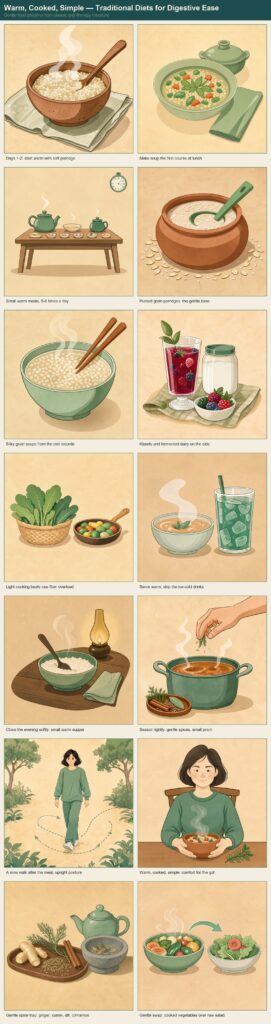
Open nearly any traditional book on eating for a comfortable stomach and the same scene appears: a pot of soft porridge, a bowl of clear soup, food served warm instead of scalding or ice-cold.[1][4] That scene is the heart of traditional diets for digestive ease: readers often expect an exotic protocol, but the recorded kitchen is gentler and simpler than that. What follows maps the patterns that recur across decades of diet-therapy writing — including the older sources those books cite — and turns them into a doable week.[1][2][3] If gentle daily movement is part of your routine, pair light meals with our Baduanjin (Eight Pieces of Brocade) beginner’s guide.
Why warm, cooked, and simple? Traditional view vs modern physiology
The traditional view starts with effect, not calories. Hippocrates sorted familiar foods by what they did to the body — lentils, barley, beet, cabbage, honey, and plum among the loosening foods; quince, unripe pear, and flaxseed among the binding ones.[4] Centuries later Avicenna still described meat juice, syrups, soft-boiled eggs, and egg yolk as mildly acting, nourishing foods, and warned specifically against overeating and pickled dishes.[4] A sixteenth-century handbook pairs buckwheat porridge with milk whey, fruit, and beet leaves — the latter recommended to improve digestion.[4] Warm, cooked, ordinary foods.

Modern physiology reads the same menu in a different vocabulary. Classical gastrointestinal rations explicitly cut foods that mechanically or chemically irritate the mucous lining, and foods that intensify fermentation and putrefaction in the gut; every dish is pureed and cooked boiled or steamed.[1] Even a modern raw-foods manual concedes the point from the other side: some high-fiber vegetables are hard to eat raw and, its author notes, are better digested after light heat treatment.[5] Warm and cooked is not folklore nostalgia — it is a low-irritation delivery format that both vocabularies describe.[1][5]
What traditional diets for digestive ease put on the table
Across the recorded rations the same building blocks repeat. The matrix below distills them, with the source each pattern is drawn from.
| Pattern | How the sources describe it | Why it tends to sit gently |
|---|---|---|
| Grain porridges, pureed | Rice, buckwheat, oatmeal, and semolina porridges on water or defatted broth, served pureed.[1] Half-liquid oat, buckwheat, and semolina porridges.[3] | Cooked starch in soft form: minimal mechanical load |
| Silky (mucilaginous) soups | Slimy soups on weak meat or fish broth with rice, semolina, oatmeal, or barley.[1] Rice, semolina, and oatmeal soups in the early days of a flare.[2] | Warm liquid plus long-cooked grains; low residue |
| Boiled, steamed, baked — not fried | Frying in culinary fats is excluded and boiling or baking preferred.[3] Dishes boiled, steamed, or baked after parboiling.[2] | Skips heavy frying fats and seared, crusty textures |
| Warm, never scalding or icy | Hot dishes served at 131–140°F (55–60°C), cold dishes no colder than 59°F (15°C).[1] Foods consumed warm, cold dishes excluded.[2] | Stays inside a mild temperature band |
| Five to six small meals | Fractional intake five to six times a day.[1][2] | Smaller load per sitting |
| Fermented dairy & berry kissels | Kefir, ryazhenka, and acidophilus milk; kissels and jellies from tannin-rich berries.[1] Cottage cheese dishes and yesterday’s bread.[6] | Soft, familiar staples that need no chewing gymnastics |

The pantry: grains, ferments, and gentle spices
Grains. Porridge is the workhorse: a sixteenth-century handbook already pairs buckwheat porridge with milk whey and fruit,[4] and modern grain cookbooks keep the form — soups built on sprouted wheat and barley, or a slow-simmered grain pot.[8]

Ferments. Japanese fermentation traditions run on miso, koji, and amazake, and their guidebook frames fermented foods as everyday support for gut balance and digestion.[9] The Eastern European rations answer with kefir, ryazhenka, and acidophilus milk.[1] Different pantries, same habit: a small fermented element beside the cooked plate.

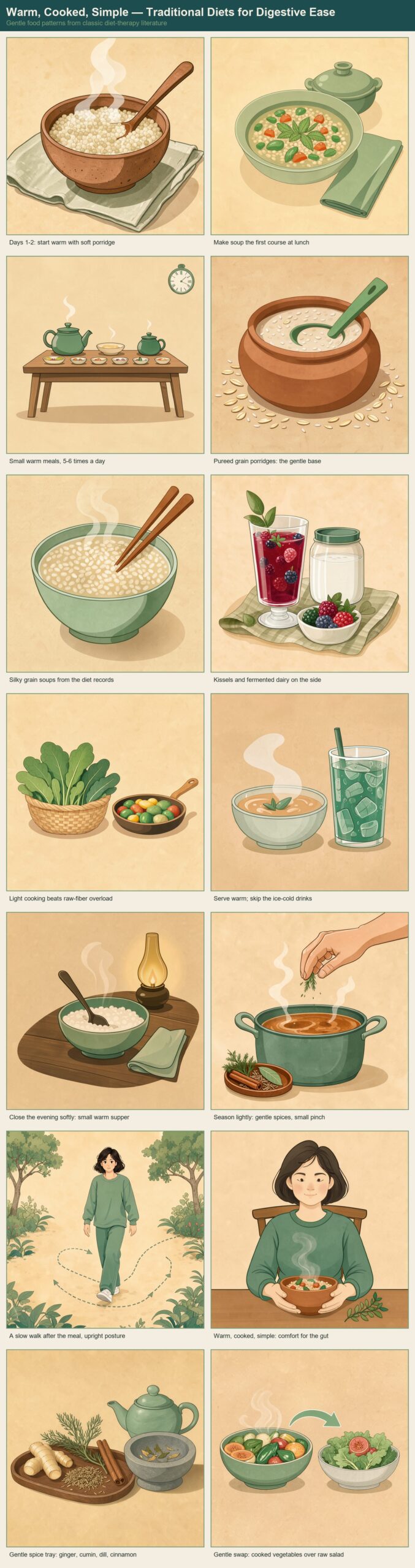
Spices. The traditional spice guides list ginger as a go-to for nausea of any origin, cumin for queasiness and gentle motility, and cardamom for appetite.[7] Think of them as flavor with a long folk resume, not as medicine.
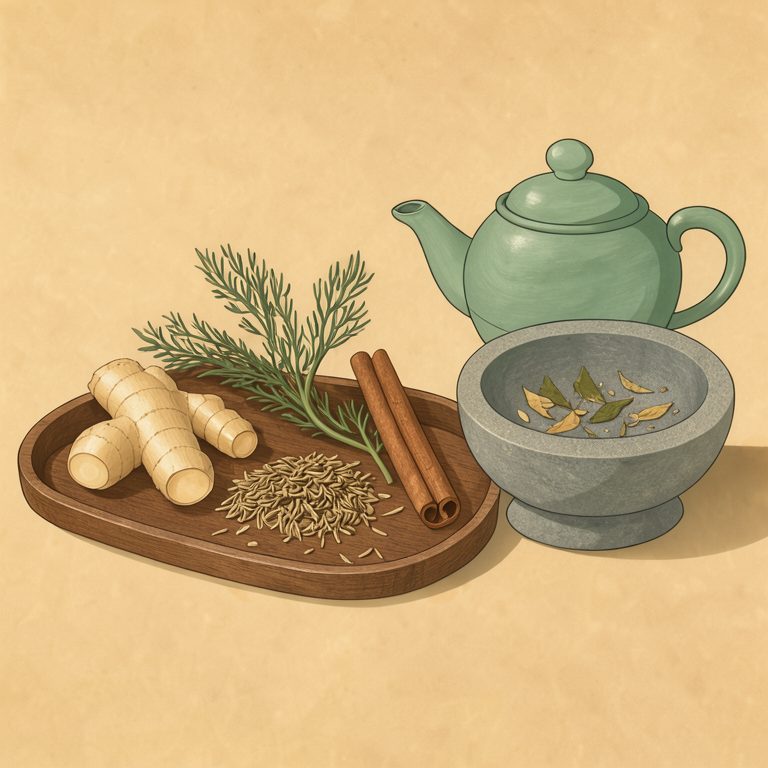
A gentle seven-day reset: the warm-cooked-simple protocol
One week is enough to feel whether this pattern suits you. It follows the structure the diet records describe[1][2][3] — without their medical context, which belongs to a clinician, not a blog.
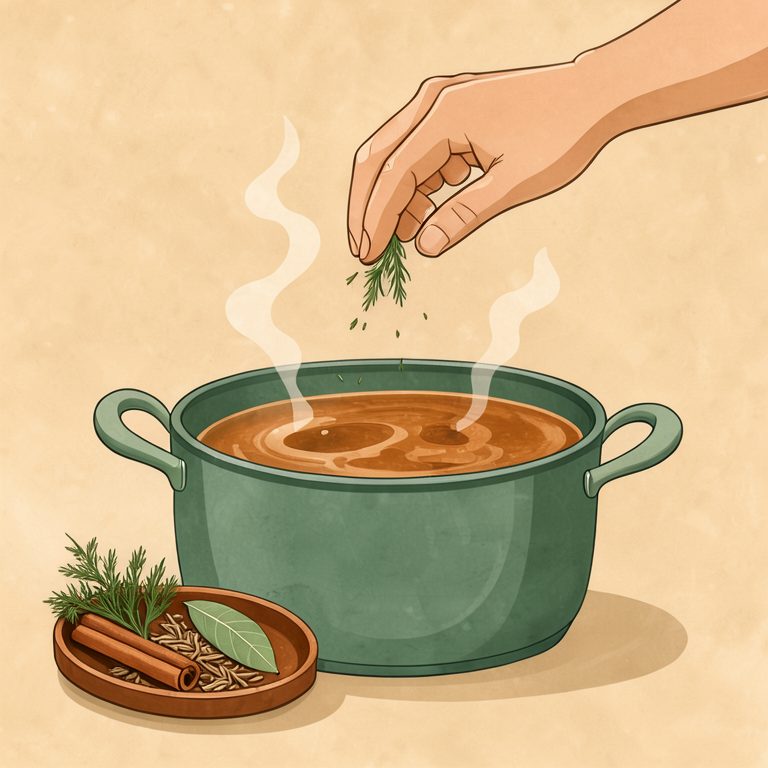
Adding gentle movement
Traditional food culture rarely travels alone: the liver-diet regimen behind several of these menus pairs fractional eating with regular physical activity,[2] and therapeutic-nutrition writing adds exercise and massage as companions to diet.[3] Slow sets like Baduanjin stay inside the same low-load philosophy, and acupressure has its own traditional place beside the plate — see our Zusanli (ST36) acupressure guide. If everyday joint stiffness shapes how you move and eat, our Joint Genesis review and Unlock Your Hip Flexors review cover the modern mobility side.

Common missteps — and the gentler swap
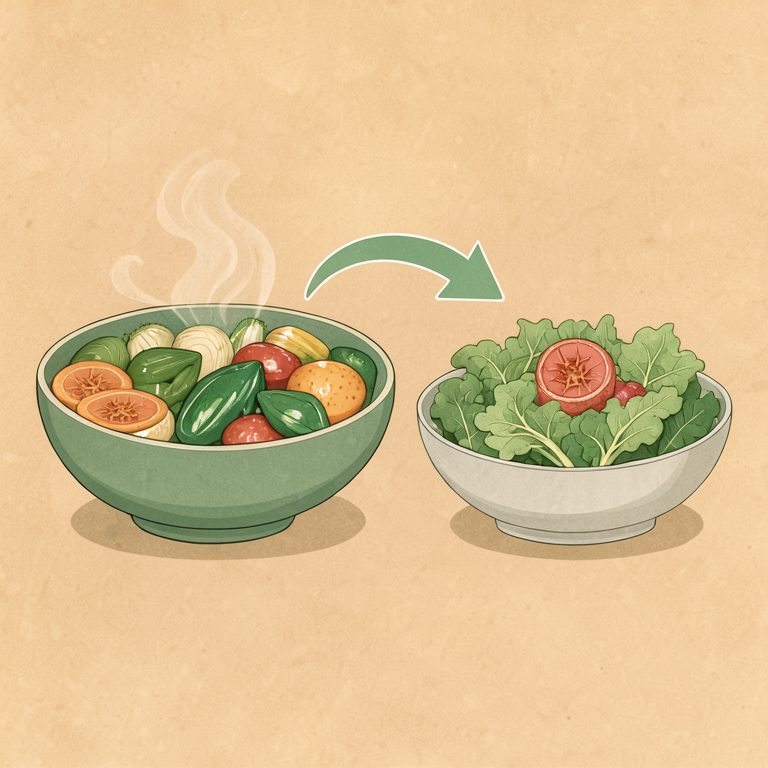
- Raw-salad overload. If large raw salads feel rough, you are in good company: high-fiber vegetables are exactly the ones better digested after light cooking.[5] Swap in steamed or boiled vegetables for a week and note the difference.
- Fiber “cleanses” during irritation. Bran protocols are described with a clear contraindication: any inflammatory process in the digestive canal.[10] The source itself swaps the bran protocol for coarse-ground bread during inflammation, so the issue is concentrated bran, not all roughage.[10]
- Ice-cold drinks with meals, or scalding-hot food. The rations hold a temperature band — hot dishes at 131–140°F (55–60°C), nothing colder than 59°F (15°C).[1]
- Fried food and heavy broths as comfort. Digestive-diet writing excludes frying outright, and one author notes that simply dropping rich broths and fried dishes brings visible relief from heartburn.[3]
- Over-restriction. Simplicity is not starvation: these rations still carry protein — soft eggs, cottage cheese, steamed fish or meat souffles — because protein supports repair of the gut lining.[1]
Safety and disclaimer
Everything above describes food patterns recorded in traditional diet literature. It is not intended to cure, treat, diagnose, or prevent any disease, and it is not a substitute for care from a qualified clinician. If you are pregnant, managing a chronic condition, recovering from illness, or taking medication, talk with your clinician before changing how you eat — especially before any fasting, fiber, or restricted-eating plan.
Frequently asked questions
What is a traditional diet for digestive ease?
In the classic diet-therapy books it is a simple pattern: warm, cooked, gently prepared food — pureed grain porridges, silky soups, and boiled, steamed, or baked dishes — served in five to six small meals a day.[1][2][3]
What serving temperature do traditional digestive diets use?
The recorded rations keep hot dishes at 131–140°F (55–60°C) and nothing colder than 59°F (15°C) with the main meals.[1]
Are raw vegetables part of a gentle digestive plan?
Large raw salads can be rough on a sensitive stomach: the raw-foods literature itself notes that high-fiber vegetables are better digested after light heat treatment, so steamed or boiled vegetables are the gentler swap.[5]
Sources
- [1] Zinets I.I. — Health and Nutrition: 100 Therapeutic Diets (1991)
- [2] Gitun T.V. — Treating Liver Disease (2007)
- [3] Pernatev Yuri — Living Food From 1,000 Diseases (2016)
- [4] Menshchikov F.K. — Diet Therapy (1972)
- [5] Kornblit Jennifer — Simply About Raw Food (2018)
- [6] Kapustina I. — The Spleen: Treating, Cleansing, Protecting (2010)
- [7] Shutova A. — How to Treat With Spices: A Guide (2022)
- [8] Shelest O. — Healing Grains: Strengthening and Cleansing the Body (2019)
- [9] Shirasaki Hiroko — A Beginner’s Guide to Japanese Fermentation (2023)
- [10] Ilyina S.I. — Health on Your Table (2005)
How we researched this
This article is based on our local library of 1,137 traditional wellness books; no internet sources were used. Every statement above was checked against the cited source passages.
