
Educational content only — not medical advice. See our full Medical Disclaimer and Affiliate Disclosure below.
Key Takeaways
- Yongquan (KI1) is the Jing-Well and Wood point of the Kidney channel — and the only acupuncture channel point on the sole, which makes it the lowest point on the body[1].
- Finding it takes two moves: measure about one third of the way from the base of the second toe toward the heel, then curl the toes down and press the pit that appears between the second and third metatarsal bones[1].
- The verified protocol runs in ten-second units — press-and-vibrate twice, rub in small circles twice, then ten downward pushes along the inner limbs — and closes with a few minutes of slow breathing[2].
- The classical grounding language has a specific source: commentary on KID-1 describes “returning the unrooted back to its source,” descending excess from the head[1].
- The books give per-session timing only — no daily or weekly regimen is recorded for this point, and this guide does not invent one[1][2].
Every acupuncture channel has to start somewhere, and the Kidney channel starts at the bottom of the foot. The Yongquan point — kidney 1 in the international numbering, written KI1 or KID-1 — is the first point of that channel and the only channel point on the sole[1]. Classical texts named it Gushing Spring and pictured Qi bubbling up at this spot like water from the ground[1][3]. This guide to foot acupressure at the body’s lowest point collects what the source books actually teach: where to place your thumb, how long to press, which breath belongs with the practice, and where the written record honestly stops.
The material below comes from six books in our offline wellness library: a canonical acupuncture manual, two qigong references by the same teacher, an internal-arts guide, and two massage handbooks[1][2][3][4][5][6]. Traditional claims are presented as traditional use, never as medical promises. Where the sources are silent — on daily frequency, on breath counts, on point-specific contraindications — the article says so instead of filling the gap.
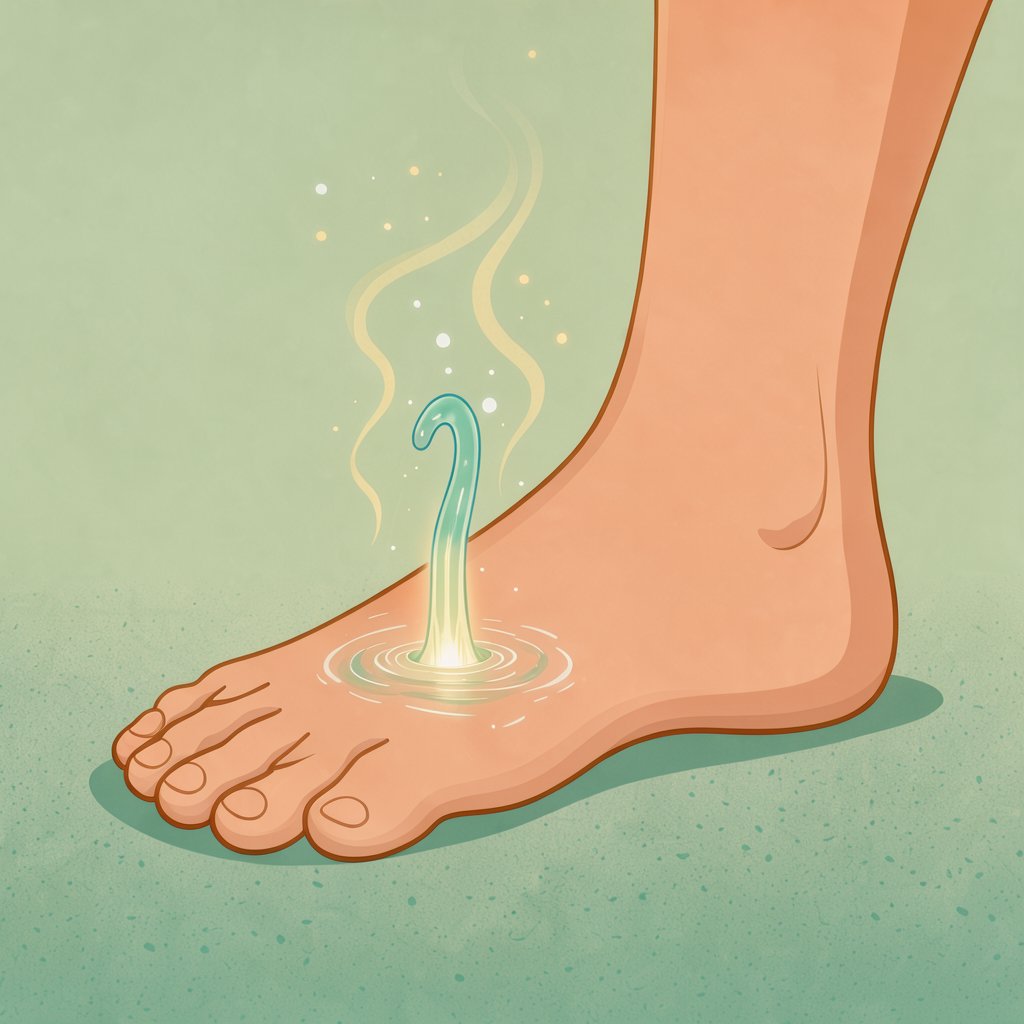
What Is Yongquan (KI1), the Gushing Spring?
Yongquan (KI1) is the Jing-Well and Wood point of the Kidney channel, named Gushing Spring in the classical literature[1]. It lies on the sole of the foot, and the Kidney primary channel reaches it by crossing the sole — this is the channel’s first, beginning point[1]. In practical terms, the point the classical anatomy places lowest on the entire body is also the point the tradition treats as a living connection between you and the ground you stand on.
That connection is not decoration. The same tradition calls the pair of points “Bubbling Wells” because the Qi is continually coming out of them, like water rising at a spring[3]. A related teaching — the five gates doctrine — counts the face, the two Laogong points (PC-8) at the center of the palms, and the two Yongquan points at the soles as five gates that both release excess Qi and absorb Qi from the environment[3]. In that picture the soles are not a dead end but an exchange surface, which is exactly why pressing them is treated as a whole-body practice rather than a local foot technique.
One more nuance keeps the practice honest. In internal arts, the name Yong Quan is used for a whole region of the front of the sole, not only for the tiny acupuncture point on a chart[4]. For self-massage this works in your favor: broad, comfortable contact through the area is consistent with how the tradition itself uses the name. The exact chart location still matters, because the pressing protocol targets a specific spot — and there is a two-second test that finds it.
How to Find the Kidney 1 Point: The One-Third Rule and the Toe-Curl Test
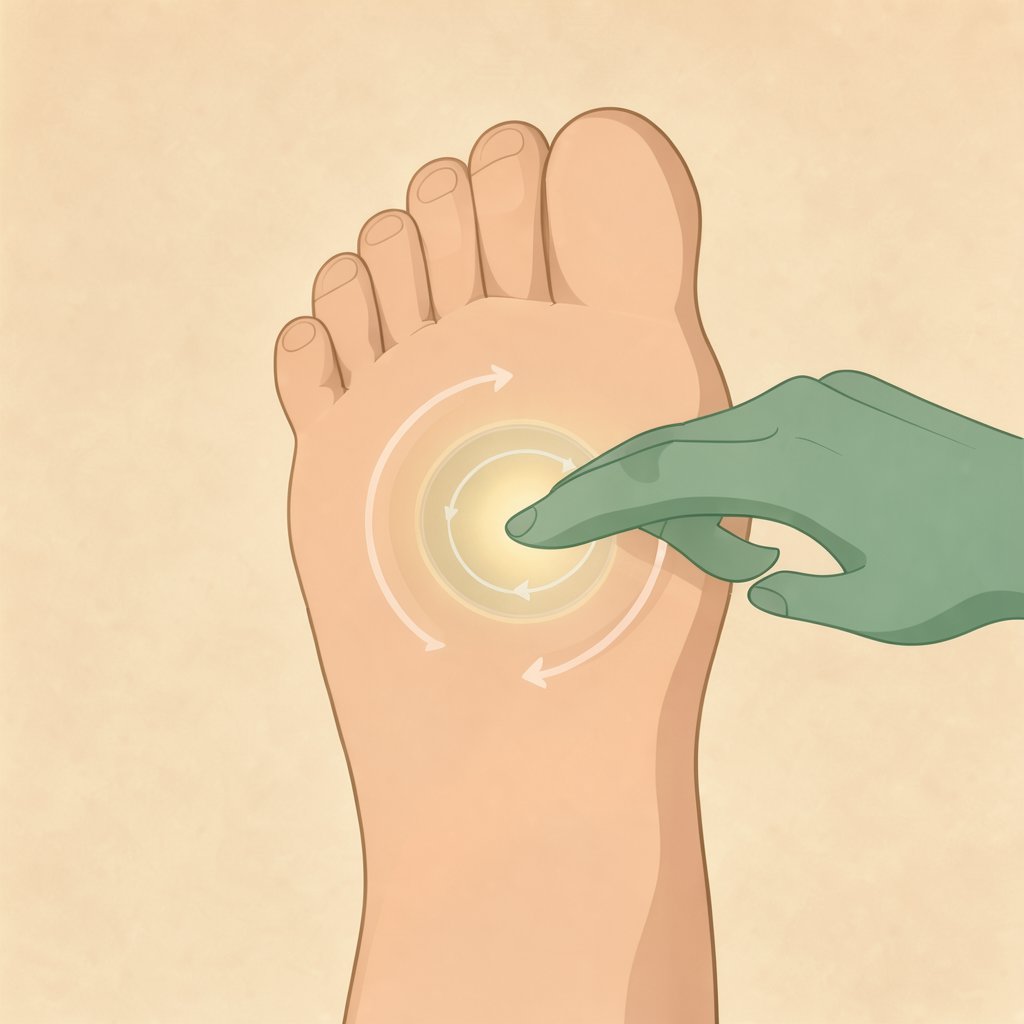
The canonical location reads almost like a field instruction: on the sole of the foot, between the second and third metatarsal bones, approximately one third of the distance between the base of the second toe and the heel, in a depression formed when the foot is plantar flexed[1]. Two coordinates do the work — the one-third distance and the gap between the two metatarsal bones. The plantar-flexion detail is the built-in confirmation check, described below as the toe-curl test.
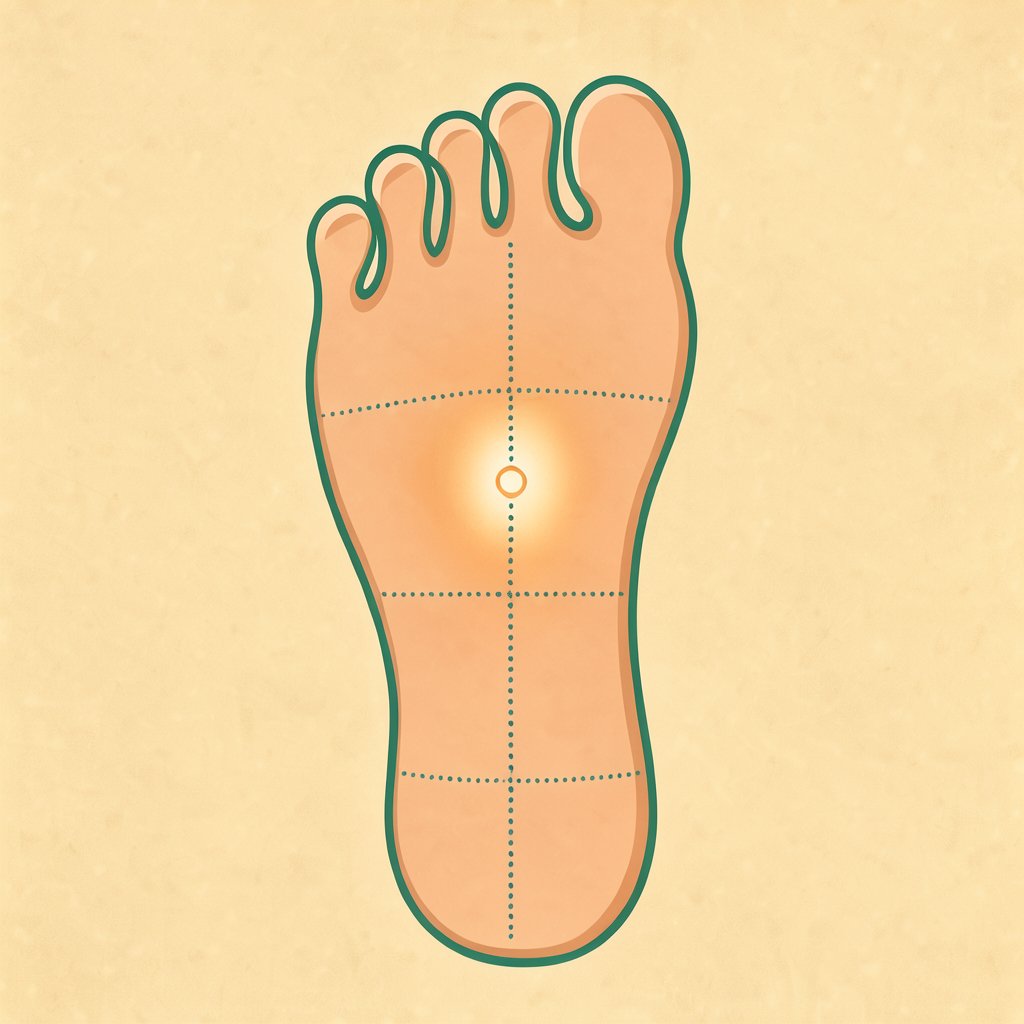
Step 1: Measure by eye with the one-third rule
Look at the sole and find the base of the second toe, then trace an imaginary line from there toward the heel[1]. Stay between the second and third metatarsal bones — the two long bones running behind those toes — as you go[1]. The point sits approximately one third of the way along that line, which lands it closer to the toes than to the heel. Estimating by eye is enough at this stage, because the next step confirms the spot by feel.
Step 2: Curl the toes and press the pit that appears
Curl the toes downward — plantar flexion, in anatomical terms — and watch the sole change[1]. A soft depression appears between the heads of the second and third metatarsal bones, right at the one-third line. When the toes relax, the pit fades, so it is easiest to keep the toes curled while you press it once with a thumb to memorize the spot. That visible, feelable depression is the confirmation that the kidney 1 point is found[1].
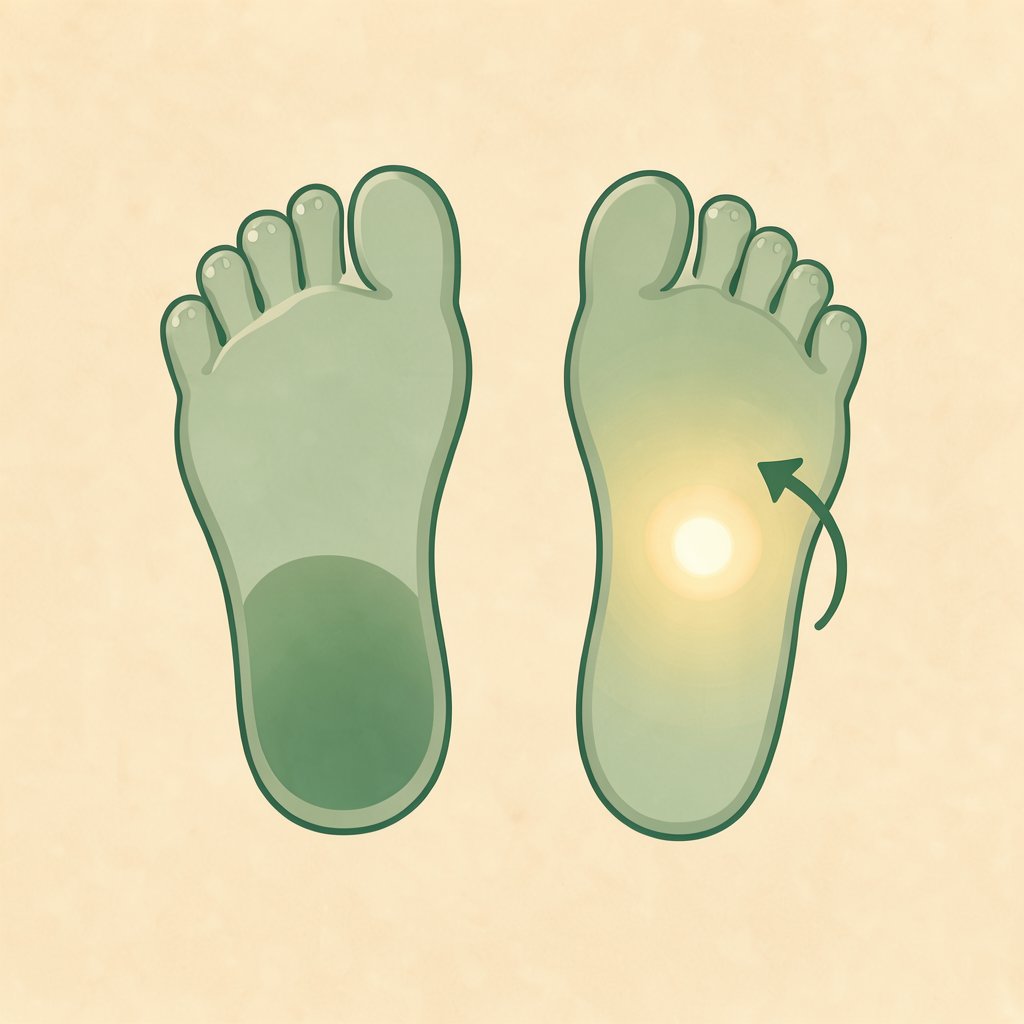
A note on depth keeps the calibration honest. The professional reference lists perpendicular insertion of 0.5 to 1 cun for this point — a needling depth meant for trained practitioners[1]. Self-acupressure never needs anything close to it: steady, comfortable thumb contact with the surface depression is the whole of the method. Comfortable, tolerable pressure is the goal throughout, and sharp pain is always a signal to ease off.
Why Classical Texts Call KI1 the Grounding Point
The traditional actions recorded for KID-1 read like a single downward gesture: it descends excess from the head, calms the spirit, and revives consciousness and rescues yang[1]. Read together, the three actions describe taking what has risen too far — agitation, heat, excess — and returning it to the body’s base. That is the classical logic that later teachers compressed into the modern word “grounding.”
The commentary tradition is more specific about the mechanism. Following the Classic of Difficulties — “in cases of deficiency reinforce the mother, in cases of excess reduce the child” — KID-1 is identified as the child point of the Kidney channel, with a powerful effect on reducing excess above by “returning the unrooted back to its source”[1]. The alternative classical names point the same direction: Earth Surge and Earth Thoroughfare (both rendered Dichong), while the Ode to Elucidate Mysteries states plainly that “Yongquan KID-1 echoes the earth”[1]. In this lineage of texts, calling the point grounding is not a metaphor borrowed from elsewhere; it is a direct translation of a recorded action.
The practice instruction that completes the chain comes from the qigong side. Rooting begins by sinking the Qi to the Dan Tian and the Bubbling Wells — the Yongquan cavity, K-1 — in the feet, while clearing the mind; only then, the teaching goes, can you begin to develop your root[3]. One honest boundary belongs here as well: “grounding” in this article means that classical descending, returning-to-source action, exactly as the texts state it. It is not upgraded into a clinical claim about any modern condition.
How to Press Yongquan: The 10-Second Protocol, Step by Step
The fullest self-massage sequence in the sources pairs Yongquan (KI-1) with Laogong (PC-8), the point at the center of the palm, and runs in ten-second units[2]. It is taught for the left side first and then repeated in full on the right. Five steps carry the whole sequence, reproduced here as taught, with no added counts and no invented modifications.
Step 1: Press and vibrate both points for ten seconds
Press and vibrate Laogong PC-8 on the left palm with the right thumb, letting the other four fingers act as leverage on the back of the hand[2]. At the same time, press and vibrate Yongquan KI-1 on the left foot with the heel of the right foot — the right hand is fully occupied with the palm point, so the heel does the sole’s work[2]. Hold the paired press-and-vibration for ten seconds, keeping the pressure firm but comfortable on both ends.
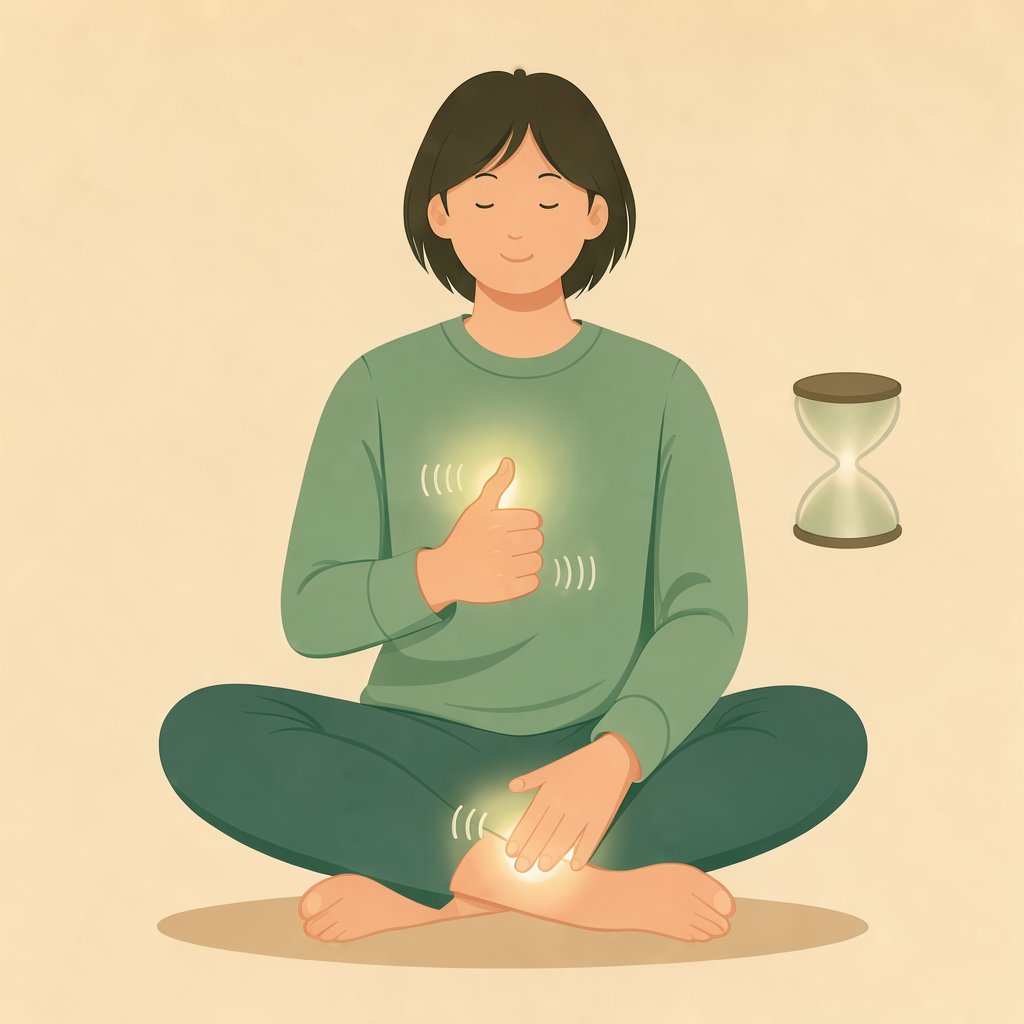
Step 2: Rest, then repeat the press-and-vibration
Release and rest for a few seconds, letting both points settle[2]. Then repeat the same paired press-and-vibration for another ten seconds. Two ten-second rounds of press-and-vibrate are the complete dose for this phase — the source adds nothing more, and neither does this guide.
Step 3: Rub both cavities in small circles
Shift from vibration to rubbing: massage both cavities — palm center and sole — with a circular motion for ten seconds[2]. Rest a few seconds, then rub again. The circles stay small and slow, over the depressions you found, rather than wandering across the whole palm and sole.
Step 4: Push downward along the inner limbs, then switch sides
Finish the left side with ten downward pushes along the inner aspects of the limbs: from the upper arm toward the fingers, and from the upper thigh toward the toes[2]. The direction matters in the source’s framing — downward, toward the extremities, following the same descending logic as the point itself. Once the pushes are done, repeat the entire sequence from Step 1 on the right side.
Step 5: Close lying down, breathing deeply and slowly
The protocol ends horizontally: lie down, relax, and breathe deeply and slowly for a few minutes so the Qi can redistribute[2]. This is not a relaxation note tagged onto the method but its stated closing step. The breathing carries its own mechanics, and the next section gives them the space they deserve.
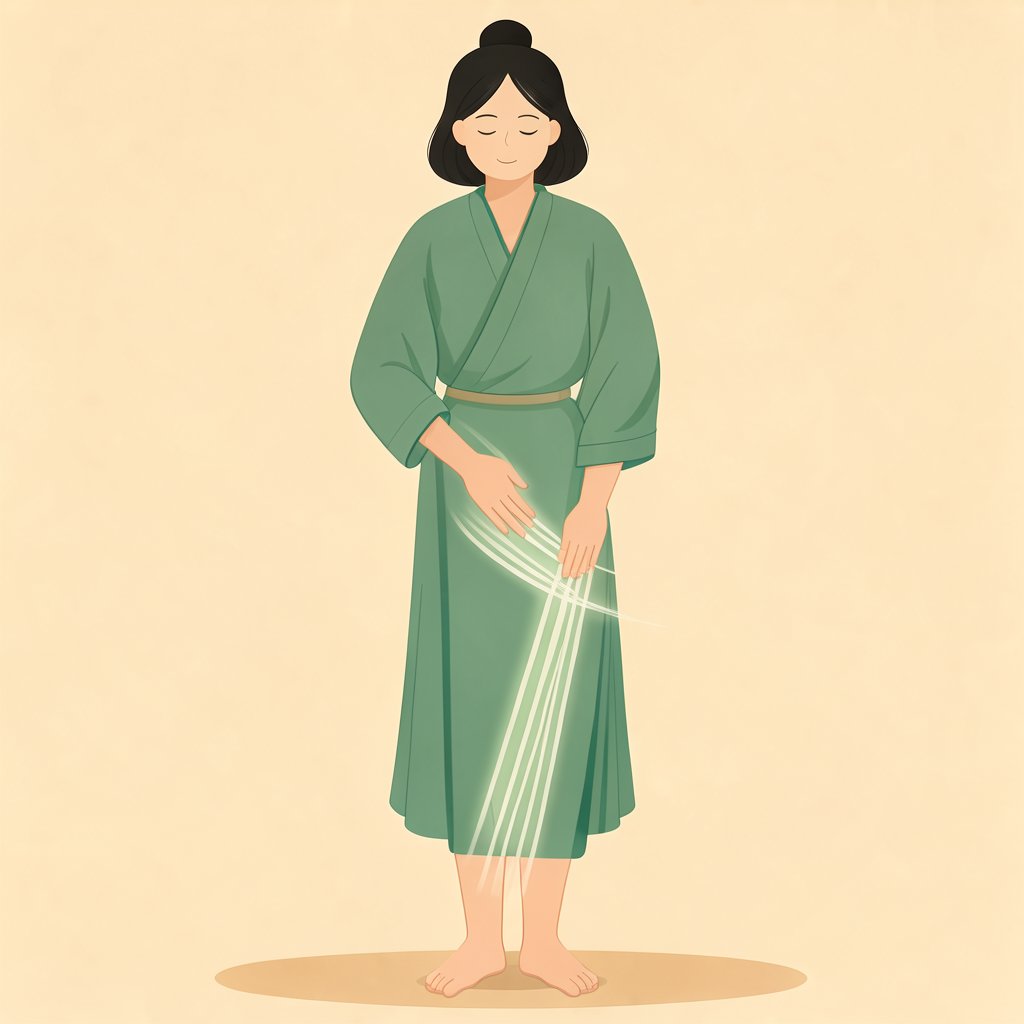
Why pair the palm with the sole at all? Because PC-8 and KI-1 are two of the five gates in the doctrine described earlier — the gates taught to release excess Qi and absorb fresh Qi from the environment[3]. Working both ends of that axis in the same ten seconds is the design of the exercise, not a stylistic choice. Counting the four ten-second phases, the rests, and the pushes, one side takes roughly a minute and a half — a small, repeatable unit.
The Breathing Pattern: Lead Qi to Your Soles on the Exhale
The same source assigns breathing a specific mechanical role rather than treating it as background calm. It is the exhalation, the text states, that leads Qi to the five centers — the head, the two Laogong cavities at the palms, and the two Yongquan cavities near the center of the soles — and brings the skin to exchange Qi with the surroundings[2]. Inhalation does the opposite work: it draws Qi deep inside, to the internal organs and the marrow[2]. One direction carries outward and down; the other carries inward and deep.
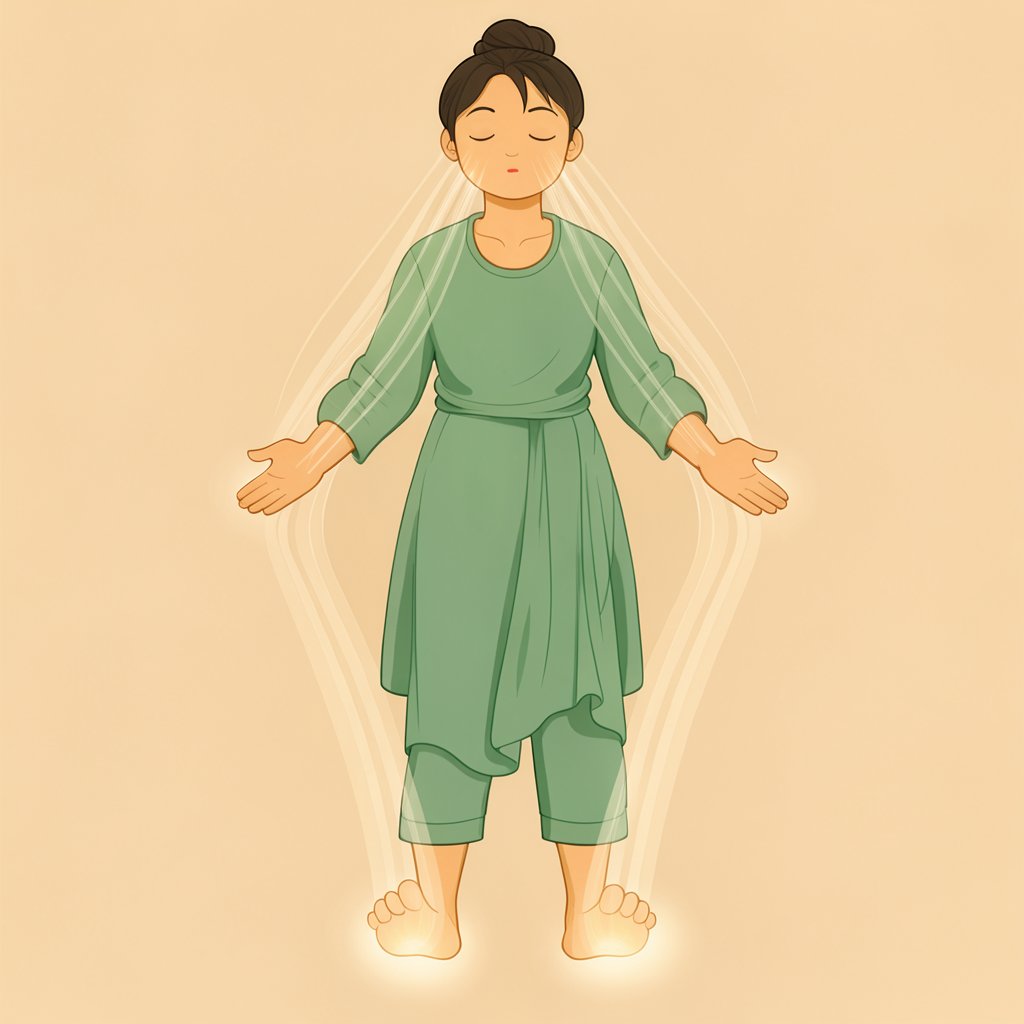
Turned into practice, the pattern is simple to hold. Sit or lie comfortably as the closing phase of the protocol begins. On each slow exhale, let your attention sink toward the two soles and the two palms — the direction the source assigns to the out-breath[2]. On each soft inhale, let the sensation settle inward without steering it anywhere in particular. A few minutes of this is exactly what Step 5 asked for: deep, slow breathing that settles what the pressing has moved.
One boundary note keeps this section honest. The sources give no breath counts, no retention times, and no inhale-to-exhale ratios for this practice — so none appear here[2]. If a teacher or an app adds counts, that addition comes from somewhere other than the books behind this article. Breathing slowly and comfortably, with attention sinking on the exhale, is the entire documented instruction.
The Warm-Palm Variant: Heart Fire Nourishes Kidney Water
When the full paired protocol feels like too much ceremony, the older of the two qigong books leaves three lighter doors into the same point, listed here in order of effort[3]. The first is a simple thumb massage: small circles with the thumb over each Bubbling Well in turn. The second rubs the sole with the center of the palm, which happens to be Laogong territory. The third is the flagship variant: rub the palms together until they are very warm, then place the Laogong centers directly on top of the Yongquan points and rest them there — classically described as “using the Heart Fire to nourish the kidney water”[3].
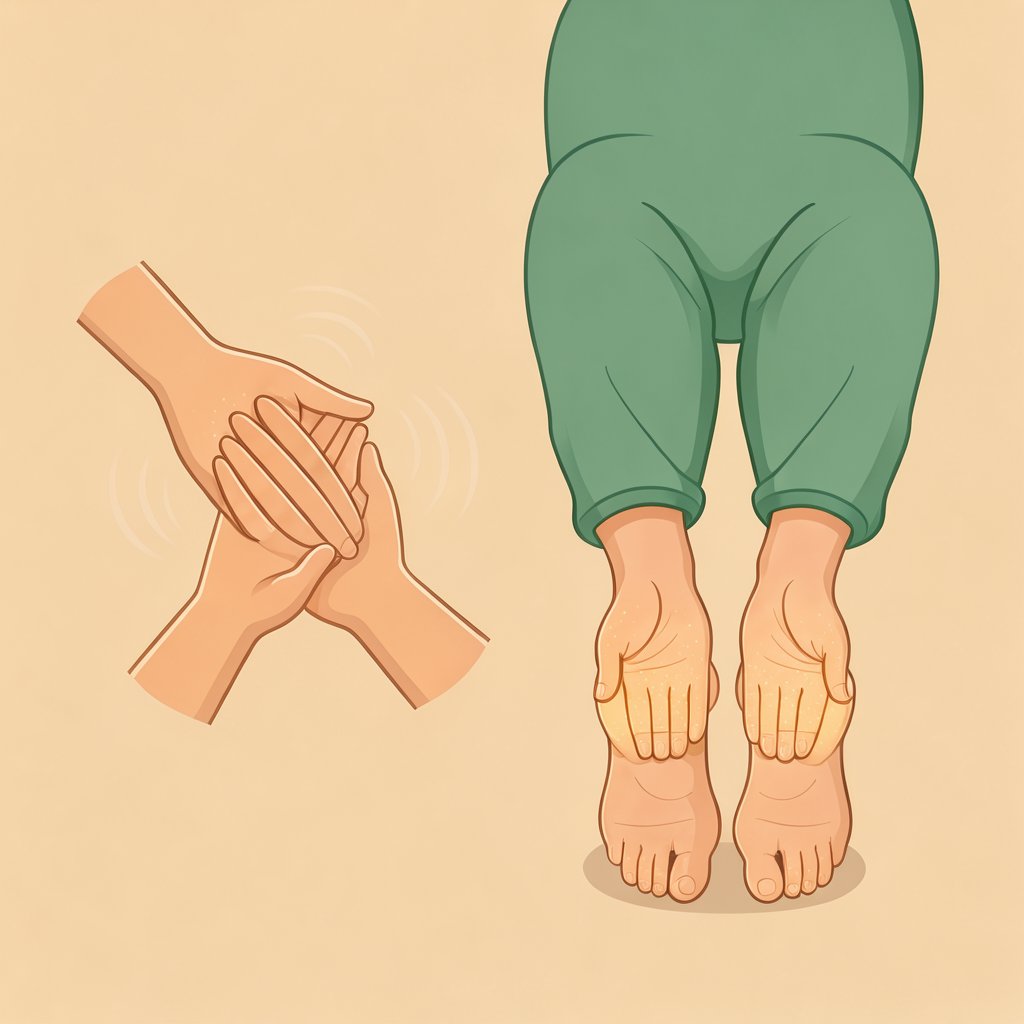
The pairing logic deserves one paragraph, staying strictly inside what the cited phrase states. The classical description — “using the Heart Fire to nourish the kidney water” — carries the whole exchange inside its own words: one end of it is named Heart Fire, the other kidney water, and the warm palm resting in between is the bridge the image draws[3]. Resting the Laogong centers (PC-8, at the middle of the palms) over the Yongquan points (KI-1, at the soles) simply makes that sentence physical, and the phrase is the source’s own, not an added theory. The same passage ranks the underlying practice highly, calling the massage of Yongquan “probably the second best technique in nourishing the Qi and improving Qi circulation around the kidneys”[3].
One safety nuance travels with this variant, stated by the same author. Warm up your hands before touching the soles — cold hands, the text warns, will drain Qi from the kidneys rather than nourish them[3]. A few seconds of brisk rubbing solves it and doubles as preparation for the palm-warming step anyway. As an evening wind-down, the warm-palm rest is the gentlest entry in the whole article: it asks for nothing but warm hands, a quiet seat, and a few unhurried minutes.
What KI1 Traditionally Addresses: From Hua Tuo’s Head Wind to Cold Feet
The classical grounding story attached to this point has a name and a date. In the second century, the physician Hua Tuo treated General Wei Tai-cu — whose complaints the commentary records as “head wind, confused mind and visual dizziness” — by needling Yongquan KID-1, and the general was cured on the spot, as the classical record tells it[1]. The working principle the anecdote illustrates is selecting points below to manage disorders above. It is history, not a promise: what a physician did with a needle in the second century is not what a thumb does tonight.
Beyond the anecdote, the manual summarizes the principal traditional uses of KID-1 in three groups: uprising of Liver yang, fire or wind; disharmony of the Heart and Kidneys; and disorders of the throat[1]. The fuller traditional indication lists from the two main sources group naturally into four regions of the body[1][2]:
- Head and spirit: dizziness, vertex headache, hypertension, insomnia, poor memory, propensity to fear, rage, loss of consciousness, epilepsy[1][2].
- Throat and chest: throat pain, sore or swollen throat, dry mouth, cough, dyspnoea[1][2].
- Lower body and fluids: infertility, impotence, edema, constipation, kidney pain, heat in the soles, cold feet[1][2].
- Emergencies, as traditionally recorded: fainting, windstroke, cerebrovascular accident, asphyxia in drowning, excessive sleepiness, blurred vision[1][2].
Every item above is a traditional indication recorded in classical-compilation sources — a record of what the point was called upon for, not a promised outcome[1][2]. One gap deserves its own sentence: the sources collected in this article contain no clinical trial figures for KI1, and none have been invented to fill the space. Where the tradition records, this article records; where it is silent, it stays silent.
How Much Is Enough: Dosage, Heel-Weight Posture, and Honest Limits
The per-session dosage that is actually sourced reads compactly: two ten-second rounds of press-and-vibrate and two ten-second rounds of circular rubbing at each point pair, plus ten downward pushes along each inner limb — then the whole sequence once more on the other side[2]. Add the closing minutes of slow breathing and the complete practice settles comfortably under ten minutes. For a lighter touch, the warm-palm variant from the previous section carries no counted dosage at all: warm hands, a quiet seat, and as long as feels comfortable.
For evening use there is also a duration convention on record. A handbook devoted to twenty-five points describes a ten-to-fifteen-minute evening massage session held to help with insomnia, including about ten minutes at the point at the center of the feet[5]. An honesty flag travels with that source: its available English translation is garbled, so the figure is used here as a convention for a relaxed evening session, not as a prescription. Framed that way it agrees well with the qigong protocol — the pressing takes its two minutes, and the rest of the session is warm contact and slow breathing.
On frequency, the honest answer is that there is no sourced answer. No explicit times-per-day or days-per-course protocol for KI1 appears anywhere in the corpus behind this article — so this guide deliberately does not manufacture a “twice a day for two weeks” style regimen[1][2]. What the sources do support is a per-session structure you can repeat whenever it serves your evening. When in doubt, less pressure held comfortably beats more pressure endured.
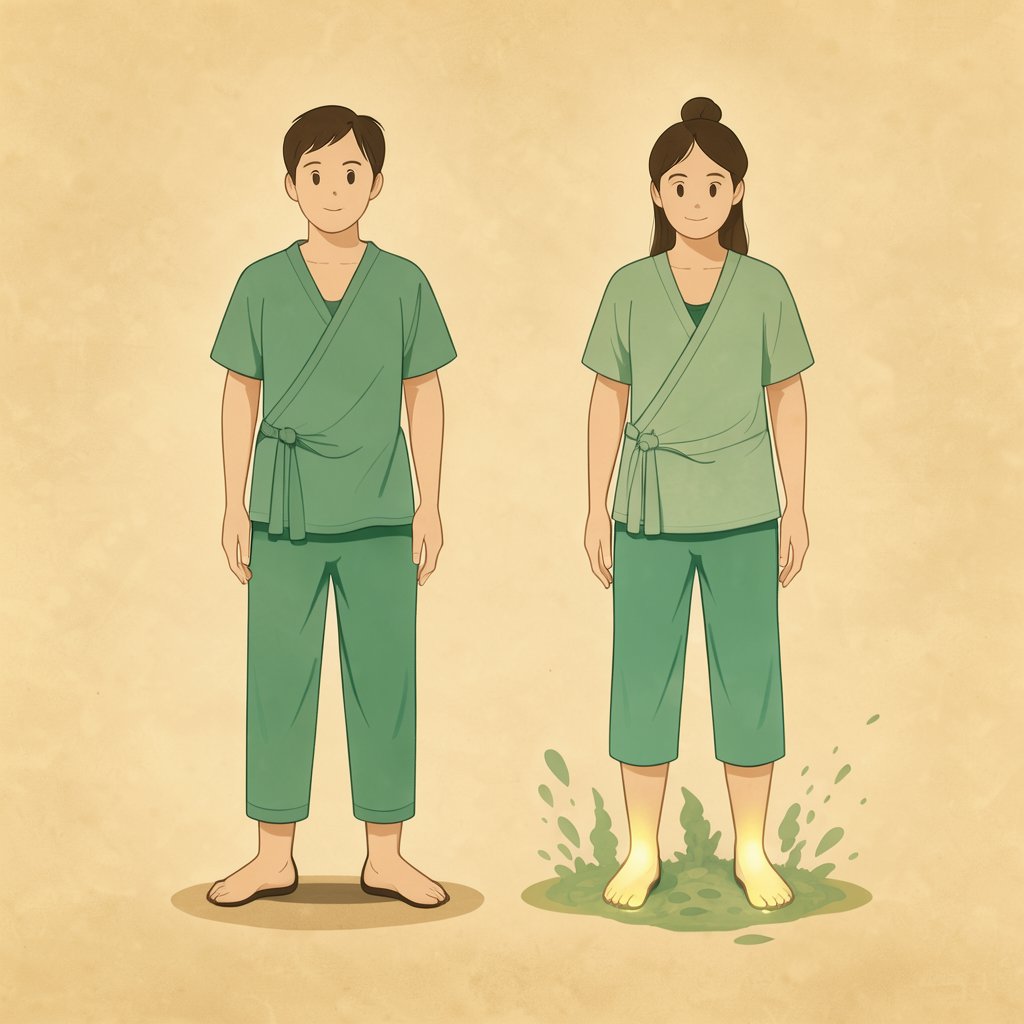
Posture turns out to be part of the dosage conversation. An internal-arts guide observes that consistently standing and walking with the weight focused into the heels “shuts the Yong Quan points,” which prevents the conduction of earthly Qi — and for that reason internal arts deliberately keep some of the body’s weight over the front of the sole, where the Yong Quan region sits[4]. As a practical translation: soft knees, weight spread toward the front of the foot rather than parked in the heels, and breath sinking toward the soles now and then through the day. The pressing protocol and the standing habit are two halves of the same classical idea — the sole as an open gate.
Safety: Who Should Be Careful with Foot Acupressure
Begin with an honest admission: the books behind this article contain no KI1-specific contraindication block — no dedicated list of conditions under which this exact point should not be pressed. What follows is therefore a general safety block for foot acupressure self-massage, assembled from the general principles the sources do state, and flagged as such rather than passed off as point-specific doctrine. Silence in the sources is a reason for caution, not for invention.
The clearest general rule is also the oldest: stop the session immediately at unpleasant sensations[6]. That principle comes from a head-and-neck massage context in its source, but it applies cleanly to the feet — a dull aching warmth is one thing, and sharp or radiating pain is a signal to lift the thumb. The warm-hands caution belongs in the same breath: cold hands drain Qi from the kidneys in the source’s framing, so a few seconds of rubbing the palms together is both comfort and technique[3].
Pregnancy deserves a specific, careful note. The canonical manual lists a pregnancy-related condition — “pain in the lower abdomen in pregnant women with inability to urinate” — as an indication for KID-1 needling by a professional, and that is exactly what it is: a professional-care item, not a self-care instruction[1]. No self-care pregnancy guidance for this point exists in these sources, so if you are pregnant, the honest direction is to a qualified practitioner rather than to a technique from an article. More generally, acupressure is not a substitute for medical care: dizziness, fainting, uncontrolled high blood pressure, or any sudden severe symptom is a reason to see a clinician, not to self-treat. Feet with neuropathy — common in diabetes — or with injured or broken skin deserve professional clearance before any self-massage routine, as a general caution.
Frequently Asked Questions About the Yongquan Point
Where exactly is the Yongquan KI1 point?
On the sole, between the second and third metatarsal bones, about one third of the distance from the base of the second toe to the heel[1]. The quick confirmation is the toe-curl test: plantar-flex the foot, and a soft pit appears right at that line — press while it is visible[1]. The walkthrough is in the finding section above; our Zusanli (ST36) manual works a neighboring point the same way.
How long and how often should I press KI1?
The classical sources give per-session timing, not a daily regimen: two ten-second rounds of press-and-vibrate, two ten-second rounds of circular rubbing, and ten downward pushes per limb, then the other side[2]. No times-per-day or days-per-course protocol exists in the corpus, so this guide repeats no invented frequency. Treat it as an evening practice you can return to whenever it serves you.
Is the Yongquan point good for sleep?
Insomnia appears on the traditional indication lists for KID-1[1], and one handbook describes a ten-to-fifteen-minute evening foot massage as a sleep-support convention[5] — with the caveat that this book’s translation is garbled. Framed honestly, this is traditional use, not a clinical promise. The warm-palm variant makes a natural pre-bed ritual; see our evening wind-down manual for the surrounding routine.
Can foot acupressure at KI1 help with headaches or dizziness?
Vertex headache and dizziness are on the recorded traditional lists, and the famous second-century anecdote has Hua Tuo needling KID-1 for head wind and visual dizziness[1]. That is history and traditional record, not a promise of relief. For recurring or severe headaches the first stop is a clinician — in the sources’ own framing, acupressure accompanies care rather than replacing it[6].
Which direction do I press or rub the kidney 1 point?
The taught sequence is press-and-vibrate for ten seconds, then small circular rubbing over the same depression for ten seconds[2]. No complicated angle or direction lore appears in the sources for this point — the depression found by the toe-curl test is the target[1]. Circles stay small and slow, over the pit.
Is pressing Yongquan safe during pregnancy?
The only pregnancy-related KID-1 item in the corpus is a professional needling indication, not a self-care instruction[1]. No self-care guidance for pregnant readers exists in these sources. The honest direction is a qualified practitioner or midwife before any foot acupressure routine.
The Yongquan acupressure point earns its reputation the quiet way: it is the lowest mapped point on the body, the first point of the Kidney channel, and the spot where the classical texts pictured a spring[1][3]. The practice assembled here — the toe-curl test, the paired ten-second protocol, the exhale that leads toward the soles, and a warm palm at the end — takes minutes, requires nothing but your own hands, and stays exactly as large as its sources. That is a good size for a nightly ritual.
Sources
- [1] Deadman Peter — A Manual of Acupuncture (2007) — the canonical KID-1 entry: point location between the metatarsals, needling depth, traditional actions, classical commentary with the Hua Tuo anecdote, and the full traditional indication list.
- [2] Yang Jwing-Ming — Meridian Qigong Exercises: Combining Qigong, Yoga, Acupressure (2016) — source of the paired PC-8 and KI-1 self-massage protocol taught step by step here, the exhalation mechanics, and the additional traditional indication list.
- [3] Yang Jwing-Ming — The Root of Chinese Qigong: Secrets of Health, Longevity and Enlightenment (1997) — the Bubbling Wells etymology, the five gates doctrine, the rooting instruction, the solo massage variants, and the cold-hands caution.
- [4] Damo Mitchell — A Comprehensive Guide to Daoist Nei Gong (2018) — the reading of Yong Quan as a region of the sole, and the observation that standing and walking with weight in the heels shuts the points and blocks earthly Qi conduction.
- [5] Medvedev A., Medvedeva I. — 25 Magic Points (2008) — the ten-to-fifteen-minute evening massage convention for sleep support including the center-of-foot point; machine-translated text, used here only as a duration convention.
- [6] Yermakova S.O. — Head and Ear Massage (2010) — the general stop-at-unpleasant-sensations principle, stated in a head-and-neck massage context and applied here as a general safety rule for self-massage.
Where to go next: this point belongs to a wider acupressure silo on the site. Work the neighboring leg point with our Zusanli (ST36) acupressure manual, take the head-and-neck map from the acupressure for head tension guide, or browse the full manuals library for complete routines. Each guide keeps the same rule: facts from books, gaps declared.
How we researched this: built from a local library of 1,137 wellness books, indexed and searched offline with no internet sources. Every factual claim above carries a numbered footnote to the book passage it came from. Where the library was silent, the article says so instead of guessing.
