
Educational content only — not medical advice. See our full Medical Disclaimer and Affiliate Disclosure below.
Search for the best probiotic for gut and immune support in 2026 and you will collect a stack of top-ten lists ranking brands you cannot verify from the page in front of you. This guide does something more durable: it turns the probiotic strains guide problem into a label-reading skill you can run on any jar in any aisle. Five checks — the strain ID, the CFU count, the live-culture claim, the format, and the protocol — compress what a research library of 1,137 wellness books actually documents about probiotics, fermented foods, and the immune tissue living in your gut wall[1]. The goal is not to crown a single winner; the goal is that you leave knowing exactly why a given label does or does not deserve your money.
One disclosure first, because it shapes everything below. Our book base — the same offline library behind every article on this site — holds detailed material on strain taxonomy, dosing thresholds, storage, and the gut–immune mechanism, but it contains zero probiotic brand or product data: the newest book in it was published in 2023[1]. So this immune probiotic review names no products and prints no podium. Where a claim traces to a book, it carries a footnote; where the library is silent, the gap is labeled as a gap rather than filled with marketing.
Key Takeaways
- A label that names only a species is hiding the product: strain properties differ strongly, one strain cannot replace another, and multi-strain formulas often give a more stable result[1].
- Dose has a floor and a benchmark: below 5 billion CFU per day a product is practically useless as a course[1], while 50 billion CFU or more, multi-strain, from a GMP maker is the supplement benchmark[3].
- Shelf-stable ferments carry no live cultures — buy from the refrigerated section and look for “live and active” wording[3]; a dairy shelf life of about 30 days practically excludes live cultures[4].
- Match format to goal and commit to a course: studied protocols run from 2 to 16 weeks, taken on an empty stomach two hours away from meals[4][8][3].
- The FDA has not approved a single probiotic for preventing or treating any disease[2], and effects fade after you stop[1] — expect a dated course, not a personality change.

Why a Label Decoder Beats Any Best-Probiotics Ranking in 2026
Every year brings a fresh crop of best-probiotics rankings, and every year they quietly assume one bottle can be best for everyone. The biology says otherwise: the human microbiota is two-thirds individual, so the same capsule meets three different ecosystems in three different people[2]. Regulation points the same direction. The FDA has not approved a single probiotic for preventing or treating any disease, which means no ranked list is standing on an official verdict[2]. A decoder built from labeled facts is simply the honest format for a category like this one.
The idea itself is more than a century old, which is exactly why label literacy — not novelty — is the useful skill. Nobel laureate Ilya Metchnikoff promoted soured milk for longevity and wrote about it for the French Academy of Sciences; the Bulgarian bacillus behind his enthusiasm was discovered by Stamen Grigorov in 1905, and Metchnikoff himself took a pure culture of Lactobacillus delbrueckii subsp. bulgaricus preventively[1]. What has changed since his day is not the bacteria; it is the label. Strain identifiers, CFU counts, live-culture wording, and cold-chain logistics are where a modern product either earns its price or does not.
So this guide runs five checks instead of a podium. Check 1 decodes the strain ID, Check 2 reads the CFU count against published thresholds, Check 3 verifies live cultures and storage, Check 4 matches the format to the goal, and Check 5 sets protocol, timing, and expectations. The closing promise comes from the sources themselves: probiotics help only those they can help[1] — a decoder at least tells you whether the jar in your hand has a chance of being one of them.
Your Gut Wall Is Immune Tissue: The Mechanism Behind the Claims
Before any check makes sense, one question needs an answer: why would bacteria on a label touch your immunity at all? Because the intestinal wall is not just digestion — it is lymphoid tissue, the gut-associated lymphoid tissue (GALT), where beneficial bacteria participate in producing lymphocytes and immunoglobulins[5]. Bifidobacteria carry muramyl dipeptide in their cell wall, a compound that activates lymphocyte synthesis; when the flora is damaged, the wall holds fewer lymphocytes[5]. The key mucosal immunoglobulin is secretory IgA, and more than 50 percent of gut lymphocytes are B-cells producing it[2].
The anatomy behind that number includes Peyer’s patches, the appendix, and the mesenteric lymph nodes[2]. IgA works by blocking pathogens from attaching to enterocytes — the cells lining the gut[2]. Commensals fight on your side as well: they produce colicins that suppress rival bacteria, and when a course of antibiotics mows the flora down, the opportunist C. difficile moves in with its toxin, diarrhea, and pseudomembranous colitis; nosocomial C. difficile is a growing cause of death in the elderly[6]. Bifido- and lactobacteria also form a protective biofilm on the gut wall, while the flora at large makes vitamins and enzymes, detoxifies heavy metals, influences cholesterol, and produces anti-cancer substances[7].

This machinery is worth protecting because it gets damaged routinely. The average person completes 10 to 12 antibiotic courses before entering university, and rare species may disappear forever — the books illustrate it with a thought experiment of a microbiome falling from 500 species to 495 and never recovering the missing five[1]. Beyond antibiotics, the listed dysbiosis drivers include alcohol and abrupt diet change[13], plus stress, smoking, hormonal changes, and long courses of statins, steroids, or acid-blocking PPIs[8]. Beneficial bacteria also stimulate mucin production and supply B vitamins for the nervous system, which is why the state of the flora echoes far beyond digestion[8].
When might probiotics be worth considering at all? One source offers a plain everyday checklist: recurring heartburn, bloating, frequent colds, irritable bowel complaints, or antibiotics more than once a year are the signals people actually notice[8]. None of that is a diagnosis, and the checklist is a conversation-starter for a doctor’s visit rather than a self-test. What it establishes for this guide is direction — the gut wall is the immune tissue those label claims are aimed at, so the claims deserve a serious reading.
Check 1: The Strain ID Matters More Than the Species
Most probiotics on the shelf belong to three groups — lactobacilli, lactic-acid cocci, or bifidobacteria — and the taxonomy runs from genus to species to strain[1]. The critical fact for a buyer sits at the deepest level: strain properties differ strongly, one strain cannot replace another, and multi-strain products often deliver a more stable result[1]. Current research concentrates on strains that survive gastric acid, with L. rhamnosus, L. casei, and L. johnsonii named as the focus[1]. A label that stops at the species — “a blend of Lactobacillus acidophilus” — is hiding the one thing that predicts behavior.

The named strains in the literature prove that the letters mean something. Lactobacillus GG carries the initials of researchers Sherwood Gorbach and Barry Goldin[2]. Gorbach spent more than twenty years screening dairy cultures across America, Europe, and Asia for bacteria that persist in the human gut — and found none; the few that survived stomach acid disappeared within one to two days[2]. That null result is worth carrying through the whole article: even a famous strain ID does not promise colonization, a point Check 5 and the fine print return to.
E. coli Nissle 1917 tells the opposite story — a strain with a documented therapeutic pedigree. Isolated by Alfred Nissle in 1917 from a soldier who resisted shigella dysentery, it became the first therapeutic probiotic and is sold as Mutaflor, approved in Germany and Europe[1]. In laboratory culture it displaces salmonella and shigella and shows activity against the cholera vibrio, listeria, and candida[1]. Other named strains carry narrower research associations: L. acidophilus NCFM enhances the expression of cannabinoid receptors in the central nervous system and the periphery, while Bifidobacterium infantis supplies tryptophan, linked in the source to tolerance and less irritability[1].
One clinical pairing shows the practical value of strain-level reading: for adjunct support alongside H. pylori therapy, the books name Bifidobacterium bifidum and Lactobacillus rhamnosus specifically, working by competitive suppression[4]. The buyer rule for Check 1 follows directly. If the label prints no letters or numbers after the species name, nothing connects the jar to any documented finding — no strain designation, no purchase.
Check 2: Read the CFU Count Against Real Thresholds
CFU — colony-forming units — is the count of live microbes a dose promises, and the sources give it hard anchors. The floor: doses below 5 billion (5×10⁹) CFU per day are practically useless, so the advice is to choose high-dose products and take them as a course, not occasionally[1]. The benchmark sits an order of magnitude higher: look for 50 billion CFU or more, multiple strains, from a reputable GMP manufacturer[3]. That spread is not a contradiction to hide — the books genuinely differ by tenfold, and an honest guide says so plainly[1][3].

Trial doses land between the floor and the benchmark. The Akkermansia muciniphila experiment that recurs through this guide dosed 10 billion cells per day for three months across 32 volunteers[1]. For perspective, breast milk — nature’s delivery system for a newborn gut — carries roughly 1 billion bacteria per liter[1]. A prescriber’s phrasing from another book makes the label itself the instrument: if you are prescribed a concentrated product, “microorganisms counted in billions — read the label,” the microbes restrain the growth of your own pathogenic flora[9].
Read as a buyer: below 5 billion CFU per day you are essentially paying for a placebo with marketing on it. Between 5 and 50 billion, the purchase only makes sense with strain IDs from Check 1 and a defined goal. At 50 billion or more, multi-strain, from a GMP maker, you have reached the supplement benchmark the sources describe[1][3]. What the CFU count cannot tell you is whether the organisms are still alive at the moment you buy them — which is Check 3’s job, together with a research twist about pasteurized cells that outperformed live ones.
Check 3: ‘Live and Active’ Cultures and the Cold Chain
The count on the label assumes the cultures are alive, and storage decides that before you ever open the jar. Store-shelf pickles and sauerkraut contain no live cultures at all: the guidance is to buy fermented foods from the refrigerated section and check the label for “live and active cultures”[3]. A dairy shelf life of about 30 days practically excludes live cultures, and the bluntest line in the library deserves quoting — the only controller of how many live microorganisms a product or supplement contains is the manufacturer’s conscience[4]. A pharmaceutical drug always contains live bacteria; supplements and foods cannot promise the same[4].
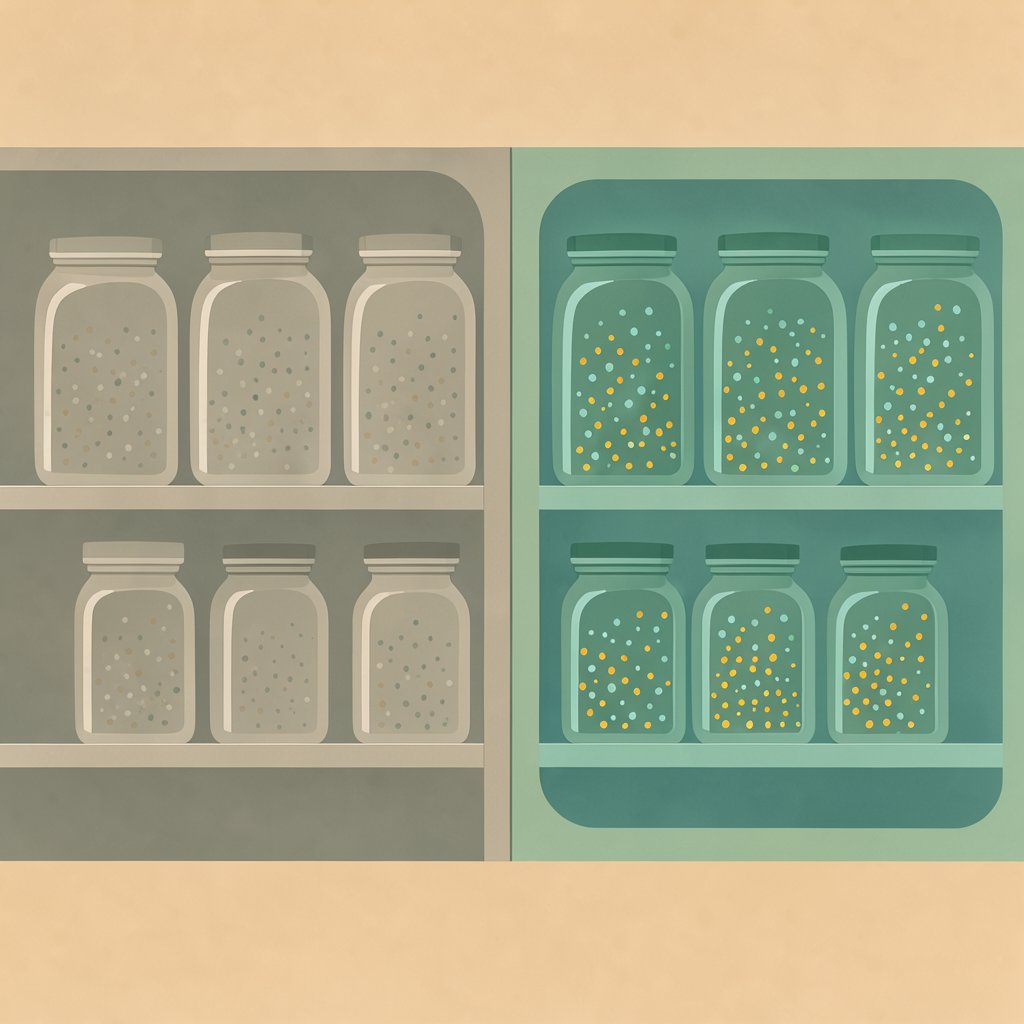
Stomach acid compounds the filter. Practically all dairy-product bacteria die in the stomach, and only the “lucky ones” reach the duodenum[4]. Hence the three-question drill for a yogurt label: which microorganism, in what quantity, and is it marked live[2]. Even three correct answers cannot guarantee an effect in your specific case, which keeps the drill honest rather than magical[2].
Then comes the twist that stops “live always wins” from hardening into dogma. In the three-month Akkermansia trial, pasteurized cells beat live ones: better insulin sensitivity, lower cholesterol and liver-inflammation markers, and about 4.4 lb (2 kg) of weight loss with 1 in (2.5 cm) off the hips[1]. The protein Amuc_1100 survives pasteurization, so the documented effect did not require living cells[1]. Akkermansia is not sold as a supplement at all — it is hard to culture, needing a chitosan medium without oxygen, and it is unpatentable, so pharma is not interested[1].
A regulatory parallel closes the check. The EU banned the word “superfood” from packaging back in 2007; the US has no such rule, and the FDA acts on complaints[12]. Treat front-of-pack wording as marketing until the back panel — organism, quantity, live marking — proves otherwise. “Live” remains the right default for ferments; the pasteurization result simply keeps this decoder honest about how much of the science is genuinely settled.
Check 4: Match the Format to the Goal
Format is where dose, spectrum, and budget meet. One serving of fermented food delivers trillions of beneficial bacteria — far more than a supplement labeled in billions — plus a wider spectrum of species[3]. Capsules generally carry a higher concentration and strains different from those in yogurts and drinks[8]. The same source is candid about the wallet: yogurt is the budget option[8]. None of that crowns one format the winner; it makes format a decision about the job you want done.
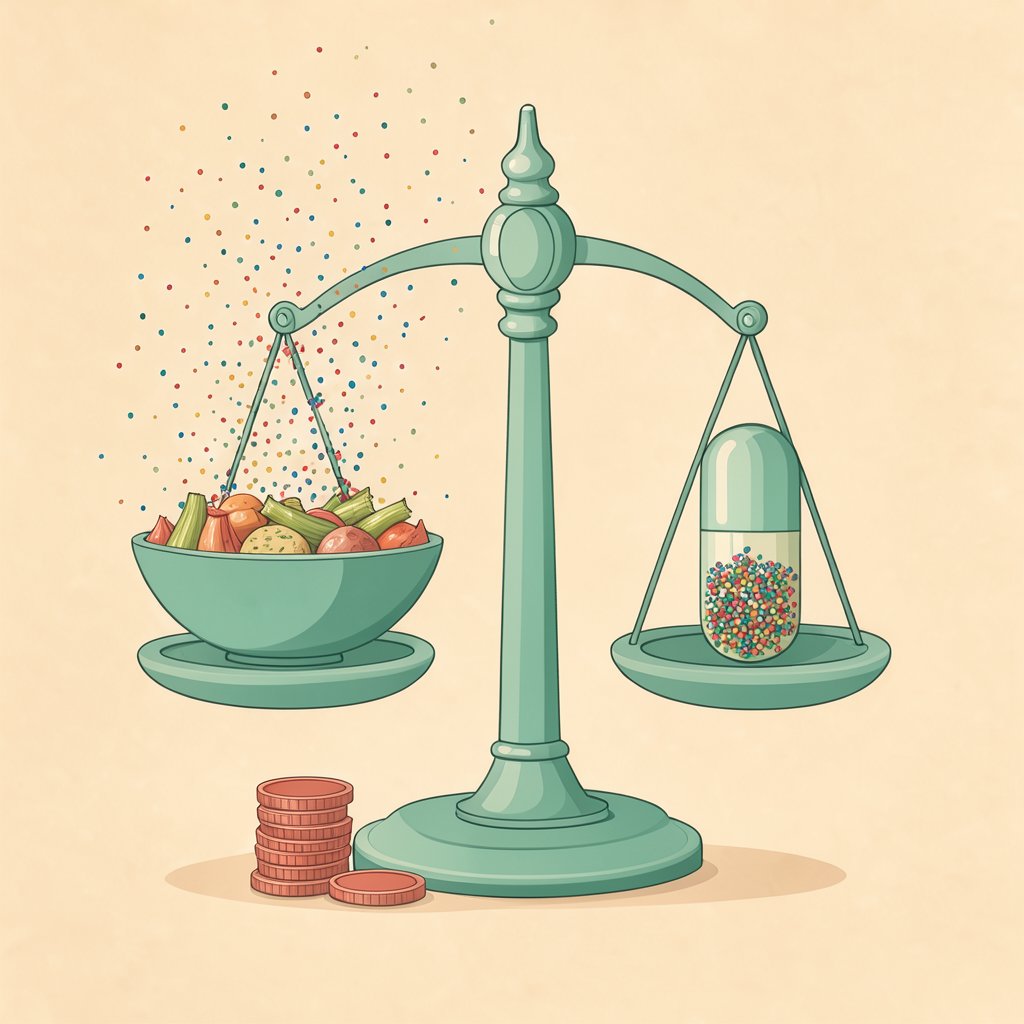
Tradition supplies the longest-running format data anyone has. Kimchi and kefir have centuries behind them in national cuisines, fermentation “does the work for you,” and in one volunteer study iron from marinated vegetables was absorbed better than from fresh ones[12]. The old techniques are the same chemistry: traditional souring and brining are lactic-acid fermentation, the same process that produces the strains a modern capsule packages[11]. A fermentation tradition is not a clinical trial, but it is centuries of kitchen-scale evidence that the format is survivable, repeatable, and food.
The practical pairing follows directly. Daily fermented food — refrigerated, labeled live and active, having passed Check 3 — buys spectrum and diet quality. A concentrated capsule with named strains fits a targeted, dated course. Yogurt covers the weeks when the budget is tight[8]. The honest verdict for this check is that format follows goal, and any review declaring one universal winner is selling you someone else’s routine.
Check 5: Protocol, Timing, and Honest Expectations
The last check is a plan, not a purchase, because studied effects arrive on course-length timescales. For adjunct support alongside H. pylori therapy, the probiotic effect appears only at two or more weeks of continuous intake[4]. Allergy courses in the sources run 12 to 16 weeks[8]. For colds and flu, a three-month multivitamin-plus-probiotic course reduced both the number and the severity of symptoms and shortened cold duration by days[8]. Even mood has a data point: a four-week cocktail of seven species improved mood in 40 volunteers in the Steenbergen study at Leiden — less rumination and less anger on the depression scale[1].

Timing is simpler: take it on an empty stomach, two hours before the first meal or two hours after the last[3]. Strain-class choice without a lab test has a rule as well — choose bifidobacteria first unless an analysis shows a lactobacillus deficiency, because bifido suffer most from external insults and lactobacilli regrow under their protection[9]. Both rules cost nothing and change what a purchase delivers, which is why they belong on the label scorecard in the next-to-last section.
Expectations are where most marketing goes wrong. Effects disappear after stopping intake[1] — a course is a dated project, not a personality change. Recall Gorbach’s twenty-year null result from Check 1: permanence is not on the menu[2]. And even a perfect protocol does not seed anything permanently, which is exactly what the lawn metaphor in the next section fixes.
Prebiotics: You Grow a Gut Like a Lawn
Every previous check assumed you can add bacteria; the strongest line in the library says you can only feed the ones you have. “You cannot colonize your gut with the right organisms — you can only grow your own. Like a lawn”[9]. Prebiotics — oligosaccharides and fiber — are therefore mandatory alongside any probiotic, not an optional upgrade[9]. The capsule is a narrow instrument on top of the diet; the prebiotic fiber in the diet is the lawn itself, the part that makes anything stick.

Nature models the pairing precisely. Breast milk delivers roughly 1 billion bacteria per liter together with GOS and FOS prebiotics — the bacteria arrive with their own food[1]. That is the template worth copying: microbes plus substrate in one system. Feeding your residents pays documented dividends too, since beneficial bacteria stimulate mucin production and the flora supplies B vitamins for the nervous system[8].
For a buyer the reframe is this: spend on the label checks first, then spend on the vegetables, legumes, and whole grains that feed whatever you already own. A course without the lawn is landscaping a lot you never water. The books are blunt that colonization-by-purchase is not how the system works — growth-by-feeding is[9].
The Five-Minute Probiotic Label Scorecard
Everything above compresses into one repeatable audit — five minutes with a label, front panel to back panel, before checkout. Run the five checks in order, and let any hard failure end the review on the spot:
- Strain ID. Find letters or numbers after the species name on every listed strain — Lactobacillus rhamnosus GG, not “a blend of Lactobacillus acidophilus.” Species-only wording means the label hides the only element that connects it to documented behavior[1].
- CFU count. Below 5 billion CFU per day is practically a placebo[1]; trial doses sit near 10 billion[1]; 50 billion or more, multi-strain, from a GMP manufacturer, is the supplement benchmark[3].
- Live cultures and the cold chain. Ferments belong in the refrigerated section with “live and active cultures” on the label — shelf-stable ferments are dead, and a roughly 30-day dairy shelf life practically excludes live cultures[3][4].
- Format by goal. Fermented food buys trillions of cells and spectrum[3]; capsules buy concentration and named strains for a dated course[8]; yogurt covers tight budgets[8]. No universal winner exists.
- Protocol. Empty stomach, two hours away from meals[3]; course lengths from two weeks (H. pylori adjunct[4]) through 12–16 weeks (allergy[8]) to three months (colds[8]); bifido-first without a lab test[9]; expect effects to fade after the last dose[1].
Five red flags end the audit even earlier, each traceable to a check above:
- a species-only label with no strain designations (Check 1);
- mega-CFU numbers with no strain IDs to attach them to (Checks 1 and 2);
- “raw” ferments sold from a room-temperature shelf (Check 3);
- “works in days” promises, when studied courses run weeks to months (Check 5);
- any claim to treat a disease, given the FDA’s record of approving none (the fine print below).

Save the scorecard and run it on the next label you meet — it keeps working after the 2026 product cycle turns over, because its checks are built from thresholds and anatomy rather than from this year’s bottles. That is the takeaway asset of this article: the decoder outlives any product it decodes. One page of fine print still belongs in the decoder before checkout, and it is the page marketing never quotes.
What Probiotics Will Not Do: The Skeptic’s Fine Print
This is the section that separates a decoder from an advertisement. The FDA has not approved any probiotic for preventing or treating any disease; the worst-case scenario researchers flag is the spread of antibiotic-resistance genes among pathogens; and the microbiota is two-thirds individual[2]. Pediatric sources add a blunt verdict of their own: there are no strong arguments that pro- or prebiotics influence the immune system, and it is unknown which strains are more effective, in what quantity, or whether single strains or mixes work — while infant-formula makers, the authors note, earn a lot of money on such claims[10].
Clinical honesty comes next. In serious disease, probiotics are ineffective, and the dose and appropriateness belong to a doctor guided by research data; not every product even delivers enough live bacteria to matter[11]. The general-health ledger is sober as well: efficacy for health improvement is still unproven, and the Bulgarian bacillus has not been seeded from volunteers’ stool since the 1920s[1]. Individual variability is enormous — one illustrative split of 1,000 IBS patients gives 600 no effect at all, 300 helped only while taking them, and 72 with improvement lasting six months or more[1].
The balance line matters as much as the skepticism: “there is certainly no harm from probiotics”[1]. So the verdict lands where the evidence does. The best probiotic for gut and immune support in 2026 is whichever label survives all five checks — taken as a dated course on an empty stomach, paired with prebiotic fiber, and held to the expectation that it helps only those it can help. Labels and products change every year; the five-check decoder and the lawn you feed are what you keep.
A note on safety, kept deliberately general because our book base contains no specific contraindication lists for probiotic supplements — no verified passages on immunosuppression, bacterial overgrowth, or histamine reactions that we could cite. Rather than invent warnings, we state the gap: if you live with a serious condition, take immunosuppressive therapy, or are pregnant, make the conversation with your doctor the first step of any course, not the last[2][11].
Frequently Asked Questions
What is the best probiotic for gut and immune support in 2026?
An honest decoder cannot crown one product. The FDA has approved no probiotic for preventing or treating any disease, and your microbiota is two-thirds individual, so the same capsule meets a different ecosystem in every person[2]. The working answer is a label that survives all five checks: named strains, a CFU count at or above the thresholds, verified live cultures, a format matched to your goal, and a real course protocol.
How many CFU should a probiotic have?
Use two anchors. Doses below 5 billion CFU per day are practically useless, which sets the floor[1]; the supplement benchmark is 50 billion CFU or more, multi-strain, from a reputable GMP manufacturer[3]. Trial doses sit in between — the Akkermansia study used 10 billion cells a day for three months[1]. Between floor and benchmark, strain IDs and a defined goal decide the purchase.
Do probiotics really support immunity?
The mechanism is real: the gut wall is lymphoid tissue (GALT), beneficial bacteria participate in producing lymphocytes and immunoglobulins, and secretory IgA blocks pathogens from attaching to the gut lining[5][2]. The outcome evidence is far more cautious — one source states there are no strong arguments that pro- or prebiotics influence the immune system, and which strains or doses work remains unknown[10]. Mechanism is a reason for interest, not a promise.
Should I take probiotics with food or on an empty stomach?
On an empty stomach: two hours before the first meal or two hours after the last[3]. The logic is gastric acid — practically all dairy-product bacteria die in the stomach, and only the lucky ones reach the duodenum[4], so timing that avoids a full stomach of acid gives the dose its best chance. Consistency matters as much as timing: studied effects appear at two weeks and beyond, not after a few capsules[4].
Can fermented foods replace probiotic capsules?
They are different tools rather than substitutes. One serving of fermented food delivers trillions of bacteria and a wider spectrum of species[3]; capsules carry higher concentration and strains that yogurts and drinks do not[8]. If the ferment is refrigerated and labeled live and active, it can serve as the daily base, with capsules reserved for dated courses with named strains[3][8].
How long until probiotics work — and what happens when I stop?
Expect weeks, not days. H. pylori adjunct effects need at least two continuous weeks, allergy courses run 12 to 16 weeks, and the cold-season study ran three months[4][8]. When you stop, the effects go too — the sources are blunt that benefits disappear after withdrawal, so treat a course as a dated project and pair it with prebiotic fiber[1].
Sources
- [1] Maria Kardakova & Ancha Baranova — What We Know (and Don’t Know) About Food (2022) — the probiotics chapter behind the strain taxonomy, the 5-billion floor, the Akkermansia trial, and the honest-efficacy ledger.
- [2] Evgeniya Umnaykova — How the Immune System Works (2019) — the FDA status, the microbiota’s two-thirds individuality, and the twenty-year Gorbach–Goldin search that found no persisting dairy strains.
- [3] Joseph Mercola — Herbs and Spices (2023)
- [4] Unknown Author — How Doctors Treat: The Truth Hidden from Patients (2020) — the shelf-life and manufacturer’s-conscience passages and the two-week H. pylori course lengths.
- [5] Natasha Campbell-McBride — Gut and Psychology Syndrome (GAPS) (2016)
- [6] Peter Parham — The Immune System, 3rd ed. (2009)
- [7] I. P. Neumyvakin — Kombucha: Natural Healer (2020)
- [8] Soher Roked — The Exhausted Person (2015) — the dysbiosis drivers and when-to-consider checklist, the capsule-versus-yogurt format comparison, and the course-length anchors with timing.
- [9] Z. Pavlova & O. Nosova — The Deception of Substances (2021)
- [10] M. Hauh & R. Hauh — Immunity: How Are You Doing (2020)
- [11] Elena Motova — My Best Friend Is the Stomach (2017)
- [12] Grant Lawton — Hacking the Human Body (2022) — the EU “superfood”-ban regulatory parallel, the kimchi-and-kefir tradition notes, and the iron-absorption study from pickled vegetables.
- [13] G. Malakhov — Self-Treatment Manual of the 21st Century
Where to go next: this guide lives in our gut-health and traditional-nutrition cluster, where the food side of the story gets its own deep guides. Readers building a wider daily routine can also read the Joint Genesis review and the Unlock Your Hip Flexors review — neither is a probiotic; they are the movement-side complements we currently review — or jump straight to the current offers: Joint Genesis and Unlock Your Hip Flexors. For practice-based habits, browse the step-by-step wellness manuals, and see our FTC disclosure — we may earn a commission if you buy through links on this page.
How we researched this: built from a local library of 1,137 wellness books queried through an offline retrieval system, with no internet sources used at generation time. Every factual claim above carries a footnote to its book; where the library held no probiotic brand data, no storage-temperature specifications, and no specific contraindication lists, those gaps are stated openly instead of filled. See the editorial policy for how sources are selected and reviewed.
