
Educational content only — not medical advice. See our full Medical Disclaimer and Affiliate Disclosure below.
Shopping for the best infrared sauna blankets in 2026 means walking into a wall of marketing: every product page promises detox, recovery, and glow, and every spec sheet looks more technical than the last. An infrared sauna blanket, in plain terms, is a wrap-style heat-therapy device you lie inside while it warms the body — a personal sweat session folded into something close to a sleeping bag, usually with the head left outside the heat. This guide takes a different route to the buying question. Instead of ranking brands, it asks what the long human record of heat-wrap therapy says about using heat safely at home, and turns that record into a safety-first checklist you can hold any product page against.
Here is our honest scope, stated up front. This sauna blanket buying guide is grounded in a local library of 1,137 wellness books — banya and hydrotherapy manuals, Ayurvedic encyclopedias, exercise-therapy handbooks — searched offline with no internet sources. That base is rich on heat-wrap tradition, session structure, and safety screening, but it contains no product-level infrared blanket data at all: no brands, no heating-element comparisons, no EMF readings. So the tradition and physiology below carry numbered citations to the books they came from, while materials and EMF specs appear only as manufacturer-stated shopping criteria, labeled as such.

Key Takeaways
- A sauna blanket is the newest member of an old family: Egyptian sand baths ended in a thick dry blanket with hot broth, Ayurvedic texts recommend “sleeping under many blankets to promote sweat,” and the Russian tradition had a birch-leaf sweat bag.[1][4]
- Buy safety design, not promised outcomes: a real thermostat with gradual heat-up, a timer that honors the 20–30 minute ceiling, and a head-out-of-heat design are the three checks with the deepest tradition behind them.[1][3][4]
- Heat is real cardiovascular work: after 10 minutes in a hot bath the pulse can reach about 120 bpm, which is why every heat tradition caps sessions.[1]
- Screen before you buy: hypertension, heart failure, epilepsy, acute eczema, and other conditions sit on the classical heat-therapy exclusion lists — a doctor’s clearance comes before a shopping cart.[3]
- Sweat takes water and minerals: the baseline daily loss is about 60 oz (1.8 L), and a hot procedure can strip up to 1.3 lb (600 g) of water per session, so plan to refill both.[1][3]
In this guide:
- What is an infrared sauna blanket?
- The safety-first buying checklist
- What heat does to your body
- The blanket’s family tree
- Heat levels and session length
- A step-by-step session protocol
- Hydration and minerals
- Who should not use one
- Overheating warning signs
- Frequently asked questions
What Is an Infrared Sauna Blanket? A New Member of an Old Family
An infrared sauna blanket is a wrap-style heat-therapy device: a padded, heat-emitting envelope you lie inside on a bed or mat while it warms the body, typically with the head left outside the heat. Marketers position it as a foldaway alternative to a cabin sauna, promising the sweat session without the sauna room. That definition is generic product information — our 1,137-book research base never mentions the device — but the practice it joins is ancient, and the books document that practice in detail.[1][4]
The family tree is easy to draw. In ancient Egypt, a sand bath ended not with a rinse but with a wrap: the person “goes into a thick dry blanket, drinks a hot broth to recover lost moisture” — moisture recovery already built into the ritual.[1] Ayurvedic practice recommends “steam tents or sleeping under many blankets to promote sweat” as a therapy for Kapha-type cough, which is a blanket session in everything but the electricity.[4] And the Russian banya tradition knew the birch-leaf sweat bag — a bag of leaves forming what the sources call “a special microclimate” to sweat in — with a hay-flower variant for variety.[1]
Why does the ancestry matter to a 2026 buyer? Because every branch of this family learned the same lessons the hard way: heat works only with controlled temperature, controlled time, and a disciplined exit. That is exactly how the buying checklist in the next section is built — each criterion traces back to a principle the heat-wrap traditions paid for in centuries of practice.
How to Choose the Best Infrared Sauna Blanket in 2026: A Safety-First Checklist
If you only skim one section of this sauna blanket buying guide, make it this one. The seven checks below grade safety design, not brands — our book base holds no product-level data, so no model wins a prize here. Each check comes with its safety rationale now and the deeper evidence later in the guide, so you can see exactly where every criterion comes from.
1. A real thermostat and gradual heat-up. The modern Finnish sauna reaches its heat through an electric furnace with central control and a thermostat — engineered humility about what uncontrolled heat does.[1] The Roman-Irish bathing tradition went further and staged the whole entry through progressively warmer rooms.[1] A blanket with an adjustable thermostat and a slow ramp follows both precedents; a blanket with a bare on/off switch does not.
2. A session timer that honors the 20–30 minute ceiling. The heat-therapy literature is blunt: beyond 20–30 minutes in a hot bath, fatigue and reduced physical and mental performance follow — sometimes two to three hours later, after you already feel fine.[1] Look for a timer, an auto-shutoff, or at minimum a loud clock in the same room. The timer is not a convenience feature; it is the safety ceiling rendered in plastic.
3. A head-out-of-heat design. In the Ayurvedic sweat tradition (svedhana), the gentler protocols prescribe only mild, brief heat with the head kept out of it.[4] The classical staged baths agree in spirit — you heat the body, not the face. Wraps that leave your head and neck outside the envelope sit closer to that safer lineage than designs that enclose everything.
4. Hydration built into the routine before it is needed. The average person already loses about 60 oz (1.8 L) of water a day, and heavy sweating shifts the body’s mineral balance — a measurable drop in sodium chloride — that must be replenished during and after the session.[3] Buy the water bottle and the habit along with the blanket. A device that quietly stretches sessions while you forget to drink is a design working against you.
5. A contraindication screen with your doctor, before buying. The sauna literature lists hard exclusions — acute myocardial infarction, malignant hypertension, acute thrombophlebitis, epilepsy, acute inflammatory gynecological disease, acute eczema — and orthodox doctors additionally oppose sauna use in hypertensive disease, heart failure, uterine myoma, and prostate adenoma.[3] Children’s high-temperature methods carry their own exclusion list.[7] The full screening section later in this guide is the one to bring to the appointment.
6. Manufacturer-stated materials and EMF specs — read as claims, not science. Here is the honest label we promised up front: our research base contains no data on blanket materials, heating elements, or EMF levels, and no far-infrared physics at all. Material grades (PVC versus polyurethane versus cotton), low-EMF claims, and element types are manufacturer-stated shopping criteria — useful for comparing products, but not something this guide can verify or source to a book. Treat them the way you would treat any seller’s spec sheet: ask for the measurement, and prefer makers who publish it.
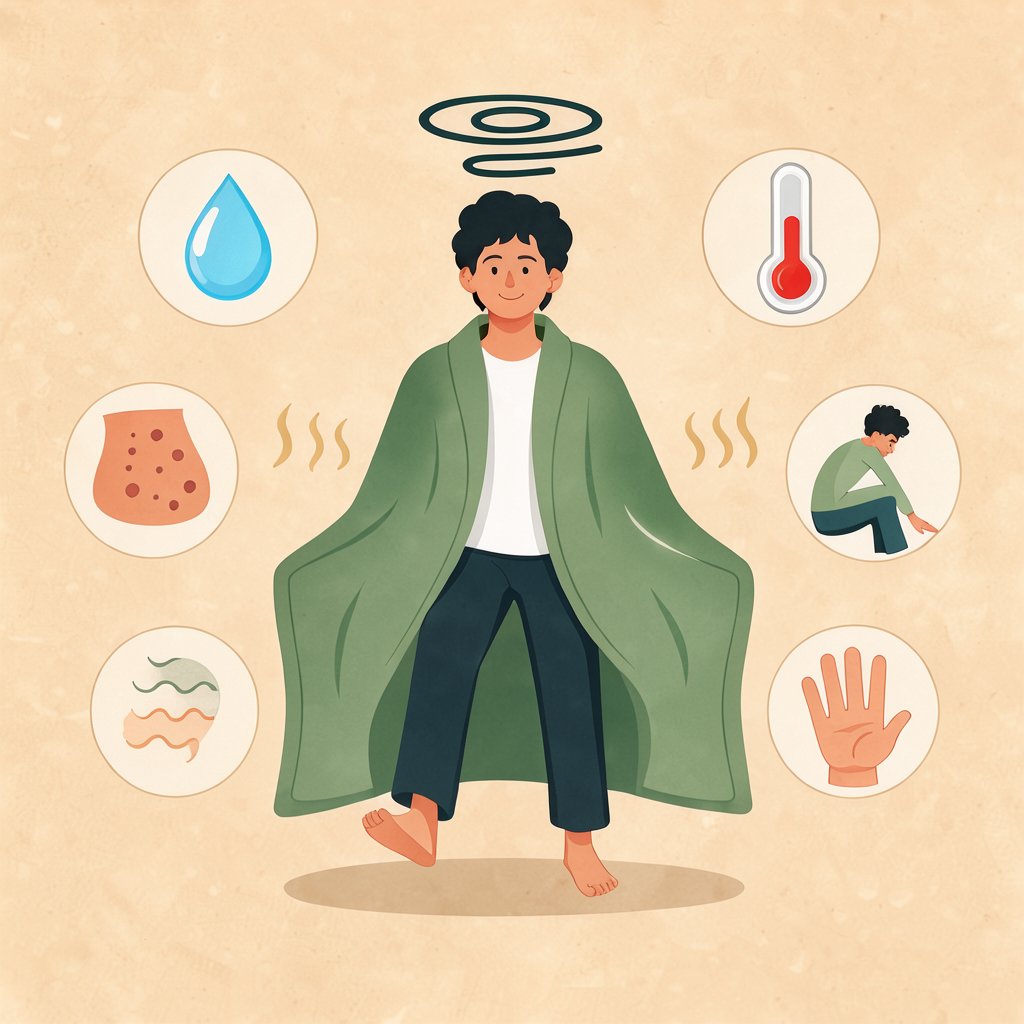
7. Your own stop-signal education. The Ayurvedic tradition wrote down exactly what too much sweating looks like: thirst, fainting, weak voice and body, giddiness, joint pain, fever, dark skin patches, vomiting.[4] A buyer who knows that list is safer in any blanket than an uninformed one in the best-engineered blanket. We reproduce the full list, with the actions that follow it, near the end of this guide.
Seven checks, one theme: the best infrared sauna blanket for you is the one whose safety design fits your body and your health picture — not the one with the loudest claims. What makes checks one and two more than preferences is what heat actually does inside the body, which is the next section’s subject.

How Heat-Wrap Therapy Works: What Heat Does to Your Body
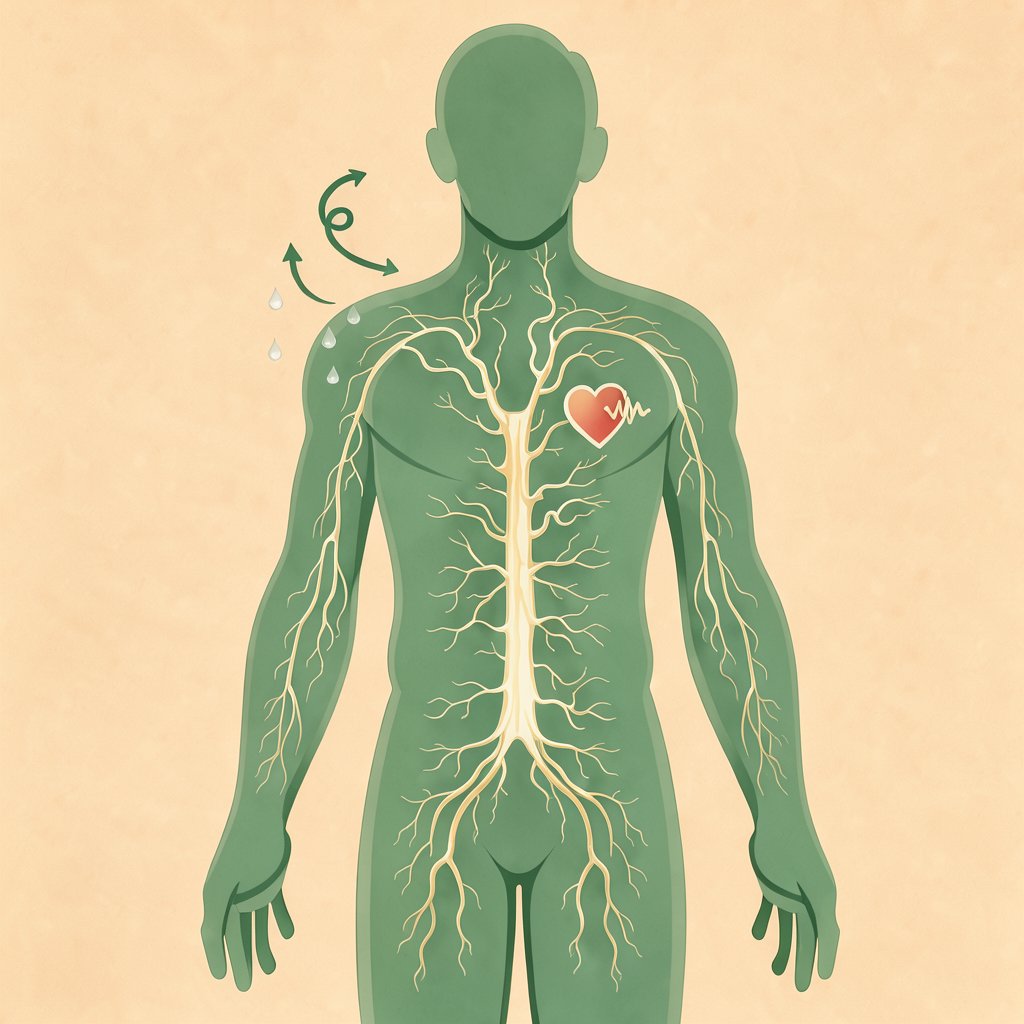
Every criterion in the checklist maps to a physiological fact, so here are the facts. Sauna heat trains the thermoregulation system and improves sweat-gland activity; as sweat evaporates, it absorbs significant heat from the layer of air right next to the skin, lowering its temperature — the body’s built-in cooling machinery, exercised deliberately.[2] That machinery runs on an impressive network: the skin holds roughly a quarter of all the body’s blood vessels — an estimated 62,000 miles (100,000 km) of capillaries — and the capillary network already halves in density by about age 25, which is one argument the hygiene literature makes for giving the circulation regular work.[1]
The load on the heart is real, and the traditions respect it. After just 10 minutes in a Japanese-style hot bath (furo), the pulse can rise to about 120 bpm — a sprint-adjacent workload delivered while you lie still.[1] That single number explains the 20–30 minute ceiling, the staged entries, and the head-out principle all at once. Alternating heat with cold adds another dimension: cold exposure boosts norepinephrine, a neurotransmitter tied to focus and mood that also promotes vasoconstriction, shrinking the body’s heat-loss surface — though the source we cite is honest enough to add that “research on it is lacking, and conclusive findings have yet to be established.”[6]
Two more documented effects round out the picture. Used after exercise, sauna heat supports relaxation and muscle distension, lets capillaries re-enter worked muscles, helps clear lactic acid, and gives vessels a healing rhythm — the traditional athlete’s wind-down.[3] The Ayurvedic mechanism is stated in its own idiom: “sweat applied to uncted persons liquefies impurities hidden in minute channels” (Charaka) — sweat follows oiling in the classical sequence, and the later texts add that steam and sweat dislodge accumulated impurities and improve digestion, a traditional account offered here as tradition rather than physiology.[4] None of this machinery is new, and people have been exercising it on purpose for millennia — which is where the blanket’s family tree begins.
From Egyptian Blankets to the Banya Bag: The Blanket’s Family Tree
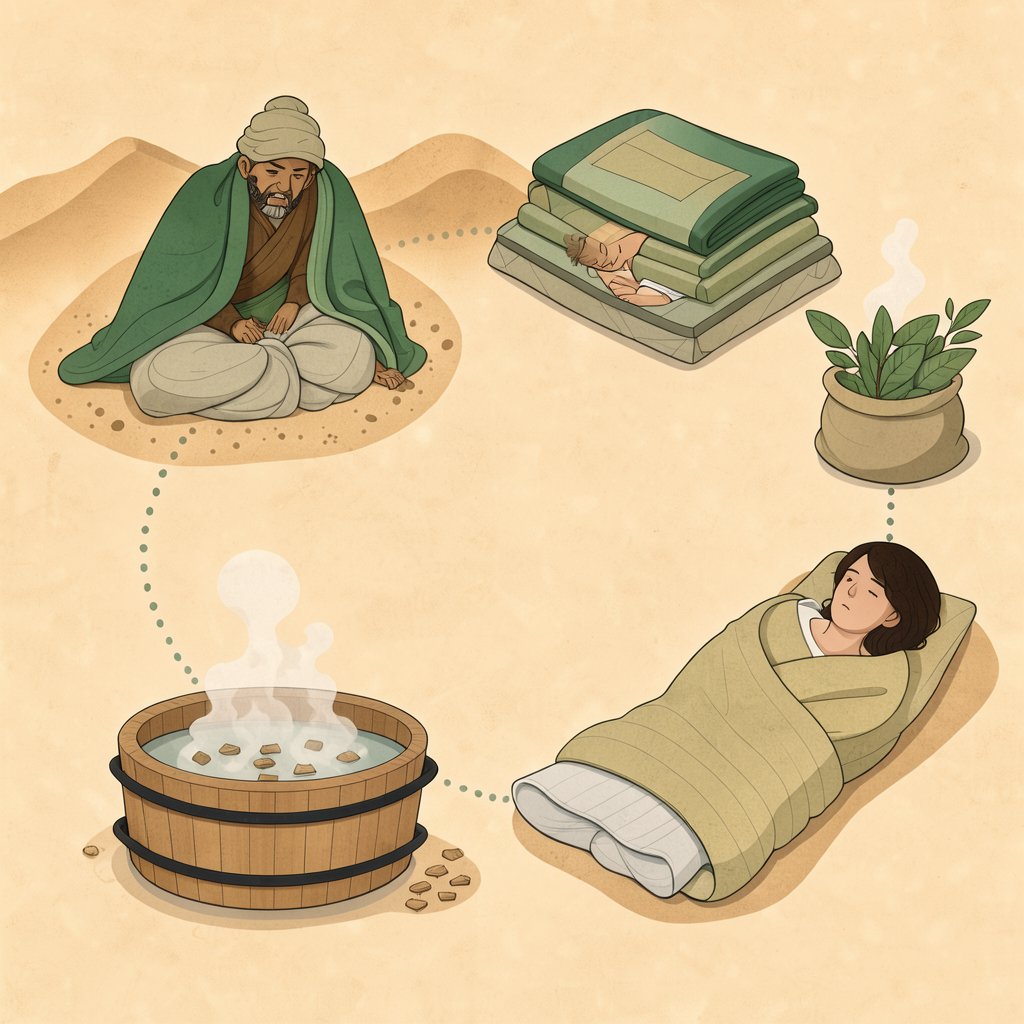
Step back from physiology and the family tree is remarkably consistent. The Egyptian sand-bath ritual ended with the client going “into a thick dry blanket” with a hot broth to recover lost moisture — the recovery drink is older than most nations.[1] Ayurveda’s contribution runs parallel: “steam tents or sleeping under many blankets to promote sweat” appears in the tradition as a prescribed therapy for Kapha-type cough, not as folklore.[4] The Russian branch contributed the birch-leaf sweat bag — a bag of leaves forming a “special microclimate” around the body — and the historical sources record a folk course of 20–25 such sessions said to relieve old rheumatism; we report that as a historical folk claim, not as medicine.[1]
East Asia added its own branches. The Japanese furo tradition centers on hot-water baths at about 131°F (55°C), with a cedar-sawdust variant heated to 122–140°F (50–60°C), steeped with some 60 herbs, and taken in sessions of just 10–15 minutes.[1] The Finnish branch has its famous athlete endorsement: Paavo Nurmi, winner of four gold medals at the 1924 Olympics, credited the Finnish hot sauna for winning in the Paris heat.[2] And the Russian banya was, for centuries, the place where “all diseases and malaise were treated in the bath,” in the rhythm its culture compressed into the sequence “work — steam — cut — tea.”[3]
Look across all five branches — Egypt, India, Russia, Japan, Finland — and the shared discipline stands out: controlled heat, controlled time, and a deliberate exit, every single time. No tradition anywhere in this base treats heat as more-is-better, and none of them hands a newcomer a temperature dial without a timer. The exact numbers behind that discipline come next.
Heat Levels and Session Length: The Case for Temperature Humility
The numbers in the heat-therapy literature teach humility fast. Dry-air baths, including the Finnish sauna, run at 140–248°F (60–120°C) air temperature at 5–25% humidity, while steam baths run cooler but wetter at 122–158°F (50–70°C) and 80–100% humidity; a modern electric sauna can be pushed to 284°F (140°C) at 5–15% humidity, and healthy people are described as tolerating dry baths of 194–248°F (90–120°C) at up to 25% humidity.[1] Those are whole-room cabin numbers — no blanket anywhere in our source base carries a documented interior temperature, and real-world blankets operate far below them, so any temperature range printed on a product page is a manufacturer-stated spec. Treat printed ranges as claims until measured.
The most important number in this whole field is not a temperature at all. It is the session ceiling: no more than 20–30 minutes in such heat, or fatigue and reduced physical and mental performance follow — sometimes arriving two to three hours later, well after you feel recovered.[1] The traditions also refused to let anyone leap straight into peak heat. The Roman-Irish bath staged its entry deliberately: a first room at 77–81°F (25–27°C), a second at 90–95°F (32–35°C) where sweating begins, and only then the hot room at 122–140°F (50–60°C).[1]
Engineering eventually caught up with tradition: the modern Finnish sauna heats through a special electric furnace with central control and a thermostat — the direct ancestor of the thermostat dial you should demand on any blanket.[1] Ceilings are only half the skill, though. The other half is how you move through a session, which is the protocol next.

How to Use a Sauna Blanket: A Step-by-Step Session Protocol
No blanket-specific protocol exists anywhere in our source base — the device appears in none of the 1,137 books — so what follows is our editorial adaptation of the classical three-period sauna scheme from the exercise-therapy literature to a wrap-style device.[3] Read it as the traditional structure applied to new hardware, not as a book’s instruction for blankets. The skeleton, in the classical formulation, is three periods: adaptation, intense warm-up, and a smooth exit.
Step 1: Warm up gently (adaptation)
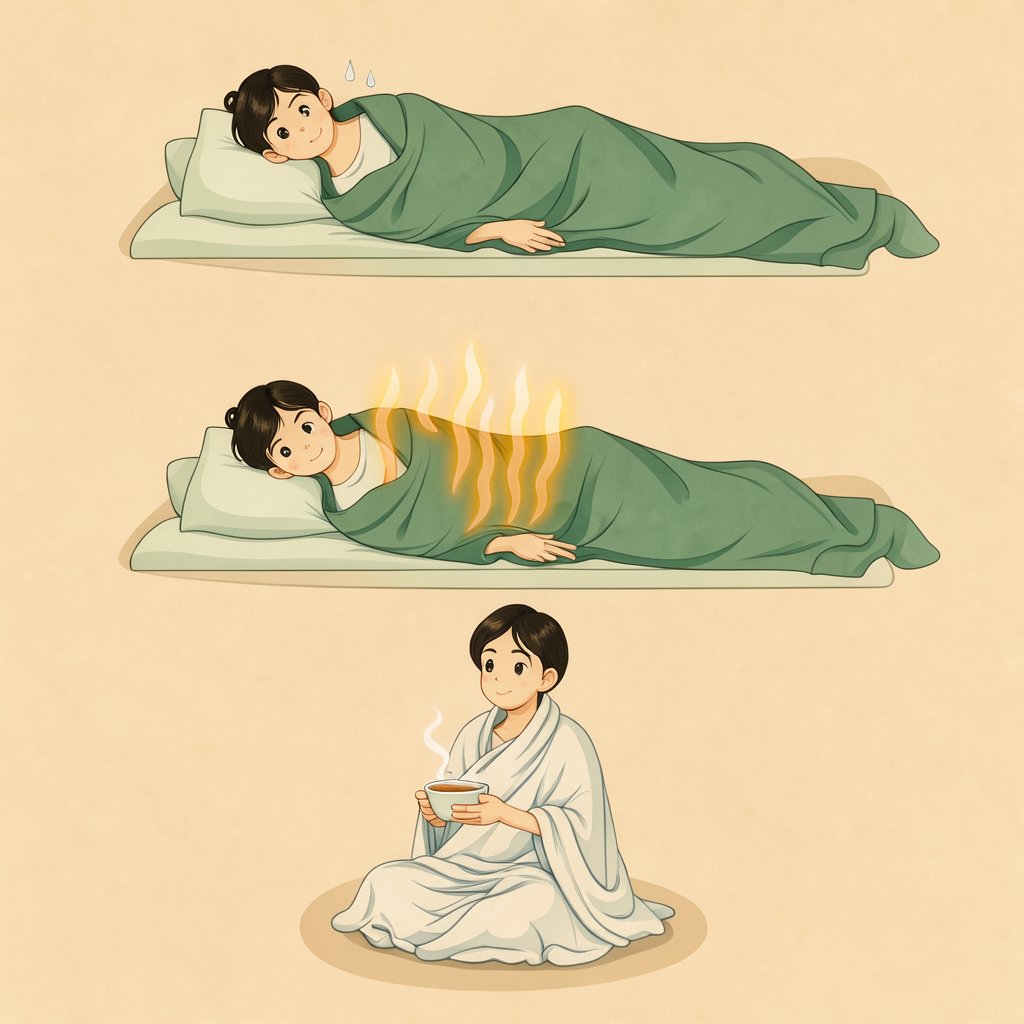
Begin at the blanket’s lowest heat setting and give the body time to start responding. The classical first period is 2–3 minutes of passive heating until sweating begins, followed by a short shower or rest wrapped in a sheet — a deliberate on-ramp, never a plunge.[3] In a blanket session, the equivalent is a few low-heat minutes before you raise anything. If you are not sweating lightly by the end of the warm-up, extend it rather than skipping it.
Step 2: Ride the peak heat (intense warm-up)
The second period is the main warming phase, and it lives inside the 20–30 minute ceiling — warm-up included, not extra.[3][1] Stay aware of your breathing and comfort rather than scrolling yourself into distraction. The head stays out of the heat, in line with the gentler Ayurvedic protocols that prescribe only mild, brief sessions with the head kept out — and drink during the session, not only after, because the same source warns that too little liquid leaves you too dry, and that too much sweating itself leads to dizziness.[4]
Step 3: Exit smoothly (the classical finish)
The classical third period is a smooth exit: wrap yourself in a warm dry robe or broad towel, rest, and take abundant tea.[3] The towel-and-tea finish is not ritual fluff — it is the first move of the hydration protocol, explained in the next section. End every session deliberately, even the short ones; the traditions that survived centuries all exit the same disciplined way they entered.
Two frequency rules complete the protocol. The sauna may be visited daily after gymnastics — heat after movement is the documented athlete’s pattern — but with no more than one to two heated sessions per visit.[3] And in clinical kinesitherapy the sauna is used only after special body preparation, ending with a cold bath of up to 43°F (6°C) for vessel tone — an advanced contrast technique to respect from a distance until you are experienced.[3]
Hydration and Minerals: What Sweat Takes and How to Give It Back
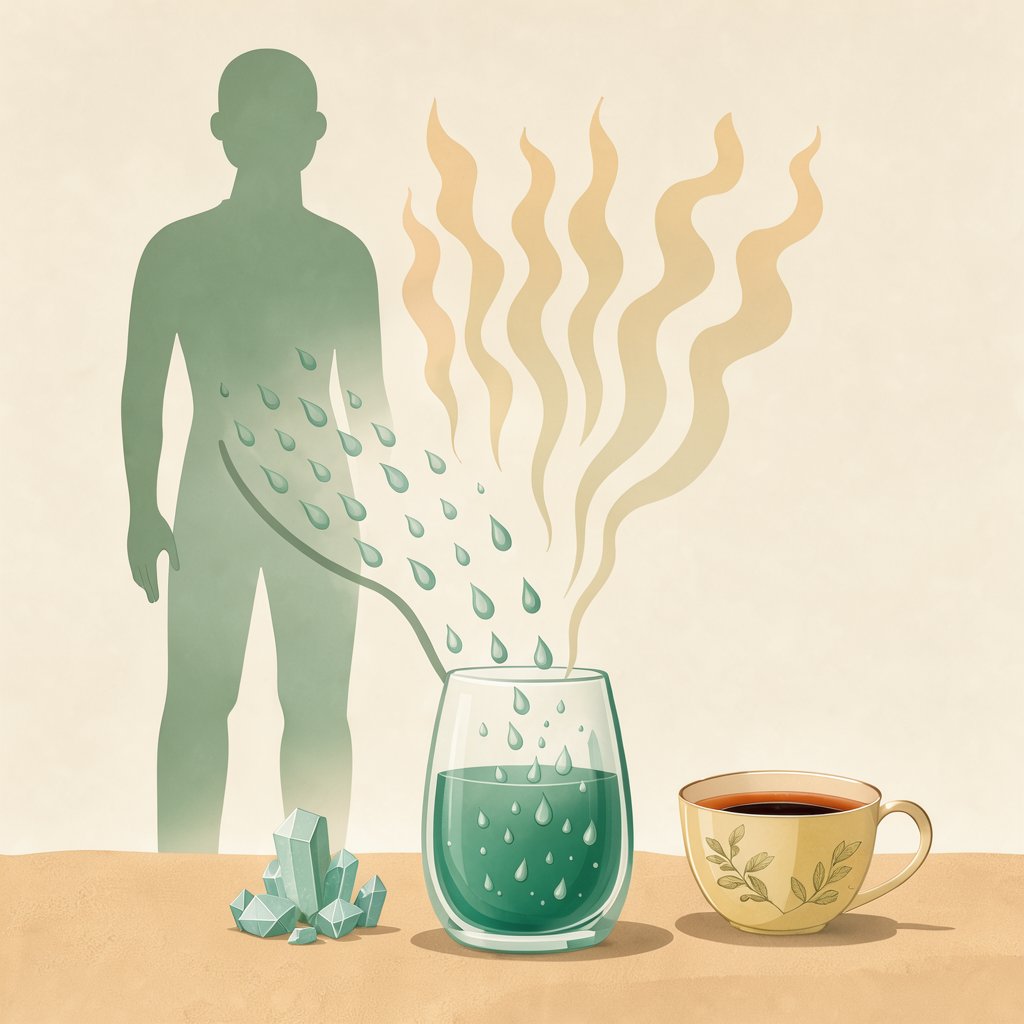
Sweat takes more than water. The baseline is already striking: the average person loses about 60 oz (1.8 L) of water per day before any sauna is involved, and sweating-induced dehydration shifts the body’s mineral composition — specifically a drop in sodium chloride — that the therapy literature says must be replenished during and after the session.[3] For magnitude, the hot-sand tradition offers a reference point: the body can lose up to 1.3 lb (600 g) of water in a single session.[1]
The traditions built recovery into the ritual itself. The Egyptian post-wrap hot broth was already a moisture-recovery move — the oldest sports drink on record, if you like — and the Russian finish of abundant tea plays the same role in the banya sequence.[1][3] Our source base offers no electrolyte products or dosages, and we will not invent any. The protocol it does support is simple: water before, water during, water after, and minerals returned through ordinary food and drink rather than supplements.
Practically, set the water bottle where you can reach it from inside the blanket, and make the post-session drink part of the exit step rather than an afterthought an hour later. If a session leaves the scale down a pound, that was water, not anything else — put it back the same day. Consistency here is what separates a sustainable practice from one that quietly runs you down.
Who Should Not Use a Sauna Blanket: Ask Your Doctor First
Everything above protects you during heat; this section comes before all of it, because the stricter question is whether you belong in the heat at all. The exclusion lists below come from the sauna, bath, and sand-bath literature — heat-therapy lists applied to wrap-style heat by extension, since no blanket-specific safety research exists in our base. Read them as a screening list to take to your doctor, never as a diagnosis or a self-test.
The sauna literature quotes absolute contraindications — conditions under which heat therapy is not to be used at all:[3]
- acute myocardial infarction
- malignant hypertension
- acute thrombophlebitis
- epilepsy
- acute inflammatory gynecological disease
- acute eczema
Beyond the absolute list, orthodox doctors are described as opposing sauna use in hypertensive disease, heart failure, uterine myoma, and prostate adenoma.[3] For children’s high-temperature methods, the hardening literature adds its own exclusions: post-hypoxic encephalopathy, congenital heart defects in the decompensation phase, acute high-fever infectious diseases, epilepsy, and consequences of early-childhood perinatal injury.[7] The sand-bath era contributes lung tuberculosis, general depletion, and anemia.[1] And the Ayurvedic tradition adds a constitutional caution: pitta types are advised to avoid saunas and steam baths altogether and to keep cool.[5]
The constructive flip side deserves the same honesty. The same sauna literature traditionally lists heat therapy as indicated for chronic non-specific lung diseases including bronchial asthma, chronic rheumatic diseases, peripheral circulatory disorders, arterial hypertension and hypotonia, varicose veins, and psoriasis — a traditional indications list, not our recommendation and not a prescription.[3] The takeaway is the frame: screen with your doctor, then decide. Exclusions are the “before” gate; the “during” gate — recognizing when a session must stop immediately — is next.

Overheating Warning Signs: When to End a Session Immediately
The oldest texts in our base already wrote the stop list. The Ayurvedic tradition describes what excess sweating looks like, and its warning signs read today exactly the way an emergency poster would want them to:[4]
- thirst
- fainting
- weak voice and body
- giddiness or dizziness
- joint pain
- fever
- blue, black, or red patches on the skin
- vomiting
The rule this guide proposes is simple: any one sign, and the session is over — no negotiating with the timer, no “five more minutes.” Cool down gradually, rehydrate, and rest. The classical antidote recorded for excess sweating is astringent and sweet therapy, which we report as historical context rather than home treatment; the modern action for severe or persisting signs is medical care, not another session.[4] Note that dizziness appears twice in the tradition’s warnings — once as a general excess-sweating sign and once as the classic signal of too much sweating in the svedhana rules — which makes it the single signal never to push through.[4]
With the stop-signs mastered, you can run the buying checklist from earlier with real confidence — you now know the before gate, the during gate, and the disciplined exit. What remains are the buyer questions the guide’s frame naturally raises, collected below.
Frequently Asked Questions
How long should a sauna blanket session be?
Stay within the classical ceiling of 20–30 minutes, warm-up included, because beyond it the documented costs are fatigue and reduced physical and mental performance — sometimes arriving two to three hours after you already feel fine.[1] Shorter is genuinely acceptable; the traditions reward consistency over endurance. If you want the full structure, the step-by-step session protocol above walks through all three periods.
Can I use a sauna blanket every day?
The classical rule allows the sauna daily after gymnastics, with a cap of one to two heated sessions per visit — heat after movement is the documented pattern, not heat instead of it.[3] Daily is therefore possible for a cleared, hydrated adult, but every session still obeys the 20–30 minute ceiling. For a gentle daily movement pairing, see our Baduanjin — Eight Pieces of Brocade manual.
Is a sauna blanket safe with high blood pressure or a heart condition?
This is a doctor question rather than a shopping question: orthodox doctors are described as opposing sauna use in hypertensive disease and heart failure, and the absolute contraindication list includes acute myocardial infarction and malignant hypertension.[3] Get screened before buying, not after. The full lists sit in our screening section above and on the medical disclaimer page.
How much should I drink around a session?
Start from the baseline: about 60 oz (1.8 L) of water is lost per day before any heat, sweating shifts minerals — a sodium chloride drop — and a single hot procedure can strip up to 1.3 lb (600 g) of water.[3][1] The supported protocol is water before, during, and after, with minerals returning through food and drink. Our hydration section lays out the full routine.
Is there proven research behind infrared sauna blankets?
Honestly: our 1,137-book research base contains no product-level infrared blanket studies at all, and even the adjacent heat-cold field carries the caveat that “research on it is lacking, and conclusive findings have yet to be established.”[6] That is exactly why this guide grades safety design instead of promising outcomes. The other buyer’s guides in our reviews and buyers’ guides hub follow the same rule.
Should my head be inside the blanket?
No — the gentler Ayurvedic svedhana protocols prescribe mild, brief heat with the head kept out of it, and wrap designs that leave the head and neck outside follow the safer lineage.[4] Keeping the face cool also makes the overheating warning signs easier to notice. The head-out design is criterion three in the buying checklist for precisely this reason.
A note for readers building a recovery corner at home: heat wraps pair naturally with movement, and we track two movement programs alongside this guide — our Joint Genesis review and the Unlock Your Hip Flexors review, with current offers at Joint Genesis and Unlock Your Hip Flexors. We may earn a commission if you buy through links on this page. Neither program is a sauna blanket, and neither is medical care — they are movement options some readers weigh next to heat therapy.
The best infrared sauna blankets in 2026 will not be found by chasing the loudest product page; they will be found by buyers who check for a real thermostat, a timer that honors the 20–30 minute ceiling, a head-out design, and an honest materials sheet — and who screen their health picture with a doctor first. That is how the oldest heat-wrap traditions would have shopped, each criterion paid for in centuries of practice. Buy the safety design, hydrate the way the tradition demands, respect the stop-signals, and the newest member of a very old family will serve you the way it has served everyone since the Egyptians wrapped in dry blankets and drank hot broth.[1]
Sources
- [1] Ivan Neumyvakin — Banya: The Healing Effect (2010) — the banya physiology and history shelf: capillary statistics, dry and steam temperature ranges, the 20–30 minute ceiling, Roman-Irish staged heating, the Egyptian and Japanese heat-wrap traditions, the hot-sand water-loss figure, and the engineering precedent for the thermostat.
- [2] Gennady Malakhov — Hardening and Hydrotherapy — thermoregulation training, sweat-gland activity, evaporative cooling of the skin-adjacent air layer, and the Paavo Nurmi sauna anecdote from the 1924 Olympics in Paris.
- [3] Sergey Bubnovsky — The ABC of Health (2017) — the three-period session structure, frequency rules, post-exercise sauna use, the hydration and sodium chloride guidance, the kinesitherapy cryo finish, and the contraindication and indication lists.
- [4] Swami Sadashiva Tirtha — The Ayurveda Encyclopedia (2007) — svedhana rules including the head-out principle and drink-during guidance, blanket-sweating as Kapha-cough therapy, the excess-sweating warning signs, and the classical sweat mechanism after oleation.
- [5] Vasant Lad — The Complete Book of Ayurvedic Home Remedies (2012) — the constitutional caution that pitta types should avoid saunas and steam baths and keep cool instead of pushing through heat.
- [6] Wim Hof and Elissa Epel — The Wim Hof Method (2020) — norepinephrine and vasoconstriction in heat-cold alternation, quoted together with its own caveat that research is lacking and conclusive findings are yet to be established.
- [7] Anonymous — Hardening the Body with Water, Air, and Sun — the children’s contraindication list for high-temperature methods, from post-hypoxic encephalopathy to acute high-fever infections.
Where to go next: this guide lives in our buyers’ guides hub, where the Best-Of shelf grows with every pack. For the recovery corner around a heat wrap, the Baduanjin — Eight Pieces of Brocade manual is a gentle daily movement pairing, and the coherent breathing practice manual teaches the calm pacing that sits well next to heat sessions — the same breath-and-heat territory the sources above map.
How we researched this: built from a local library of 1,137 wellness books, queried through an offline retrieval system with no internet sources; every factual claim above was checked against the cited book passage before publication. Where the base held nothing — product specs, brand data, far-infrared physics, blanket temperature ranges — we labeled the gap instead of filling it. That is the standard we hold every buyer’s guide on this site to.
