
Educational content only — not medical advice. See our full Medical Disclaimer and Affiliate Disclosure below.
Key Takeaways
- Ba Duan Jin (the Eight Pieces of Brocade) is a roughly 1,000-year-old qigong set credited to Marshal Yue Fei of the Song dynasty[2][4].
- The set was originally twelve forms, shortened to eight over more than eight hundred years of transmission; several distinct styles exist today, all built on the same core theory[1][2].
- In classical terms it is Wai Dan (“external elixir”) practice: gentle movement builds Qi in the limbs first, and that build-up is then carried inward through the body[6].
- Beginners progress by slow movement, natural breathing, and daily consistency — the classical rule is “exhale while stretching, inhale while changing sides”[2].
The Eight Pieces of Brocade (Ba Duan Jin) is one of the most widely practiced qigong sets in China[2]. This beginner’s guide covers where the set came from, how its traditional theory works, a gentle five-step way to start practicing, and the safety notes worth reading before a first session — everything below is drawn from the classic instructional literature on the set. New to qigong entirely? Start here, then browse our qigong guides; when you are ready for the piece-by-piece walkthrough, our Ba Duan Jin practice manual expands every step below.
What Is Ba Duan Jin? History in Brief
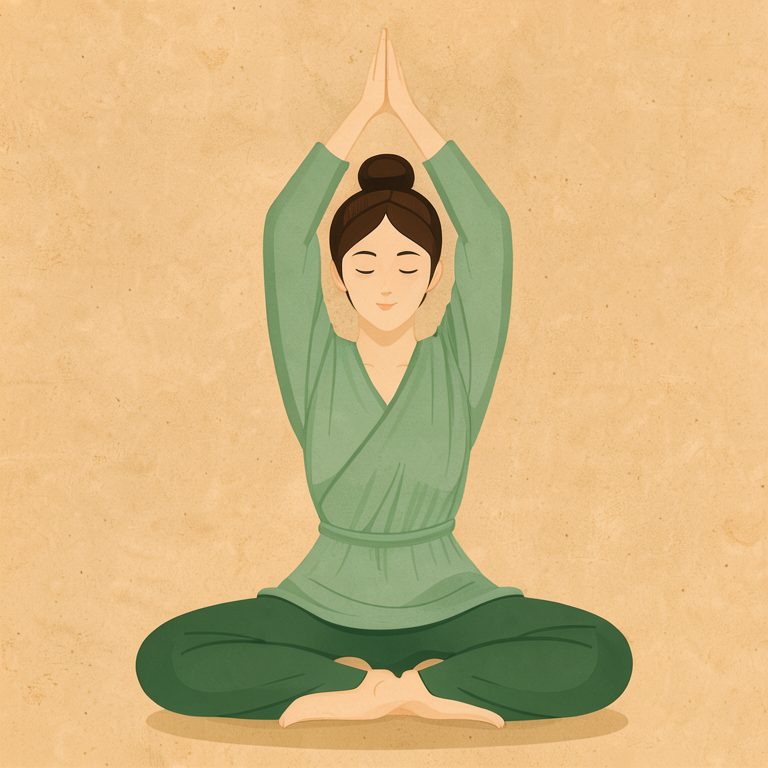
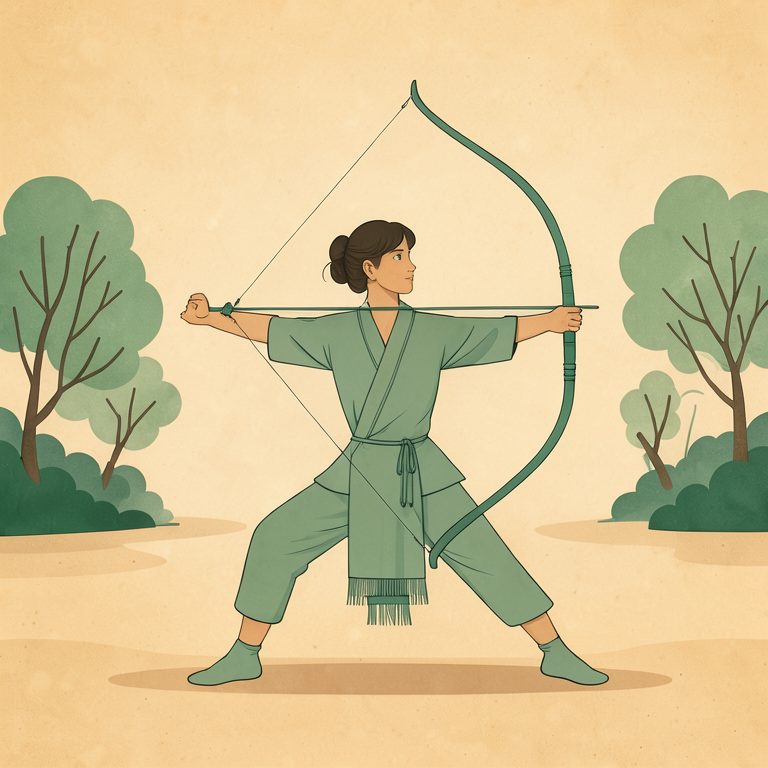
The traditional account names Marshal Yue Fei, a twelfth-century general, as the creator of the set. Yang, Jwing-Ming reports that Yue Fei is credited with creating the Eight Pieces of Brocade during the Song dynasty in order to improve the health of his soldiers[2][5], and reference works date the attribution to the Southern Song dynasty (1127–1279 CE)[4]. One version of the story traces the lineage further: Yue Fei is said to have used Da Mo’s Yi Jin Jing exercises as a foundation and adapted them into the Twelve Pieces of Brocade, which later generations simplified into today’s eight pieces[2].
| Question | Short answer |
|---|---|
| Who created it? | Marshal Yue Fei, credited in the classical literature[2][5] |
| When? | Twelfth century, Southern Song dynasty (1127–1279 CE)[4] |
| Original form? | Twelve pieces, edited down to eight over time[1][2] |
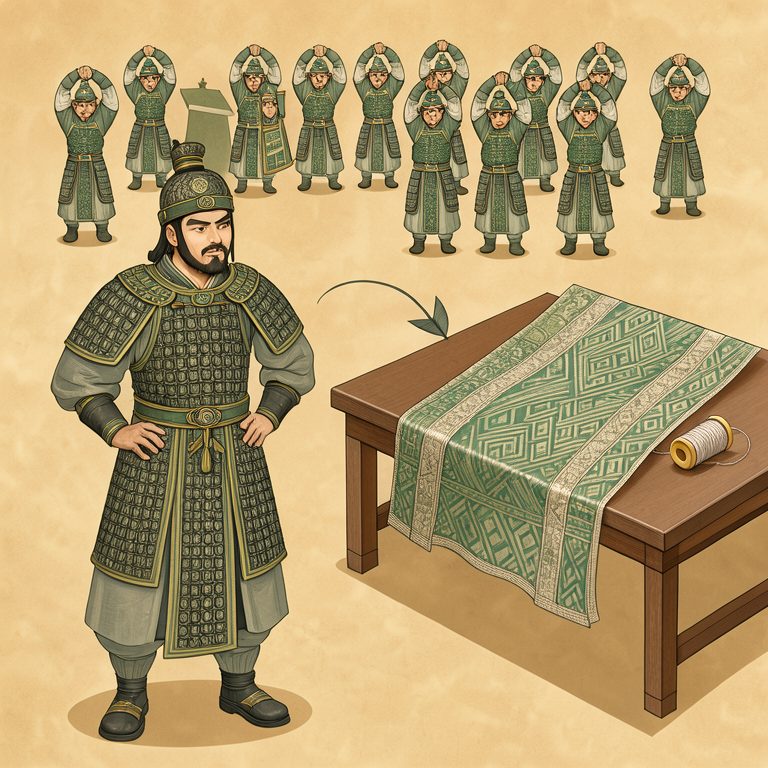
| Why “brocade”? | Brocade is prized patterned silk; the health the set produces is prized the same way[2] |
| Where is it practiced? | Widely practiced across China, with several distinct styles[2] |
Because the set has been passed down from generation to generation for well over eight hundred years, many versions exist, and any single book teaches only one of them[1][2]. Yue Fei is also remembered as the founder of the Eagle Claw and Xingyi martial styles[1][5], and from the Southern Song through the end of the Qing dynasty many further qigong styles and written manuals appeared[5]. For a beginner this variety is good news: the differences between versions are small enough that the set stays recognizable across schools.
The written record grew alongside the practice. Later qigong manuals such as Bao Shen Mi Yao (“The Secret Important Document of Body Protection”) by Cao, Yuan-Bai described moving and stationary qigong practices, and Yang Shen Fu Yu (“Brief Introduction to Nourishing the Body”) by Chen, Ji-Ru discussed the three treasures of Jing, Qi, and Shen[3]. Yue Fei himself is remembered as a pivotal figure of the era — a general who had learned Shaolin Gongfu and who is credited with the internal style Xingyiquan as well as with the Brocade, a popular qigong set for health[7]. A set that traces through that much history arrives with the rough edges of transmission: versions differ, and that is expected rather than a defect.
Traditional view vs modern physiology
Traditional teaching frames the set as a way to circulate Qi. The name itself carries the frame: brocade is a cloth, usually of silk, woven into complex and colorful patterns, and it is highly prized — just as the good health produced by these simple exercises is prized[2]. Classically, all of qigong is divided into two training families, Wai Dan (“external elixir”) and Nei Dan (“internal elixir”)[6], and Ba Duan Jin belongs to the first: Wai Dan practice increases Qi circulation by stimulating one area of the body until a large energy potential builds up and flows through the Qi channel system[2].
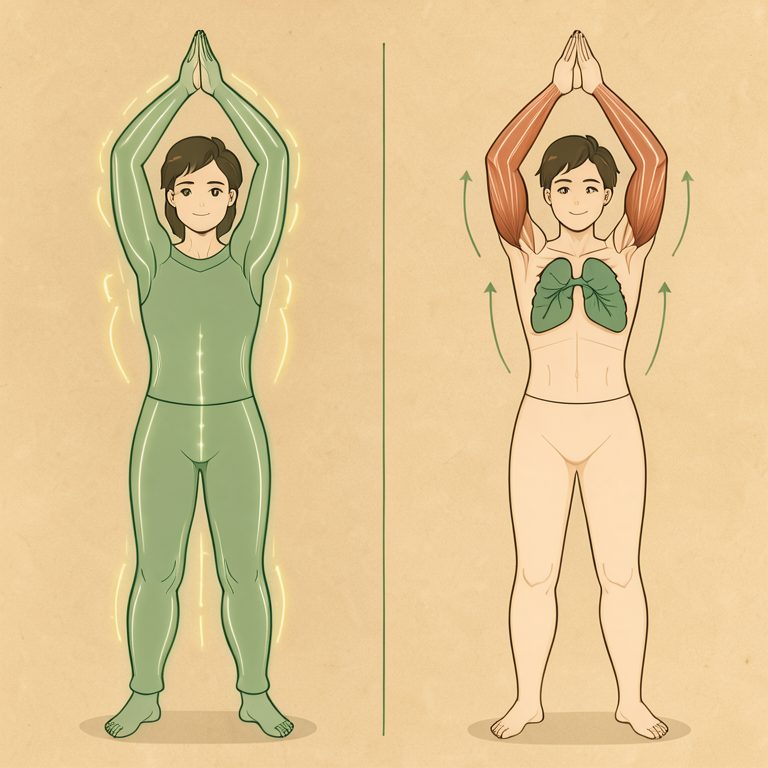
A modern reader can recognize the same choreography as something familiar: gentle, full-range movement paired with paced breathing — low-load mobility work in everyday clothes. The instruction to keep muscular effort low, because great tension was believed to constrict the Qi channels[2], reads today as a plain cue to keep the movement easy. The classical observation that Wai Dan practice is simpler, easier, and safer than Nei Dan meditation[6] also matches how beginners actually start. The vocabulary differs between the two readings; the direction is the same.
How the practice works
In the Wai Dan model, movement builds Qi in the limbs and at the surface of the body first, and the student then allows that build-up to flow inward to the center of the body and the internal organs to nourish them[6]. Concretely, the moving exercises work by repeatedly tensing and relaxing a muscle or body region while the mind stays concentrated there, with as little tension as possible[2]. That loop — move gently, attend to the sensation, release — repeats through the whole set, which is why the pieces feel cumulative rather than isolated.
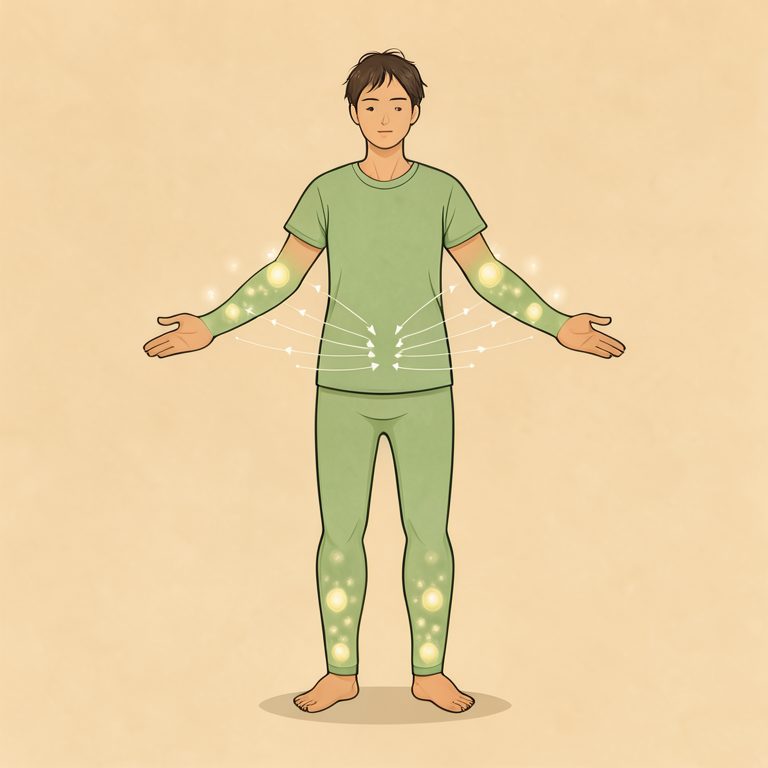
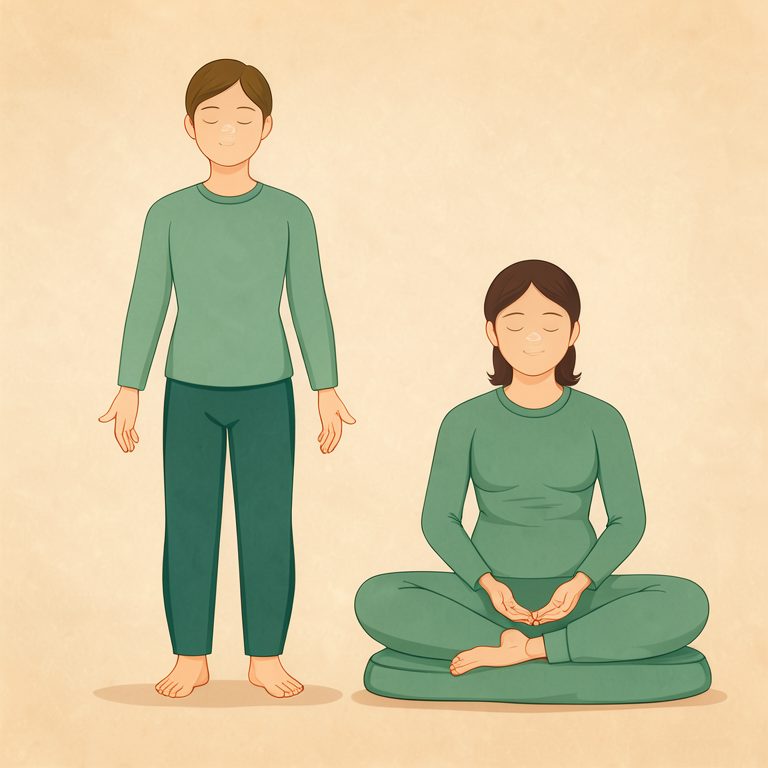
Two versions of the set exist: a sitting set and a standing set[1][2]. The sitting set opens with a quiet piece — eyes closed, hands resting in the lap, breathing regulated until it is smooth and uniform, and three to five minutes of stillness before any movement at all[1]. The standing set is the one most commonly demonstrated in modern instructional books[2], and it is the version this guide describes. Classical theory also fixes an order of priorities: regulating the body — posture — comes before breath work[3], which is why the routine below begins with stance and breathing rather than with the pieces themselves. That opening piece of the sitting set is a complete lesson in miniature: posture, breath, and attention are settled before anything else is allowed to happen[1].
A gentle beginner routine
The protocol below compresses the set into the five decisions a first-week beginner actually makes: how to stand, how to breathe, how fast to move, how much to do, and how to finish. Work through it in order the first few times; after a week the order will feel natural. For the full piece-by-piece walkthrough of all eight movements, see our Ba Duan Jin practice manual — this article is the on-ramp, the manual is the road.
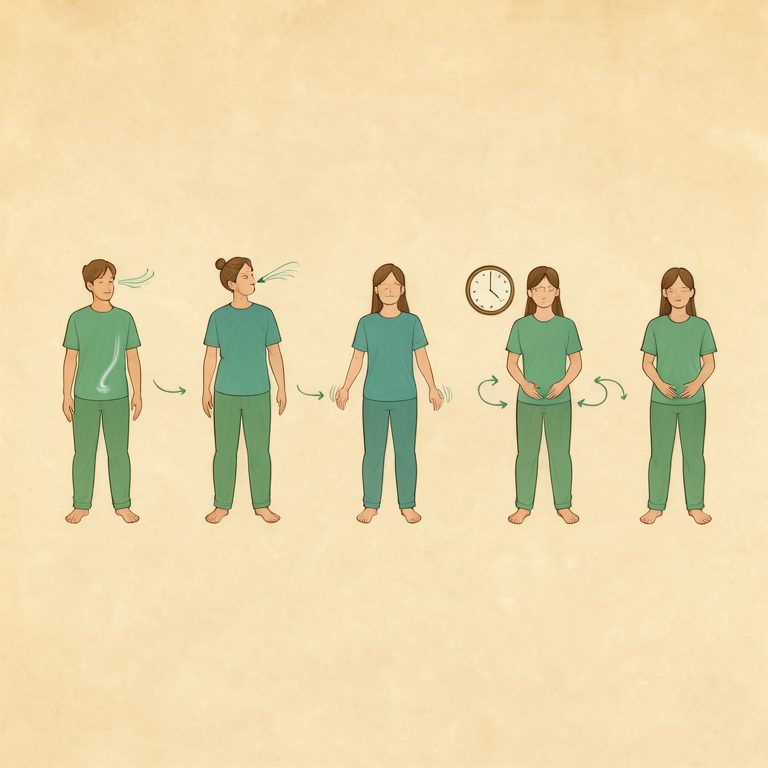
How much structure you impose on yourself is genuinely your choice. Yang’s own advice to students is to try the exercises presented, adopt a training schedule suited to their needs, and keep a flexible attitude as those needs change — some practitioners stay with one set every day for months or even years, others rotate between sets[2]. For a first month, though, the simplest workable rule wins: same time, same spot, same short session. Novelty can come later, once the habit exists.
Safety notes
Move within a pain-free range; stop if you feel dizzy or unwell; if you are pregnant, managing a chronic condition, or recovering from injury, consult your physician before starting (see our medical disclaimer). None of this is medical advice — it is a practice guide.
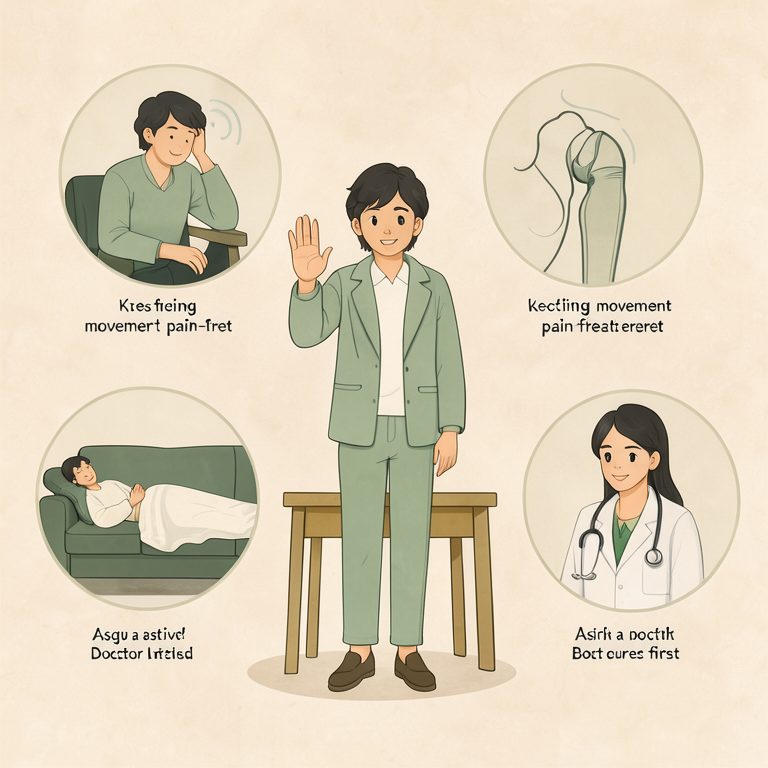
Two habits keep the set comfortable for beginners. Keep the range of each movement small at first and let it grow on its own; depth forced early is the main avoidable source of strain. And treat skipped pieces as part of the practice rather than a failure of it — the set is deliberately short, so a reduced session still counts as a session.
Breath deserves its own caution. The classical rule pairs every stretch with an exhale[2], so if you notice yourself holding your breath, shrink the movement until the exhale returns; straining to reach a shape is the opposite of what the set asks for. Dizziness during or after a session is a signal to stop for the day, not to repeat the piece “one more time correctly.”
Frequently asked questions
How long is a beginner’s Ba Duan Jin session?
Ten to fifteen quiet minutes a day is a complete beginner session, including the closing minute of stillness. The set is deliberately short, and the classical emphasis falls on daily regularity rather than on longer, harder sessions. Once the habit holds, length grows on its own. If you pair the set with walking or other exercise, treat it as the calm anchor of the day rather than another item to grind through.
Standing or sitting — which version should a beginner start with?
Both versions exist in the classical literature[1][2]. The sitting set opens with several minutes of complete stillness — eyes closed, hands in the lap, breath made uniform[1] — while the standing set is the one most commonly demonstrated today[2]. If standing for ten minutes is uncomfortable, the sitting set is a legitimate alternative rather than a compromise. The underlying pieces overlap enough that skills transfer if you switch between versions later.
How fast should the movements be?
Slower than feels productive. The pieces are performed slowly and symmetrically with minimal muscular tension, because classical teaching holds that great tension constricts the Qi channels[2]. A pace at which the exhale stays unhurried is about right. Filming yourself once and watching it back is the fastest way to see where the pace creeps up.
Can I practice Ba Duan Jin right after a meal?
Gentle as the set is, it involves bending, reaching, and heel lifts, which are more comfortable on an empty stomach. If a session right after dinner feels heavy, simply move it later in the evening. Our practice manual covers timing and food in more detail.
Do I need any equipment or special clothing?
No equipment is needed — flat shoes or bare feet and enough floor space to stand and stretch the arms will do. Loose, comfortable clothing that does not bind at the shoulders or waist suits the pieces best. This simplicity is part of why the set has survived more than eight hundred years of transmission[1]. Many practitioners also keep the same spot and roughly the same time each day, which removes every decision standing between them and the first piece.
Sources
- [1] Yang, Jwing-Ming — Eight Simple Qigong Exercises for Health – The Eight Pieces of Brocade (1997)
- [2] Yang, Jwing-Ming — Qigong for Health and Martial Arts (1998)
- [3] Yang, Jwing-Ming — The Root of Chinese Qigong (1997)
- [4] Yang, Jwing-Ming — Pain-Free Joints (2017)
- [5] Yang, Jwing-Ming — Tai Chi Qigong – The Internal Foundation of Tai Chi Chuan (2013)
- [6] Yang, Jwing-Ming — Qigong Meditation Embryonic Breathing (2003)
- [7] Yang, Jwing-Ming — Qigong, The Secret of Youth: Da Mo’s Muscle/Tendon Changing and Marrow/Brain Washing Classics (1999)
How we researched this
This guide is based on our local library of 1,137 books on traditional wellness practices, consulted offline with no internet sources. Every factual claim above was checked against the cited source passage before publication.
