
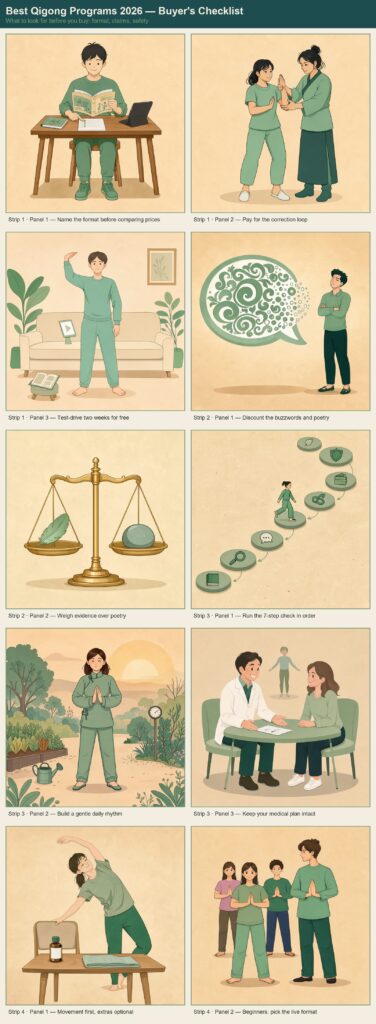
Educational content only — not medical advice. See our full Medical Disclaimer and Affiliate Disclosure below.
Key Takeaways
- The best qigong programs come in three delivery formats — a live class, a video course, or an app subscription — and the format decides how fast someone corrects your form.
- Before paying, run the claims test: storytelling about “miracles of nature” and “ancient wisdom” can mask empty marketing[1].
- Traditional training cultures expect long practice — treat any overnight-mastery promise as a red flag[3].
- A responsible program never asks you to change medical treatment; safe programs explicitly say the opposite.
Qigong has moved from park mornings to paid platforms, and the phrase “best qigong programs” now sells everything from budget video sets to year-long coaching. This buyer’s guide — updated November 8, 2026 — is not a ranking of vendors we have not audited. It gives you the selection criteria we would use ourselves: what to look for, what to distrust, and how to test any program before money changes hands. Every factual statement below comes from critical wellness literature in our library and is cited in the Sources block.
Health is the one skill that quietly underwrites every other one — once it slips, other accomplishments lose their value[5]. A daily-practice purchase deserves a careful look, not an impulse click.

What a “qigong program” actually sells: formats
Traditional teaching, modern packaging. In traditional settings, learning passed through long practice under a teacher who insisted on etiquette and correct execution[3]. Modern programs repackage that relationship into formats — and the format determines how much correction you actually receive.

| Format | Teacher feedback | Correction speed | Best for | Watch for |
|---|---|---|---|---|
| Live in-person class | Direct, hands-on | Immediate | Beginners who want form corrected | Class size; instructor’s own training background |
| Live online small group | On camera | Same session | Remote learners wanting accountability | Group size vs promised attention |
| Structured video course | None, or delayed Q&A | Days to weeks | Self-directed learners with some base | Whether form cues are shown from multiple angles |
| App-guided daily sessions | None | Never | Habit building on a schedule | Streak mechanics standing in for progression logic |
| Book + free manual self-study | None | Never | Testing interest at zero cost | Skipping safety notes — read them first |
The table is our editorial framework — format definitions, not a market survey. Use it to decide which format you are actually shopping for before comparing prices.

The claims test: five red flags to run before you pay
Singh and Ernst describe a familiar pattern in non-conventional medicine marketing: a practice may bring no real benefit while good advertising persuades people it works, and storytelling about “miracles of nature” and “ancient wisdom” keeps clients from asking harder questions[1]. The same study notes how buzzwords — “holistic approach,” “energy meridians,” “self-healing,” “individualization” — can sit where specifics should be[1]. When you evaluate a qigong offer, discount the poetry and look for the concrete.

- Ancient-wisdom theater. Heritage is real; heritage alone is not evidence. Ask what the program concretely teaches, week by week[1].
- Buzzword fog. If “energy meridians” and “individualization” appear without a syllabus, treat them as decoration[1].
- Overnight mastery. In training cultures that take practice seriously, students train for years[3] — speed promises contradict the very tradition the seller quotes.
- Testimonials only. Observation itself can produce perceived improvement — the Hawthorne effect Singh and Ernst flag in study design[1]. Lived stories are nice; they are not measurements.
- No evidence-based posture. Serious care decisions rest on scientific data — as a rule, randomized clinical trials — and that is what equips practitioners and patients with the most reliable information[1]. A seller working in that spirit can explain their reasoning without dodging.

Evidence over poetry — serious care decisions rest on data
One more traditional marker worth trusting: masters who insist on etiquette and correct execution[3]. A program that corrects your form is doing the part that matters.
How to choose the best qigong program: a 7-step protocol
Run this checklist in order. Each step takes minutes; together they filter out most regrettable purchases.
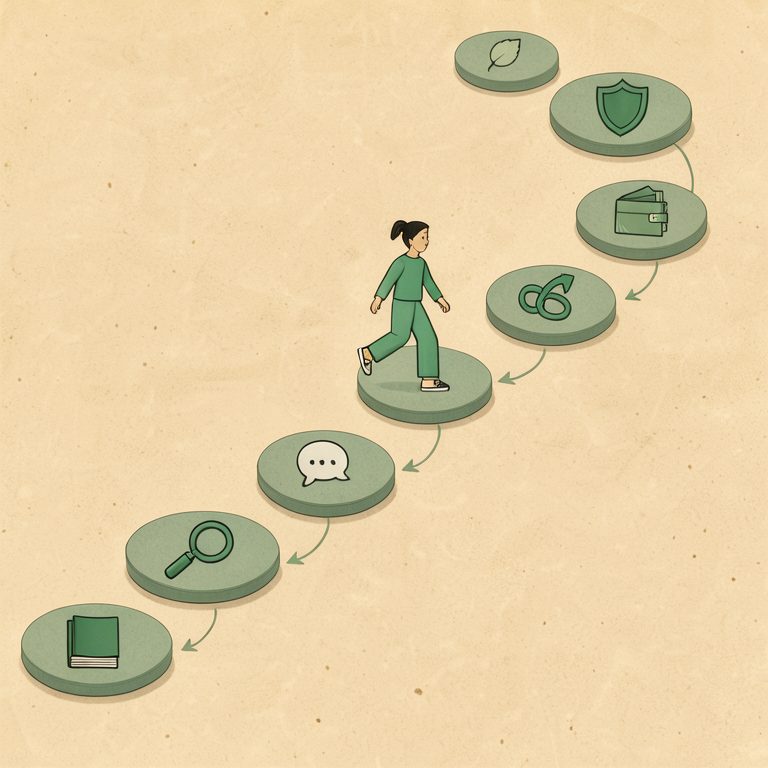
- Name the format. Match the offer against the table above — live class, live online, video course, app, or self-study.
- Run the claims test. Apply the five red flags to the sales page before reading any reviews.
- Check the correction loop. Ask: how and when does someone correct my form? “No feedback” can be a fair deal — as long as the price reflects it.
- Check progression, not intensity. Traditional wellness routines were built as daily-life patterns — the Okinawan lifestyle that researchers describe is daily garden work, floor sitting, and fresh self-grown food, not bootcamps[2]. Prefer programs that build a gentle daily rhythm over ones selling intensity.

Step 4 — prefer a gentle daily rhythm over intensity - Check the safety posture. A responsible program states it is not intended to cure or treat any medical condition and tells you to keep your doctor’s plan intact.
- Check price and exit terms. Refund window, what happens after it closes, and whether coaching is included or sold separately.
- Test-drive free first. Spend two weeks on a free routine before paying — our Baduanjin (Eight Pieces) manual and the Zusanli ST36 acupressure guide are built for exactly this trial.

Step 7 — test-drive a free routine for two weeks before paying
Safety and honest expectations
Qigong is a gentle movement practice traditionally used for relaxation, balance, and daily routine. It may support general well-being, and it is not intended to cure or treat any medical condition. If you take prescription medication, one rule from the clinical literature matters more than any course brochure: do not change medical treatment on your own — if you are unhappy with your care, change the doctor, not the treatment[4]. A program that urges you to alter prescriptions is a program to walk away from.

Safety note: this guide is general information for choosing a program. If you have a medical condition, are pregnant, or are recovering from an injury, talk with a clinician before starting any new practice.
Where the two offers we review fit
Two reviewed products live in this cluster, and neither one is a qigong program — they are complementary options some readers choose alongside daily practice:
- Joint Genesis — a daily supplement option marketed for everyday joint comfort; our Joint Genesis review covers labeling and value. Movement remains the foundation; capsules are a convenience layer some readers add on top.
- Unlock Your Hip Flexors — a targeted mobility routine that pairs naturally with standing qigong practice; details in our Unlock Your Hip Flexors review.

Disclosure: we may earn a commission if you buy through links on this page. Ratings and recommendations are our editorial opinion.
Bottom line: the best qigong program for you is the one whose format matches your learning style, whose claims survive the red-flag test, and whose safety posture respects your medical plan. Pay for correction and progression — not for mythology.
Frequently asked questions
What is the best qigong program format for a beginner?
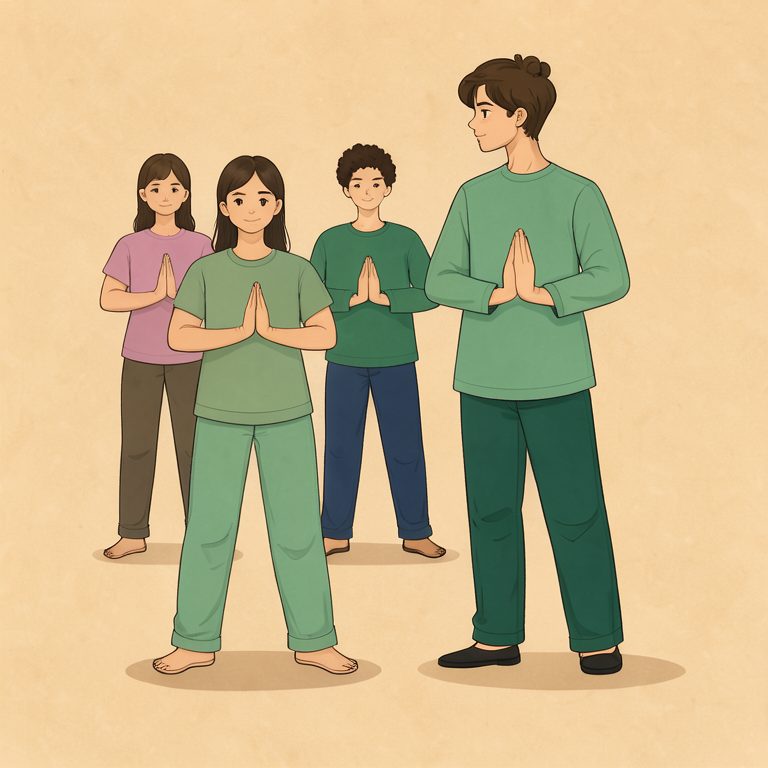
For a first purchase, a live class — in person or in a small online group — is the format that actually corrects your form. Video courses and apps can build a daily habit, but their feedback loop is delayed or absent, so match the format to your learning style before comparing prices.
How do I know if qigong program marketing is overselling?
Run the claims test: discount ancient-wisdom theater and buzzword fog[1], treat overnight-mastery promises as a red flag[3], and remember that observation alone can produce perceived improvement[1]. A concrete week-by-week syllabus beats poetry.
Should a qigong program ever change my medical treatment?
No. A responsible program states it is not intended to cure or treat any medical condition and tells you to keep your doctor’s plan intact. The clinical literature puts it plainly: do not change medical treatment on your own — if you are unhappy with your care, change the doctor, not the treatment[4].
Sources
- [1] Singh S., Ernst E. — Neither Your Wallet nor Your Life: Alternative Medicine Under Investigation (2017)
- [2] Smirnov A., Kononenko I. — Markers of Aging (2022)
- [3] Sobolenko S.A. — Vaccination Against Ignorance
- [4] Unknown Author — How Doctors Are Treated: The Truth Hidden from Patients (2020)
- [5] Butakova O.A. — Essential Information About Health
How we researched this
This article is based entirely on our local library of 1,137 books on traditional wellness practices, consulted offline with no internet sources. Every claim in the text was checked against the cited source passages before publication.
