
Educational content only — not medical advice. See our full Medical Disclaimer and Affiliate Disclosure below.
Most desk workers searching for chest opening exercises are really chasing one thing: a neck that stops aching by mid-afternoon. The movement-tradition books behind this guide say that instinct is correct, but the order matters more than the effort. Their shared finding is blunt: a collapsed chest drags the head forward and loads the neck, so the protocol puts chest opening first and neck release second. This guide assembles that chest-first, neck-second protocol step by step, with posture drills drawn from wushu, taiji, Soviet-era therapeutic gymnastics and modern joint-mobility practice.
Every drill, hold time and caution below is footnoted to a named source book from our offline library, and each tradition is called by name wherever its numbers differ from its neighbors. The core logic comes from Pak A.L.’s 2024 trigger-point manual: forcibly holding an erect posture over a tight chest overloads the thoracic muscles, so shortened chest zones must be released before the straight-back habit is trained[1]. One honest scope note before we begin: this is a movement protocol only, and the source base holds no desk-ergonomics material, so monitor height and chair setup stay deliberately out of scope. If you want the short version first, the key takeaways below compress the whole protocol into four lines.
Key Takeaways
- The order is the protocol: release the shortened muscles at the front of the chest first, and only then mobilize the neck and shoulder girdle; forcing an erect posture over a tight chest simply overloads the thoracic muscles until pain appears[1].
- The mechanism is mechanical: a thrust-forward head and slouched shoulders strain the neck, and static desk hours reinforce the very muscles that create poor posture[3].
- The daily menu is five posture drills: the wushu arms-overhead open-and-close cycle, the doorway thoracic release, the 10-second floor back-bend, the seated four-sharp and one-slow arm pulls, and three-plane neck movements with shoulder circles[2][1][3][10][9].
- The dosage ladder starts at ten movements and adds ten a week, never bouncing, with your age in years as the long-term repetition target[9].
What Is the Chest-First, Neck-Second Protocol?
The chest-first, neck-second protocol is a two-stage daily posture routine: stage one releases the shortened muscles at the front of the chest, and stage two only then mobilizes the neck and shoulder girdle. It is not a grab bag of stretches but an ordered sequence with a reason for its order. The logic belongs to Pak A.L., whose trigger-point manual compresses it into one line: first release all shortened zones in the chest muscles, and only after that build the habit of holding the back straight[1]. Skipping stage one, in this reading, is why most posture resolutions collapse within weeks.
The full protocol keeps five drills from four traditions. From wushu comes the arms-overhead open-and-close cycle, a complete chest movement mapped to the breath[2]. From Pak’s manual comes the doorway thoracic release with its one-minute hold, and from a walking-fitness handbook the 10-second floor back-bend[1][3]. From therapeutic gymnastics comes the desk-friendly seated opener, and from Pavel Tsatsouline’s morning joint series the three-plane neck movements and shoulder circles that form the neck half[10][9].
None of the five needs equipment beyond a door frame and a patch of floor, and each keeps its own dosage numbers, assembled later in this guide. The sections that follow first explain why the chest, of all places, decides how the neck feels. Then comes the history, two quick self-checks, and the drills themselves in their working order.
How a Collapsed Chest Loads Your Neck: The Desk-Hunch Chain
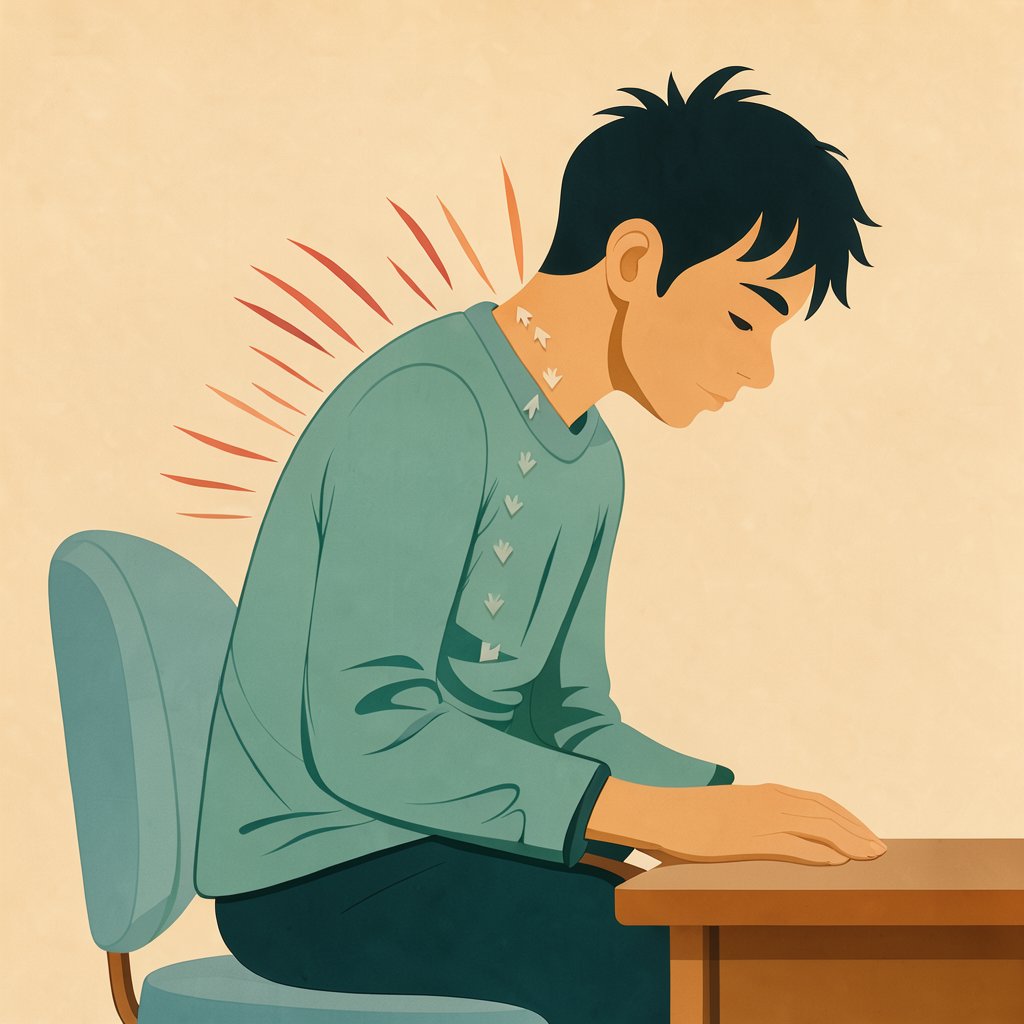
The chain starts at the desk, and a walking-fitness handbook by Barough N. describes every link of it. In poor posture, the book observes, the head is thrust forward with the chin jutting out, straining the muscles of the neck and the shoulders, while the shoulders slouch and the chest collapses[3]. Its caption for that picture is a whole lecture in five words: a collapsed chest affects oxygen flow[3]. The driver is not mysterious either, since modern technology keeps us hunched over desks, reinforcing the very muscles that create poor posture[3].
An unattributed spine-health manual follows the chain one segment deeper. The neck extensors overload from the static tension of simply holding the head up, especially with incorrect sitting posture, and the cervical curve deepens as the head shifts forward — in the book’s image, like a turtle’s[4]. From there the manual describes what prolonged desk posture can slide into: chronic impairment of cerebral circulation, with headaches and even fainting[4]. The tone is clinical rather than alarmist, but the direction of travel is clear, and none of it happens overnight.
Lee Holden’s qigong handbook adds the piece every office worker recognizes by feel. Under stress and desk work, he writes, the shoulders gradually rise toward the ears, and the shortened muscles begin causing pain and numbness[5]. His energy image is worth keeping on a sticky note: squeeze a fist all day and you will be exhausted by evening, and that is precisely what an unconsciously clenched neck does[5]. The neck, in other words, is rarely the villain of this story; it is the victim holding a position the chest forced on it.
Why Forcing Upright Posture Backfires: Release Before You Straighten
The obvious response to a collapsed chest is to sit up straight and hold it, and Pak A.L. is the source that explains why that fails. Symptoms in this picture worsen after prolonged static load, whether that means sitting hunched or half-turned, or working with the arms extended forward[1]. Forcibly holding an erect posture, the book states, strongly overloads the thoracic muscles; they tire quickly, and pain appears[1]. The mechanics underneath are plain: shortened muscles at the front of the chest pull the shoulders forward and flex the thoracic spine, so the back muscles must stay constantly tense just to resist them[1].
The chest-to-neck linkage also runs through the breath, and Vasilyeva’s applied-kinesiology text supplies the sharpest mechanism passage in the whole source set. The ribcage-opening phase of a full inhale actively stretches the pectoralis minor, supporting the elasticity of the bronchial tree and the drainage of the lymphatic ducts, and stretches the sternal fascia[6]. That same phase activates the interscapular muscles, which stabilize the attachment points of the long neck extensors — without which, in the book’s words, optimal neck movement is impossible[6]. A chest that never opens is therefore not just a visual problem; it quietly removes the base the neck moves from.
Breathing gymnastics adds the final, ironic detail. The accessory muscles of the inhale include the scalenes, the sternocleidomastoid, the pectoralis minor and major, and the subclavius, which means every shallow, shoulder-lifting breath recruits exactly the muscles that choke the neck[7]. That is the basis of the old coaching cue to breathe into the ribs, not the shoulders: it hands the work of inhaling to the ribcage openers instead of the neck binders[7]. Several drills below are built around exactly that trade.
The Silk Weavers’ Twelve Exercises: A 4,000-Year-Old Desk Problem
Sitting at precise handwork for a living is not a new problem, and the wushu manual by Popov, Sagayan and Didenko preserves what it presents as the oldest recorded answer to it. The oldest known Chinese preventive and therapeutic gymnastics, the authors write, is the set of twelve exercises of the silk weavers[2]. The weaver’s trade demanded colossal static effort in the service of tiny, precise hand movements, and the book keeps the period’s own image of it: to “sit from morning to evening at this jewelry work”[2]. The exercises were created, the same page explains, to perfect the arms’ work, remove fatigue and serve prevention — a fair one-line job description for the drills in this article too[2].
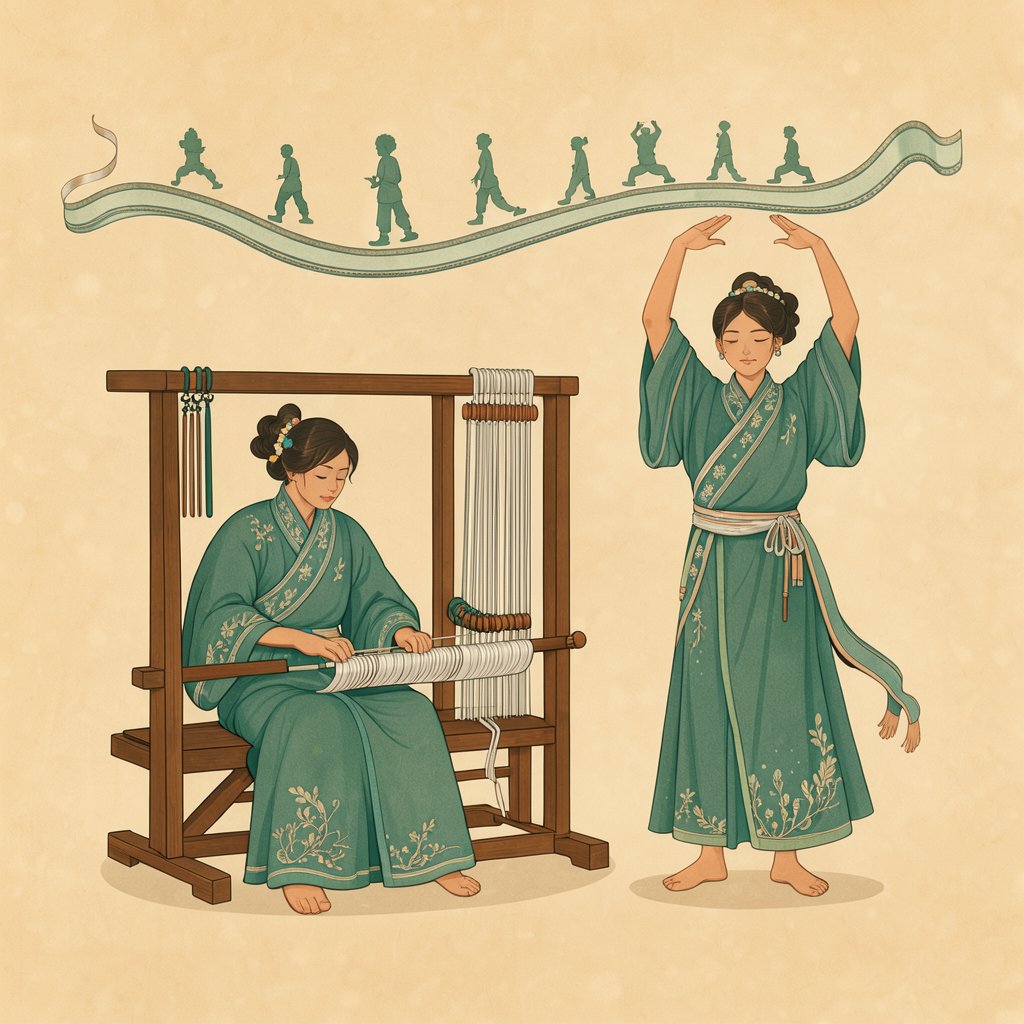
The same book sketches the tradition around those exercises: the warrior sport of jiaoli was popular around 250 BC with its archery and chariots, and strategists around 400 BC already valued wushu as a way of building a strong army[2]. Lee Holden’s handbook carries the lineage forward and frames qigong as the base of tai chi chuan and many other martial arts — “not a newfangled fad but an ancient science,” its formulas “tested over the last four thousand years”[5]. Holden admits his own first taiji class left him shaking, with an impossibly light head, a useful reminder that tradition and intensity are not opposites[5]. The gymnastic pole of this article is younger but no less disciplined: Tsatsouline’s morning joint-regeneration ritual comes from the Russian and sambo tradition, with named moves like the Egyptian, the Russian pool and the Cossack[9].
One honesty note before the drills begin. The source base for this guide contains no old-time-strongman or bridging history, so this article deliberately adds none, and the gymnastic side is represented by Tsatsouline’s practice alone. What the two poles share, and what matters here, is the conviction that sedentary work deserves a systematic counter-practice rather than an occasional stretch.
Check Yourself First: The Chin-to-Chest Test and the Posture Checklist
Two low-tech checks give you a baseline before day one, and neither needs anything but a mirror-length piece of wall. The first comes from the spine-health manual: holding the thoracic spine straight, let the chin drop toward the chest[4]. If the movement feels blocked well short of the chest, the manual reads it as a sign that the neck extensors are likely in spasm[4]. Treat that as a self-observation rather than a diagnosis, note how far the chin travels, and retest after a few weeks of the protocol.
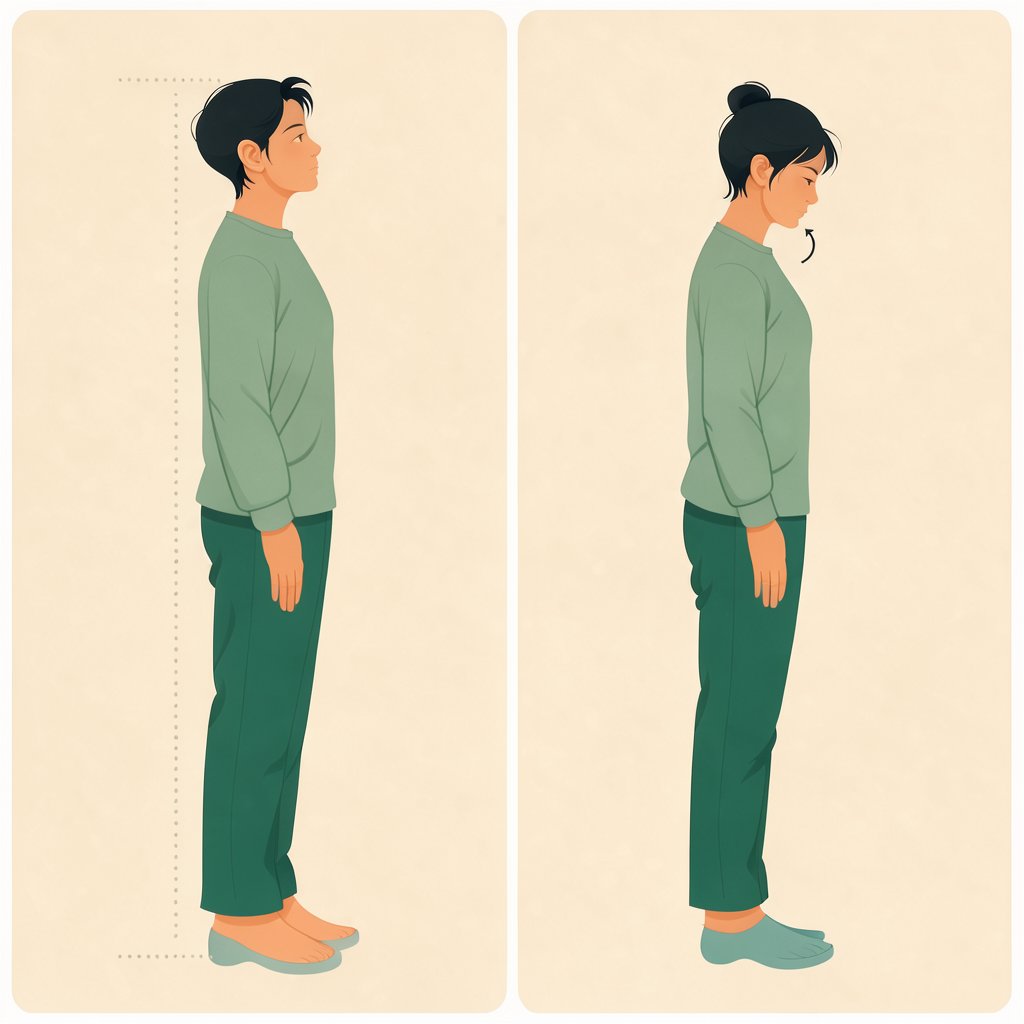
The second check is Barough’s standing posture checklist, and it doubles as the target picture the drills aim at[3]. Walk through it point by point in a mirror or a window reflection, without correcting anything yet. The six points are the book’s own:
- the chest is raised and open;
- the shoulders are down and relaxed;
- the neck is softly extended;
- the chin is parallel to the floor;
- the crown points to the ceiling;
- the spine is neutral, its natural curves retained.
Most desk workers miss at least three of the six on the first try, and that is information rather than verdict. Wherever the checklist breaks down, start the protocol farther from the ideal and progress more slowly. Persistent symptoms belong first in front of the safety section’s consult-a-doctor rule, and only then on the practice mat.
How to Open the Chest: Four Drills, Step by Step
The first half of the protocol happens where the problem lives: the front of the chest. Each drill below names its source tradition, its exact cues and its hold times, and none of them needs more than a door frame or a floor. Learn them in order, because they progress from standing and breath-mapped work to floor work.
Drill 1: The Wushu Arms-Overhead Open-and-Close Cycle
The cycle starts standing, and the inhale opens it: the arms rise through the sides overhead, the head lifting with them and the eyes following the hands[2]. At the top, feel a soft whole-body stretch upward while the heels stay on the floor[2]. The rising inner surfaces of the arms, the wushu manual notes, intensively massage the lateral chest wall — an important reflexogenic zone linked to breathing and circulation[2]. On the slow exhale, lower the arms back through the sides with the elbows bending, letting the sinking shoulders compress the ribcage and aid a fuller exhale, while the knees soften slightly[2].
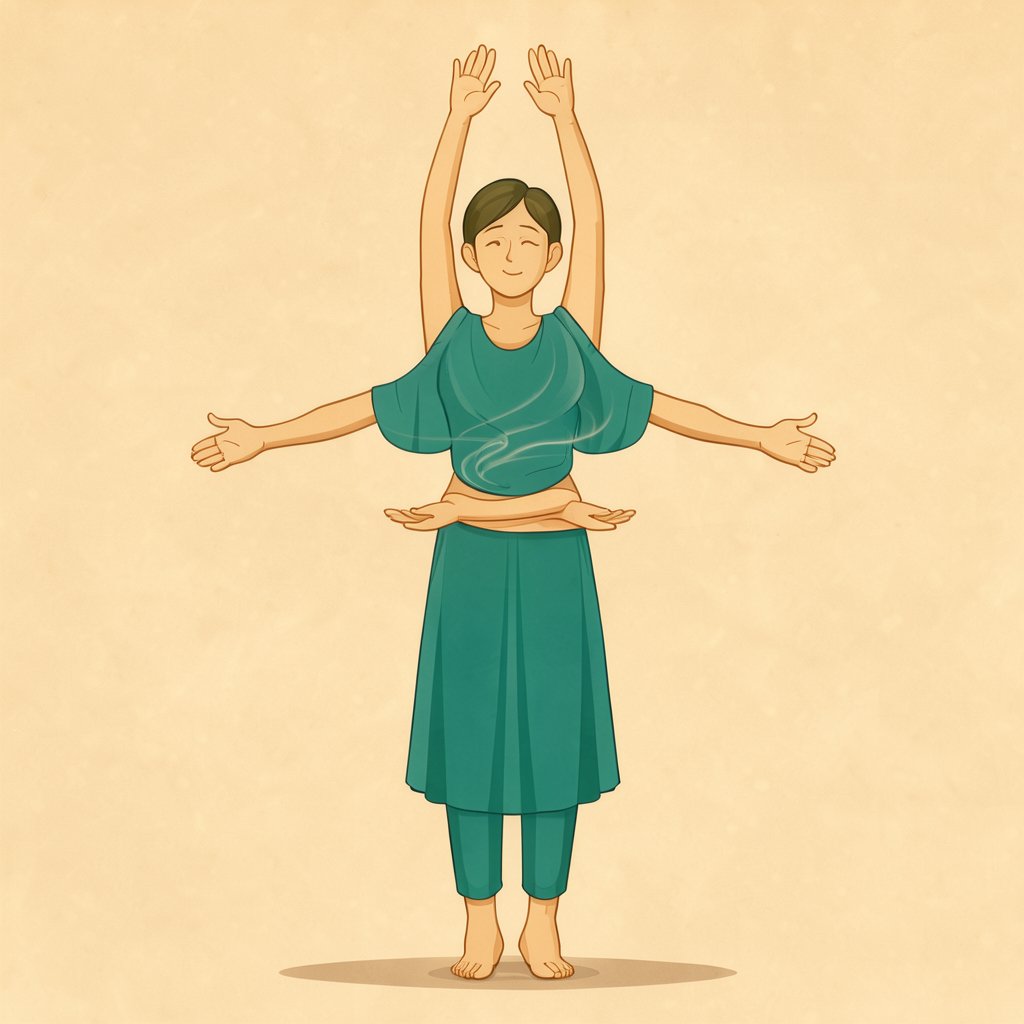
At the bottom the arms cross low in front of you, right under left, forearms touching and palms up, and the next, more energetic inhale raises them again — one complete open-and-close cycle mapped to the breath[2]. The taiji form rules from Wang Lin govern the whole movement: the shoulder is freely sunk and the elbow droops, and lifting the shoulder during the movement is considered an error[8]. Keep the torso strictly vertical with the waist and hips relaxed, and borrow his kinesthetic image of a thread between the hands that is quietly stretched but never snapped[8]. How many cycles belong to day one is a dosage question, and the dosage section below answers it with the traditions’ own numbers.
Drill 2: The Doorway Thoracic Release
Pak’s doorway work is a three-part drill built around a door frame, and it opens as self-massage. Stand pressed into the corner of the frame at the level of the tight muscle, and shift slowly left and right, feeling the small muscles roll under the pressure[1]. Work the whole thoracic area this way, spending the most time where the roll feels knotted.
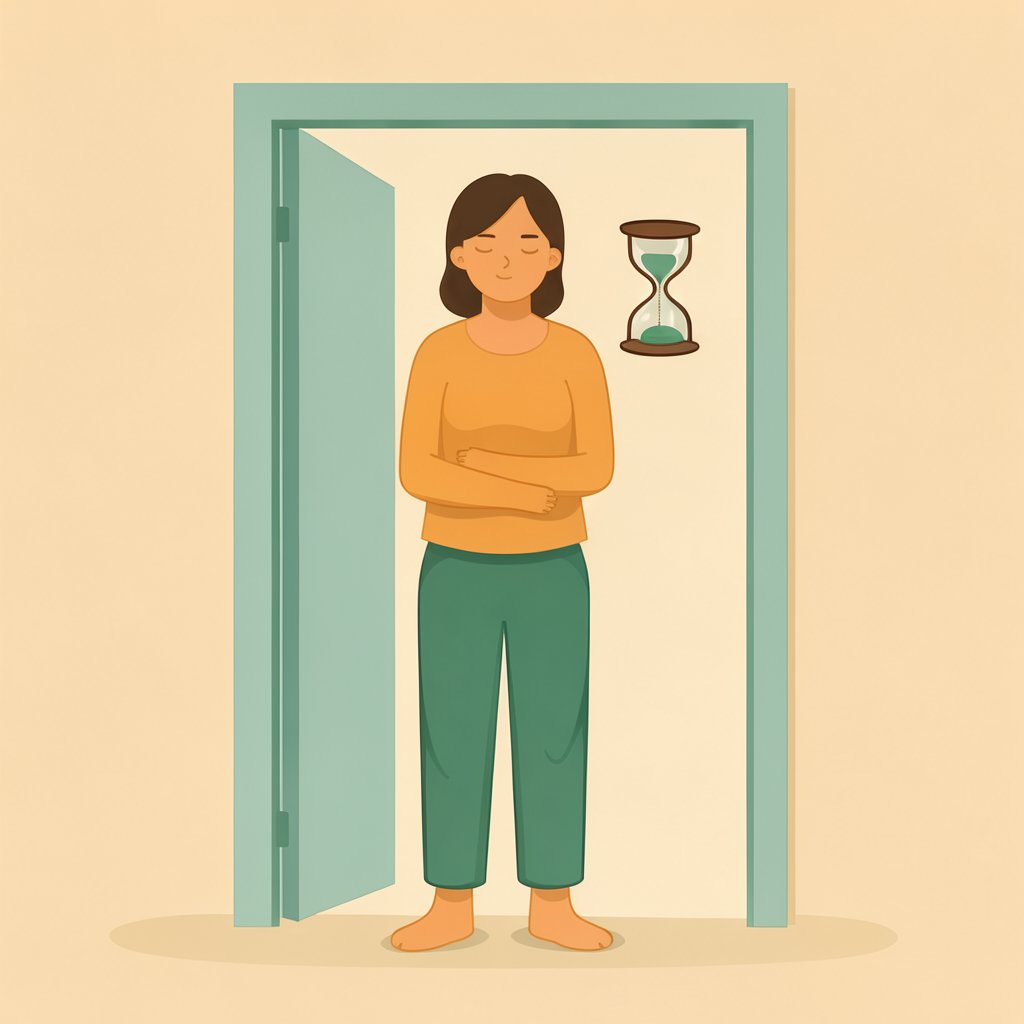
The second part is the hug-stretch: seated or standing, wrap your arms around your torso and round forward at the thoracic spine, only to light tension, then hold that position for a full minute before swapping which arm rests on top and repeating[1]. The one-minute hold is the drill’s signature, deliberately far longer than most people instinctively give a stretch. The third part is the diagonal arm reach: send one arm about 45 degrees across toward the opposite side, let the other hand grasp its wrist and draw it further, and bend the thoracic spine until a light tension appears near the shoulder blade[1]. Light tension is the ceiling in all three parts, because Pak’s system works by release, not by force.
Drill 3: The 10-Second Floor Back-Bend
Barough’s floor back-bend takes the chest opener to the floor. Lie face down with the hands under the shoulders, press the upper body up while keeping the elbows at roughly 90 degrees, and hold for 10 seconds, feeling the stretch travel down the back[3]. The advanced version continues until the arms are straight but not locked, with the chest and shoulders raised and the shoulder blades dropped, again for a 10-second hold[3].
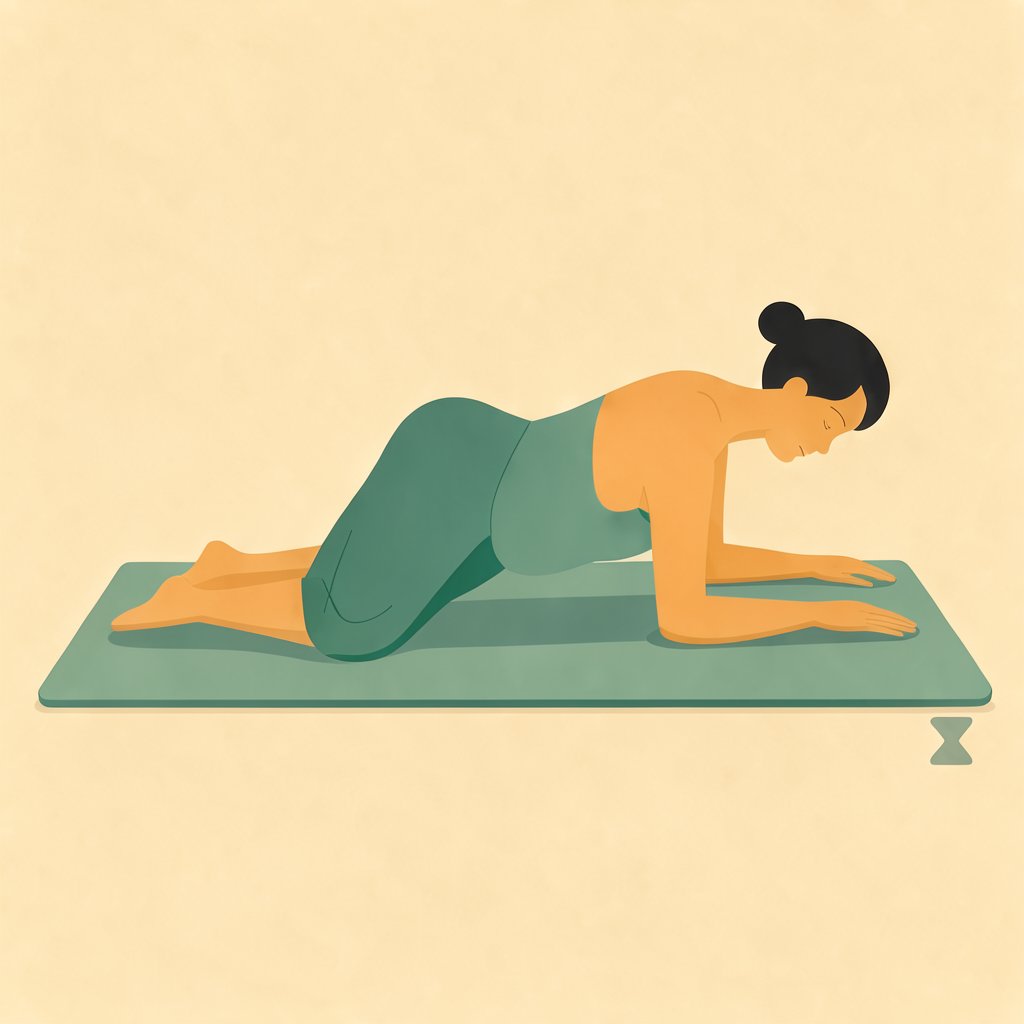
This is the one drill in the set with an explicit red-light clause, and it deserves quoting: “avoid this exercise if you have any sensitivity or problems in your back”[3]. The doorway release and the seated opener cover the same territory more gently, and choosing them instead is a legitimate reading of the sources rather than a shortcut. The book’s own dosage for each version is the hold itself — 10 seconds — with no repetition count attached[3].
Drill 4: The Seated Four-Sharp, One-Slow Opener
The desk-friendly opener from Timofeeva and Belicheva’s therapeutic-gymnastics manual can be done seated between meetings. Sit or stand straight with the feet shoulder-width apart, bend the elbows and raise them to chest level[10]. On the inhale, pull the bent arms sharply back four times; on the exhale, pull the straight arms slowly back once[10].
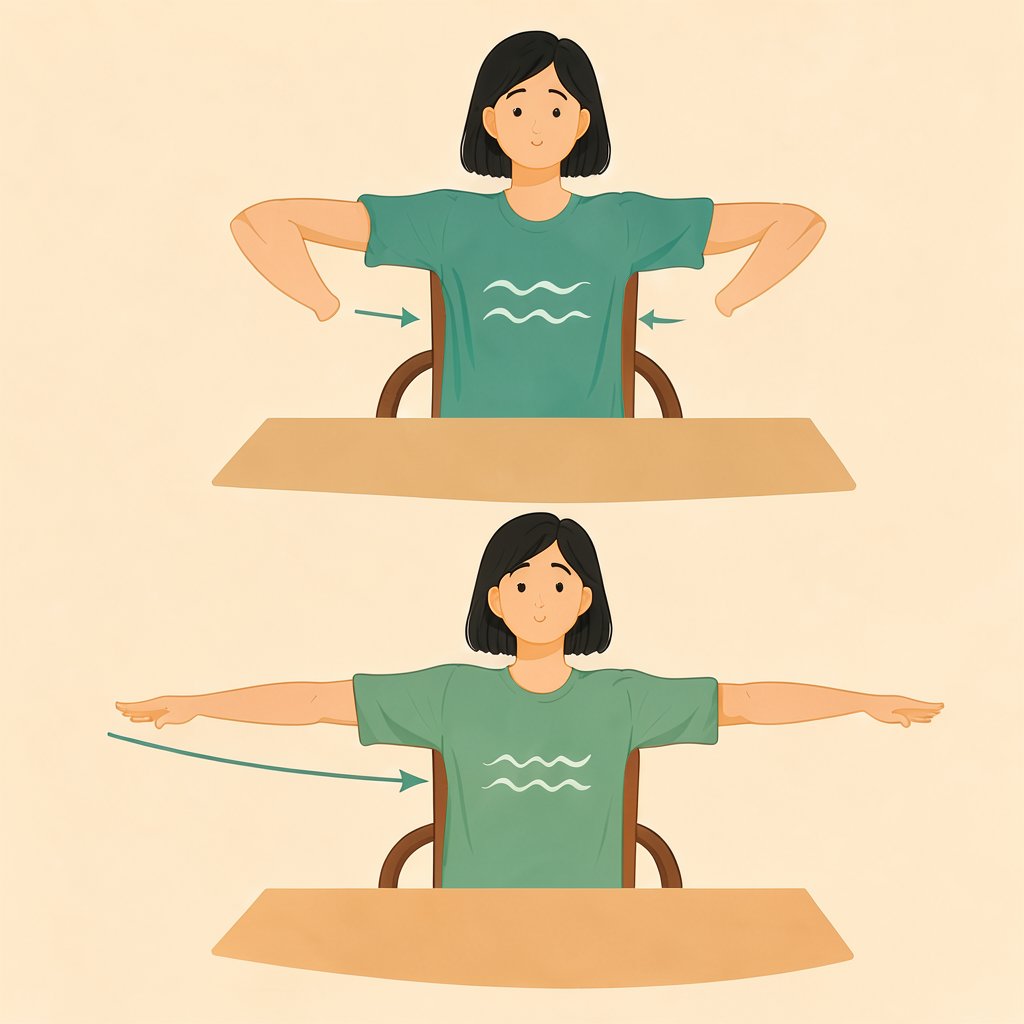
That four-sharp, one-slow rhythm makes the drill a breathing exercise as much as a stretch, and the same book’s morning complex doses each of its exercises at five to six repetitions[10]. The rhythm also trains the ribcage openers from the mechanism section: sharp pulls on the inhale, a long slow drain on the exhale. It is the easiest drill to keep alive on heavy workdays, which is exactly why it earns its place in the set.
Two lighter companions round out the menu. Olishevskaya’s breathing arm lifts raise the arms through the sides on the inhale and lower them with deliberate relaxation on the exhale, dosed at six to eight repetitions, with a forward-fold variant at five to eight[11]. Rodionova and Nikitina’s thoracic set arches the back strongly on all fours for holds of two to three seconds, five to seven repetitions, then lifts the head and legs from a prone position for five to eight — exercises the encyclopedia credits with ensuring normal mobility of all thoracic segments and building correct posture[12]. Together with the four main drills, they give the chest every angle it needs.
How to Release the Neck: The Second Half of the Protocol
With the chest released, the neck can finally accept movement instead of guarding it, and this second half of the protocol is the neck release proper — deliberately modest. Its core is the opening pair of Pavel Tsatsouline’s Super Joints morning series: exercise one is three-plane neck movement — looking up, turning the head side to side, and tilting an ear toward each shoulder — and exercise two is slow shoulder circles[9]. The series then continues into arm circles and flexion and extension of the spine, always in the same calm register.
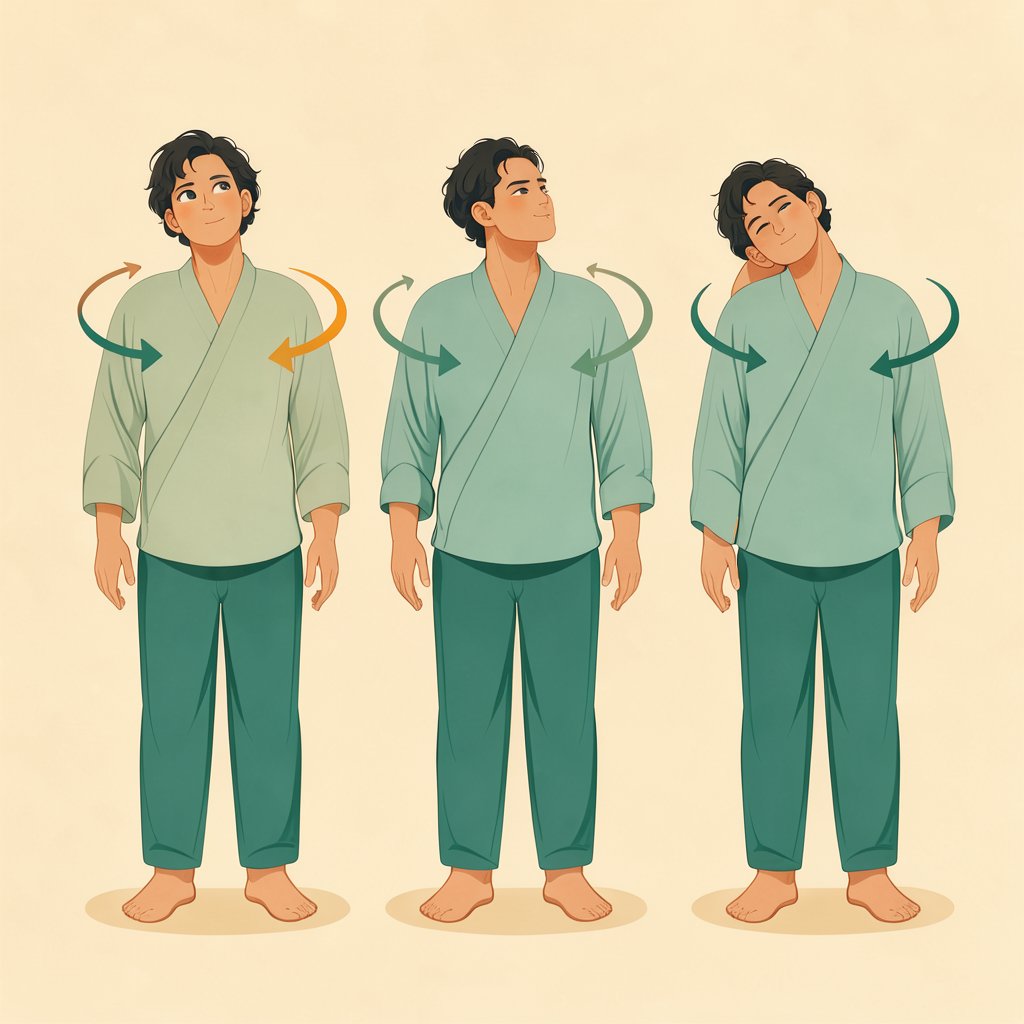
The series carries three standing rules, all from the book. Do it every morning, and work from the extremities to the center of the body[9]. Control the movements, because in Tsatsouline’s own words you should “not bounce, especially when it concerns your spine”[9]. And keep the shoulders down and away from the ears throughout, which is Wang Lin’s error-flag from the drill section applied to the neck itself[8].
For the end of a workout rather than the start of a morning, Tabata’s training system prescribes a cool-down pair that the book presents as mandatory after short intense loading[13]. The seated pectoral stretch sits cross-legged with the arms behind and the back arched, stretching the chest one last time[13]. The neck side stretch tilts the head and gently draws it toward the shoulder with the hand, and the neck back stretch tucks the chin and draws it gently forward for the back of the neck[13].
Where these drills sit in the wider exercise world is easy to see in Libman’s anatomy catalog, whose posture chapter lists the bridge, the cobra stretch, bilateral scapular retraction and a dedicated neck-and-shoulder range-of-motion section[14]. The drills in this protocol are the gentle subset of that menu, chosen for desk workers rather than athletes. That is a feature of the set, not a limitation.
Dosage and Progression: Start with Ten, Add Ten a Week
The cleanest dosage protocol in the source set is Tsatsouline’s, and it is a ladder. Start with ten movements and add ten a week; if that is too ambitious, add five a week for the first month and then ten a week until the target number is reached[9]. The repetitions need not be back-to-back, since the book explicitly allows reaching your goal in multiple sets if you need the rest[9]. The long-term target is memorable: match your repetitions to your age in years[9].

Hold times are short by design. Barough’s chest and back stretches hold for 10 seconds in both variants, the side rolls run about 15 seconds per side, and the standing neck-side stretch holds 10 seconds before repeating on the other side[3]. Belaya’s exercise-therapy textbook frames the whole practice as low intensity: a breathing-to-strengthening ratio of one-to-one or one-to-two, four to eight repetitions at a slow to medium tempo through the full amplitude, and a pulse that rises only five to ten beats per minute[15]. When pain is present her rule flips the structure: sessions shrink to five to seven minutes and repeat every hour[15].
Readers who want a strengthening format can borrow Bubnovsky’s circuit scheme: five series of five repetitions, 25 total, progressing to five series of ten, with sessions of 20 to 30 minutes and rests of 20 to 30 seconds between series, or 10 to 15 seconds for the well-trained[16]. He also recommends keeping a training diary for motivation and reminds readers that correct exhaling removes load from the heart[16]. The older Soviet therapy school of Avdulina adds historical benchmarks: the standing complex repeats eight to ten times, breathing drills three to five, one session runs up to about 200 repetitions, and the day’s ceiling sits at 400 to 500 spread across the day[17]. Those are prescription conventions of that school rather than trial results, and they are presented here as exactly that; her own chest-opening cue lives inside the complex as a breathing exercise of “turning palms forward, straightening the chest”[17].
Two practice conditions close the numbers. Ovsyannikov paces the breath by the pulse, measured before practice: a rate of 60 to 80 beats per minute means the inhale spreads over four to six walking steps, odd rates of 61 to 81 over three to seven, with the inhale through the nose and the exhale through the mouth with the lips in a tube[7]. Sitel’s spine manual sets the room rules — a ventilated space or the outdoors, and an empty stomach or a three-hour gap after eating[18]. Modest numbers, honestly sourced, and enough to build a year of practice on.
Safety: Never Drill Through Pain
Every tradition quoted above agrees on one safety floor, and Borenstein’s spine book states it plainly: there is no sense doing exercises in the presence of pain[19]. His program logic is to expand your personal “territory of good health” gradually, increasing repetitions or hold times stepwise rather than in jumps[19]. An osteochondrosis manual sharpens the same point from the other side: whatever your fitness level, loads exist that are inadmissible for you, and forcing through them leads to severe consequences[20]. Animals instinctively refuse such loads, the book notes, and humans should too[20].
The desk-day counter-dose belongs to Dikul. The longer you sit relaxed, he writes, the greater the load on the intervertebral discs, so his proposed work-break micro-complex takes only two to three minutes[21]. He also tells readers not to fear coworkers’ smirks about doing gymnastics instead of a smoke break, which may be the most practical sentence in this entire guide[21].
The disclaimer standard comes from Time-Life’s Healthy Back handbook, and its wording still holds: the material “was not conceived as an alternative to medical care,” and readers with health problems should consult a doctor or physiotherapist before exercise that demands significant effort[22]. The same book’s own mobility drill keeps a pillow under the abdomen and moves only to a gentle C-curve, a model of the softness it preaches[22]. Barough’s floor back-bend caution from the drill section belongs in this list as well: with any sensitivity or problems in the back, that drill is off the menu[3].
One honest limit, stated as such: none of the retrieved source books lists a specific neurological red-flag protocol for neck drills, and this article will not invent one. The guidance the sources do support is generic, and it is enough. Pain during a drill means stop, not push through, and unusual or persistent symptoms mean a conversation with a doctor before the next session. That rule is small, but every tradition in this guide signs it.
Frequently Asked Questions
Why would chest opening exercises help my neck?
Because the neck is usually the victim, not the culprit. Shortened muscles at the front of the chest pull the shoulders forward and force the back muscles to stay constantly tense resisting them, while the ribcage-opening phase of the inhale activates the interscapular stabilizers that the long neck extensors attach to[1][6]. Release the chest, and the neck stops fighting the chest’s war — the mechanism section above walks that chain in full, and our desk posture micro-checks guide adds workday resets that fit the same idea.
Can’t I just force myself to sit up straight?
For a while, yes — and then it backfires. Pak A.L.’s manual is direct: forcibly holding an erect posture strongly overloads the thoracic muscles, they tire quickly, and pain appears, which is why the protocol releases the shortened chest zones before training the upright habit[1]. Sitting straight over a tight chest means paying a muscle tax every minute, as the release-before-straighten section above explains.
How many repetitions do I start with?
Ten, then a ladder. Tsatsouline’s prescription starts with ten movements and adds ten a week, or five a week for the first month if that is too ambitious, with multiple sets allowed and your age in years as the long-term target[9]. Barough’s holds run 10 to 15 seconds and Belaya keeps sessions at four to eight slow, full-amplitude repetitions[3][15]; the dosage section assembles the complete number set.
Is the floor back-bend safe for everyone?
No, and its own source says so explicitly. Barough’s instruction to avoid the exercise with any sensitivity or problems in the back is quoted verbatim in the drills section and repeated in the safety section[3]. The doorway thoracic release and the seated four-sharp, one-slow opener work the same territory more gently[1][10].
How often should I take a break at my desk?
Dikul’s answer is generous: a two-to-three-minute micro-break whenever the workday allows one, because the longer you sit relaxed, the greater the load on the intervertebral discs[21]. He frames the break as a standing appointment, smirking coworkers included[21]. Our desk posture micro-checks guide collects the resets that fit inside that window.
How long until my posture improves?
Honestly: the source books give prescription-style dosage but no weeks-to-improvement timelines and no trial data, so this guide will not quote a number. What the sources offer instead is a progression frame — Tsatsouline’s weekly add-ten ladder, Belaya’s pulse ceiling of five to ten beats per minute, and Borenstein’s rule to expand your territory of good health gradually[9][15][19]. Track the two self-checks monthly and let them, not a calendar, answer the question.
The chest-first, neck-second protocol is deliberately unheroic: chest opening exercises first, neck release second, every morning, a few minutes at a time. Its drills come from traditions that spent centuries answering one problem — the sedentary day — and their numbers, from ten starting repetitions to 10-second holds, are small enough to survive a busy week[9][3]. Do the chest half before the neck half, keep the shoulders away from the ears, and stop at pain[8][19]. The traditions’ wager is that order and regularity outperform intensity, and that is a wager worth testing at your own doorway tomorrow morning.
Sources
- [1] Pak A.L. — Get Rid of Trigger Points (2024), the source of the chest-first ordering rule, the desk-posture pathology and the three-part doorway thoracic release with its one-minute hug-stretch hold
- [2] Popov G.V., Sagayan O.A., Didenko V.V. — Wu Shu: The Path to Health and Harmony, the source of the arms-overhead open-and-close cycle with its breath mapping, the silk weavers’ twelve exercises and the jiaoli historical context
- [3] Barough N. — Walking For Fitness (2017), the source of the posture checklist, the desk-hunch chain, the floor back-bend with its ten-second holds and the standing neck-side stretch dosage
- [4] Healthy Spine: Recipes and Recommendations (unattributed manual)
- [5] Lee Holden — 7 Minutes of Magic (2008)
- [6] Vasilyeva L.F. — Applied Kinesiology: Restoring Tone and Function of Skeletal Muscles (2018), the source of the ribcage-opening inhale phase and the interscapular link to the long neck extensors
- [7] Ovsyannikov V.D. — Breathing Gymnastics (1986)
- [8] Wang Lin — Taijiquan: The Art of Harmony and a Method of Life Prolongation
- [9] Pavel Tsatsouline — Super Joints, the English-language source of the morning joint series, the three-plane neck movements, the start-with-ten dosage ladder, the no-bounce rule and the age-in-reps long-term target
- [10] Timofeeva S.A., Belicheva T.M. — Therapeutic Gymnastics: Health at Any Age (2015)
- [11] Olishevskaya N. — 365 Golden Breathing Exercises (2010)
- [12] Rodionova O.N., Nikitina G.A. — Osteochondrosis: Best Treatment Methods (medical encyclopedia)
- [13] Tabata Izumi — Tabata Method: Japanese Training System (2022)
- [14] Libman Kh.L. — Anatomy of Exercises (2013)
- [15] Belaya N.A. — Exercise Therapy and Massage (2001), the source of the low-intensity dosing rules: the one-to-one or one-to-two breathing ratio, the five-to-ten-beat pulse ceiling and the slow full-amplitude tempo
- [16] Bubnovsky S.M. — Healthy Vessels, or Why a Person Needs Muscles (2012)
- [17] Avdulina A.S. — Exercise Therapy for Cardiovascular Diseases (1966)
- [18] Sitel A.B. — All About the Spine: Freedom of Movement Without Pills (2014)
- [19] Borenstein D. — The Spine: Key to Health (2006)
- [20] Defeat Osteochondrosis (unattributed manual)
- [21] Dikul V. — Spine and Joints (2025), the source of the two-to-three-minute work micro-break prescription, the intervertebral disc rationale behind it and the smoke-break comparison
- [22] Time-Life Books (ed.) — Healthy Back: Preventing and Relieving Pain (1997)
Where to go next: within the same mobility pillar, the desk posture micro-checks guide collects two-minute workday resets, and the traditional mobility versus modern programs comparison maps how these old systems hold up next to contemporary routines. The five Tibetan rites practice is another daily movement ritual with a fixed sequence worth knowing. If chronic neck and shoulder tightness rides along with your desk days, the Joint Genesis review and the Unlock Your Hip Flexors review take an honest, criteria-based look at two popular movement programs.
How we researched this: this article was built from a local library of 1,137 wellness books, indexed and searched offline with no internet sources. Retrieval focused on the joint-mobility, posture and gentle-vitality collection of that library, with five targeted queries on mechanisms, protocols, dosage, safety and history. Every drill, number and caution above was checked against the cited book passages before publication, and gaps in the base are marked as gaps rather than filled.
