
Educational content only — not medical advice. See our full Medical Disclaimer and Affiliate Disclosure below.
Key Takeaways
- Desk stiffness has two well-documented sides: a nervous-system side — proprioceptors that stop getting new input and make the nervous system “tighten up” the muscles — and a tissue side — discs that lose fluid and deep stabilizing muscles that fade during long sitting.[2][9]
- The 60-second posture check below walks your whole sitting position — head, chin, shoulders, chest, pelvis — using cues from classic fitness and back-care manuals.[1]
- Five range-of-motion checks come with degree benchmarks for the joints desk work narrows most: neck, shoulders, elbows, wrists, hips, knees and ankles.[10][11]
- A 3-minute reset routine, done at or beside your desk, is built from isometric and stretching moves with the exact hold times and repetitions the sources prescribe — and a hard “no pain” rule.[3][7][8]
If your workday is measured in hours at a screen, your body pays the bill: stiff neck, tight hips, a back that feels “rusty” by mid-afternoon. This guide collects the posture and mobility checks for desk-bound days described in classic back-care, kinesiology and fitness manuals: a 60-second sitting self-check, five range-of-motion benchmarks with reference numbers, a 3-minute reset routine with exact holds and counts, and a desk-setup checklist that lets your furniture hold the posture for you.
Why a desk day makes your body feel rusty
The traditional explanation starts with the nervous system. Pavel Tsatsouline describes the familiar “Tin Man” feeling in Super Joints: you get “rusty” whenever your proprioceptors — the sensors that report your body’s position and speed of movement — stop receiving new input for a while. When nothing moves, the nervous system is not sure what to expect from the environment and tightens the muscles “just in case.” Movement wakes the proprioceptors up, the nervous system settles, and you limber out — which is why the same source recommends mobility drills every morning to shake off stiffness.[2]
The modern physiology account reaches the same place from the tissues. In Muscles, How Are You Doing?, Andreas Stippler and Norbert Regitnig-Tillian explain that uncomfortable positions — such as prolonged sitting with a hunched back — and lack of physical activity allow the deep muscles that stabilize the spine to waste away. Intervertebral discs lose fluid and elasticity from constant sitting and become flatter; the ligaments between vertebrae can weaken, leaving the spine less stable. The weakened back muscles then have to tense harder, chronic spasms follow, pain worsens posture, and worse posture breeds new spasms — a closed circle.[9]
Trigger-point practice adds a third, very practical detail: the muscles of the thoracic region produce that familiar ache between the shoulder blades that can spread to the shoulder blades, neck and sometimes the head, and the symptoms most often get worse after prolonged static load — sitting at a working desk hunched over or half-sideways, or working with the arms extended forward.[8]
None of this needs a gym to counter. Fitness-walking manuals already observe that modern workplaces have made people more sedentary than ever, bodies hunched over desks and reinforcing the very muscles that create poor posture — and that an activity such as walking, where good posture and breathing are part of the exercise, is the natural antidote.[1] The checks below tell you where you stand today.
The 60-second posture check at your desk
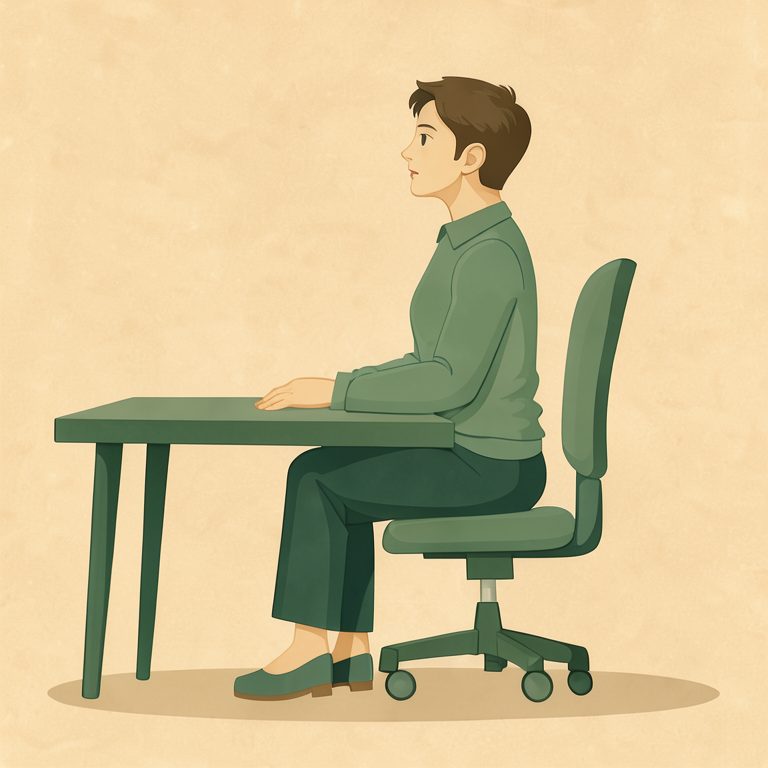
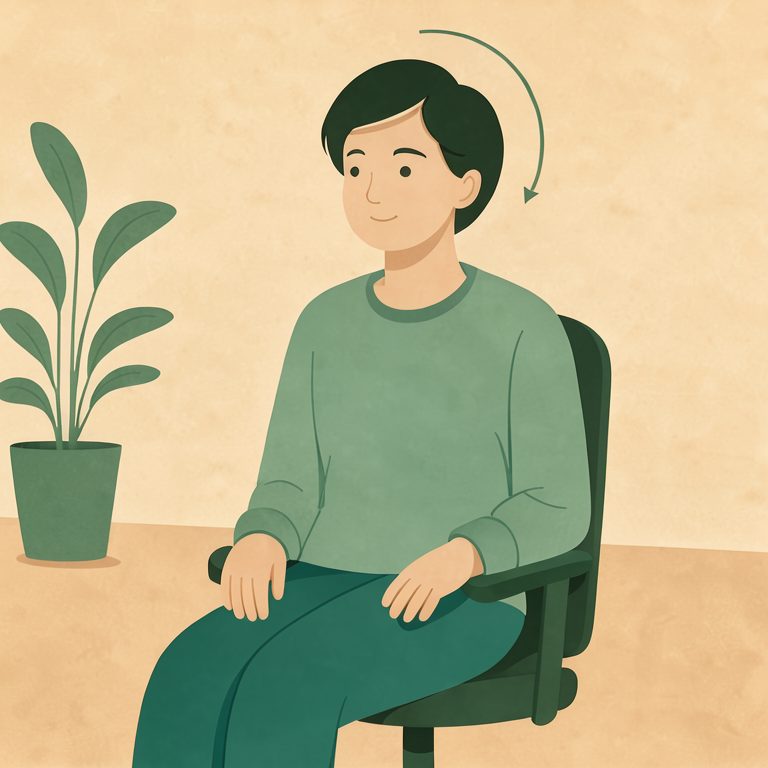
The posture check in Walking for Fitness is built on a clear contrast between an incorrect pattern and a correct one.[1] Run these five checks about once an hour, sitting or standing:
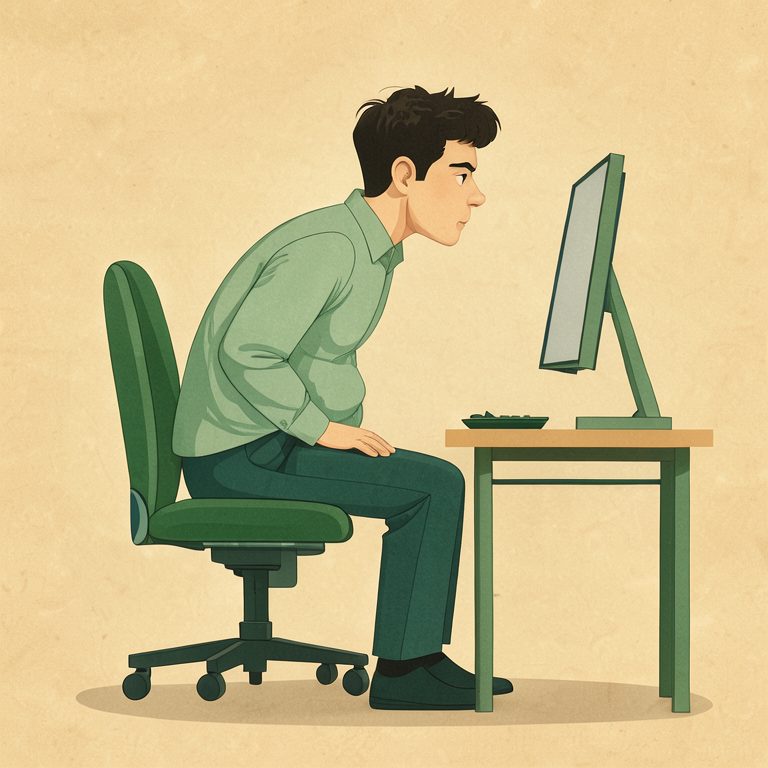
- Head and chin. Incorrect posture thrusts the head forward with the chin jutting out, straining the neck and shoulder muscles — and people who sit a lot, especially in front of a computer, tend to push the head and neck forward.[1] Correct it: the chin is parallel to the floor and the crown points to the ceiling. The body follows the head — when the head juts forward, the spine follows suit.[1]
- Shoulders and chest. Slouched shoulders and a collapsed chest are the classic desk pattern; a collapsed chest affects oxygen flow, and poor posture can restrict the rib cage so the lungs cannot expand properly.[1] Correct it: shoulders down and relaxed, chest raised and open.
- Pelvis and lower back. Pushed-out abdominals arch the spine and throw the pelvis back.[1] Correct it: hips gently tilted so the bottom is tucked under, and the spine in neutral — allowed to keep its natural curves.
- Legs and feet. Weight evenly distributed, feet slightly apart to form a stable base, and a straight line from the heel through the back of the knee — not locked.[1]
- The corset test. Sitting or standing tall, draw your navel gently toward your spine, as if zipping a natural corset, and notice how the spine realigns itself; done regularly, this also trains the abdominal muscles that hold you upright.[1]
One caution from the trigger-point literature: forcing yourself to hold a rigidly upright posture overloads the thoracic muscles just as much as slouching does — they tire quickly and start to ache. Shortened muscles on the front of the chest pull the shoulders forward and round the thoracic spine, so the back muscles must stay tense to resist them. Release the shortened zones first (the reset routine below does exactly that), and only then rebuild the sitting habit.[8]
Posture and mobility checks: five range-of-motion benchmarks
A self-check is only useful if you know what to compare against. The exercise-therapy manual by N. A. Belaya publishes average mobility values, measured in degrees from the neutral position, for the joints of the limbs.[10] Test both sides, note any asymmetry, and never force a range — these are reference values for healthy adults, not targets to hit today.
| Joint | Movement | Average benchmark (degrees)[10] | Why desk workers should check it |
|---|---|---|---|
| Neck (cervical spine) | Flexion – extension | Flexion until the chin touches the sternum; extension until the back of the head approaches horizontal | The cervical section is among the most mobile parts of the spine — and among the most loaded in sitting[10][5] |
| Shoulder | Flexion – extension / abduction / rotation | 180–60 / 0–180 / 90–90 | Reaching a shelf overhead tests all three planes; desk posture rounds the shoulders inward[11] |
| Elbow | Flexion – extension | 145–0 | Keyboard work uses only a narrow slice of this single plane[11] |
| Wrist | Flexion – extension / side-to-side | 90–80 / 20–45 | The wrist allows only two degrees of angular freedom — protect both[11] |
| Hip | Flexion – extension / adduction – abduction / rotation | 125–15 / 10–45 / 45–45 | Sitting parks the hips at about 90° of flexion for hours; short hip flexors then tilt the pelvis[2] |
| Knee | Flexion – extension | 130–0 | Long sitting leaves the knees folded; check full extension after work |
| Ankle | Flexion – extension | 45–20 | Feet flat under the desk all day barely use this range |
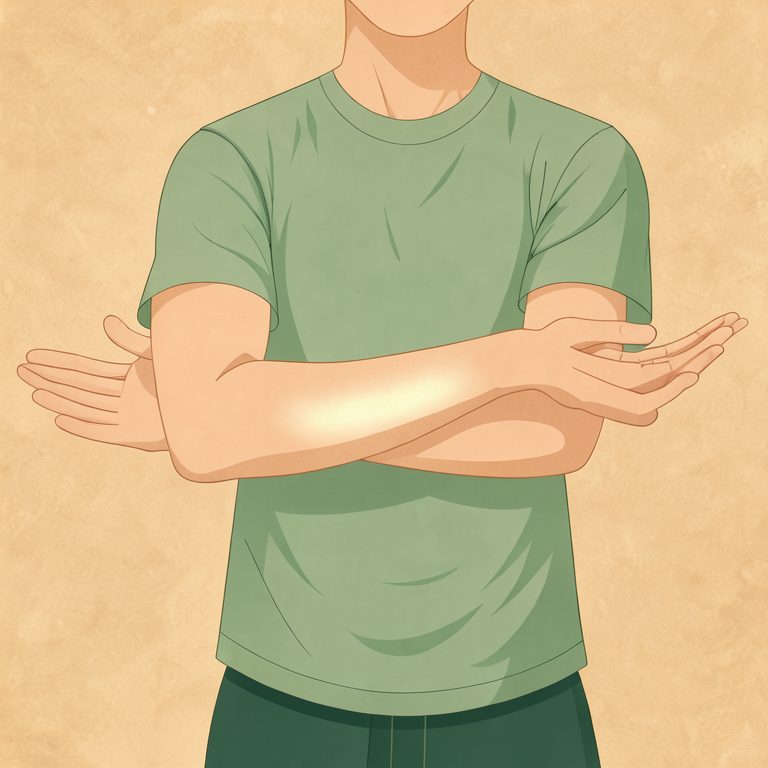
The anatomy explains why desk work narrows these numbers so quickly: the shoulder has three degrees of angular freedom, the wrist only two, and the elbow just one — and keyboard work lives almost entirely inside that single elbow plane.[11] In the spine, the most mobile sections are the cervical and lumbar — exactly the two segments that carry the extra load of a sitting position[5][10] — while the thoracic section moves the least.[10]
The 3-minute desk reset protocol
Isometric specialist Igor Borshchenko states the desk problem plainly: immobile sitting work causes a whole complex of harmful changes in the body, and if there is no chance to take a break, you should use the working time itself for training.[3] The protocol below follows his iron rule — pain is never allowed, stop the exercise the moment it appears — and borrows from four more sources. Do it at or beside your desk, once or twice a day:
- The “Japanese greeting” chest press (10–30 s). Sit or stand and place your palms together in front of your chest, the way people greet each other in Southeast Asia. Press the palms against each other for 10–30 seconds — starting and finishing the pressure gradually, never sharply — so the chest muscles engage under resistance.[3]
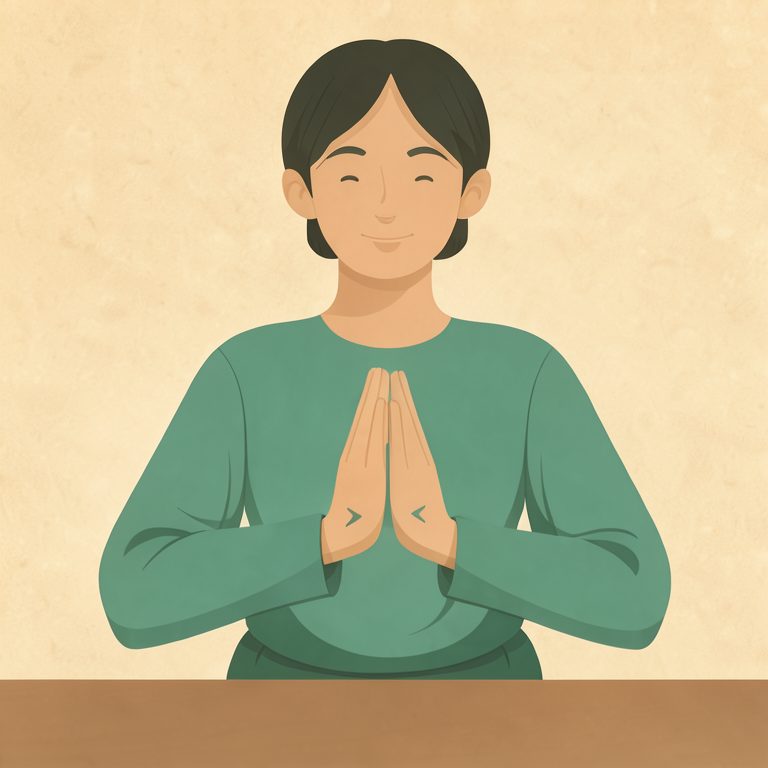
Reset 1 – Japanese greeting chest press: palms together at chest, gentle mutual pressure - Doorway chest stretch (10–30 s). Place your hands on the two edges of a door frame, hold them there, and — without pushing on the frame — step your torso forward until you feel the chest muscles stretch. Hold 10–30 seconds; stop immediately if pain appears.[3]
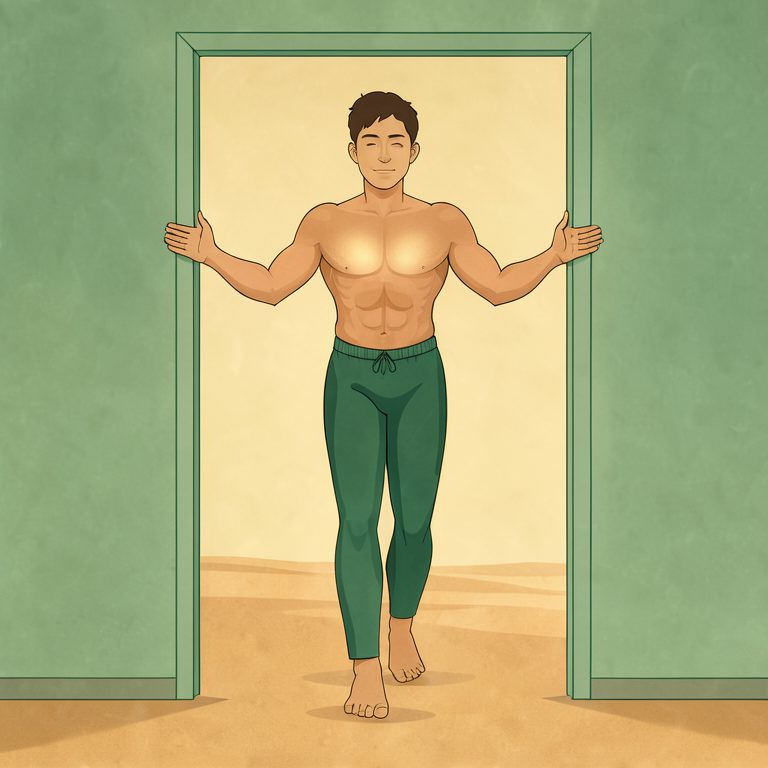
Reset 2 – Doorway chest stretch: hands on both door frame edges, torso stepping forward - Shoulder circles (10 each way). Draw circles with your shoulders, as big as possible, in both directions: inhale and expand the rib cage as the shoulders move back, exhale as they come forward; switch directions after every ten revolutions.[2]
- The chin press (3 reps). Elbows on the desk, chin resting on your palms. Inhale deeply and, keeping the neck straight, press the chin firmly down into the palms; hold the breath briefly, exhale slowly, and straighten the head. Repeat 3 times.[7]
- Seated abdominal hold (1 min). Sit on the chair, arms along the body, and hold the abdominal wall tense for about a minute, breathing shallowly; rest a minute, then repeat — the full cycle is done 2–3 times.[3]
- Standing hip flexor stretch (10 s per side). Stand tall, feet hip-width apart, and step back with the left leg; place your hands on the right thigh just above the knee. Lunge slowly forward onto the right leg, keeping that knee at 90 degrees above the heel; keep the hips square and gently tighten the buttocks so the front of the left hip stretches. Hold 10 seconds, then change sides.[1] A second variant — a normal stride forward, knees bent, rising onto the balls of both feet, hips square — works the same area from a shorter stance.[1]
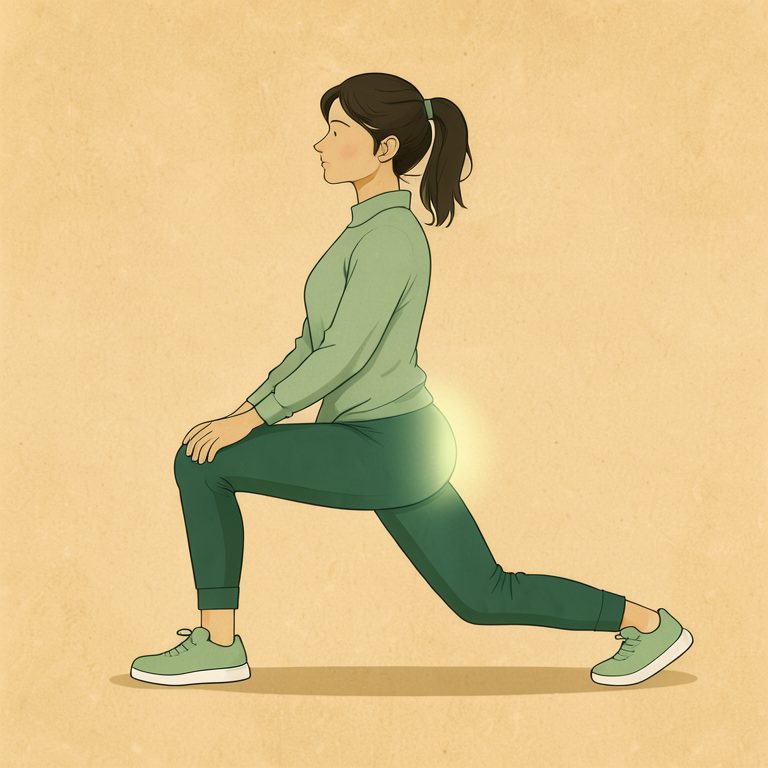
Reset 3 – Standing hip flexor stretch: half-kneel lunge, front knee at 90 degrees above the heel - Forearm and finger release (about 30 s per side). Arm extended forward, elbow straight, palm up: with the other hand grasp the fingers and extend the wrist until you feel light tension along the inner forearm. Then palm down, and flex the wrist for the back of the forearm. Finish by gently pulling each finger out to the side in turn, holding each about 30 seconds.[8]
Two programming notes from the sources: never bounce a stretch — especially anything that involves the spine — and control every movement;[2] and with stretches, “little but often” is the best policy.[1] If the front of your hips stays stubbornly tight no matter how often you stretch it, our Unlock Your Hip Flexors review examines a dedicated program for that one muscle group — what it contains and who it suits.
Desk setup that holds the posture for you
Checks catch the drift; setup removes the cause. The back-care literature converges on a short, cheap list:
- Desk height. Adjust the desk so the working surface sits about halfway between your waist and your shoulder blades; this lets you hold your head straight, stop the shoulders from dropping, and stop bending over the desk.[4]
- Chair that follows the spine. An office chair with adjustable seat height and backrest angle holds the spine in the correct position, follows its curves and takes over part of the load, easing the tension in the back muscles. Set the height so your elbows rest on the table freely — without bending your back.[5] A firm lumbar cushion between the lower back and the backrest, and a small footstool under the feet, complete the setup.[4]
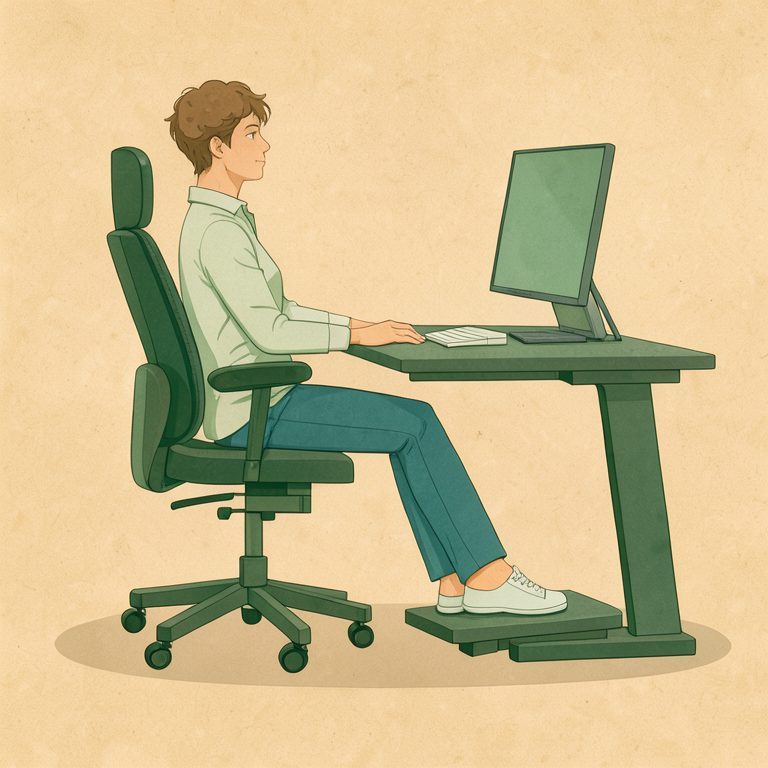
Setup – The self-holding desk: lumbar cushion on the chair back, elbows on the table, feet on a low footstool - Sit fully back, rise from the front. Always sit with your back against the chair back; if it has armrests, rest both arms on them. To stand up, slide to the front edge, tilt the torso forward from the hips, and rise following your head while keeping the torso straight.[6]
- Interrupt the sitting. The sitting position increases the load on the cervical and lumbar spine — especially when the torso or the head lean too far forward[5] — so stand up from time to time, stretch, and take several steps around the room.[4] In standing tasks, shift the weight from one foot to the other every 5–10 minutes, or rest one foot on a low stand.[5]
- A visible reminder. Tie an elastic band around something you look at often during the workday — the desk phone, for example. Every time you notice it, spend 30 seconds squeezing your shoulder blades together. Kept up, this becomes second nature, strengthening the upper back and helping improve posture.[1]
Want a structured practice instead of self-checks? Our step-by-step practice manuals adapt traditional mobility sets to a modern schedule, and the Joint Genesis review explains what to look for in joint-support formulas — selection criteria, not promises.
Safety first
All sources draw the same red line: no pain. If a pressure, a stretch or a movement hurts, stop that exercise — pain is not a working sensation here.[3] Build ranges gradually: the mobility tradition starts a new drill at ten slow movements and adds ten per week at most, and if your joints are already damaged, higher repetition counts belong in a plan approved by your doctor.[2] These checks and exercises are gentle, educational material for healthy adults who want to stay mobile through desk-bound work; they do not replace evaluation by a qualified clinician. Numbness, radiating pain or dizziness is a signal to see one — not to do another set.
Sources
- [1] Barough, N. — Walking for Fitness (2017)
- [2] Tsatsouline, Pavel — Super Joints
- [3] Borshchenko, Igor — Neck Without Pain (2012)
- [4] Goryanaya, G. A. — Get Rid of Osteochondrosis (1994)
- [5] Healthy Spine: Recipes and Recommendations — author not listed in the source library
- [6] Time-Life Books (ed.) — Healthy Back (1997)
- [7] Vakulich, E. L. — Better Vision for Computer Users (2010)
- [8] Pak, A. L. — Get Rid of Trigger Points (2024)
- [9] Stippler, A., Regitnig-Tillian, N. — Muscles, How Are You Doing? (2020)
- [10] Belaya, N. A. — Exercise Therapy and Massage (2001)
- [11] Neumann, Donald A. — Kinesiology of the Musculoskeletal System
How we researched this
This article is based entirely on our local library of 1,137 books, queried through an offline retrieval system — the open internet was not used at any point. Every factual statement above was checked against the source excerpts and carries a numbered citation to the book it was taken from.
Frequently asked questions
How often should I run these posture and mobility checks?
Two rhythms come out of the sources: a quick hourly check of your sitting position — chin parallel to the floor, shoulders relaxed, chest open[1] — and a fuller mobility pass daily, since mobility drills are “ideally performed every morning” to shake off stiffness.[2] With the stretches, little but often beats one long session.[1]
Can I do the reset routine without leaving my desk?
Mostly yes — that is the point. The palm press, the chin press and the abdominal hold are done in or at the chair; shoulder circles fit any open corner. Only the doorway chest stretch and the standing hip flexor stretch ask you to stand up for a moment — and the back-care manuals want exactly that anyway: stand up, stretch, walk a few steps around the room.[3][7][1][4]
Why do my hips feel tight after a desk day even though I train?
Short, tight hip flexors are the classic culprit: these muscles run from the small of the back, through the abdomen, to the front of the thighs — and when they shorten, they pull the lower back forward, increasing its arch and tilting the pelvis.[2] Long sitting keeps them folded in exactly that shortened position, so the direct countermeasure from the sources is the 10-seconds-per-side standing stretch, done often.[1]
