
Educational content only — not medical advice. See our full Medical Disclaimer and Affiliate Disclosure below.
Most of us end the day with tight shoulders and a screen-tired mind, and the pull toward green spaces feels almost physical. Japanese has a name for answering that pull: shinrin-yoku, or forest bathing, a slow and attentive walk among trees rather than a workout in the woods. It is not hiking, not jogging, and not step counting — it is closer to walking in the woods the way you would move through a quiet gallery, letting the place set the pace. This guide covers what the practice is, how to start it this week, and what the walking literature actually documents about its effects.
Here is our honest scope, stated up front. Our source library — 1,137 wellness books searched offline — holds no dedicated shinrin-yoku manual, so we did not invent Japanese clinical history to fill the gap. Instead, this guide rebuilds forest bathing from the shelves the base does have: a walking-as-medicine system, mindful tai-chi walking, cardiac-rehabilitation breathing rules, and qualitative traditions about forest air. Every claim below carries a numbered footnote to the book it came from, and traditional claims are labeled as tradition, never as clinical proof. For a standing companion practice on rest days, see our Baduanjin — Eight Pieces of Brocade manual.
Key Takeaways
- Shinrin-yoku (forest bathing) is the Japanese name for a slow, continuous, mindful walk among trees; this guide rebuilds the practice from walking science, because our book base holds no dedicated shinrin-yoku source.[1]
- The beginner dose comes from the walking shelf: a continuous 20-minute stroll 3-4 times a week, built to 30-40 minutes at 4.5-5.5 km/h (2.8-3.4 mph) with a heart rate around 80-100 bpm.[1]
- Books describe forest air as rich in negative ions and phytoncides — a qualitative traditional claim, not a verified trial result.[2][3]
- Regular walking at 5×40 or 3×60 minutes per week is documented in the walking literature to lower blood pressure and normalize lipid profiles; anyone with a heart condition should clear the habit with a doctor first.[1][4]
What Is Shinrin-Yoku (Forest Bathing)?
Shinrin-yoku is the Japanese term for a slow, continuous, breath-coupled walk taken among trees, with attention resting on the place rather than on pace targets or distance records. It is walking in the woods the way the tai-chi tradition walks across a room: unhurried, aware, and deliberately gentle. There is no gear beyond supportive shoes and no venue beyond a treed path.
One honesty note belongs right here, because the internet will not give you one. Our offline library contains no shinrin-yoku history and no Japanese forest-therapy trial data, so this guide does not repeat the usual 1982 origin story — our sources cannot confirm it, and we do not quote what we cannot check. What the base does hold is a walking shelf that validates every practical element of the practice: the dose, the pace, the technique, and the safety rules. That is the material this guide is built from, footnote by footnote.
The framing, though, is older than the buzzword. One system in our base is literally titled Walking Instead of Pills — gentle walking presented as a therapeutic habit in its own right[1] — while the qigong teacher Lee Holden teaches what he calls tai-chi walking, a special form of walking in which every step brings maximum benefit to health and emotional state[2]. Nordic-walking author G.M. Kibardin adds the cultural backdrop with a chapter on Japan’s centenarians and their walk-everywhere daily life[4]. Read through this shelf, forest bathing is simply those disciplines taken outdoors among trees — which raises the obvious question of why the trees matter at all.
Why Trees? What the Healing Traditions Say About Forest Air
Why not a treadmill or an indoor track? The traditions in our base answer with air, not with statistics. Holden’s exercise-and-nature chapter reports that negative-ion concentration is significantly higher near trees and large bodies of water, and describes negative ions as absorbed by the body, charging it with energy, making outdoor exercise more toning and emotionally balancing than the indoor kind[2]. The same book is blunt about mood: time in nature cleanses emotionally, and, in its own words, transforms negative emotions as effectively as the best therapy session[2].
The family-health encyclopedia by O.N. Rodionova and G.A. Nikitina makes a related claim about what forest air physically carries. Forest and meadow air, the encyclopedia says, is saturated with essential oils, phytoncides, so-called atmospheric vitamins, and aeroions, and it credits that air with benefits for the skin; sea air, by contrast, is described as saturated with salt aerosols[3]. Holden’s broader prescription is to combine physical activity with fresh air whenever possible — walking, jogging, cycling, beach play, and gardening all draw what he calls positive energy from trees, forests, and the landscape[2]. On this reading, a treed alley is not scenery; it is the medium the practice happens in.
Treat all of this as traditional, qualitative description, because that is exactly what our sources contain. Our base holds no phytoncide trial numbers, no natural-killer-cell counts, and no cortisol measurements from forest exposure — and the headline numbers that circulate online come from studies our library cannot verify, so they do not appear here. What the books do assert, plainly, is that walkers have felt better among trees for a very long time, and that the feeling is part of why the practice stuck. Tradition makes the promise; physiology explains what the walk itself delivers — which is the next section.
How Forest Bathing Calms the Body
Under the calm, the walking literature describes a concrete stress-discharge mechanism. In I.S. Pigulevskaya’s account, working muscles dilate the vessels, lower blood pressure, and accelerate the breakdown of adrenaline — the hormone that keeps a tense day tense — while fresh-air oxygenation activates oxidative processes and settles the system; her summary is that the simplest reliable way to drop tension is to go out into fresh air[5]. Walking among trees, in this framing, is not an escape from stress so much as a physiological way to spend it.
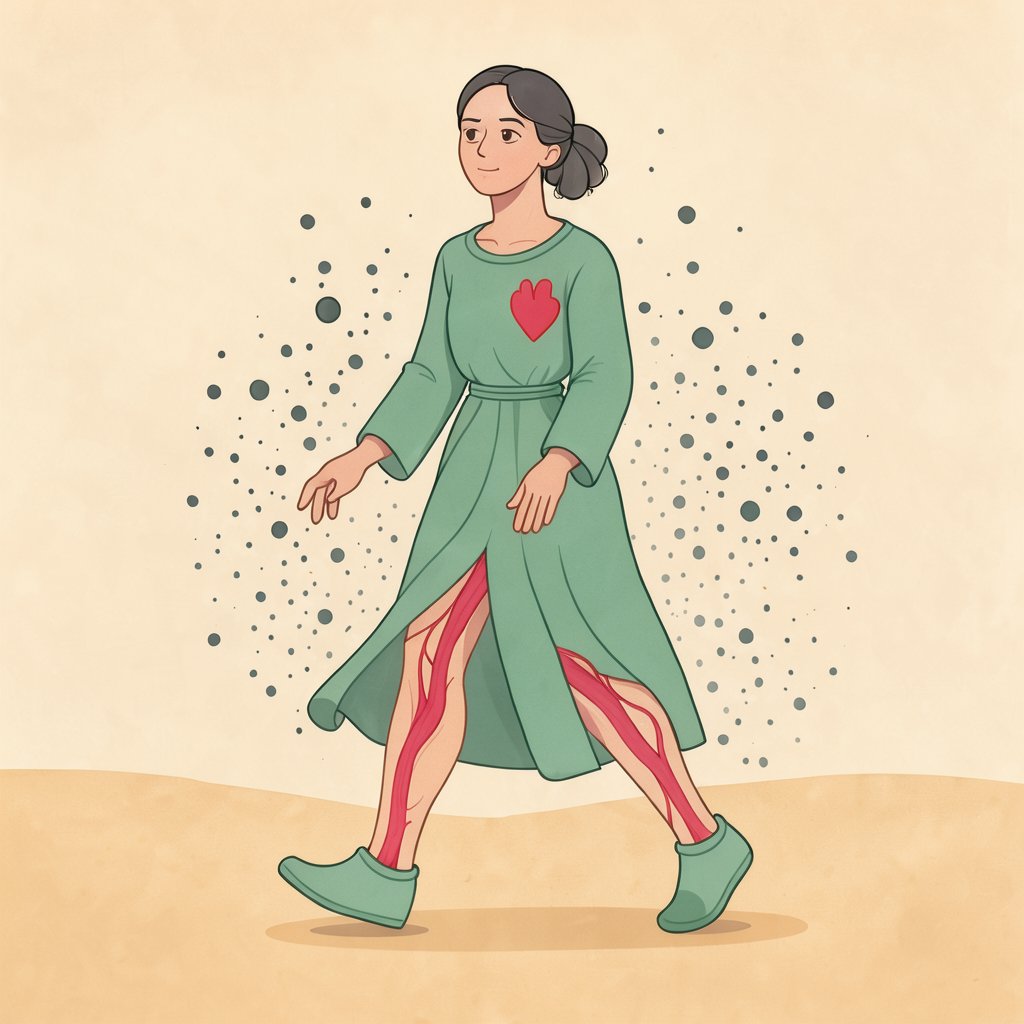
Breathing pattern decides whether a walk calms or taxes you. The cardiac-rehabilitation manual of A.S. Avdulina prescribes free-paced walking with a full inhale, a full exhale, and a pause of rest, coordinated at three to four steps per breathing phase; its rule is that slow, deep breathing spares the heart, while frequent shallow breathing tires it[6]. The manual also fixes the priority order: movements should follow the rhythm of normal circulation, not the rhythm of forced breathing[6]. That single sentence is the best argument for why shinrin-yoku is a slow walk rather than a march.
Holden’s benefits list rounds out the picture, best read as a qigong teacher’s qualitative claim rather than as trial data. Regular walking, he writes, improves circulation and breathing, fights depression, stimulates the immune system, helps with weight control, lowers blood pressure, improves cholesterol and lipid levels, builds bone density as a defense against osteoporosis, and refines flexibility, coordination, and balance enough to lower fall risk[2]. None of that is exclusive to forests — the forest argument is that the air and the quiet make the same walk feel easier to keep. And physiology, in turn, dictates the dose and the pace, which is where the protocol begins.
How to Start: The 20-Minute Slow-Walk Protocol
The protocol below is Milner’s beginner stage, applied to a treed route[1]. Stage one is deliberately modest: a continuous stroll of about 20 minutes, three to four times a week, at your habitual pace, with no stops — no shop windows, no long chats — because stopping and starting turns a training walk into a series of standings. Duration grows to 30-40 minutes over weeks or months, and the book insists the growth happen naturally, without violence; it pointedly rejects rigid week-by-week tables in favor of individualization[1].
The reference load from the author’s walking club makes the pace concrete: 1,600 meters — almost exactly one mile — covered in 18 to 20 minutes, which works out to 4.5-5.5 km/h (about 2.8-3.4 mph) at a heart rate of 80-100 bpm[1]. The long-term goal of the system is walking 6-6.5 km (3.7-4 miles) in an hour without strain[1]. If you are starting from the couch, ignore the numbers entirely and let the trees set the tempo; the figures are a compass, not a test.
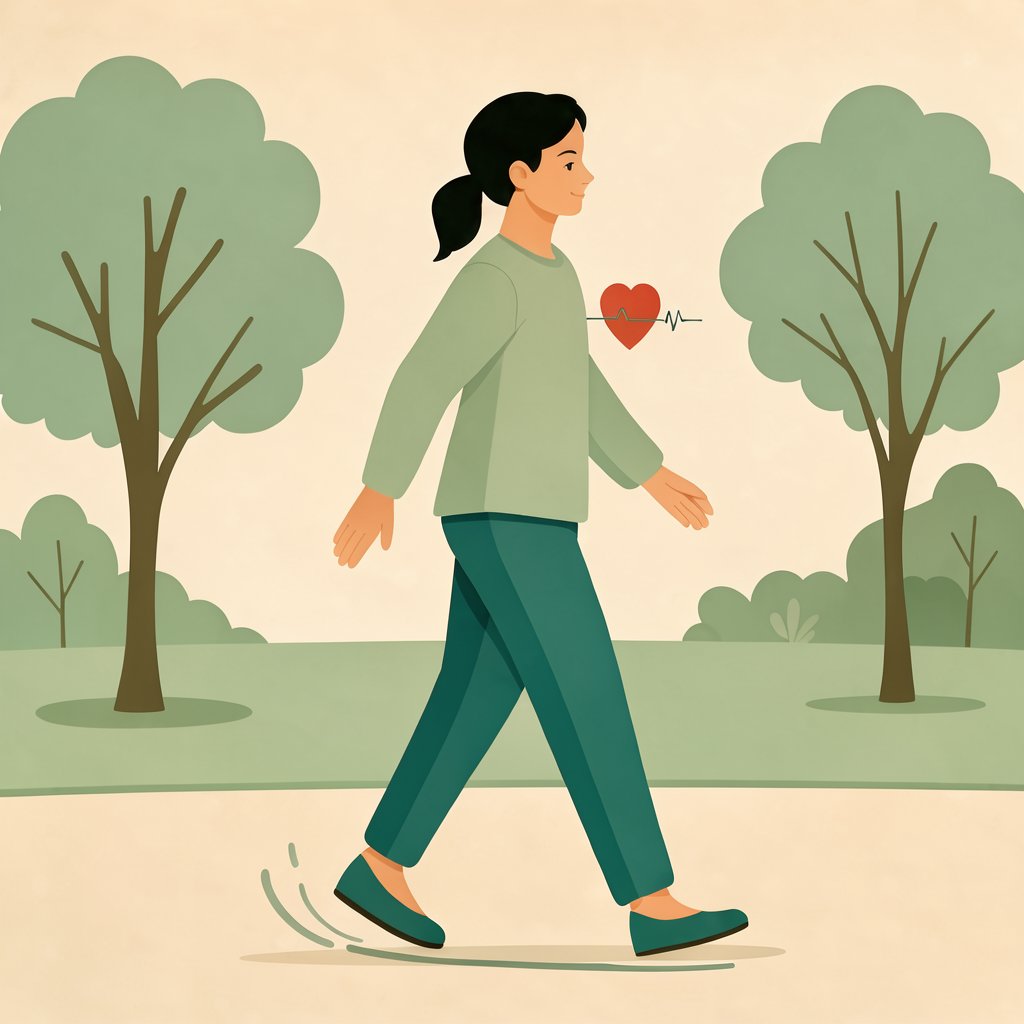
Step 1: Choose a green route
The ideal route, in Milner’s book, is an alley in a park; his own club walked an 800-meter square loop and a one-kilometer park loop[1]. A practical walking guide in our base adds that legs are built for soft natural surfaces, which treat joints more kindly than asphalt — and its rule of thumb is blunt: if the choice is between a high-traffic polluted street and an indoor track, indoors wins, because exercising on a polluted street does only harm[7]. So pick the park alley, the arboretum loop, or the wooded trail, and treat distance as decoration rather than a goal.
Step 2: Fix the weekly dose
Start at 20 continuous minutes, three to four times a week, and hold that for a few weeks before extending anything[1]. Stretch sessions toward 30-40 minutes only when the current length feels easy, and keep the growth gradual — duration should grow naturally, without violence, as the system puts it[1]. Resist the urge to leap ahead; the same book that prescribes the dose also warns that exceeding your optimal speed is the classic amateur error[1].
Step 3: Add one or two longer sessions
Once the short walks are a habit, Holden’s scheduling advice applies: beyond brief daily routines, plan one or two longer outdoor sessions per week — a fuller walk in a larger park or a morning on a forest trail[2]. These longer walks are where the practice starts to feel like forest bathing rather than exercise logistics. Keep them unhurried; the treed route is the point, and the pace follows from it.
Foot Roll and Breath: The Technique, Step by Step
Technique is what separates a training walk from a distracted shuffle. Milner’s foot rule is to land on the mid-heel and roll softly through the foot to the toe, with the feet carried parallel[1]. The failure mode he flags is the heel stopper strike — landing hard on the back of the heel with the foot cocked upward, which sends a shock wave up the legs to the joints and the spine with every step[1]. On soft park ground, this one correction alone changes how a walk feels by the second kilometer.
Breath comes from the cardiac-rehab tradition: a full inhale, a full exhale, and a brief pause of rest, cycled at roughly three to four steps per breathing phase[6]. In practice, on level ground, that means inhaling for three unhurried steps, exhaling for three, and letting a step or two pass empty before the next breath. Avdulina’s manual is explicit that the breathing should stay free rather than forced, since circulation — not willpower — sets the rhythm[6]. If the counting ever feels like strain, drop it and simply walk slowly enough that conversation would be easy.
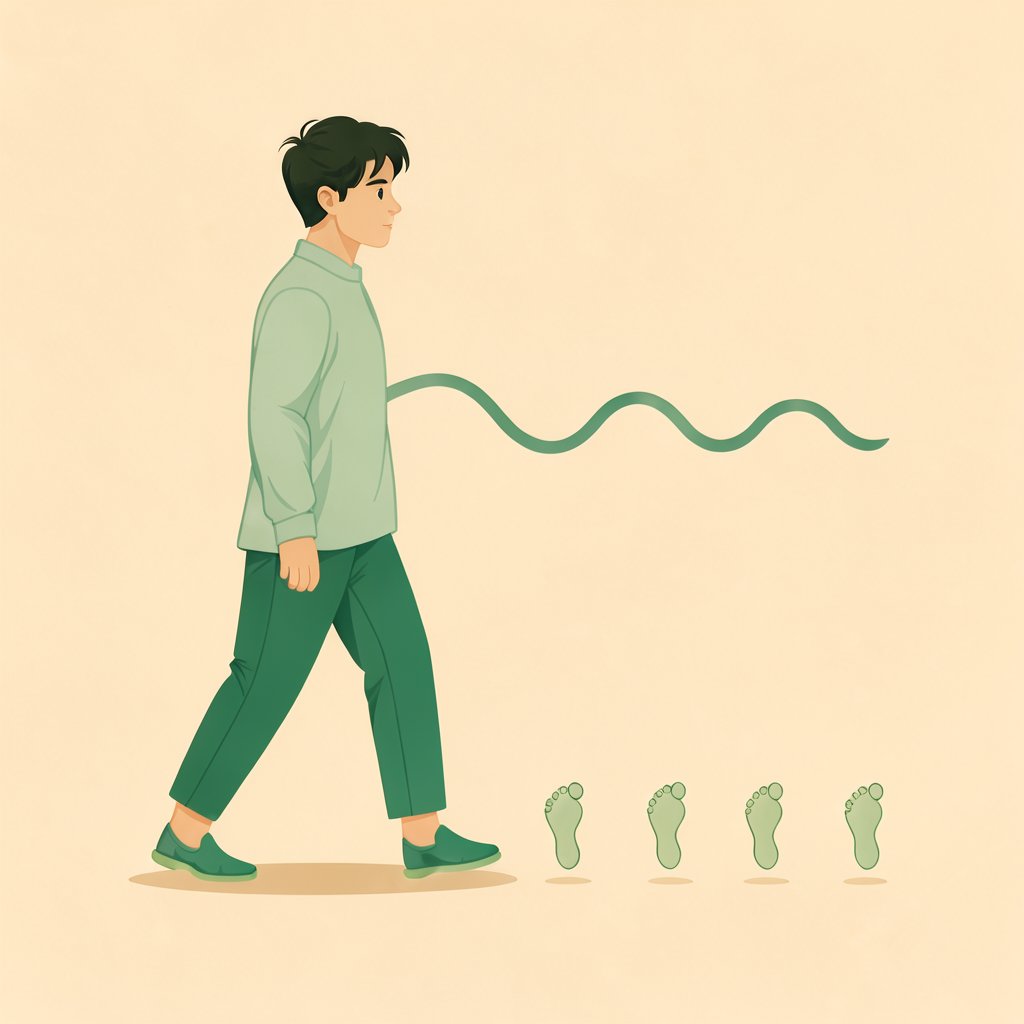
The mindful attitude around these mechanics is Holden’s contribution. His tai-chi walking treats each footfall as something done on purpose — every step brings maximum benefit, in his phrase — and his philosophy is a little, every day: seven minutes in the morning and seven in the evening, with a one-month trial period before judging results[2]. The tai-chi classic by Wang Lin supplies the longer lineage, framing slow movement as an art of harmony and a method of life extension[8]. Forest bathing inherits all three layers: a sound foot, an unforced breath, and attention that stays on the walk — and that combination is what the measurable numbers reward.
What Regular Walking Measurably Does
Honesty first: the numbers below are walking-science figures cited in Milner’s book, not forest-bathing trial results — no forest-exposure studies exist in our base[1]. They are the strongest evidence this guide’s sources can offer. They also happen to be the numbers that make the habit worth keeping.
The threshold dose the book gives for cardiovascular prevention is about 2,000 kilocalories per week, which works out to brisk walking of 40-60 minutes, five times a week[1]. For perspective, it cites a five-continent survey finding heart-attack mortality four times lower among people training at that energy expenditure, mostly through walking and running[1]. It also reports a 14 percent gain in aerobic capacity after twelve weeks of walking 40 minutes five times weekly — a figure the book attributes independently to Kenneth Cooper’s school and to Japanese researchers[1].
The dose-response picture continues at lower volumes. Risk-factor reduction is already observed from three hours of walking per week — six half-hour walks — and the book reports that programs of 5×40 minutes or 3×60 minutes per week lowered blood pressure and normalized lipid profiles, including cholesterol, HDL, and LDL fractions[1]. There is a ceiling, though: for trained walkers the optimum is about five hours of brisk walking per week, beyond which extra volume adds no further aerobic gain and risks cardiovascular overload[1]. Slow forest walks sit comfortably inside that window — which is culture’s cue.
Lessons From Japan’s Walking Culture
Japan earns its place in this practice’s name, and our base offers one honest window into how: Kibardin’s chapter on Japanese centenarians. His figures have Japanese women living to around 85 and men to 78, supported by three pillars — specific fresh seasonal food, emotional well-being (a sense of purpose, no dwelling on past failures, laughter), and sport plus physical activity outdoors[4]. Nothing in the chapter mentions shinrin-yoku by name, and this guide will not pretend otherwise.
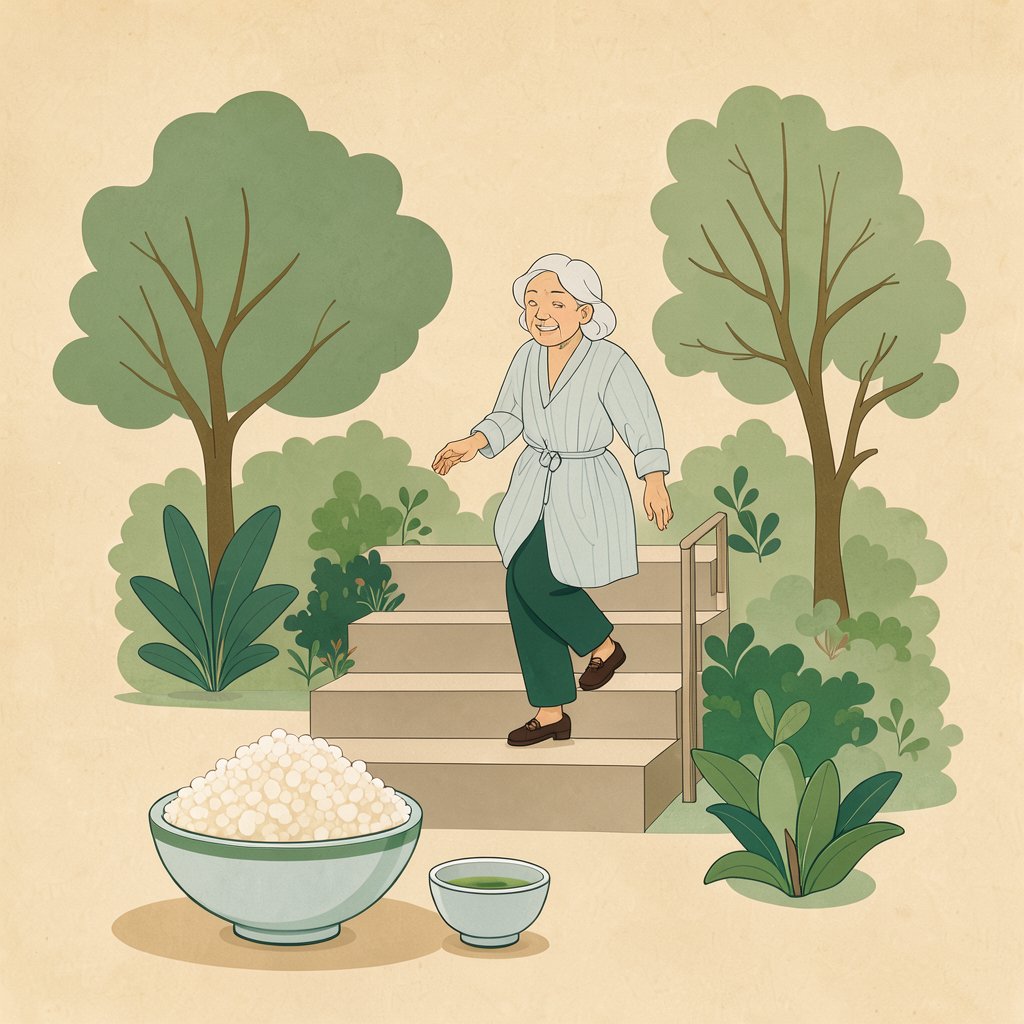
The daily-movement detail is the transferable part. Japanese daily life, as the chapter describes it, is built on walking significant distances, cycling, and climbing stairs, with minimal furniture and floor sitting that train legs and balance well into old age[4]. Two habits complete the picture: eating until 80 percent full, and green tea — the book links five cups a day to mortality more than 25 percent lower, and we report that as the book’s claim rather than as settled fact[4].
The gap between that culture and the online mythology of forest therapy is worth naming once more. Our sources contain no account of the 1982 naming of shinrin-yoku by Japan’s Forestry Agency and no clinic-grade forest trials — only a walking culture, plus Rodionova and Nikitina’s aside that in Japan the saying goes, the more a person walks unclothed, the longer they will live, a remark about air baths for neurasthenia rather than about forests[3]. The honest Japanese lesson is simpler and sturdier than the mythology: an ordinary life arranged around daily outdoor walking, taken gently enough to keep for decades.
Safety: When to Check With a Doctor First
Walking is gentle, but it is not exempt from medical sense. Kibardin’s rule is to consult a doctor before starting, especially after a long break from training, and his postponement list is short — contraindications, in his words, are almost none, mostly extreme cases[4]. Postpone the walks and speak with your physician first if any of the following apply:
- a prescribed bed or half-bed regime[4]
- fresh injuries, an acute illness, or an exacerbation of a chronic condition[4]
- severe joint disease or osteoporosis[4]
- pronounced angina, or severe high or low blood pressure[4]
- primary recovery in the period right after surgery[4]
Milner’s contribution is the intensity rule. Maximum heart rate is estimated as 220 minus age, and the walk should stay below the anaerobic threshold — the point where pushing harder stops being aerobic work[1]. The book’s history lesson is sobering: exceeding optimal speed is what historically caused cardiac events in amateur sport, which is why shinrin-yoku’s slow pace is a safety feature rather than a stylistic choice[1]. If you use the 80-100 bpm reference from the protocol section, you are already inside the safe zone by design.

Session hygiene rounds out the safety picture, all from Kibardin[4]: dress in layers, alpinist-style, for cold weather; break sneakers in before the walk, not during it; finish with static stretches held 15-45 seconds per muscle as a cool-down; drink about half a liter (two cups) of water for every half kilogram (roughly a pound) of body weight lost; and time meals so you eat one to one-and-a-half hours before a session, or three hours before after a heavy meal. One gap we will not paper over: our sources contain no forest-specific cautions about ticks, terrain, or weather, so let ordinary outdoor common sense cover what the books do not. And per the practical guide already quoted, a polluted high-traffic street is the one route to skip entirely — indoors is the better choice that day[7].
Frequently Asked Questions
How slow should forest bathing be?
Stroll-slow, by a concrete standard: Milner’s club reference is 1,600 meters (about one mile) in 18-20 minutes — 4.5-5.5 km/h, or 2.8-3.4 mph — at a heart rate of roughly 80-100 bpm[1]. The field test is conversational: if you could not speak in full sentences, you are walking too fast for the practice. More gentle-movement routines live in our mobility and posture hub.
How often should a beginner walk among trees?
Begin with a continuous 20-minute walk three to four times a week, without stops, then extend toward 30-40 minutes over weeks or months as the distance feels easy[1]. The system’s phrase for progression is naturally, without violence — no rigid tables. Once the short walks are routine, add one or two longer outdoor sessions each week[2]. Our manuals library collects similar gentle progressions.
Is forest bathing different from an ordinary walk?
The difference is attention and air. Holden’s tai-chi walking makes every step deliberate and pairs the walk with slow breathing[2]; the traditions also describe forest air as richer in negative ions and phytoncides[2][3], a qualitative claim, not a trial result. Same gait, different mind, treed route. Our slow breathing guide trains the same unhurried breath.
Can slow walking lower blood pressure?
Yes, at sufficient dose: Milner reports that 5×40 or 3×60 minutes per week lowered blood pressure and normalized lipid profiles[1]; Pigulevskaya describes the mechanism — working muscles dilate vessels and speed adrenaline breakdown[5]. These are walking results, not forest-trial results, and no reason to change medication without your clinician. If stiff joints are the barrier, see our Joint Genesis review.
Who should check with a doctor before starting?
Anyone resuming training after a long break, and anyone on Kibardin’s short postponement list: a prescribed bed or half-bed regime, fresh injuries, acute illness or a chronic exacerbation, severe joint disease or osteoporosis, pronounced angina, severe high or low blood pressure, or primary post-operative recovery[4]. Otherwise, contraindications are almost none[4]. Our full medical disclaimer spells out the editorial side.
What about the famous Japanese forest-therapy studies?
They are beyond our sources. Our library holds no natural-killer-cell, cortisol, or blood-pressure forest-exposure trials, so none of those numbers appear here — repeating unverifiable figures would break our editorial rule. What we can document is walking epidemiology: at 2,000 kcal per week of brisk walking, heart-attack mortality was four times lower in a five-continent survey Milner cites[1]. Our editorial policy explains how we source claims.
Sources
- [1] E. Milner — Walking Instead of Pills (2010) — the walking-as-medicine system this protocol follows: beginner stages, pace and heart-rate references, dose thresholds, foot technique, and the aerobic-zone safety rule.
- [2] Lee Holden — 7 Minutes of Magic (2008) — tai-chi walking as the mindful model, the seven-minute daily routine, longer outdoor sessions, and the qualitative claims about negative ions and nature’s emotional cleansing.
- [3] O.N. Rodionova, G.A. Nikitina — Osteochondrosis. Best Treatment Methods (family-health encyclopedia) — the phytoncide, aeroion, and essential-oil description of forest and meadow air, plus the Japanese air-bath anecdote.
- [4] G.M. Kibardin — Treatment. Nordic Walking Poles (2018) — the pre-walk consultation rule, the postponement list, session hygiene from layers to hydration, and the chapter on Japanese centenarians’ walking culture.
- [5] I.S. Pigulevskaya — Restoring Vision Without Doctors and Medicines (2018) — the stress-discharge physiology of outdoor walking: vessel dilation, blood-pressure effects, and accelerated adrenaline breakdown in fresh air.
- [6] A.S. Avdulina — Therapeutic Exercise for Cardiovascular Diseases (1966) — the breath-coupled slow-walking rule from cardiac rehabilitation: full inhale, full exhale, rest pause, three to four steps per phase.
- [7] Health Running and Walking: A Practical Guide (unattributed manual) — route guidance: soft natural surfaces over asphalt, the park over the polluted high-traffic street, and the honest limits of outdoor exercise.
- [8] Wang Lin — Tai Chi Chuan. The Art of Harmony and the Method of Life Extension — the classical tai-chi framing of slow movement as an art of harmony and a method of life extension.
Where to go next: the mobility and posture hub gathers this guide’s sister articles on gentle daily movement. If you want a seated-or-standing companion practice for rainy days, the Zusanli (ST36) acupressure manual pairs well with slow walking; and if tight hips are what keep you off the trail, the Unlock Your Hip Flexors review examines one popular mobility program in detail.
How we researched this: built from a local library of 1,137 wellness books, queried through an offline retrieval system with no internet sources — every factual claim above was checked against the cited book passage before publication. Where the base held no source (Japanese forest-therapy trials, the 1982 naming story, forest-specific hazards), we said so plainly instead of filling the gap. If one impulse survives the reading, make it this one: twenty unhurried minutes among trees, three times this week — that is all forest bathing asks of a first session.
