
Educational content only — not medical advice. See our full Medical Disclaimer and Affiliate Disclosure below.
Shopping for the best gua sha tool in 2026 means walking past shelf after shelf of polished stones, each card promising smoother skin and released tension with nearly identical confidence. The tool itself is disarming in its simplicity: a smooth-edged scraper, usually stone, glided over oiled skin in repeated strokes along the same lines. Yet the buying advice around it is loud, self-assured, and almost never sourced, and that combination is exactly where shoppers lose their bearings. This gua sha buying guide takes a quieter route to the same question.
Here is our honest scope, stated plainly before anything else. This guide is grounded in a local library of 1,137 wellness books, searched offline with no internet sources at any point. A base-wide, unfiltered check of that library found zero gua sha-specific sourcing: no jade-versus-metal comparisons, no stroke protocols, no cleaning instructions, nothing at all. Rather than invent the specs the shelves pretend to have, this guide builds every buying criterion from a documented sister tradition of tool bodywork, attributes each rule to its source, and labels every gap it cannot fill.
Key Takeaways
- Gua sha is a scraping technique — a smooth-edged tool, usually stone, glided over oiled skin — and it appears nowhere in our 1,137-book source base, so this guide invents no material rankings and no stroke protocols.
- The closest documented parallel is Tibetan stick massage (Jud-Shi), described in its source text as a practice that frees blocked areas and eliminates stagnation of energy and body tissues caused by insufficient activity, stress and overload[1] — cited here as a sister tradition, never as gua sha.
- The transferable rules: shape follows function, because the stick tradition used several tool kinds for tapping, rubbing, and pressing[1]; stone on the body is an old, simplified idea[1]; and a tool is chosen for the body’s lines, not the shelf photo[2].
- Safety is the strongest documented layer: an absolute no-go zone map and a 19-item contraindication checklist govern any rigid tool[1] — and both run before checkout, not after.
What Is Gua Sha? The Tool, the Promise, the Sourcing Reality
Start with the smallest honest definition, labeled for what it is. Gua sha is a traditional Chinese technique in which a smooth-edged tool — most often a polished stone such as jade or rose quartz — is scraped or glided over oiled skin, and traditional teaching describes the goal as moving stagnation. This block is minimal reader context for shoppers, not a fact from our book base: a base-wide, unfiltered search across all 1,137 books returned no gua sha-specific material in any category, and the nearest neighbors were Tai Chi manuals, Tibetan medicine texts, and a Zen-Shiatsu handbook. Those neighbors matter, and the next paragraph explains why.
The stagnation promise has a documented next-door neighbor. The Tibetan stick-massage tradition, Jud-Shi, describes its practice as one that frees blocked areas and eliminates stagnation of energy and body tissues caused by insufficient activity, stress and overload, helps energy flow freely, and improves metabolism[1]. That is the tradition’s claim about its own sticks — not a study of gua sha stones — and it is the closest documented mechanism analogue our base contains for what scraping tools are marketed to do. This guide cites it exactly that way: as a parallel, never as proof about gua sha.
So what can an honest best-of guide deliver here? Not brand rankings and not stone-versus-metal verdicts, because the sourcing for both simply does not exist in the base. What it can deliver is nine centuries of documented tool-practice rules — how tools were chosen by job, where they were never allowed on the body, and who was never allowed under them — rebuilt into criteria you can hold against any product page. That is the backbone of everything below.

How This Guide Was Built: A 900-Year-Old Tool Tradition
The criteria in this guide come from a source old enough, and documented enough, to teach tool choice. The Jud-Shi tradition traces to two origins: one yogic-spiritual, the other the 11th-century master Gyalwa Yangonpa and his treatise, “Diamond-like Instructions on Stick Massage”[1]. Its methods were transmitted teacher to student and kept secret until the 19th century, which is why a practice this old has a surprisingly thin public paper trail until fairly recently[1].
Frame the age honestly, because age is currency in this market. Roughly nine centuries of documented, named, transmissible tool bodywork is a verifiable lineage: a named master, a named treatise, a dated chain of transmission. That is a very different object from the vague five-thousand-year claims that hang over the gua sha shelf, and this guide returns to that distinction with a proper skeptic’s lens in a later section.
One methodological swap is stated here so it follows you through every criterion below. Where gua sha-specific data is absent — which, the audit says, is everywhere — the documented Jud-Shi rule serves as the stand-in criterion, always attributed and never dressed up as gua sha instruction. It is a strict but fair arrangement: you get real rules with real provenance instead of invented specs with none.

Criterion 1 — Shape Follows Function: What Tool Typology Teaches
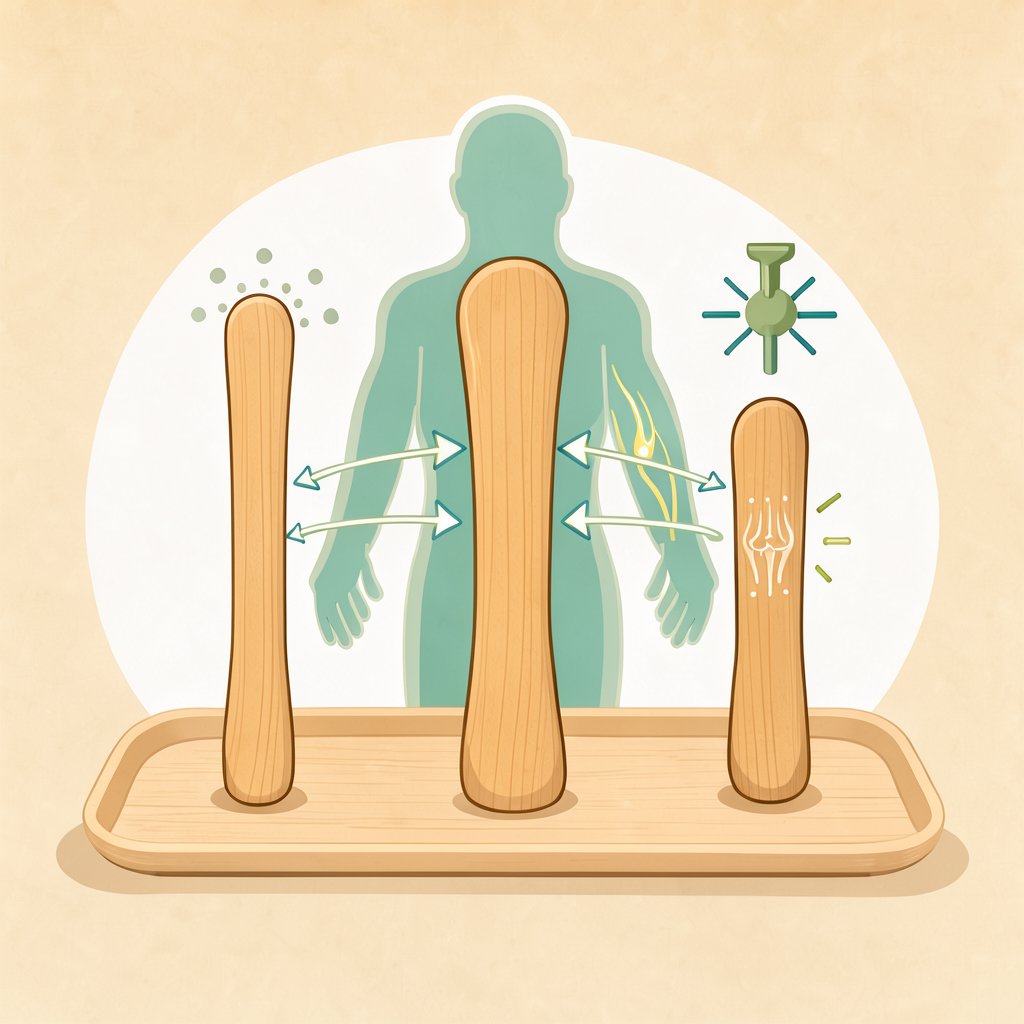
The oldest rule in the found books is also the most practical one. The stick tradition did not treat tools as interchangeable: several kinds of massage sticks were used depending on the need — for tapping, for rubbing, and for pressing muscles — and they were applied where energy channels and points run[1]. Three jobs, three tool behaviors, three shapes; the tradition’s toolkit reads like a workshop, not a jewelry box.
Translated into 2026 shopping language, that rule becomes the first gate in any gua sha buying guide: a tool’s shape must answer what job it will do before it answers how pretty the stone looks. A broad, flat edge and a fine curved notch are different instruments in the same way a tapping stick and a pressing stick were different instruments. One all-purpose do-everything edge was the tradition’s exception, not its rule — and a product page promising a single shape for every task claims more versatility than nine centuries of practice ever assumed.
Applied honestly to gua sha: wing, comb, and heart shapes absolutely exist on shop shelves, but our book base holds no gua sha shape data — no face-versus-body fit tests, no edge-geometry comparisons, nothing to rank them with. Shop shape claims therefore get judged by the typology principle rather than by source-backed rankings. Ask of every shape the question the tradition asked of its sticks: which single job does this exist to do?
Criterion 2 — Stone on the Body: Old Idea, Modern Simplification
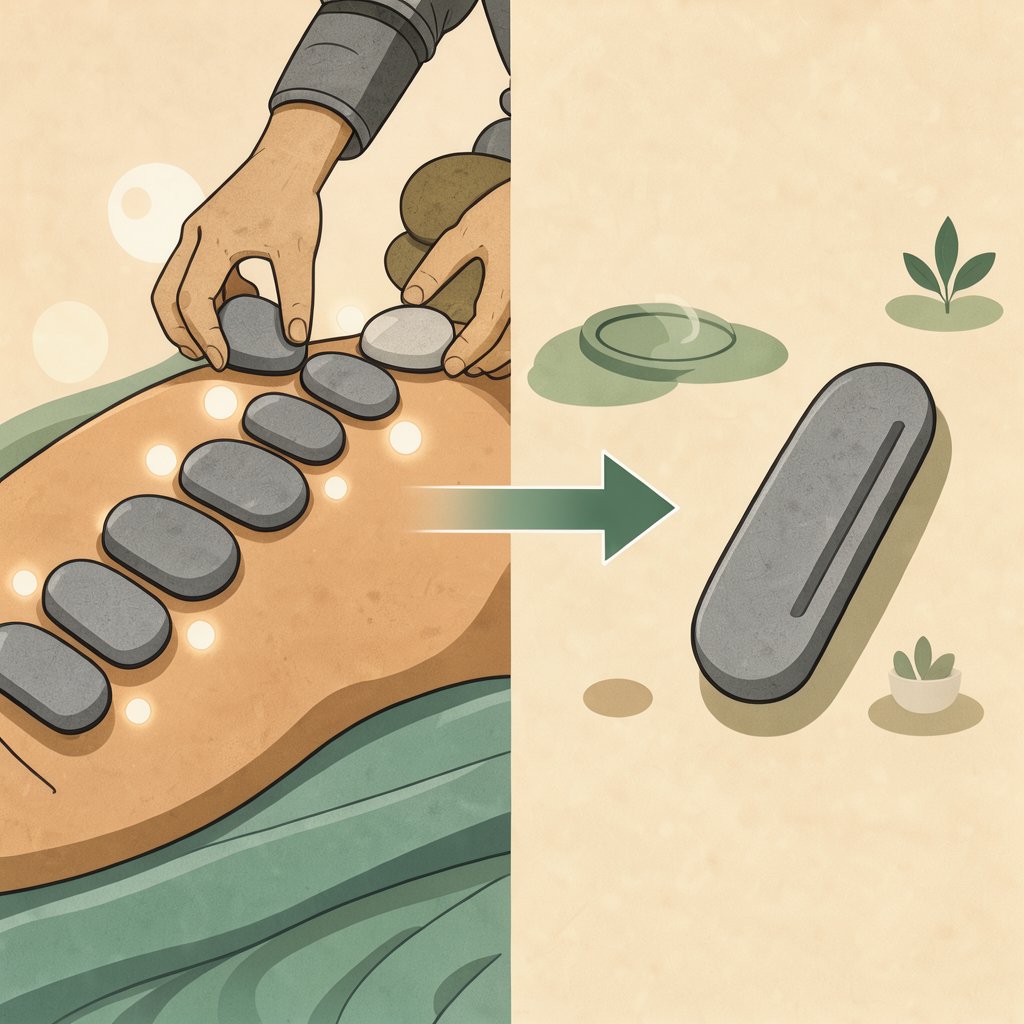
Material marketing is the loudest voice in the gua sha aisle, and the books have exactly one thing to say about it. The Jud-Shi text describes today’s popular stone massage as merely a simplified version of an ancient practice in which specially selected stones were placed on specific body areas[1]. Stone on the body, in other words, is genuinely an old, cross-cultural idea — and the modern stone tool is a descendant of a richer, more deliberate practice, not its equal.
Now the hard limit, stated as such. The base contains no jade versus rose quartz versus metal versus horn comparison, no mineral data, and no functional case for any stone over steel; the question gua sha stone vs metal cannot be answered from these sources, full stop. Mineral-energy language, purity grades, and crystal-therapy framing on product pages are vendor copy, not source data. A guide that confidently crowns one material is asserting a comparison its sources probably never made.
The buyer’s rule that survives the gap: treat every material claim as marketing until a named source states a functional difference — edge polish, skin feel, care requirements, anything concrete. Until then, material is a matter of preference and budget, not of documented performance. And whatever the material, remember that the tool exists to trace the body’s lines — the documented tradition is specific about lines, which is the third criterion.
Criterion 3 — Pick a Tool for the Body’s Lines, Not the Shelf Photo
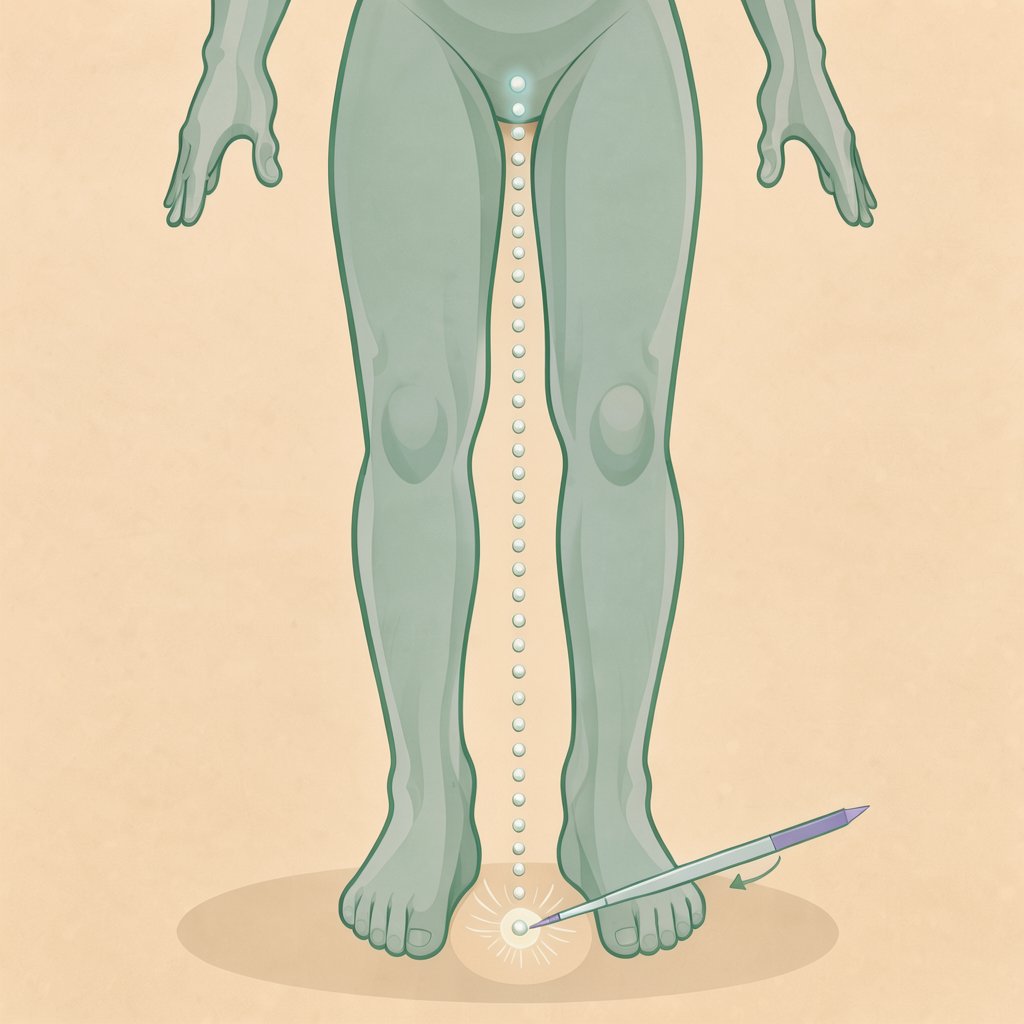
A tool is only as good as its aim, and in documented East-Asian theory the aim is the body’s channel lines. Zen-Shiatsu, the Japanese channel-therapy tradition, maps the body along meridians — the kidney meridian alone carries 27 points, and its first point, Ni 1, the “bubbling spring” (Yongquan) in the sole of the foot, is taught as activating yang energy[2]. Bodywork along channel lines is standard theory across these traditions, which is why their tools are chosen to work lines and areas rather than random surfaces[2].
The buyer’s translation is a sequencing rule: know which lines and areas you intend to work before choosing the tool that will work them. A tool sized and edged for broad back lines is a poor fit for precise point work, and the reverse is just as true — which is the typology principle of the first criterion coming back around. Buying the tool first and the territory second is how drawers fill with unused stones.
Keep the attribution strict, as this guide promised up front. The meridian facts above are channel-tracing background from a shiatsu handbook, presented to explain the logic of tool choice — they are not gua sha technique, and no stroke direction, pressure, or session protocol can be sourced from them. The base simply contains no gua sha how-to, and this guide will not manufacture one.
Where a Hard Tool Must Never Go: The No-Go Zone Map
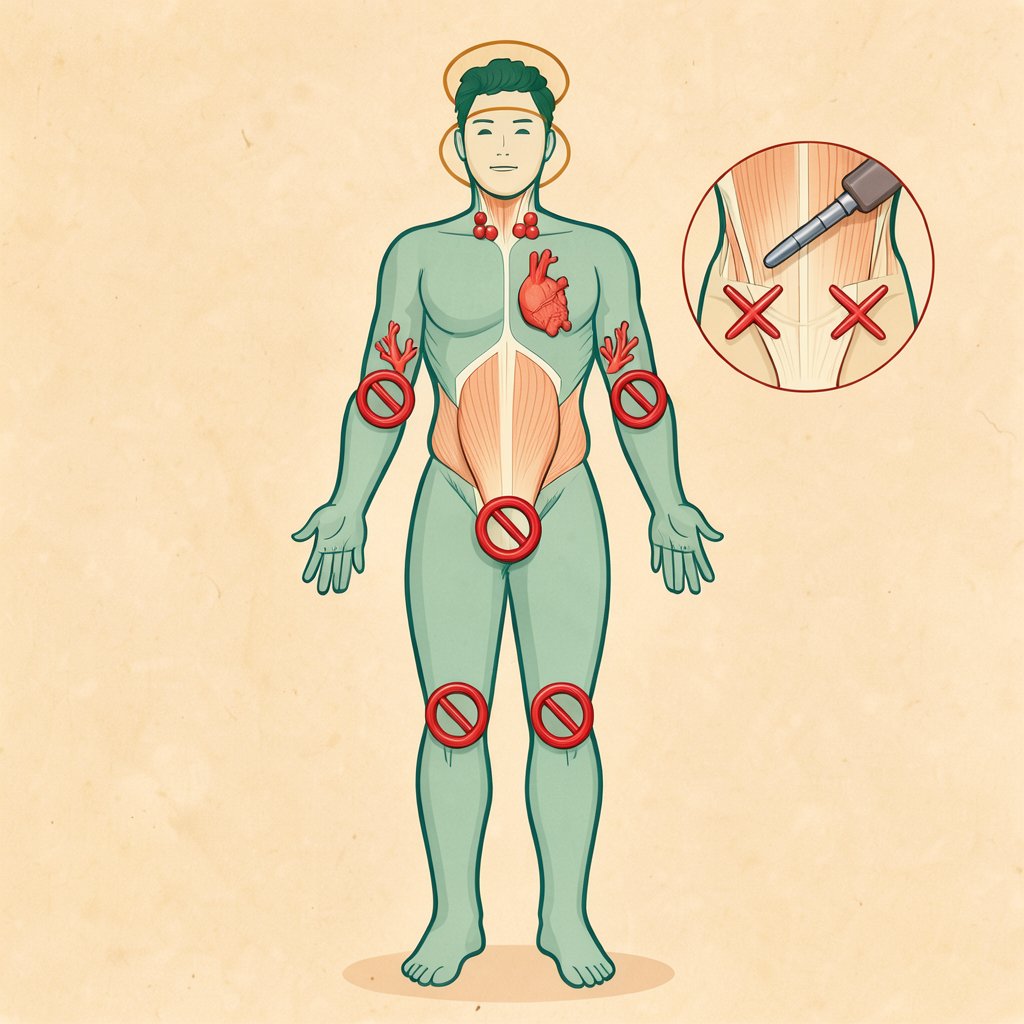
The tradition’s safety map starts with geography: there are places a hard edge simply never belongs. The Jud-Shi rules are absolute about where sticks are not used — lymph nodes, internal and sexual organs, joints, the female breast, and the “heart mandala” area around the left nipple[1]. For caution rather than prohibition, the tradition names the crown-of-head point and the points of the face, areas to approach with restraint if at all[1].
One further rule covers the gray zone between muscle and bone. At muscle-tendon junctions, the tradition works only the central part of the muscle — the belly, never the tethering ends where tissue thins toward tendon[1]. Zones, in other words, were decided before the tool ever touched skin. The compact map, transferred to any rigid scraping or gliding tool, reads as follows:
- Absolute no-tool zones: lymph nodes, internal and sexual organs, joints, the female breast, and the heart area around the left nipple[1].
- Caution zones: the crown-of-head point and the points of the face[1].
- Tendon-adjacent rule: at muscle-tendon junctions, work only the central muscle belly[1].
Hold this map as a pre-purchase readiness test rather than a tutorial. If you cannot name the safe territory for a rigid edge on a body — yours or anyone else’s — you are not ready to own one, whatever the stone is made of. The list above is the tradition’s zone map reproduced with attribution; this guide deliberately adds no zones of its own and turns none of it into stroke instruction.
Before You Buy: The Full Contraindication Checklist
Physical safety has a second gate beyond geography: your current health state, checked item by item before money changes hands. The Jud-Shi source keeps a strict stop-list for its sticks, and the retrieval report behind this guide called it the strongest safety asset in the entire book base[1]. It is reproduced here in full, with attribution, as a pre-purchase filter — a tool bought for someone on this list is a tool that should stay in its box[1].
- Infectious diseases[1]
- Flu[1]
- High fever[1]
- Poisonings and intoxications[1]
- Ulcers[1]
- Abscesses[1]
- Dermatitis[1]
- Wounds and damaged skin[1]
- Edema[1]
- Fractures[1]
- Varicose-vein areas[1]
- Spine injuries[1]
- Lymphatic-system disease[1]
- Cysts or tumors[1]
- Jaundice[1]
- Cancer[1]
- Pregnancy[1]
- Infancy[1]
- Extreme old age[1]
Read the list the way it was written: as the tradition’s stop-list, not as this site’s medical opinion. No additions were made and no conditions were softened, because a safety list edited for smoothness stops being the source’s list[1]. One framing note belongs here rather than in a footnote: this page is general buying guidance, not medical advice, and anyone living with anything on the list — or shopping for someone who does — should treat it as a conversation to have with a qualified provider first.
Why run this at purchase time rather than first-use time? Because a tool bought as a gift for an elderly parent, a pregnant friend, or someone recovering from illness lands in exactly the households this list exists to protect. A safe purchase, in other words, is a screened one — and it is also a skeptical one, which is the final filter below.

Ancient Does Not Mean Proven: Filtering Heritage Marketing
The final filter is not about the tool at all — it is about the story sold with it. In “Trick or Treatment,” Simon Singh and Edzard Ernst document that European acupuncturists kept publishing positive results for decades, including an 1836 article in the Lancet, while origin legends of traditional practices grew thicker with every retelling[3]. The same book critically dissects the famous Oetzi tattoos-as-ancient-acupuncture claim, showing how easily an ancient provenance gets attached to a practice and then repeated as fact[3].
Those episodes concern acupuncture and traditional Chinese medicine broadly, not gua sha specifically — that limit is stated here deliberately. The transferable lesson stands anyway: an antiquity claim is a marketing artifact until it names its lineage. Contrast the two objects on your shelf. Jud-Shi can name its master (Gyalwa Yangonpa), its treatise, its century, and its chain of transmission[1]; a five-thousand-years claim on a product card typically names nothing at all.
The buyer’s rule: age claims must name their source, and unnamed antiquity is a red flag rather than a credential. Note the balance, too — this is a filter against marketing, not a dismissal of traditional practice, whose documented rules fill most of this guide. Skepticism, aimed well, is what lets the real traditions through the door.

The Honest Gaps: What No Book in Our Base Can Tell You
An honest guide ends by naming its own blind spots, so here they are, item by item. An unfiltered cross-check confirmed the gap is base-wide rather than a category-mapping accident, and retrieval honesty is part of the record: relevance scores for the buyer’s-guide category were near zero, and the top neighboring hits were supplement catalogs rather than tool texts. The tradition angle rests on a smaller retrieval sample still, which is one more reason its facts are quoted narrowly above.
- No gua sha-specific content anywhere in the 1,137-book base — no tool text of any kind surfaced.
- No jade, rose quartz, metal, or horn comparisons — the stone-versus-metal question is unanswerable from the sources.
- No tool shapes, edge geometry, or face-versus-body fit data.
- No stroke direction, pressure, lubrication, session-length, or frequency protocols.
- No tool cleaning or sanitation instructions.
- No explanation of sha marks (petechiae) and no aftercare guidance.
The conclusion for you as a buyer is uncomfortable but useful. Any outlet confidently ranking the best gua sha tools of 2026 is asserting data its sources may not have either, and the polite question to bring to every listicle is simply: what is yours? A guide that cannot answer it is selling preferences dressed as research, and after reading this page you can tell the difference.
This cluster has no gua sha offers to review yet, so there is nothing to sell you at the end of this page — arguably the most honest ending a buyer’s guide can offer. For readers building a wider self-care stack, we do track two adjacent options with full editorial reviews: see our Joint Genesis review and our Unlock Your Hip Flexors review, or go straight to the current offers for Joint Genesis and Unlock Your Hip Flexors. Their spec sheets are vendor claims and are labeled as such on the review pages. Disclosure: we may earn a commission if you buy through links on this page; ratings and recommendations remain our editorial opinion.

Frequently Asked Questions
Is jade better than rose quartz or metal for a gua sha tool?
No book-source data exists to say. Stone-on-the-body is an old idea — today’s stone massage is described as a simplified descendant of an ancient selected-stone practice — but the base holds no jade, quartz, or metal comparison, so the gua sha stone vs metal question is unanswerable from these sources[1]. Treat material as preference and marketing until a source names a functional difference. For the practice side of the ritual, see our Gua Sha: Traditional Skin and Lymphatic Ritual manual.
Which gua sha shape should a beginner choose?
Judge shape the way the stick tradition judged its tools: shape follows function, and tapping, rubbing, and pressing were different sticks for different jobs[1]. Pick the shape that matches the single job you actually plan to do, not the most versatile-looking one. No source-backed shape ranking for gua sha exists, so beware any chart that claims one. The hands-on counterpart is our Tui Na self-massage manual.
Are gua sha tools safe for everyone?
No. The documented stop-list is long and specific — nineteen conditions from infectious disease, fever and damaged skin to varicose areas, cancer, pregnancy, infancy, and extreme old age, reproduced with attribution in the checklist above[1]. If anything on that list applies to you or to the person you are buying for, treat the tool as decorative until a qualified provider says otherwise. For the wider tradition behind such cautions, see our Chinese organ body clock guide.
Which body areas should I avoid with a gua sha tool?
The no-go map is absolute about lymph nodes, internal and sexual organs, joints, the female breast, and the heart area around the left nipple; caution applies to the crown of the head and the face, and at muscle-tendon junctions only the central muscle belly is worked[1]. If you cannot name the safe territory, you are not ready to use a rigid edge. Our reviews and buyer’s guides apply the same filter to every tool we cover.
Does gua sha really go back thousands of years?
Unnamed antiquity is a marketing artifact: Singh and Ernst critically dissect origin legends of traditional practices — including the Oetzi tattoos claim — and show how easily ancient provenance gets invented and repeated[3]. The verifiable tool lineage next door is 11th-century Jud-Shi, with a named master and treatise[1]. Age claims must name their source before they earn your trust.
How do I clean my gua sha tool?
No cleaning or sanitation instructions exist anywhere in our source base — the honest answer is that any soap, alcohol, or crystal-care protocol you read online is unsourced advice with respect to these books. What the sources do enforce is skin-state screening before use: damaged, irritated, or diseased skin sits on the stop-list, which prevents most hygiene trouble before it starts[1]. When we add sourced care guidance, it will appear in the Gua Sha lymphatic ritual manual.
That is the whole method, compressed into one sentence. The best gua sha tool for your shelf is the one whose claims you can trace: a shape matched to a single job you can name, material claims discounted to preference, a lineage that survives the marketing filter, and a stop-list respected before checkout rather than after. Buy by rules you can verify — shape for the job, skepticism for the story, and safety before the sale.
Sources
- [1] Unknown Author — Tibetan Massage, Meridians and Jud-Shi Procedures (Materials and Schemes) (Russian-language source; publication year not stated in its metadata) — the tool typology, the Gyalwa Yangonpa lineage, the no-go zone map, and the contraindication checklist cited throughout this guide.
- [2] Masunaga Shizuto — Handbuch Zen-Shiatsu (Zen Shiatsu Handbook) (German-language source; publication year not stated in its metadata) — the kidney meridian’s 27 points and the Ni 1 “bubbling spring” context behind the channel-line criterion.
- [3] Simon Singh, Edzard Ernst — Trick or Treatment (held in our base as its Russian edition; publication year not stated in its metadata) — the 1836 Lancet episode and the critical dissection of origin legends used in the marketing filter.
Where to go next: inside the bodywork silo, the natural companion is our Gua Sha: Traditional Skin and Lymphatic Ritual manual, which covers the practice side this guide deliberately does not instruct. For a hands-on tradition that needs no tool at all, the Tui Na self-massage manual is the matching piece, and the Chinese organ body clock guide explains the channel theory that Criterion 3 stands on. All three follow the same book-first, no-promises method as this page.
How we researched this: built from a local library of 1,137 wellness books, queried through an offline retrieval system with no internet sources used at any point. Every factual statement above carries a numbered citation to the book it came from; where the base holds nothing — materials, shapes, protocols, hygiene — the gap is declared rather than papered over. Retrieval quality notes, including the near-zero relevance scores and the small tradition-angle sample, are reported in the honest-gaps section rather than hidden.
