
Educational content only — not medical advice. See our full Medical Disclaimer and Affiliate Disclosure below.
Key Takeaways
- No honest “best tai chi online course” list can be written from marketing copy alone, so this review builds its standard from the masters’ own manuals instead[1][2].
- Five axes separate real teaching from packaging: a named lineage, foundation before form, one-move-at-a-time sequencing, honest daily minutes, and written safety edits[1][3][5].
- The documented ladder runs from a 6-minute entry complex through the 24-form to the 88-form — a course selling “the whole form” as one blob fails the test[1].
- Safety edits are non-negotiable: the inflamed-joint rule and the two-hour pain rule come straight from the qigong therapy shelf, and a course without them is asking you to learn the hard way[5].
Type “best tai chi online course” into a search engine in 2026 and you will collect a dozen round-ups, each handing you five or six platform names and a star rating. What almost none of them can show you is depth: which branch the course actually teaches, how the syllabus is staged, or how many honest minutes a day it demands. Taijiquan is, in the classical literature, “one of the major divisions of the internal school” of Chinese martial arts[2], and one popular manual claims over 200 million practitioners worldwide — a figure to read as the book’s own marketing claim rather than a census[1]. A market that size attracts packaging, so this tai chi course review flips the usual method: instead of ranking platforms, it hands you the checklist the masters themselves wrote down.
Every criterion below comes from one offline evidence base: our local library of 1,137 wellness books, scanned full-text for this review, with 61 files mentioning tai chi. That corpus is rich in style histories, teaching methods, practice dosages, and safety rules — and it contains no verified platform, pricing, or instructor-market data for 2026, which is exactly why you will find no invented product podium here. What you get instead are five axes — lineage transparency, foundation before form, sequencing discipline, honest dosage, and safety edits — plus a 15-minute scorecard for running them against any sales page. New to gentle movement altogether? Our Baduanjin — Eight Pieces of Brocade manual is a calm place to start while you comparison-shop.
- What makes a course worth paying for
- Axis 1 — Lineage transparency
- Axis 2 — Foundation before form
- Axis 3 — Sequencing discipline
- Axis 4 — Honest dosage
- Axis 5 — Safety edits
- The book + video standard
- The 15-minute scorecard
- Verdict: depth-per-dollar
- Frequently asked questions
What Makes a Tai Chi Course Worth Paying For in 2026
Most “best of” lists answer an easier question than the one you are actually asking. They compare subscription tiers and video libraries, but the sources that document this art describe something else: a staged discipline of breath, stance, stillness, and sequence, transmitted from teacher to student[3][4]. A modest course can be worth its price if it carries that structure honestly, and a glossy one can be worthless at any discount if it does not. That is why this guide defines value as depth-per-dollar: how much real, verifiable teaching you get for whatever the course asks.
Depth, it turns out, is checkable — and the masters’ manuals hand you the checks. The books name the founding lineage of the art and its branches[1][2], stage the classical curriculum from breath work up to the full sequence[3], set learning doses in plain minutes[1], and state joint-safety rules outright[5]. The five axes of this review — lineage, foundation, sequencing, dosage, and safety — are those checks lifted directly from the source manuals. Read the axes in order, then compress them with the scorecard near the end.
One framing note before the axes. The entry gate to this art is genuinely wide: the teaching manual opens it “at any age, regardless of physical form and health status,” and calls age an asset rather than an obstacle[1]. Width of entry, however, says nothing about width of teaching — and teaching depth is what you are paying for. The rest of this review is a device for measuring it.
Axis 1 — Lineage Transparency: Does the Course Name Its Branch?
The first thing to demand from any online tai chi course is a name: which branch does it teach, and through which teacher line? Taijiquan’s internal school contains dozens of sub-categories, “based on the teachings of one master or a family with generations of experts,” with the Chen and Wu origins documented in the classical literature[2]. A course that teaches “tai chi” without ever naming Chen, Yang, Wu, or Zhaoobao has skipped the most basic fact about its own content. That omission is not modesty; it is a choice, and it usually conceals a syllabus assembled from mixed sources.

The documented record gives you names, dates, and places to test any lineage claim against. Chen Wangting, born in Chenjiagou village in Henan province, served as a militia warrior before the fall of the Ming in 1644, then withdrew as a Daoist hermit and built the taijiquan complexes on 32 forms inherited via Qi Jiguang’s earlier martial system — a contribution the manual lists as having “connected martial arts to Daoyin”[1]. His seven complexes passed five generations to Chen Changxing (1771–1853)[1]. From that trunk grew the branches a modern course should be able to name: the compact, slow Zhaoobao line with its extra cycles, split via Chen Qingping’s line near Chenjiagou; the Yang line that Yang Chengfu (1883–1936) re-edited toward a predominantly health-oriented approach; and the Wu style, which traces through Wu Jian-Quan[1][2].
Transmission itself is the final lineage test. The taiji classics were preserved as secret poems and songs passed orally from teacher to student, and they “have only been revealed to the general public in this century” — the twentieth, as the source explains[2]. In other words, genuine lineages are recent enough in public life to be traceable on paper. A sales page that gestures at “an ancient Chinese art” while naming no branch, no teacher, and no line is not being poetic; it is being unverifiable — and this axis is scored on verifiability alone.
Axis 2 — Foundation Before Form: Qigong, Stances, and Stillness
In a properly staged course, week one contains no form at all — and the classical table of contents proves it. The complete long-form curriculum moves in a fixed order: the Five Steppings (Wu Bu) first, then the Fundamental Eight Stances (Ji Ben Ba Shi), then Still Sitting Meditation (Yin) and Still Standing Meditation (Yang), then moving and stationary drills — and only then the traditional sequence, all of it taught under the theory of the Thirteen Postures[3]. That order is not decoration; it is the pedagogy itself. Breathing and coordination capacity is built before the choreography that spends it.
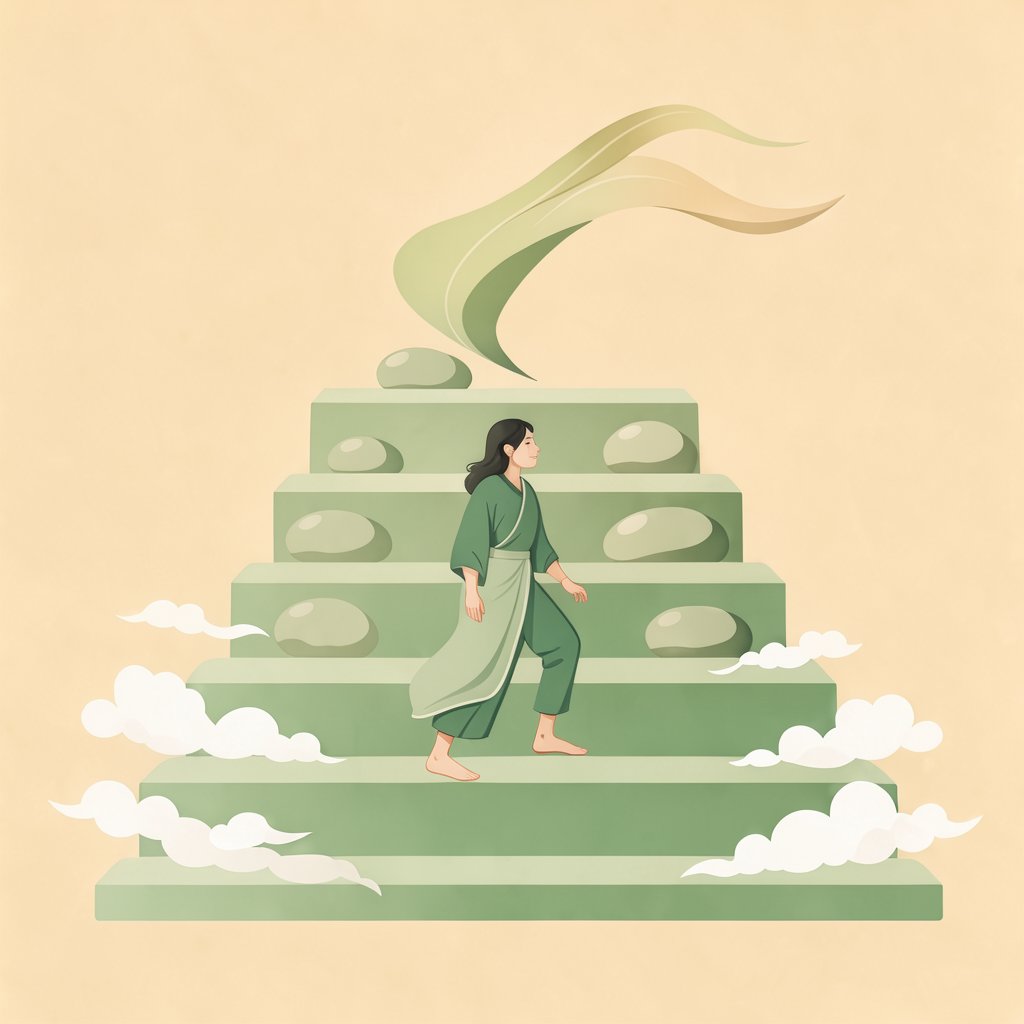
The foundation argument is stated flatly in the qigong literature: “Taiji qigong is the foundation of taijiquan practice” — breathing and coordination work must precede and support the form, and foundation and form “must balance and coordinate” with each other[4]. Read that sentence again as a buying criterion. A course that opens with choreography in lesson one is asking you to spend a capacity you have not built, in an art whose defining quality — continuous, coordinated flow — depends on exactly that capacity.
When you audit a syllabus, look for the foundation layer by name: qigong or breath work, stances, steppings, and a stillness practice of some kind. Our Zhan Zhuang standing practice manual shows what a still-standing session looks like in detail, and the coherent breathing practice manual does the same for paced breath work. A course with no equivalent layer fails this axis no matter how beautiful its form videos are.
Axis 3 — Sequencing Discipline: One Move at a Time
How the form itself is fed to you is where teaching methods live or die. The manual’s method is the motion-division approach: each movement is broken into elements, errors are corrected element by element, and only after mastering one move does the student move to the next[1]. The book is refreshingly honest about the pace this produces: “learning may seem too slow, but each move will be solid and correct, and in practice, learning is fast”[1]. Each new move must then be re-linked to the previous form repeatedly, so the continuity that defines tai chi is never lost while you add material[1].
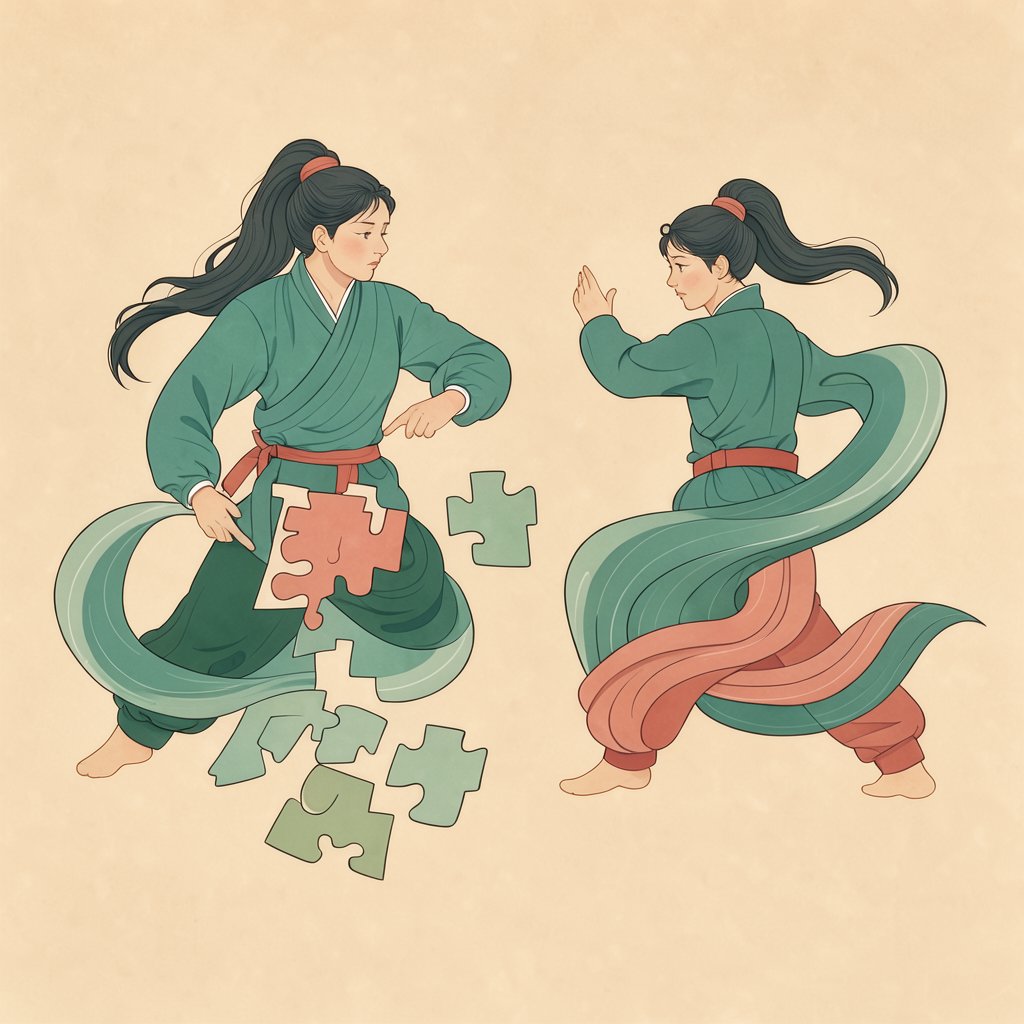
Demand the same discipline as a published ladder of forms. The documented progression starts with a 6-minute entry complex, then the 24-form simplified sequence — 24 groups conditionally divided into eight parts, building coordination, attention, and breathing gradually — then the 88-form complex, which “almost completely repeats the basic Yang style complex taught by Yang Chengfu” with slightly easier trajectories[1]. The 24-form is presented as learnable “in two months” without pre-training, a promise to hold loosely since it is the manual’s own claim rather than a measured average[1]. A 42-form competition-style variant with four kicks is also documented for students who want a performance target[1].

Structured short systems make useful comparison shopping, too: the Taiji Qigong Twenty-Eight Steps complex[8] and an 18-form Tai Chi & Qigong beginner complex[9] both package the same staging logic in smaller footprints. The buyer test on this axis is simple. Does the course publish its form-count ladder — entry complex, 24-form, 88-form — with one-move-at-a-time teaching between the rungs, or does it sell “the whole form” as one undivided blob of follow-along video?
Axis 4 — Honest Dosage: The Real Minutes per Day
Minutes are where teachers separate themselves from marketers, because a body has to actually spend them. The manual’s learning dose is explicit: “one hour per day be devoted to learning a new form,” with the next day spent repeating it[1]. Maintenance doses are smaller and well anchored: 10–20 minutes a day is the standing claim for the Eight Pieces of Brocade companion practice[6], a seven-minutes-a-day morning program is documented as a complete daily minimum[7], and the full 88-form takes roughly 20 minutes to perform once learned[1]. Any course promising mastery in “minutes a week” collapses against those numbers.

The minutes also have a stated rationale in the sources, worth quoting as tradition rather than as clinic-grade evidence. Circular taiji-qigong movement “makes the blood and lymph move faster, especially in the upper torso, improves heart contraction” and builds shoulder, elbow, and knee mobility[8]. Our evidence base holds no clinical trial data or comparative dosage studies, so those claims stay attributed to their authors — and an honest course keeps the same modesty.
Score this axis with arithmetic. Ask what the course expects daily at the start — anything from 7 to 20 minutes is defensible against the anchors[6][7] — and what it expects while a new form is being learned, where about an hour a day is the documented norm[1]. A syllabus that will not state its minutes in plain numbers is not being flexible; it is being evasive.
Axis 5 — Safety Edits: Joint Rules Every Course Must Teach
The final axis is the safety contract, and a credible course states it in writing. The teaching manual opens the art to everyone — “at any age, regardless of physical form and health status” — and calls age an asset, not an obstacle; but it adds that in the case of persistent diseases and old age it is desirable to consult a doctor beforehand[1]. That sentence is the template for the whole axis: openness plus honesty about limits. A course that copies the openness and drops the honesty has already failed.
The joint rules come from the qigong therapy shelf. When a joint is inflamed, no heavy qigong: gentle massage and light, easy exercises only[5]. Relaxed, gentle movement comes first, and strength work only after the joint is rebuilt, because — in the Chinese physicians’ rationale the book quotes — exercises that tense the muscles “increase pressure on the joint and can increase the damage”[5]. Practice more on low-pain days, never overdo, and minimize stress on affected joints[5].
Two rules deserve verbatim status. The two-hour pain rule: “if about two hours after practice you still feel significant pain, then it was probably too much. The next time, reduce the number of repetitions”[5]. And the modification rules: keep the knees slightly bent during forward bends if you have back problems, and deepen the knee bend progressively as the legs strengthen[5].
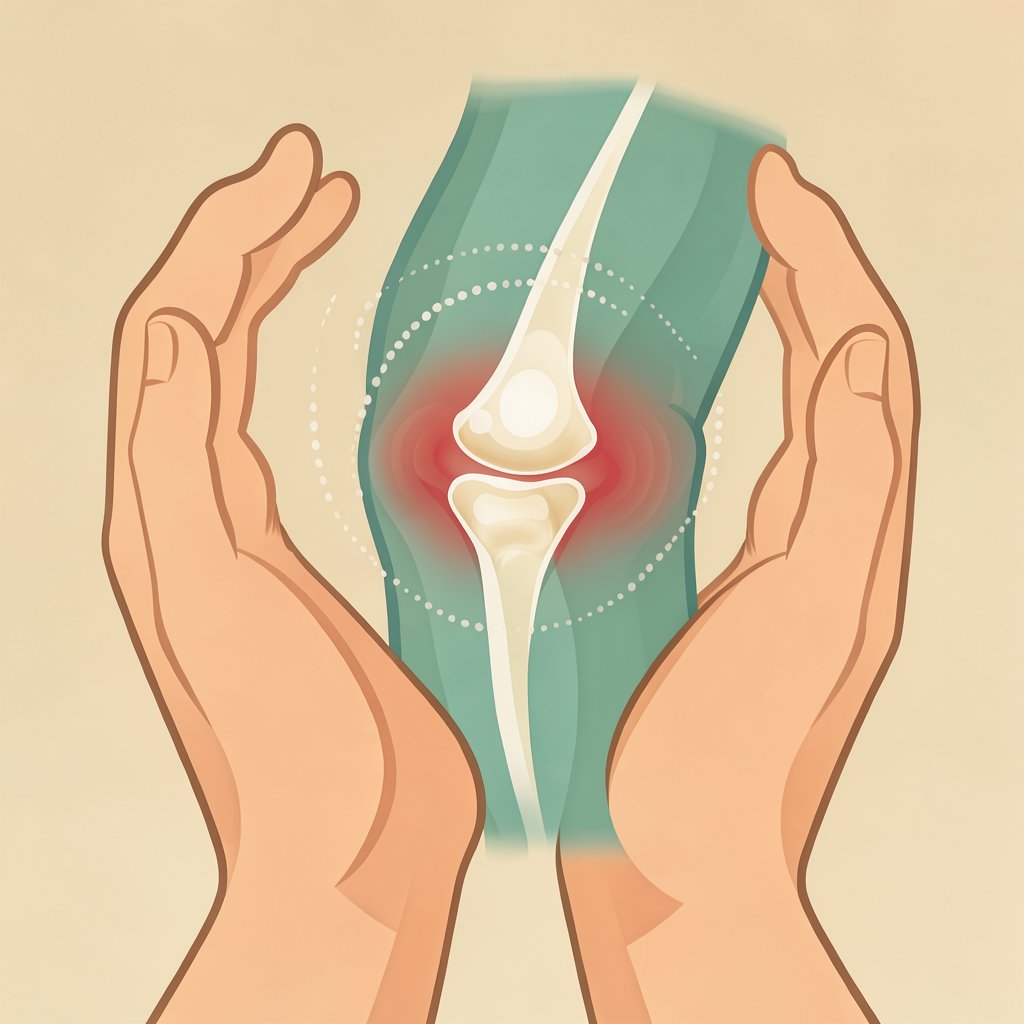
As a buyer, look for these edits in the course’s own materials, not in a footnote you have to ask for. Written inflamed-joint guidance, a pain-check rule, knee and back modifications, and a plain note to consult a doctor for chronic illness or older age are the minimum[1][5]. Silent safety is not a style choice; it is a gap you will discover with your own knees.
The Book + Video Standard: What Real Structured Instruction Looks Like
Calibrate expectations against the documented gold standard of home study in this art. Classical Yang Style: The Complete Long Form and Qigong (2010) was explicitly designed as a book-plus-companion-DVD system, with disc icons printed throughout the text pointing to the matching video chapters — the book even carries a section on “Using the book and DVD together”[3]. Its author, Dr. Yang, Jwing-Ming, is described in the same volume as the author of 35+ books and 80+ instructional videos who has taught in 18 countries[3]. That is what structured video instruction has historically meant: written theory and cued video designed as one system, not a wall of follow-along clips.

The same ecosystem shows what depth looks like beyond the empty-hand form: Taiji Sword, Classical Yang Style (1999) documents the weapon-form path for students who keep climbing[10]. Now state the honest gap plainly. Our entire evidence base — 1,137 books — contains no online-course platform data, no pricing tiers, and no instructor-market statistics, which is precisely why this review is criteria-first and names no 2026 products; a list that named them would be inventing its facts.
So hold any online course to the book-plus-video standard: theory you can read, video cued to it, and an integration design visible in the syllabus. Streaming changes the delivery, not the standard. If a course cannot show how its reading and its video refer to each other, it has not earned the comparison.
Where the two offers we review fit
Two reviewed products sit naturally beside a tai chi practice as complements — neither is a tai chi course, and neither is scored on the five axes above. They address the two comfort questions a standing practice most often surfaces: everyday joint comfort and tight hips. Treat them as optional add-ons; the rubric always comes first.
- Joint Genesis — a daily supplement option marketed for everyday joint comfort; our Joint Genesis review examines its labeling and value against the same honesty standard.
- Unlock Your Hip Flexors — a targeted mobility routine that pairs naturally with the stance work a real tai chi course will demand; details in the Unlock Your Hip Flexors review.
Disclosure: we may earn a commission if you buy through links on this page. Ratings and recommendations are our editorial opinion.
How to Score Any Tai Chi Course in 15 Minutes
With the five axes in hand, any sales page becomes a fifteen-minute audit. Open the course site and its syllabus in two windows and run the five checks below in order, each mapped to one axis and to the manual it comes from. If a check fails, note it and keep going — you want the full picture before the verdict, not just the first dealbreaker.
- Name the branch and the line. Find the named style — Chen, Yang, Wu, or Zhaoobao — and the teacher’s line behind it; since the record from Chen Wangting through Chen Changxing to Yang Chengfu’s health-oriented edit is documented, a pitch built on “ancient art” with no names fails here[1][2].
- Read week one. The opening syllabus should show taiji qigong, the Fundamental Eight Stances, the Five Steppings, and a stillness practice before any form work, mirroring the classical staging[3][4].
- Demand the ladder. A published progression from the entry complex through the 24-form to the 88-form, taught one move at a time with re-linking to the previous form, is the documented method[1].
- Check the minutes. Compare the stated daily ask against the anchors — 10–20 minutes a day for maintenance, about an hour a day while learning a new form[1][6].
- Hunt the safety edits. The inflamed-joint rule, the two-hour pain rule, knee-bend modifications, and a doctor-consult note for chronic illness or older age must appear in writing[5].
Four red flags end the audit early: an unnamed lineage, form-first teaching, “mastery in minutes” promises, and silent safety. Any one of them marks the course as packaging over pedagogy, whatever the production budget looks like. A course that clears all five checks at its asking price is, by the standard of this review, worth paying for.

Verdict: Depth-per-Dollar Is the Only "Best" That Matters
Without verifiable 2026 product data, the ranking this niche deserves is not a podium of platforms but a standard — and that standard is now in your hands. The best tai chi online course for you is the one that clears all five axes at whatever price it asks: a named lineage you could trace back toward Chenjiagou if you had to[1], foundation before form[3][4], one-move sequencing with re-linking[1], honest daily minutes[1][6], and safety edits in writing[5]. That is depth-per-dollar, the only “best” that survives contact with a checkout page.
A note on method, in plain sight. The criteria above were built by a direct full-text scan of the tai chi shelf of a 1,137-book library; vector reranking was not run, so retrieval order was unranked and every fact was verified against the cited page rather than a ranking score. The 200-million-practitioners figure stays what it always was: the manual’s own marketing claim[1]. Where the base held nothing — platforms, prices, star ratings — we labeled the gap instead of filling it.
Platforms and pricing pages change every year; the masters’ checklist has already outlived a century of them. Learn tai chi online the way the lineage actually teaches — breath first, stance next, one move at a time, every day — and the “best” label takes care of itself. The five axes are the part of this review you keep for life.
Frequently Asked Questions
What is the best tai chi online course in 2026?
No honest answer names a single product out of thin air. Our evidence base — 1,137 offline books — holds no verified platform, pricing, or instructor-market data for 2026, so this review builds a five-axis standard instead: lineage transparency, foundation before form, sequencing discipline, honest dosage, and written safety edits. Run the 15-minute scorecard on any finalist and let depth-per-dollar pick the winner, starting in our buyers’ guides hub.
Can I really learn tai chi online?
Structured home study has a documented pedigree. The classical long-form curriculum was published as a book-plus-DVD system with video cues throughout, by an author credited with 35+ books and 80+ instructional videos[3] — proof that reading plus cued video can carry the teaching when the staging is honest[4]. To learn tai chi online successfully, pair your course with a daily foundation practice such as our Eight Pieces of Brocade manual.
How long does it take to learn the 24-form?
The manual presents the 24-form as learnable “in two months” without pre-training, with about one hour per day devoted to each new form and the next day spent repeating it[1] — treat the two months as the book’s promise, not a measured average. Once you reach the 88-form, allow roughly 20 minutes to perform it[1]. For the breath layer underneath, see the coherent breathing practice manual.
Which tai chi style should a beginner choose?
Choose transparency over branch loyalty. The documented map runs from the Chen complexes of Chen Wangting through Chen Changxing to Yang Chengfu’s health-oriented re-edit, with the Zhaoobao line and the Wu style of Wu Jian-Quan alongside[1][2]. A course that names its branch and teacher line is auditable; one that names neither is a coin toss. Stillness transfers to any branch — our Zhan Zhuang standing manual builds it.
Is tai chi safe if I have arthritis or bad joints?
Traditionally, yes — with edits, and the edits are the point. The sources direct readers with persistent diseases or in old age to consult a doctor beforehand[1], suspend heavy qigong on an inflamed joint in favor of gentle massage and light movement[5], and apply the two-hour pain rule to size the dose[5]. Read our medical disclaimer before starting any new practice, and loop in your clinician.
How much should I pay for an online tai chi course?
There is no verified pricing data in our evidence base, so any number we quoted would be invented. What the sources do support is a value test: a course is worth its price when it clears all five axes — lineage, foundation, sequencing, dosage, and safety — at that price[1][3][5]. Depth-per-dollar, not discount, is the measure; see how we apply it across the reviews and buyers’ guides hub.
Sources
- [1] Wang Lin — Tai Chi (Taijiquan): Art of Harmony and Life Extension — the core teaching manual behind this review: the founding history from Chen Wangting of Chenjiagou to Chen Changxing, the motion-division teaching method, the 6-minute / 24-form / 88-form / 42-form ladder, the one-hour learning dose, and the open-at-any-age entry framing.
- [2] Yang, Jwing-Ming — Tai Chi Secrets of the Wu Style (2002) — lineage and transmission: the internal school’s dozens of sub-styles, the Wu Jian-Quan line, and the secret oral classics revealed to the general public only in the twentieth century.
- [3] Yang, Jwing-Ming — Classical Yang Style: The Complete Long Form and Qigong (2010) — the staged curriculum (Five Steppings, Fundamental Eight Stances, still meditations, drills, sequence) under the Thirteen Postures theory, plus the book-plus-DVD design and the author’s 35-book / 80-video teaching record.
- [4] Yang, Jwing-Ming — Tai Chi Qigong: The Internal Foundation of Tai Chi Chuan (2013) — the foundation-before-form argument: taiji qigong as the foundation of taijiquan practice, with foundation and form required to balance and coordinate.
- [5] Yang, Jwing-Ming — Pain-Free Joints: 46 Simple Qigong Movements (2017) — the joint-safety contract quoted in Axis 5: the inflamed-joint rule, the two-hour pain rule, low-pain-day practice, and the knee-bend modifications for back problems.
- [6] Yang, Jwing-Ming — Eight Simple Qigong Exercises for Health: The Eight Pieces of Brocade (1997) — the 10–20-minutes-a-day maintenance anchor used to sanity-check every course’s stated daily ask.
- [7] Lee Holden — 7 Minutes of Magic (2008) — the seven-minutes-a-day morning program, the smallest defensible daily minimum in the corpus.
- [8] Li Ding & Bambang Sutomo — Taiji Qigong: Twenty-Eight Steps (2003, Foreign Languages Press, Beijing) — the 28-step short system and the circulation-and-mobility rationale attributed in Axis 4.
- [9] Khorev V.N. & Vilchinsky A.S. — Qigong for Beginners (2011) — the 18-form Tai Chi & Qigong beginner complex used as a comparison-shopping benchmark in Axis 3.
- [10] Yang, Jwing-Ming — Taiji Sword, Classical Yang Style (1999) — the documented weapon-form path showing what advanced depth looks like inside the same teaching ecosystem.
Where to go next: this guide lives in our buyers’ guides hub alongside every criteria-first review we publish. While you comparison-shop courses, the Baduanjin — Eight Pieces of Brocade manual gives you a complete 10–20-minute daily practice today, and the Zhan Zhuang standing manual trains the stillness layer every real course will demand. The coherent breathing manual completes the foundation triad — breath, stance, stillness — before you spend a dollar anywhere.
How we researched this: built from a local library of 1,137 wellness books, queried through an offline retrieval system with no internet sources; for this review the tai chi shelf was scanned full-text (61 files mention the art), and every factual claim above was checked against the cited book passage before publication. Vector reranking was not run, so retrieval order was unranked. Where the base held nothing — platform names, prices, ratings — we labeled the gap instead of filling it, which is the standard every buyer’s guide on this site is held to.
