
Educational content only — not medical advice. See our full Medical Disclaimer and Affiliate Disclosure below.
Key Takeaways
- On the traditional Chinese organ clock, qi is described as circulating organ to organ across twenty-four hours, and the pre-dawn 03:00-05:00 stretch is the window of maximal oxygen uptake — the lung’s home territory in the same framework[1].
- An honesty note the sources force on us: no text in our library prints a sentence saying “the lung meridian rules 3 to 5 AM.” The lung link is assembled from the oxygen row, the lungs’ “first organ to receive cosmic energy” framing, and the Metal element with channel index P[1][3].
- The same tradition calls 2 to 5 AM the body’s weakest hours, and one author’s hour-value table prices sleep after 3 AM in minutes — which is why lying awake then feels so final[1][7].
- The habit kit is numeric: a fixed wake anchor with morning light, a caffeine curfew 3-5 hours out, screens off one hour before bed, a 60-64°F bedroom, and a 15-20 minute get-up rule[5][6][11].
- Early morning waking for about a month, or waking together with persistently low mood, is a doctor question first — the source books say so explicitly[5][13].
It is 3:47 AM, the house is silent, and your eyes are wide open — again. If waking up between 3 and 5 AM has become your unwelcome routine, whether that is waking up at 4 AM on the dot or a fuzzier half-past-three jolt, you have a great deal of company: in a Gallup poll of 1,000 adults reported by a physicians’ advisory book, one third said they wake in the middle of the night unable to fall back asleep, and insomnia ranks just after colds, stomach trouble, and headaches among the reasons people see a doctor[5]. Traditional Chinese medicine (TCM) has been interested in that exact stretch of night for a very long time, and its organ clock keeps a specific, breathing-centered reading of it[1].
This guide walks through that reading honestly. First, what the organ clock is and where the lung meridian sits on it; then what the tradition actually says about the 3 to 5 AM window — and, just as important, what it does not say. From there we turn to why early morning waking feels so final after 3 AM, a five-step habit kit with real numbers attached, a protocol for the exact moment you surface, and the red flags that make early waking a doctor question rather than a meridian question. Everything here is educational, drawn from traditional wellness and sleep books — not medical advice.
What Is the Lung Meridian Theory of Waking at 3 AM?
The lung meridian theory of 3 AM waking is a traditional Chinese medicine reading of early morning waking. In it, qi — the tradition’s word for vital breath-energy — circulates from organ to organ across twenty-four hours, giving every organ predictable hours of maximal work and rest[1]. The pre-dawn 03:00-05:00 stretch is described in that framework as the window of maximal oxygen uptake, and oxygen is the lung’s home territory[1].
The lung assignment comes with the tradition’s own furniture. The lungs belong to the Metal element, paired with the large intestine, and their channel carries the international index P under the formal name “hand tai-yin lung meridian”[3]. In the same book that tabulates the organ clock, the lungs are called “the first organ to receive cosmic energy”[1]. Set those pieces side by side and you can see why popular accounts compress the whole story into a slogan: 3 to 5 AM is “lung time,” so waking then must be about the lungs.
This guide is careful with that slogan, because the sources are. None of the texts in our library prints a sentence saying “the lung meridian rules 3 to 5 AM” — the connection is assembled, not quoted, from three beams: a pre-dawn table row whose entire content is oxygen, the lungs-first framing, and the Metal/P channel assignment[1][3]. That makes the theory a lens worth understanding rather than a diagnosis, and the sections below keep that distinction in view.
How the Chinese Organ Clock Reads Your Night
The clock is not a metaphor in this tradition — it is a literal daily circuit of energy. The classic texts describe qi as moving from organ to organ so that every day at the same time there are periods of maximal organ work and periods of rest[1]. The map is old: the Huangdi Neijing, the Yellow Emperor’s Inner Classic, dated in our source to roughly the third century BCE, already precisely described the locations of the meridians and the effects of acupuncture points, comparing the channels to the great rivers of China — the word jing itself carries the senses of river, road, path, and blood vessel[2].
The system is detailed to a degree that surprises most newcomers. About 700 biologically active points are described, of which roughly 150 are in common treatment use, each a mere 1-2 mm (about 0.04-0.08 in) across, and stimulating points “at the right time” is said to normalize the function of the corresponding organ[2]. Organs come in two classes: the zang, solid yin organs, which include the lungs, and the fu, hollow yang organs, which include the lungs’ standing partner, the large intestine[2]. The word qi is itself a family of meanings — spirit, breath, vital energy — with parallels in Japanese ki, Indian prana, and Hawaiian mana, and a loose Western analogy in bioelectricity[2].
One more layer matters for the pre-dawn hours: the flow is not constant. Every channel has its own qi-flow strength that varies throughout the day in a regular cycle, modified by the mind, the weather, the time of day, food eaten, and mood — in dry weather, lung qi is said to run more yang[4]. The full timetable of twelve two-hour windows belongs to our companion Chinese organ body clock guide; for this article we need only one row of it, the row that reads entirely in terms of breath.
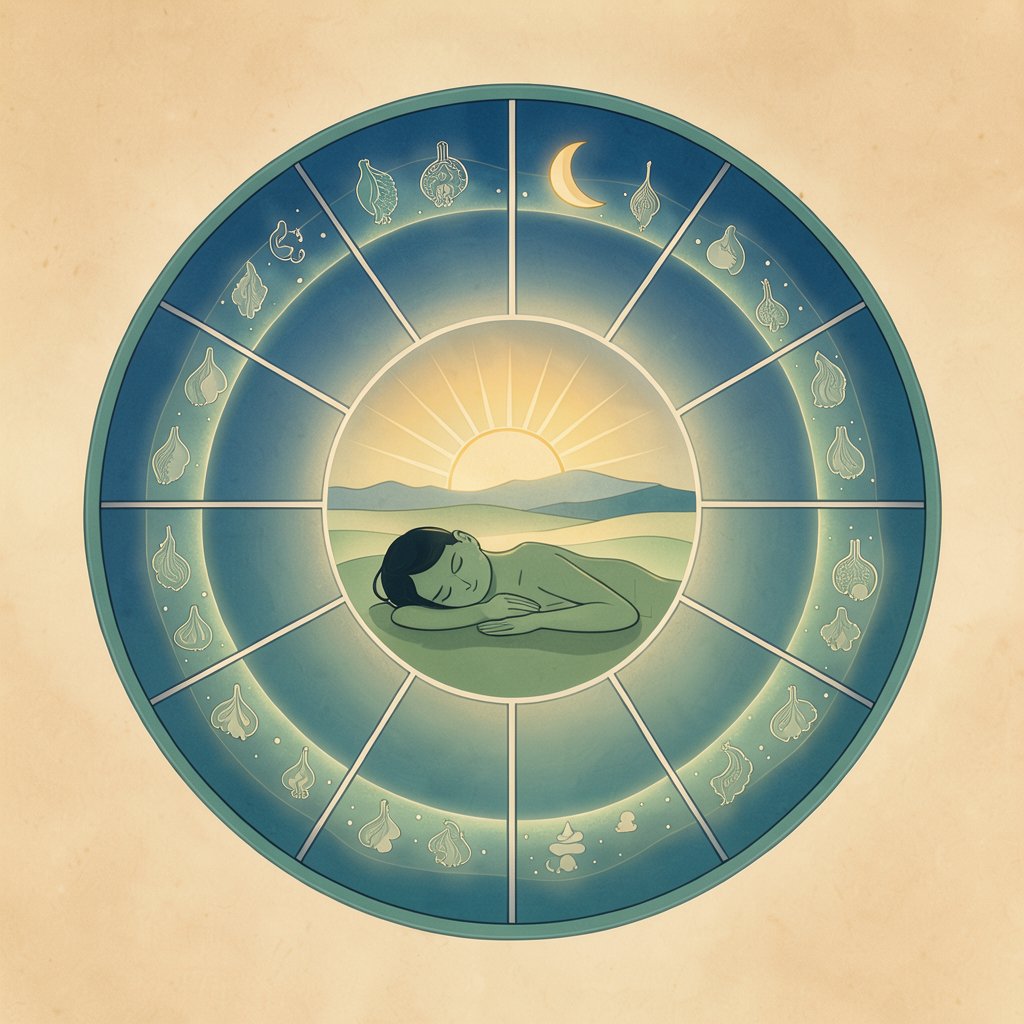
The 3 to 5 AM Window: The Oxygen Hours of the Organ Clock
Open the organ table at the pre-dawn row and something strange happens: no organ is named at all. The 03:00-05:00 entry of maximal activity reads, in full, “time of sleep with an open window, maximal oxygen uptake and recharge of the brain, the first wave of self-regulation. Distribution of oxygen through the body, removal of excess gas. Yin energy”[1]. Sleep with an open window; oxygen taken up maximally and distributed through the body; the brain recharged; the first wave of self-regulation — the entire row is a description of breathing.
That is exactly how the lung attribution works, and it deserves to be stated honestly. The row never prints the word “lungs”; the lung link is built from three beams in the same tradition — a window whose content is oxygen, the lungs as “the first organ to receive cosmic energy,” and the lungs’ Metal element with channel index P[1][3]. In the organ-clock tradition this window is described in lung terms, oxygen uptake above all, rather than claimed for the lung channel in so many words.
The same sources add texture around the row. The lungs are paired with the large intestine, and the organ-clock author holds that “we must start treating the respiratory organs by cleansing the intestine” — a traditional-use statement, not a clinical instruction[1]. A health-qigong foundation text notes that aging lungs lose elasticity as part of a general weakening of the five organs with age[14]. And the window is flagged as a yin phase — deep night, inward-turned — which is why the tradition reads waking inside it as a disturbed oxygen-and-qi phase rather than random insomnia: an interpretive frame, offered as such.
Why Sleep After 3 AM Feels Like It Is Worth Minutes
There is a second explanation for the 3 AM despair, and it is brutally simple: by that hour, the night’s real work is largely done. The organ-clock source states flatly that the person is weakest from 2 to 5 AM and between 12:00 and 14:00, and strongest from 8 to 12 and again from 14 to 17[1]. The 3 to 5 AM waking window sits squarely inside the body’s weakest hours — one traditional answer to why everything feels heavier at 4 AM than it did at midnight.
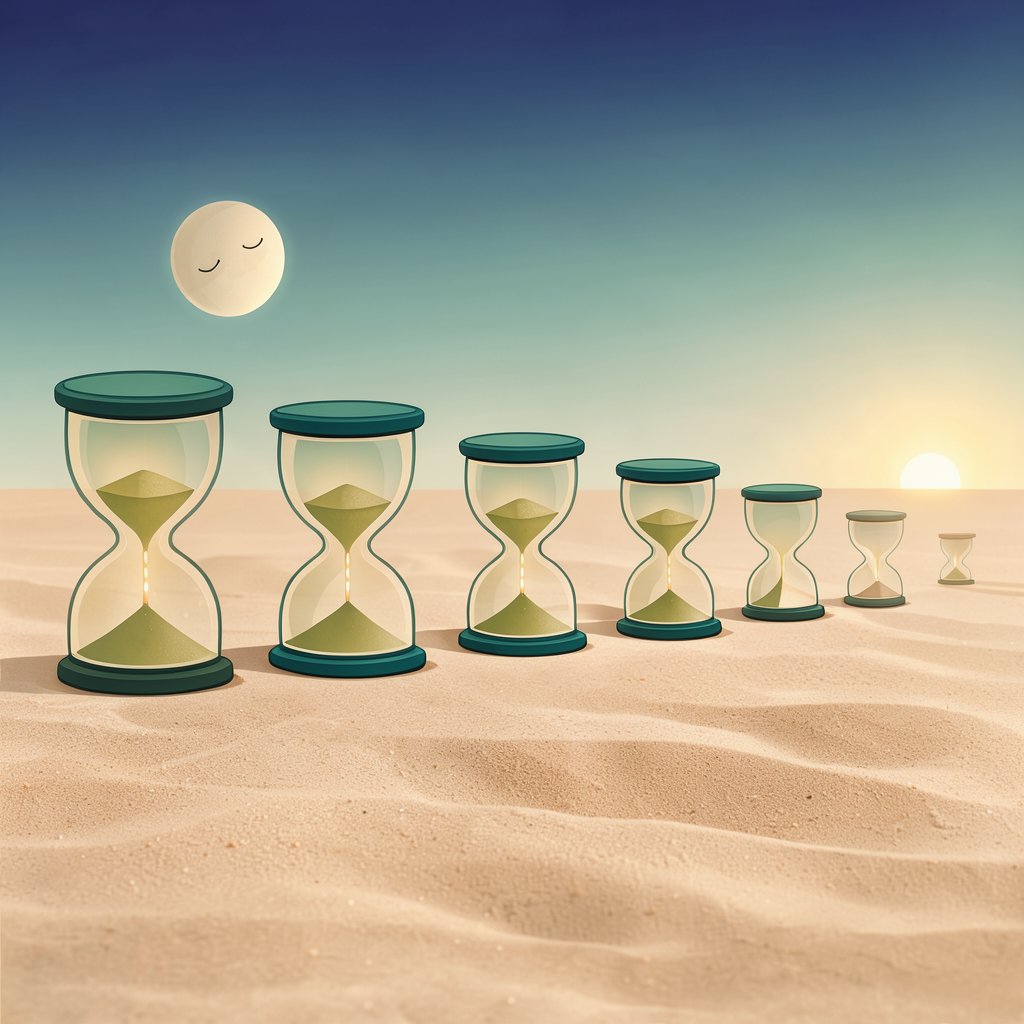
A second author makes the same point with arithmetic. “All organs and systems, including the blood, work strictly by the clock,” he writes, then prices each hour of sleep: the hour from 21:00 to 22:00 is worth five hours of restoration, 22:00-23:00 four, 23:00-24:00 three, 00:00-01:00 two, 01:00-02:00 one, 02:00-03:00 half an hour, 03:00-04:00 fifteen minutes, 04:00-05:00 seven minutes, and 05:00-06:00 a single minute[7]. On that ledger the recommended night runs 21:00 to 05:00, and 19:00 to 05:00 for weakened people[7]. One honest label is mandatory here: this hour-value table is one author’s system, not TCM canon — but as a description of why returning to sleep after 3 AM feels “not worth it,” it is remarkably candid.
The frustration itself carries a measurable cost. After one sleepless night, activity in the amygdala — the brain’s threat alarm — rises by about 60 percent while prefrontal cortex control drops, according to a modern sleep book in our library[8]. The 3 AM spiral of anxious arithmetic — “if I fall asleep now I still get three hours” — is not a character flaw riding on weakness of will. It is a documented brain state layered on top of a night whose deepest restoration is already banked.
Is Your 3 AM Waking a Pattern? How to Tell
One 3 AM wake-up is an accident; the same minute returning night after night is a schedule, and schedules can be read. The practical heuristic costs nothing: if the same hour has returned for a week or two, you have a pattern the tradition would treat as window-specific rather than random. Before reading anything mystical into it, though, rule out the mundane physiology first — and that check is one question long.
The clearest mundane explanation is phase. With age the circadian rhythm shifts earlier, so a person who falls asleep at 19:00 can find themselves waking at 2 to 4 AM unable to get back to sleep — a pattern the sleep manuals call advanced sleep phase and describe as typical in the elderly[6]. The self-check is simply your bedtime on the clock against your wake hour. An early-evening sleeper waking pre-dawn may need a later schedule, not a meridian interpretation.
The traditional readings are worth knowing all the same. A practice memoir explains the 4 AM hour physiologically: the body uses 21:00 to 24:00 for restoration, and around 00:00-01:00 the restored energy is said to help the liver prepare the body for self-cleansing, “which begins an hour before dawn,” with the final stage ending at 06:00 — so waking before six is framed as a chance to regulate those processes consciously[9]. A parallel tradition, clearly not TCM, reads the same hours idealistically: an Ayurvedic regimen book grades rising at 3 AM as suited to renunciants and clergy, and calls the 3 to 4 AM tier hours “intended by nature itself” for practice[10]. Whatever the reading, the levers that follow are daily and physical, not mystical.
Habits That Guard the 3 to 5 AM Sleep Window
The window is guarded hours before it opens. The sleep literature in our library converges on five small daily rules, each with numbers attached, and none of them requires anything dramatic. Run the set for two weeks before judging results, because the tradition’s own rule for any rebuilding of the body’s rhythms is gradualness above all[17].
Step 1 — Anchor the wake time, then get light
Fix one anchor and defend it: the same wake time every day, weekends included, because light on waking is what sets the biological clock[6]. Morning bright light is called “the best synchronizer of the daily rhythm” in the insomnia manual, and the physicians’ advisory describes the laboratory version — two hours in front of high-intensity full-spectrum lamps in the morning, paired with dark glasses in the evening — plus the free home version: a morning walk, sitting in the sun, or yard work[5]. Our guide to circadian light habits expands this step into a full routine.
Step 2 — Set a caffeine curfew
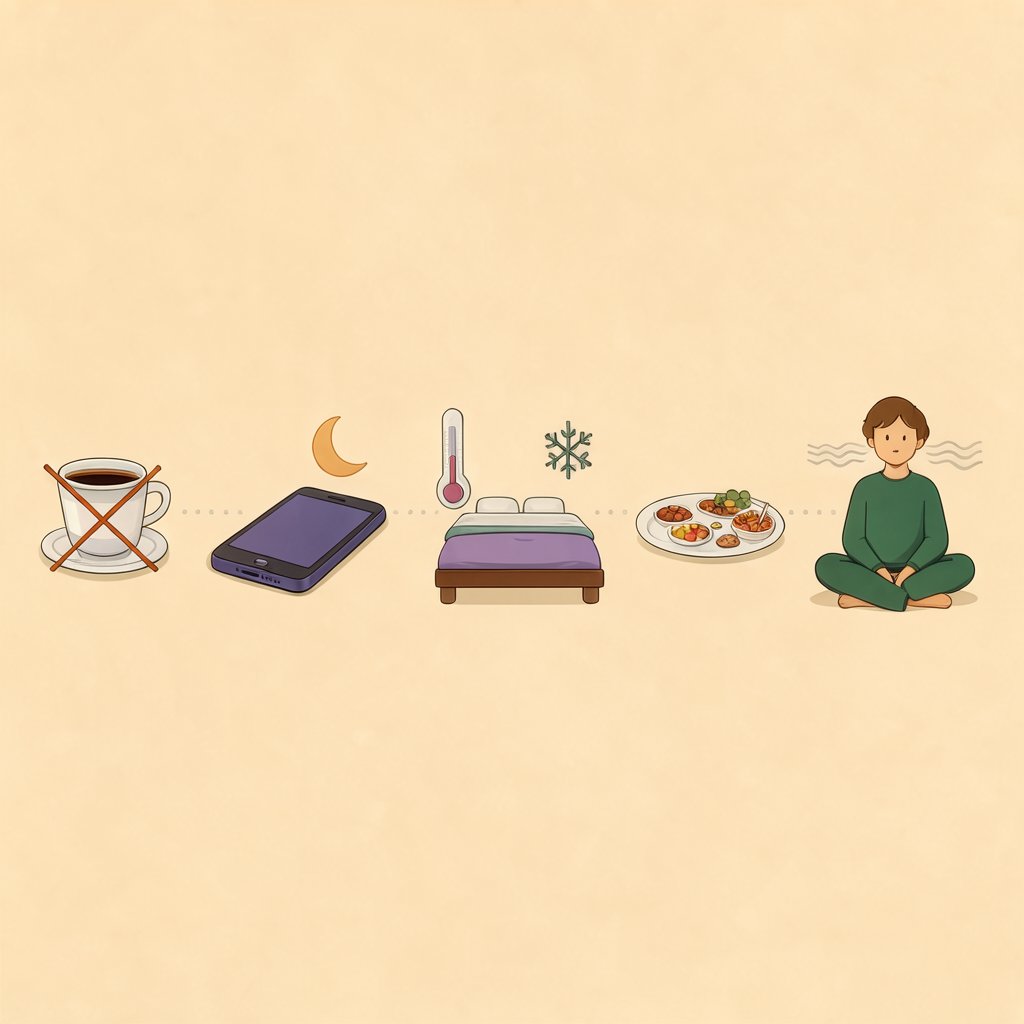
Caffeine acts for three to five hours, so count backward from bedtime — and audit the hidden sources, not just coffee. A cola carries about 46 mg of caffeine, Pepsi and diet Pepsi about 35 mg, and a 50 g (1.8 oz) portion of milk chocolate adds its own share[6]. The same manual groups alcohol and tobacco with caffeine on the list of before-bed stimulants to avoid[6]. A curfew works because it is arithmetic, not willpower.
Step 3 — Build the evening buffer
A 2025 health handbook turns the last hours of the day into a checklist: screens off at least one hour before bed; stimulants — coffee, nicotine, alcohol — at least four hours before; a light dinner; naps capped at 30 minutes; no stressful discussions in the final two hours; and a bedroom that is dark, quiet, and cool at 60-64°F (16-18°C)[11]. The same protocol closes with a short breathing practice before sleep — abdominal breathing in a “cardiac coherence” style[11]. Our evening wind-down ritual guide builds this buffer into a full ceremony.
Step 4 — Spend your time in bed efficiently
The insomnia manual is blunt about efficiency: eight hours of sleep out of 8.5 hours in bed is more effective than eight out of ten[6]. Its corollaries follow the same logic: stay in bed only as long as you believe sleep needs, plus about 15 minutes; skip daytime naps; and resist going to bed early just because last night was short[6]. Compressing bedtime to real sleep need is what keeps the 3 to 5 AM window deep instead of thin.
Step 5 — Practice gently, and in the right order
If you add evening practice, follow the tradition’s own dosage rules: static qigong in the evening and dynamic forms in the morning, sessions of 20 to 30 minutes — no more, “otherwise the reverse effect” — the last meal at least an hour before practice, and breathing kept “calm, even, slowed and thin”[2][15]. One advanced breathing scheme in the library — a 100-second cycle of 15 seconds in, 40 held, 40 out, 10 paused, practiced 40 to 50 minutes daily — is explicitly for healthy readers building capacity over months, never a 4 AM project[16]. For older readers there is one more guard: limit evening fluids, because sometimes the 3 AM wake-up is simply the bathroom[5].
What to Do When You Wake Up at 3 AM
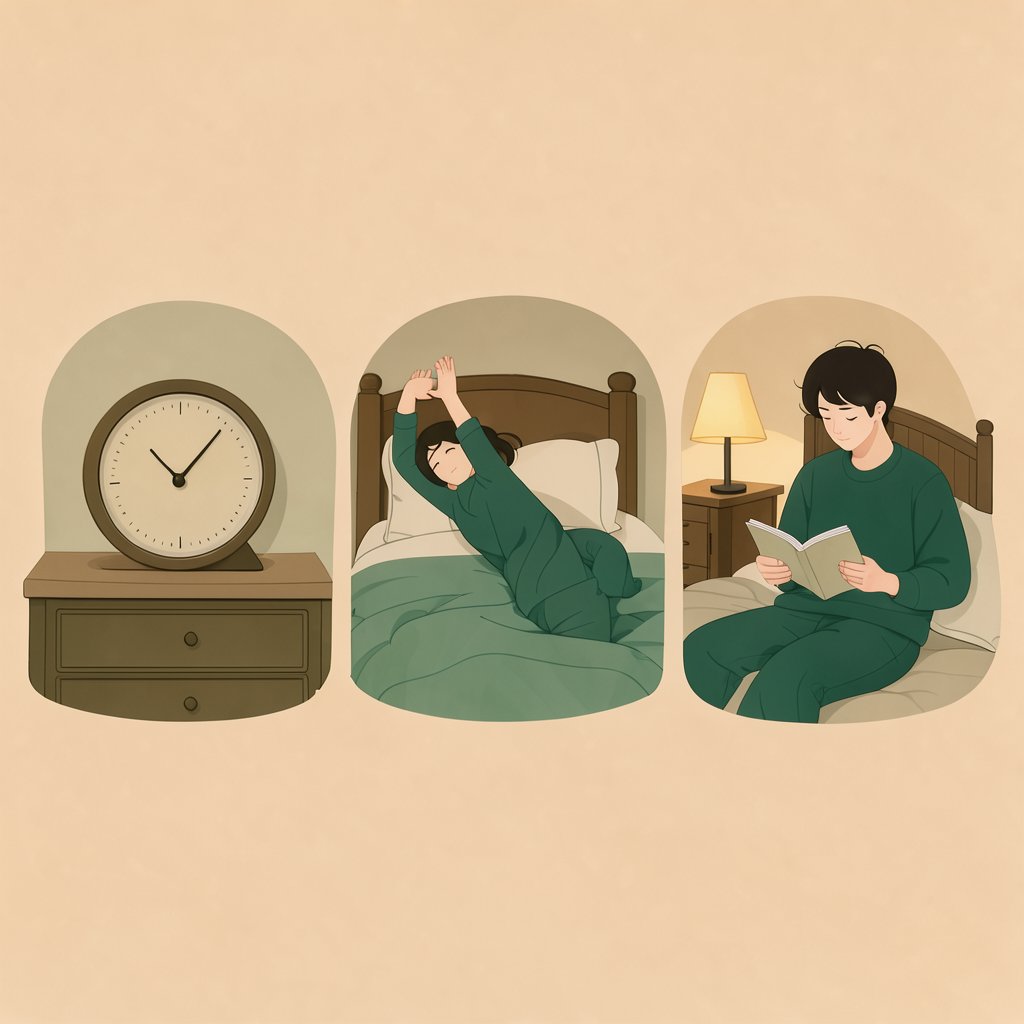
It is 3:12 by the glow you promised not to check, and what happens in the next fifteen minutes decides the rest of the night. Rule zero comes first: turn the clock face away before bed — “what difference does it make what time it is if you cannot sleep anyway” — and when you do surface, keep your eyes mostly closed[6]. Checking the time converts a drift into an audit, and the audit is what wakes you all the way up.
The first minutes belong to micro-moves designed for exactly this moment. A breathing-techniques manual prescribes three: “Freeze” — press your chin into the pillow, freeze the chest and abdomen, then tense one more muscle group; “Cat stretches” — stretch arms and legs one at a time with deliberately shallow breathing; and “Morning,” for waking on your back too heavy to turn over — a slow stretch with muscle effort, a fist under the head, breathing kept shallow[12]. The same manual notes that tensing the muscles around the eyes and lips reflexively shallows the breath, a quirk of wiring you can borrow on purpose[12].
If sleep does not return, both rulebooks agree: leave the bed. The insomnia manual gives it about 30 minutes — then get up, read, watch television, listen to calm music, or briefly leave the bedroom[6]. The US physicians’ version is tighter: if you are not asleep in 15 to 20 minutes, get up and do “something pleasantly monotonous” — a magazine article, knitting, television, balancing the checkbook — and explicitly not computer games and not chores; repeat as needed through the night, and always rise at the same time[5].
And if you decide the night is over — say, at 5 AM after a genuinely good bank of sleep — do not launch out of bed. Lie about ten more minutes so the body glides from sleep to waking, a gentleness rule the health-without-medications books insist on[13]. The same books warn that forced early rising compounded with cold showers taken “through force” can push toward heart disease, depression, and disordered sleep — gentleness is not decoration here, it is the safety mechanism[13].
The Heart-7 Acupressure Point for Night Waking
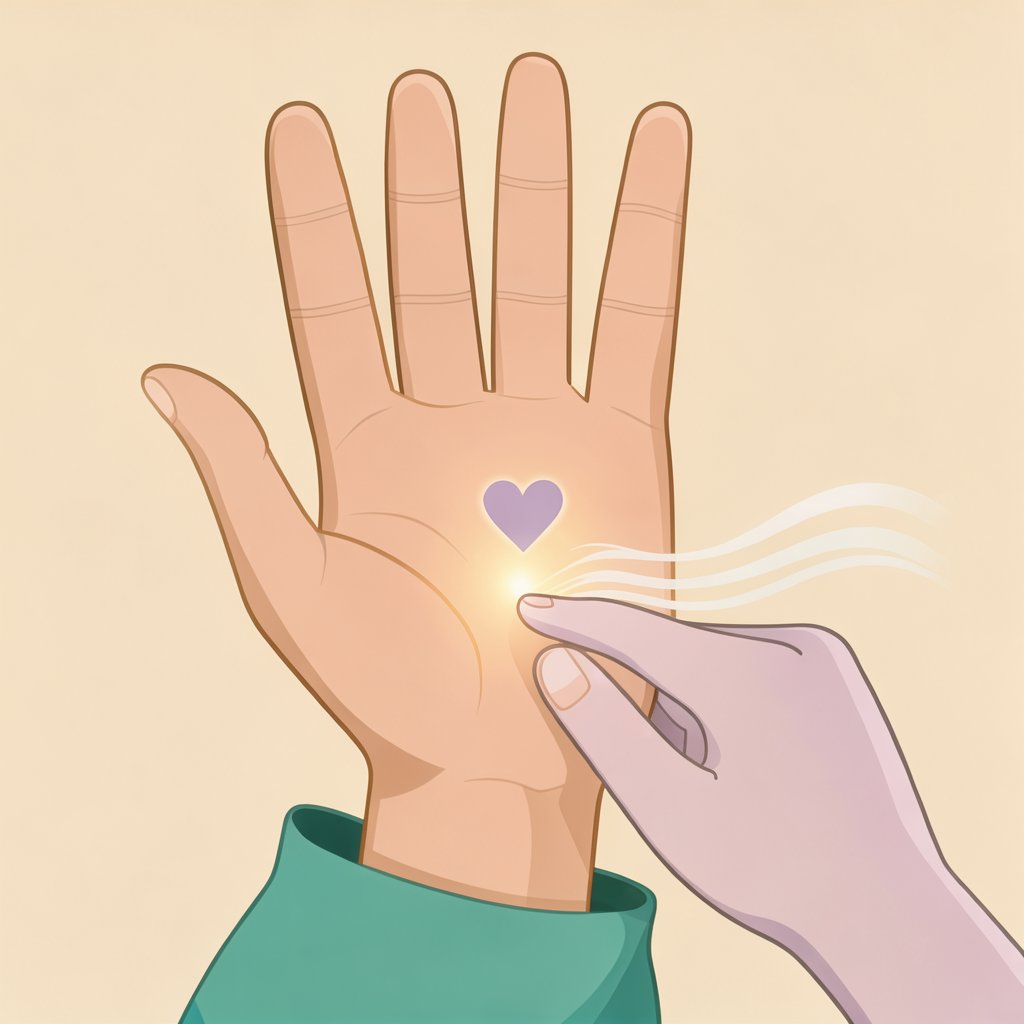
The sleep books converge on one surprisingly specific ritual: a point the tradition numbers as Heart-7, on the crease of the wrist at the little-finger side. The full palm routine from a 2025 handbook runs in four moves. Rub your hands together for 30 seconds to warm them; press Heart-7 with a fixed press, then press on the exhale and release on the inhale, about ten repetitions on the left hand and then the right; work the diaphragm reflex zone on the palm with a crawling movement, ten times per hand; finish at the solar-plexus zone with five fixed presses per hand and two minutes of slow counterclockwise rotation on each[11].
The evidence framing deserves the same honesty as the lung attribution. The book cites a 2015 study in which palm reflexotherapy once a week for four weeks improved sleep quality and reduced fatigue and depression — and that is all the detail the retrieved source provides, with no sample size, journal, or design given, so this guide reports it exactly as the source states and no further[11]. The tradition context is the point map described earlier: roughly 700 active points, about 150 in common use, with stimulation “at the right time” said to normalize organ function[2].
Two safety notes close the ritual. It is a calming evening practice — a wind-down for the last hour before bed, not a 4 AM project performed in the dark — and the pressure stays gentle throughout, with pain or discomfort as the stop sign. For a fuller night-practice set, our guide to acupressure points for deep sleep extends the same logic.
Red Flags: When Early Waking Needs a Doctor
Everything above assumes an ordinary, healthy 3 AM. Some versions of early morning waking are the body filing a formal complaint, and the rulebooks draw the line in months and moods. The American Sleep Disorders Association rule, as reported in the physicians’ advisory: if you cannot easily fall or stay asleep for about a month, consult a physician first, then an insomnia specialist[5].
The mood line matters just as much. “If a person falls asleep with difficulty or wakes too early, this may be one of the first signs of depression” — a health-without-medications book states it plainly and lists alcoholism, heart disease, and suicide risk among the consequences of untreated depression[13]. If pre-dawn waking arrives together with persistently low mood, the right next step is a conversation with a doctor, not a meridian map. Said calmly, and meant seriously.
A symptom list from the insomnia manual overrides self-care entirely. It names chronic insomnia, daytime sleepiness, overwhelming anxiety, dizziness or fainting spells, a persistently rapid pulse, sweaty palms, trembling of the limbs or inside the body, rash, chronic or acute headache, and back or neck pain — especially if these never happened before and are hard to explain otherwise[6]. For severity context, a modern sleep book adds that drowsy driving causes more road deaths than drunk driving[8]. A depleted pre-dawn waker behind a wheel is a public-health fact, not a private inconvenience.
Practice carries its own stop signs. Headache, a feeling of air deficit, palpitations, or a dry throat during breathing or qigong work mean stop, relax, and breathe naturally; qi is never forced upward, which the sources flag as a blood-pressure risk; and practice is skipped altogether when exhausted[2]. Any rebuilding must be extremely gradual, never driven to breathlessness[17]; individual sleep need runs 6 to 9 hours, and the weaker the person, the more sleep they need[13]. Herbal sleep tinctures also exist in our source base — one alcohol-based valerian-peony-angelica formula with exact doses — but dosage-level herbal therapy is outside this article’s scope: that conversation belongs to a physician, as the recipe’s own source insists[18].

Frequently Asked Questions
Why do I keep waking up at the same time every night?
On the traditional organ clock, qi circulates organ to organ with daily hours of maximal and minimal activity, so a repeated hour reads as a window-specific signal rather than chance[1]. The same source calls 2 to 5 AM the body’s weakest stretch, which makes the pre-dawn hours the easiest to surface from[1]. The full timetable is mapped in our Chinese organ body clock guide.
Does waking between 3 and 5 AM mean my lungs are weak?
No source in our library says that. The tradition describes the window in lung terms — maximal oxygen uptake, brain recharge — and calls the lungs “the first organ to receive cosmic energy,” but no retrieved text states that waking then indicates weak lungs[1]. It is a lens for self-observation, not a diagnosis; the neighboring window has its own piece in why you wake between 1 and 3 AM: the liver meridian theory.
How can I fall back asleep after waking up at 4 AM?
Keep the clock face turned away and your eyes mostly closed; run the in-bed micro-moves — “Freeze,” “Cat stretches,” “Morning”[12]; and if sleep has not returned in 15 to 20 minutes, get up for something pleasantly monotonous instead of lying in the audit[5]. The front half of the night is covered in our evening wind-down ritual.
Is sleep after 4 AM really worthless?
One author’s hour-value system prices it at minutes — 04:00-05:00 worth seven minutes, 05:00-06:00 one minute — but that table is one writer’s system, not TCM canon[7]. The organ-clock source adds only that the body is weakest from 2 to 5 AM[1]. “Thin,” not “worthless,” is the honest word, and steady circadian light habits support the rhythm either way.
When should early morning waking prompt a doctor visit?
Two triggers: trouble falling or staying asleep for about a month — the American Sleep Disorders Association rule — or early waking arriving with persistently low mood, which one source calls a possible first sign of depression[5][13]. A physician comes first, then an insomnia specialist[5]. For structured help, our best sleep programs 2026 review looks at what is actually inside the popular options.
Does the Heart-7 acupressure point really help night waking?
The handbook citing it reports a 2015 study: palm reflexotherapy once a week for four weeks improved sleep quality and reduced fatigue and depression, with no sample size or design given, so it stands exactly as reported[11]. As a ritual it is gentle, evening-scheduled, and stopped on discomfort. The acupressure points for deep sleep guide extends the same toolkit.
Read this way, waking up between 3 and 5 AM stops being a nightly verdict and becomes a signal with a vocabulary. The organ clock explains why the pre-dawn stretch is the body’s thinnest; the habit kit explains why the guardrails belong to the daytime; and the red-flag list keeps the tradition in its proper place, behind the doctor. Anchor the morning, guard the evening, meet the waking gently — that combination is what the books in our library actually say, and it is a workable philosophy of the pre-dawn hours.
Sources
- [1] S. Kashnitsky — Chinese Miracle Methods: How to Live Long and Be Healthy! (2014) — the organ-activity timetable with the 03:00-05:00 oxygen row, the weakest-hours rule (2-5 AM), the “first organ to receive cosmic energy” framing, and the lung–large intestine pairing.
- [2] E. A. Polyakova — Health Workshop: Eastern Health-Improving Practices (2015) — the Huangdi Neijing history and rivers metaphor, the ~700/~150 point counts with 1-2 mm diameters, the zang-fu organ classes, the qi glossary, evening-practice dosage rules, and the stop-signs safety list.
- [3] N. Olshevskaya — 365 Golden Recipes of Ancient Healing Practices (2010) — the five-element assignments (lungs = Metal), the lung meridian’s international index P and “hand tai-yin lung meridian” name, and the three positive energies.
- [4] Yang Jwing-Ming — Qigong Meditation: Embryonic Breathing (2003) — the regular daily cycle of qi strength in every channel and its modification by mind, weather, time of day, food, and mood.
- [5] Home Doctor: Advice from American Physicians (2007) — the Gallup night-waking statistic, Dr. Stepanski’s 15-20 minute get-up rule, the NIMH morning-light protocol, the American Sleep Disorders Association month rule, and evening-fluid advice for the elderly.
- [6] Lyudmila Berezhkova — How to Get Rid of Insomnia (n.d.) — the fixed wake-time anchor, the clock-face rule, caffeine’s 3-5 hour action with hidden-source figures, the time-in-bed efficiency arithmetic, advanced sleep phase, and the see-a-doctor symptom list.
- [7] S. A. Budilov — New Body, Stage 1 (2011) — the “organs work strictly by the clock” principle, the hour-value sleep table (used here with the one-author-system label), and the 21:00-05:00 recommended night.
- [8] Allen Carr, John Dicey — The Easy Way to Better Sleep (2024) — the amygdala’s ~60 percent activity rise after one sleepless night and the drowsy-driving versus drunk-driving comparison.
- [9] I. A. Shimansky — The Verdict Is Rescinded (n.d.) — the practice memoir’s 4 AM rationale: restoration until midnight, liver preparation at 00:00-01:00, self-cleansing beginning an hour before dawn and ending at 06:00.
- [10] Oleg Torsunov — Daily Routine (n.d.) — the Ayurvedic rising tiers at 3 AM and 3-4 AM, used here only as a clearly labeled parallel tradition, not as TCM support.
- [11] Emeric Persilye — Health in Your Hands (2025) — the evening buffer checklist with the 16-18°C bedroom figure and the Heart-7 palm reflexotherapy protocol with its cited 2015 study.
- [12] D. Preobrazhensky — Golden Breathing Techniques of Health (2009) — the in-bed micro-moves “Freeze,” “Cat stretches,” and “Morning,” plus the eye-and-lips tension rule that shallows breathing.
- [13] Alla Tartak — Golden Book-4 / Golden Book-6, or Health Without Medications (n.d.) — the ten-minutes-after-waking rule, the early-waking depression warning, forced-regime risks, and the 6-9 hour individual sleep range.
- [14] Jiao Guorui — Foundations of Health Qigong (2013) — the note that aging lungs lose elasticity as one of five organs weakening with age.
- [15] Xu Qihui — Secrets and Methods of Life Extension (1991) — the breathing-quality rules (calm, even, slowed and thin) and natural chest-and-abdomen breathing.
- [16] I. Yu. Isa — Mastering Vital Energy (n.d.) — the extended 100-second breathing cycle (15/40/40/10 seconds) and the 8-10 breaths-per-minute resting rate reported after 1-2 months of daily practice.
- [17] A. A. Mikulin — Active Longevity (1977) — the gradualness rule for any physical rebuilding: extremely gradual, never driven to breathlessness.
- [18] L. Lyubavich — 260 Tincture Recipes: Healing Through the Centuries (2024) — the alcohol-based valerian-peony-angelica tincture held out of this article on compliance grounds; the source itself directs readers to consult a physician.
Where to go next: the companion Chinese organ body clock guide lays out the full twelve-window timetable this article borrows a single row from, and the neighboring window has its own piece in why you wake between 1 and 3 AM: the liver meridian theory. To widen the night toolkit, the acupressure points for deep sleep guide and the evening wind-down ritual expand two of the habits above, and our best sleep programs 2026 review examines what structured help actually contains.
How we researched this: this article is built from a local library of 1,137 wellness books, queried through an offline retrieval system with no internet sources. Every factual statement above was checked against the cited book passages and carries a numbered footnote to its source. Traditional claims are presented as tradition, and where a claim is one author’s system rather than the tradition’s canon, the text says so.
