
Educational content only — not medical advice. See our full Medical Disclaimer and Affiliate Disclosure below.
Key Takeaways
- German chamomile is the one herb in our source base with both a documented mechanism — its apigenin competitively blocks flunitrazepam binding at the central benzodiazepine receptor — and a printed adult dosage: 2-8 g of dried flowerheads as an infusion, three times daily[1].
- The traditions behind a calming tea are exact, not vague: Ayurveda steeps half a teaspoon per cup for 5-10 minutes[8], and the Russian folk compendia weigh mint, valerian, and hawthorn to the gram, steep blends 30-40 minutes, and cook warming drinks in a thermos overnight[9][10].
- Passionflower appears in no sleep protocol anywhere in the sources we scanned — the pharmacopoeia keeps it in its pregnancy-caution table — so this guide refuses to invent a bedtime passiflora dose[1].
- Safety decides who skips the teapot: ragweed-family allergy cross-reacts with chamomile, with documented anaphylaxis[1], and the insomnia handbook draws the caffeine line at 4 p.m., when a single cola still carries 46 mg[13].
A cup of bedtime tea is the quietest ritual in the wellness cabinet: hot water, a spoonful of dried flowers, and half an hour between a loud day and a dark bedroom. It is also a corner of the internet where copy rarely quotes anyone. Most posts about chamomile tea for sleep recycle the same three claims — calming, ancient, caffeine-free — without ever showing the line a book actually printed. This guide does the opposite: every dose, steep time, and caution below is transcribed from a named source, and where the sources say nothing, we say nothing.
Our reading list is a local library of 1,137 wellness books — a Royal Pharmaceutical Society pharmacopoeia, an Ayurvedic home-remedy manual, Slavic folk compendia that weigh herbs in grams, and modern sleep-hygiene handbooks. In the sleep corpus of that library, chamomile leads with 22 herb mentions, valerian follows with 21, and passionflower — the headline herb of many a listicle — returns zero. So the bedtime tea story starts with chamomile, and passiflora gets an honesty section instead of a fabricated protocol. If you want to build the whole hour around the pot, our evening wind-down ritual guide places the cup in its wider context.
What Are Bedtime Teas? What the Herbal Texts Actually Say
Bedtime teas are caffeine-free herbal infusions — flowers, leaves, or roots steeped in hot water — taken in the evening to settle restlessness before sleep. The definition is not ours to polish: the pharmacopoeia states plainly that German chamomile “is commonly used in herbal teas,” that it is GRAS-listed, and that the Council of Europe classes it as a natural flavouring of category N2[1]. In other words, the most documented bedtime tea ingredient of the traditions is officially a food, not an exotic medicine.
The same reference lists chamomile’s documented herbal uses, and two of them matter at midnight: a mild sedative and a traditional answer to restlessness — the pharmacopoeia’s own word — alongside carminative, antispasmodic, anti-inflammatory, antiseptic, and anticatarrhal actions; German Commission E approved it for gastrointestinal spasm and inflammation, and the traditional indications include digestive disturbance with nervous irritability in children[1]. Note the register of that list: traditional use, recorded by a professional reference — not a clinical promise that one cup will switch you off. The paper trail reaches back further still: a Holy-Land herbal cites Maimonides (Rambam) on the region’s plants, a reminder that the evening plant drink carries centuries of written tradition behind it[2].
Why does chamomile go first in a guide that names passiflora in its title? Because we counted. A scan of the sleep category in our library — 99 herb mentions in total — returns chamomile 22 times, valerian 21, lavender 7, hops 5, mint 5, lemon balm 3, and linden once, against zero for passionflower. The hierarchy of this article simply follows the hierarchy of the texts. Where a tradition speaks with a dosage in hand, we quote the dosage; where it stays silent, we report the silence and move on.
How Does Chamomile Work? Apigenin and the Benzodiazepine Receptor
Most bedtime tea articles skip mechanism entirely, which is a shame, because chamomile has the best-documented one on the whole sleep shelf. Here is the pharmacopoeia sentence, verbatim: apigenin “competitively inhibited binding of flunitrazepam to the central benzodiazepine receptor, but lacked activity at other receptors, including muscarinic, alpha1-adrenoreceptor and GABAA”[1]. In plain English, the flavone apigenin competes for the same docking site that certain anti-anxiety medications target, while leaving a series of other receptors untouched — a selective fit rather than a blanket depressant effect. It is the closest thing to a mechanism sentence anywhere in the herbal-tea literature of this library.
The supporting pharmacology runs in the same calmative direction. Chamomile fractions produce a “prolongation of hexobarbital-induced sleeping time” in preclinical models — the classic laboratory sign of sedative potentiation[1]. On isolated guinea-pig ileum, apigenin proved more than three times as potent as papaverine as an antispasmodic, with alpha-bisabolol comparable to papaverine — the pharmacology behind the old idea that a settled gut makes for a calmer evening[1]. These are preclinical data cited by a professional reference, not human sleep-trial results, and this guide deliberately presents them at exactly that register.
The chemistry explains where the action lives. The flowerheads carry flavonoids — apigenin, apigetrin, apiin, luteolin, quercetin, quercimeritrin, and rutin — and 0.24-1.9% volatile oil, of which (-)-alpha-bisabolol can reach 50% and chamazulene 1-15%; matricin, the precursor of chamazulene, is a stronger anti-inflammatory than chamazulene itself, and the actives inhibit 5-LOX and COX in the test tube[1]. For a tea drinker the takeaway is simpler: the cup is a water extract of a chemically well-mapped flower, and the map is printed in a book anyone can check. A mechanism, though, means little without a dose — and the pharmacopoeia prints an exact one.
Chamomile at Bedtime: The 2-8 Gram Rule and a Basic Infusion
Here is the number most articles skip. For German chamomile (Matricaria recutita), the adult oral dosage in the pharmacopoeia is 2-8 g of dried flowerheads taken as an infusion, three times daily — or 1-4 mL of liquid extract (1:1 in 45% alcohol) three times daily[1]. Roman chamomile (Chamaemelum nobile), the sweeter cousin, is dosed at 1-4 g of dried flowerheads as an infusion three times daily, with its liquid extract at 1-4 mL (1:1 in 70% alcohol)[1]. For a US kitchen, 2-8 g of dried flowerheads is roughly 1 to 2.5 teaspoons — our approximation for measuring spoons, not the book’s unit.
One honest note before you brew: the pharmacopoeia spreads its chamomile across the whole day — three cups, not one heroic nighttime mug. No single “bedtime-only” chamomile dose exists anywhere in our source base, and we will not convert the daily range into a megadose after dark. A bedtime tea in this tradition is the evening third of a day-long rhythm, which is exactly how the folk compendia in the sections below drink their herbs too.
The folk variants around the flower are gentler still. A Russian home-remedy encyclopedia gives a colic-pain chamomile tea as 1 tablespoon of flowers plus 1 tablespoon of honey per 250 mL (one US cup) of hot water[3]. A fever manual, for context only, prescribes chamomile flower tea drunk hot every two hours — an illness protocol, printed here as a neighbor of the bedtime cup, not a model for it[4]. The basic infusion itself is three moves:
- Measure the flowers. Weigh 2-8 g of dried German chamomile flowerheads per adult portion — about 1 to 2.5 teaspoons, an approximation for US measuring spoons — and keep the day’s total inside the three-times-daily rhythm the pharmacopoeia prints, so the evening cup stays one part of the day rather than the whole of it[1].
- Pour boiling water. Cover the flowers with freshly boiled water in a warmed cup or small pot — the folk manuals brew herbs “like tea,” straight off the boil[10]. One editorial habit of ours, not the book’s instruction: lid the vessel while it steeps, so the aromatic steam stays in the cup rather than drifting off with it.
- Steep and strain. Let the infusion stand until it drinks full-bodied, then strain out the spent flowers; the Slavic compendia steep their blends anywhere from 15 to 40 minutes, so a first experiment somewhere in that window — tasting as you go — follows the documented range rather than a guess[9][10].
Valerian: From Dioscorides and Pliny to Avicenna’s Two-Bowl Decoction
Before tea bags, there were clay bowls, and valerian’s reputation is old enough to have several. A herbal history of the Holy Land records that valerian “was known in the ancient world — Dioscorides and Pliny wrote of it,” and maps the root’s chemistry in the same breath: an ester oil carrying bornyl, isovaleric acid, isovalerenate, and limonene, plus alkaloids, saponins, and organic acids[5]. Two thousand years of continuous writing is not a marketing claim — it is a documented paper trail, and it makes the valerian cup the oldest bedtime tea ancestor on this shelf.
The older decoction grammar survives in an Avicenna-style entry compiled in a 1992 collection of Eastern materia medica: “Valerian root harms kidneys; corrects this — honey; valerian root — one bowl boiled to two bowls”[6]. Read it as tradition, not as dosage advice: a reduction ratio, a named harm, and a correcting agent — the full logic of premodern pharmacy in three clauses. Academic medicine eventually shook hands with the folk shelf on this very root: a Soviet-era ethnobotany of the Dersu peoples counts valerian among the plants “introduced into science medicine from traditional medicine”[7].
The practical decoction line in our base comes from the fever manual’s root protocols: boil the roots for 30 minutes on a low fire, let them insist for another 10 minutes, and drink the result warm, in slow sips[4]. The same root also reaches the bathtub in the home-remedy encyclopedia — 50 mL of soft extract plus 50 mL of valerian tincture in a hot bath, 15 minutes a day, in courses of up to ten baths — which is bathing context, clearly separated from anything you would drink[3]. And one gap, stated plainly: the valerian monograph body is missing from our extraction of the pharmacopoeia, so no pharmacopoeial valerian dose exists in this library — and we quote none.
Ayurvedic Calming Cups: The Half-Teaspoon, 5-10 Minute Steep
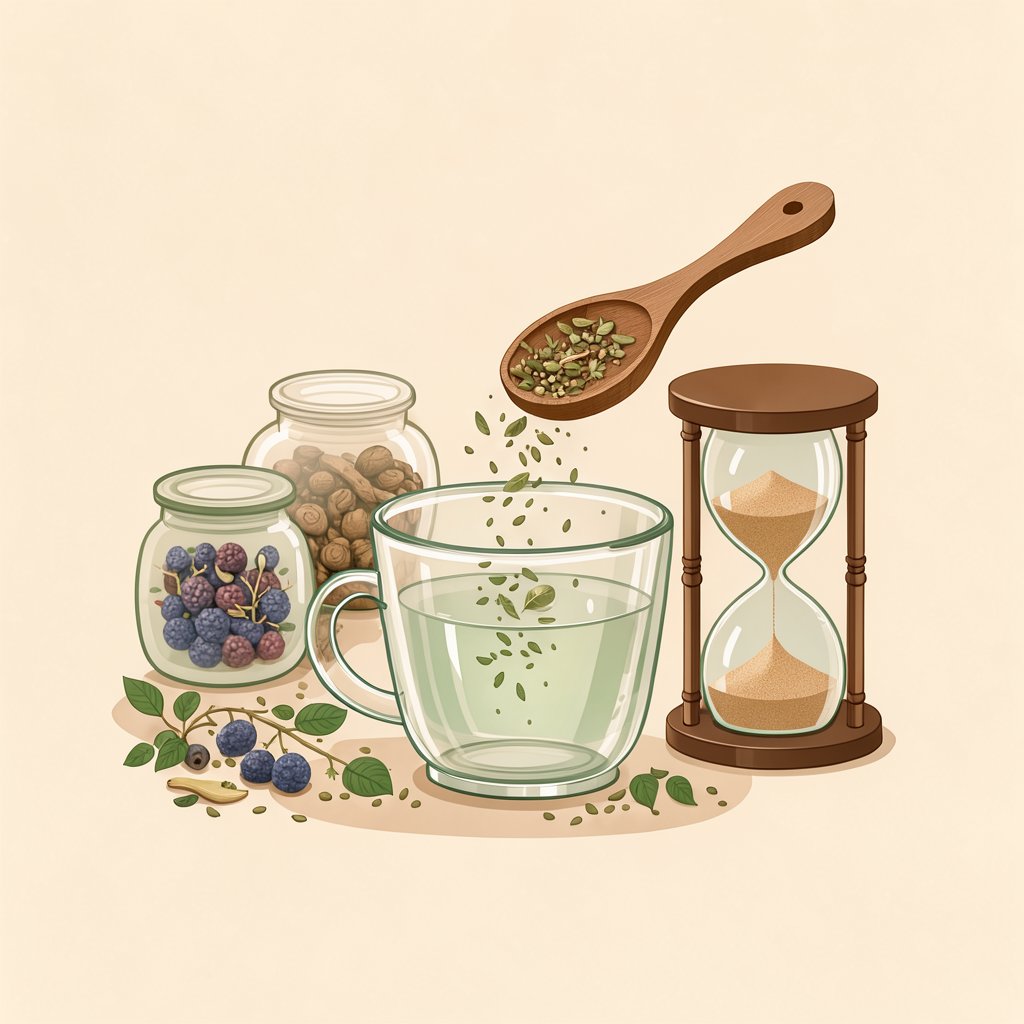
Ayurveda’s answer to “how much” is disarmingly small: steep half a teaspoon of the herbal mixture in a cup of hot water for 5-10 minutes[8]. Where the Slavic compendia weigh grams, the Ayurvedic home-remedy manual measures spoons and clocks, and the result is a lighter bedtime tea by design. The method runs in three moves, and each one comes from the book itself.
Step 1: Mix the herbs. The formulas the manual actually prints are blood-pressure formulas, and we present them as exactly that — never as sleep prescriptions. The first blends punarnava one part, passion flower one part, and hawthorn berry two parts; a second runs jatamamsi two parts, musta two parts, and tagar one part[8]. Weigh the parts once, mix them dry, and store the blend — the half-teaspoon measure below is taken from the mixture, not from each herb separately.
Step 2: Steep the half-teaspoon. Place 1/2 teaspoon of the mixture in a cup, pour hot water over it, and give it 5-10 minutes — the window printed beside every formula in the book[8]. The short steep is the tradition’s own dose control: half a teaspoon of dry blend yields a light cup, and the timer keeps it there. Longer is not more traditional; the text says five to ten minutes.
Step 3: Place the cup in the day. The hypertension tea is drunk after lunch and after dinner[8] — an evening cup inside a daily rhythm, never a standalone nightcap. That rhythm is explicit in the same tradition: supper around 6 p.m., bed by about 10-11 p.m., and no coffee or black tea as daily fuel, because they “drain kidney energy, overstimulate the adrenals, promote constipation,” and are habit-forming[8]. Insomnia itself is framed as a vata/pitta imbalance, and the text offers its own model of the restless mind: “if there is insomnia from excess rajas, some tamasic food in moderation will help the person get grounded”[8].
Note what the Ayurvedic manual never does: dose passionflower for sleep. The herb appears only inside those blood-pressure blends — including the pregnancy-edema formula of hawthorn berry, passion flower, and arjuna in equal parts, one teaspoon per tea twice a day after meals[8]. Hold that thought for the honesty section below.
Russian Folk Blends: Gram Weights, Spoons, and the Overnight Thermos
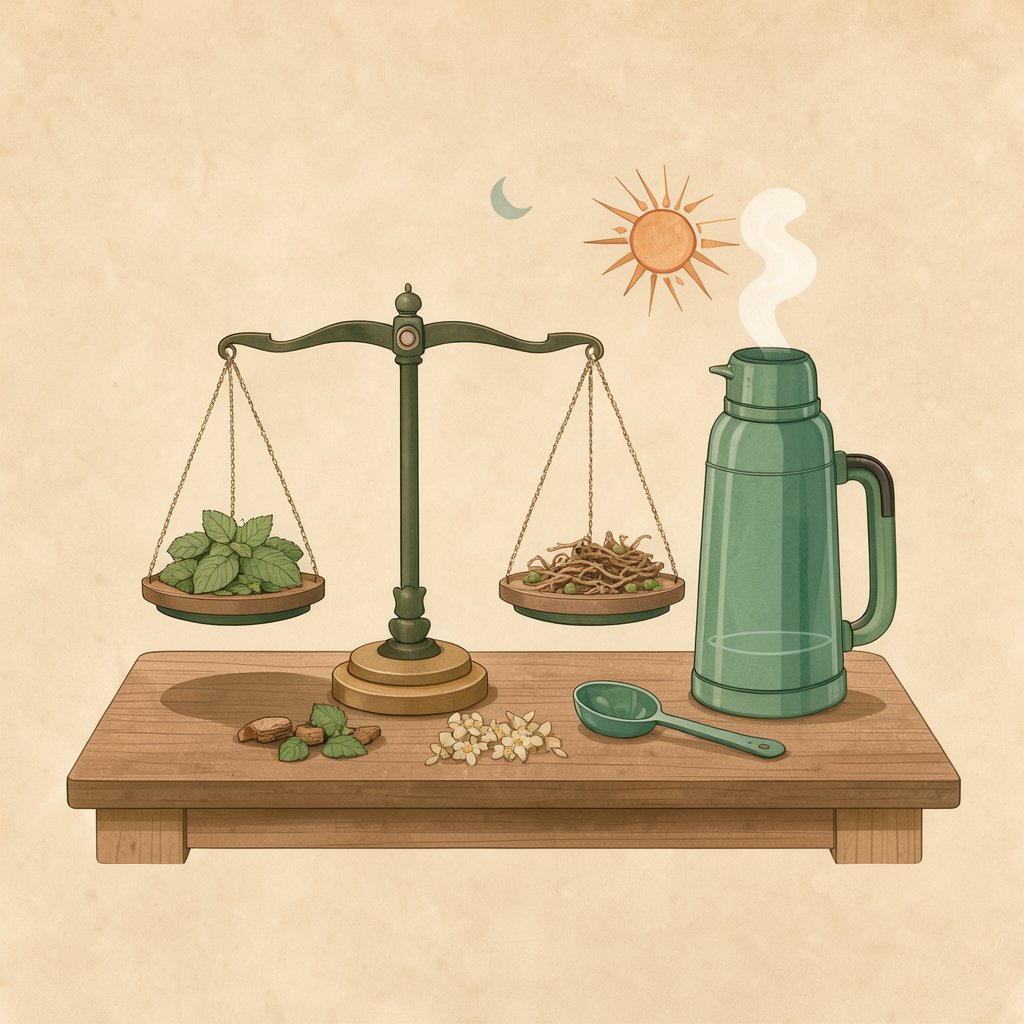
The Slavic compendia did not write “a pinch” — they wrote grams, spoons, and minutes. A calming tea for neuroses from a folk self-treatment encyclopedia mixes mint leaves 20 g, valerian root 25 g, and hawthorn flowers 50 g with oregano and sweet clover; the brew is 2 tablespoons of the mix per 0.5 L (about two US cups, our approximation) of boiling water, drunk in glasses through the day before food[9]. This is the tradition’s valerian root tea — a measured blend rather than a single-herb mug, and its hawthorn share outweighs the valerian two to one.
The same book’s lemon-balm cup is lighter: melissa leaves 20 g plus strawberry leaves 40 g, one tablespoon per glass, steeped 15-20 minutes[9]. A men’s-health manual goes the other direction, toward patient strength: an equal-parts blend that includes chamomile, one teaspoon of each herb per 400-500 mL (roughly 1 3/4 to 2 US cups) of boiling water, brewed like tea, steeped 30-40 minutes, strained, then taken at 50-100 g (about 2 to 3.5 US fluid ounces, our approximation) two to three times a day, 10-15 minutes before eating — in a course of at least two weeks, better a month[10]. A folk course is weeks, not one night, and the compendia are blunt about it.
And then there is the one line that feels written for this article — the bedtime glass. For regular use, the same manual allows no more than 1 g of dry herb in a glass of warm water, and notes it is better taken before bed; warming drinks, it adds, are best cooked in a thermos overnight[10]. That is the only herbal tea before bed protocol in the library with an explicit evening instruction: a single gram, warm water, and the thermos doing the steeping while you do the sleeping. It is also, quietly, the smallest bedtime tea dose anywhere in this guide.
Passionflower, Lavender, and Hops: What the Texts Do Not Say
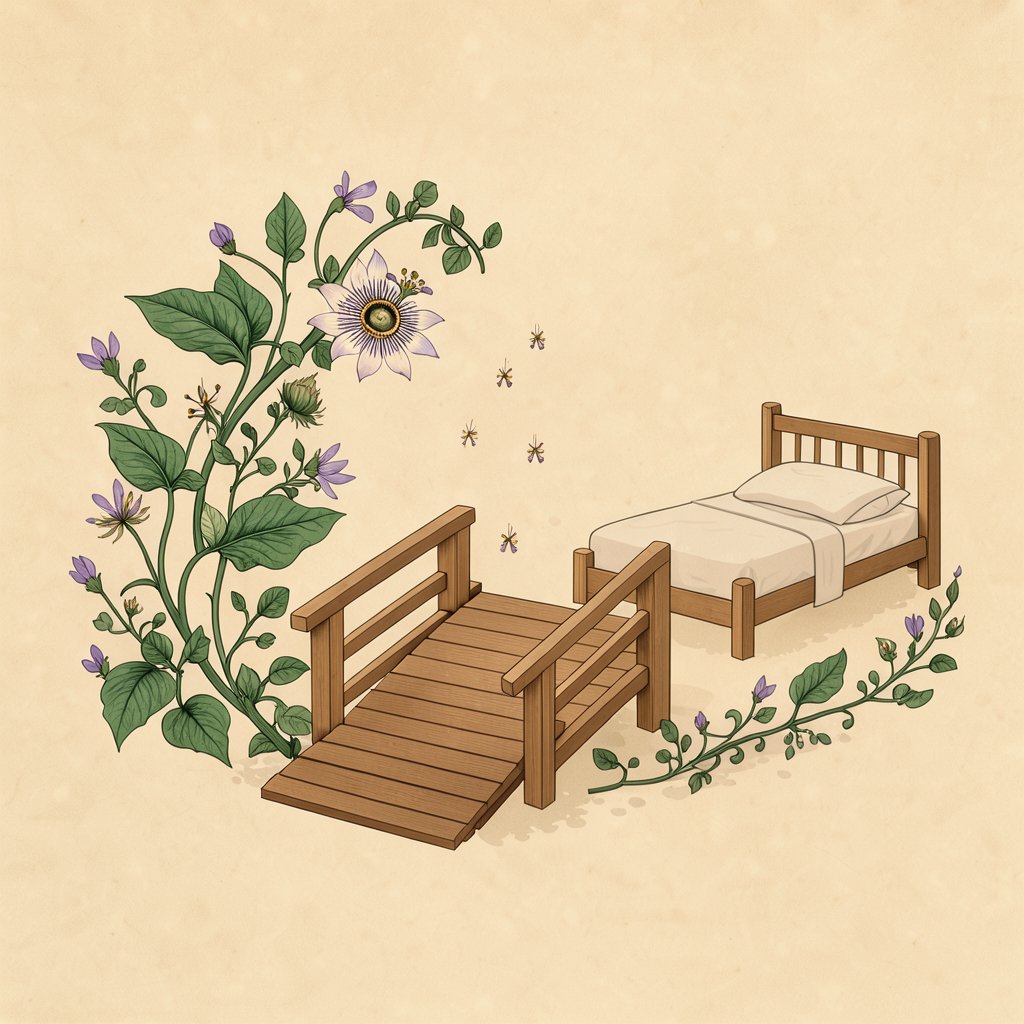
The title of this guide names passiflora, so here is exactly what the traditions do — and do not — say about it. In the scanned sleep corpus, passionflower returns zero hits; across the whole 1,137-book library it appears in three books, none of which doses it for insomnia. What the pharmacopoeia actually holds is a caution: its pregnancy table flags “passionflower — harman, harmaline uterine stimulants, in vivo,” and its chemistry chapter notes harman as the indole alkaloid of the plant — while the passionflower monograph body itself is missing from our extraction[1]. A caution and a molecule, then, and no sleep protocol underneath them.
The neighboring sources agree by silence. The Ayurvedic manual uses the herb only inside blood-pressure formulas, covered above[8]. The Holy-Land herbal lists a Passiflora incarnata chapter at page 105 of its table of contents — the same contents page places valerian at 27, lemon balm at 30, and mint at 151 — but the chapter body did not survive our extraction, so its text is unrecoverable here[5]. The same honesty applies to passionflower’s famous listicle neighbors: lavender appears in the sleep corpus only as aromatherapy, two to three drops of oil on a napkin, never as a lavender tea protocol[11]; and hops survive only as a table-of-contents line at page 354, with the monograph body missing from the extraction[1].
That sets the editorial rule for the whole article: no source in this library offers passionflower — or lavender, or hops — as a bedtime tea with a dose attached, so this article does not either. That is the difference between a guide and a listicle. A listicle needs every herb to have a bedtime number; a guide needs every number to have a book behind it. When a precise-looking passiflora sleep dose appears in your feed, the only question worth asking it is: which page, in which text?
Safety: Ragweed Allergy, Pregnancy, and the 4 P.M. Caffeine Cutoff
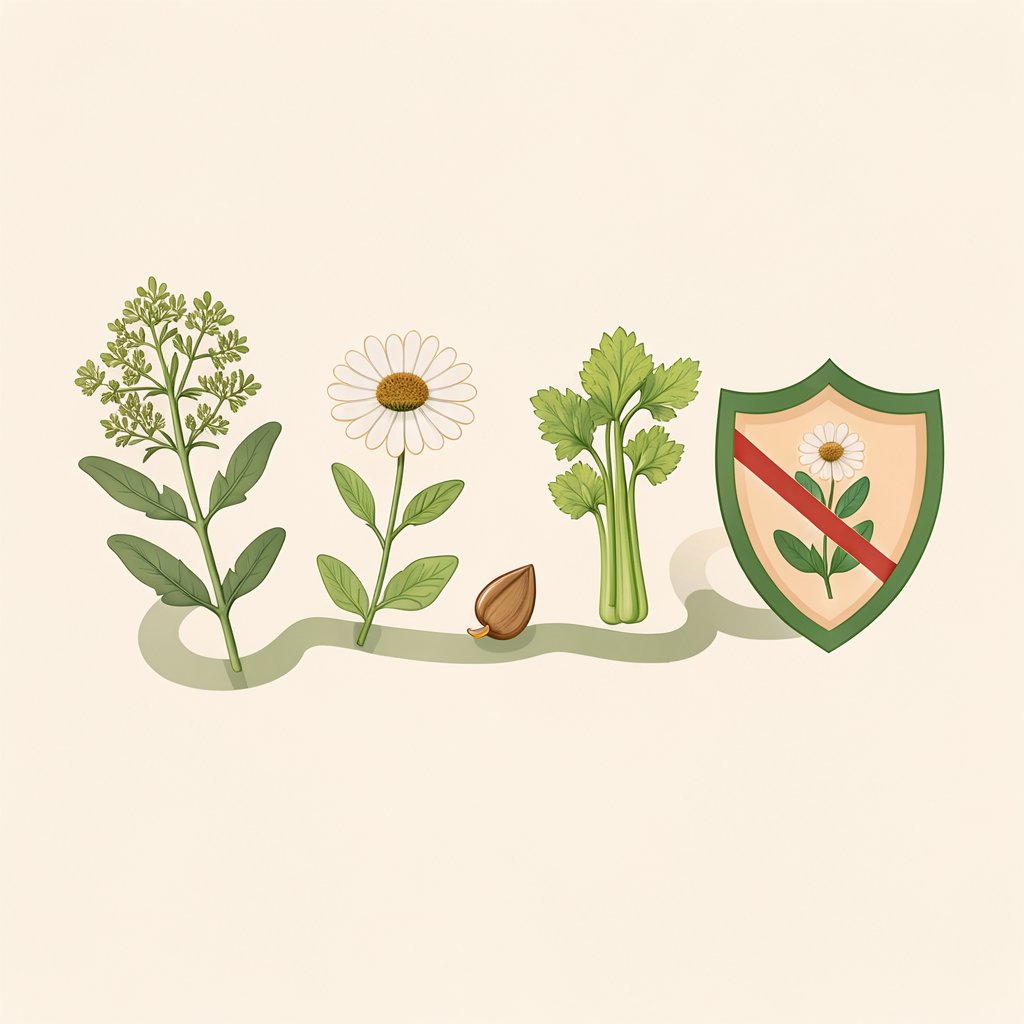
Every herb in this guide has a flip side, and the pharmacopoeia prints it in the same paragraph as the benefits. Allergic reactions to chamomile are rated “common”; cross-sensitivity runs through the Asteraceae/Compositae family — the ragweed family — and through celery; and documented anaphylactic reactions exist, both in patients with ragweed hypersensitivity, with symptoms up to angioedema, urticaria, and upper airway obstruction. The reference adds that chamomile tea may exacerbate existing allergic conditions[1]. The allergy handbook widens the same net with a household example: plants of one family cross-react, so a sunflower-seed allergy is a reason to look twice at a chamomile cup[12].
Pregnancy and childhood carry their own lines. Chamomile extracts are uterotonic and reputed to affect the menstrual cycle, which is why the pharmacopoeia counsels caution in pregnancy; the tea is not recommended for teething babies; and animal teratogenicity studies put the oral toxic dose of alpha-bisabolol at 1-3 mL per kilogram of body weight[1]. Passionflower’s uterine-stimulant flag was quoted in the honesty section above. If you are pregnant, nursing, allergy-prone, or managing a condition, read this as tradition reporting — and take the questions to your provider before the cup.
The caffeine side of the ledger is the mirror image of the bedtime tea shelf, and the insomnia handbook is numerical about it: no caffeine drinks after 4 p.m., because a cola carries 46 mg of caffeine, a Pepsi 35 mg, and 50 g of milk chocolate 9 mg; alcohol fragments sleep, nicotine worsens it, and physical exercise should finish at least six hours before bed[13]. The modern sleep handbook agrees from its own angle, listing caffeine, alcohol, refined sugar, and processed carbohydrates among the main causes of sleep disorders[14]. Against all that, the insomnia handbook’s non-herbal comparator is almost modest: tryptophan in dairy improves sleep, and “a glass of warm milk at night can help”[13]. The oldest bedtime drink in these texts, it turns out, is not a tea at all — which only underlines how much respect the herbal ones deserve.
Frequently Asked Questions
Is chamomile tea safe if I am allergic to ragweed?
No — treat the cup as a cross-reactive risk, not a neutral swap. The pharmacopoeia rates chamomile allergy as common, lists cross-sensitivity with the Asteraceae family (ragweed’s home) and celery, and documents anaphylactic reactions in ragweed-hypersensitive patients, with angioedema and upper airway obstruction among the symptoms[1]. If ragweed season hits you hard, ask an allergist before the first sip. The full chain sits in the safety section.
How much chamomile tea is a normal adult dose?
The pharmacopoeia prints 2-8 g of dried German chamomile flowerheads as an infusion, three times daily (or 1-4 mL of liquid extract 1:1 in 45% alcohol, three times daily); Roman chamomile runs 1-4 g of flowerheads as an infusion three times daily[1]. The day’s dose is spread across three cups, so a bedtime tea is the evening third — never a megadose. The steps are in the dosage section.
Can passionflower tea help me sleep?
No source in our library doses passionflower for insomnia — zero mentions in the sleep corpus, and only three books name the herb at all. The pharmacopoeia keeps it in the pregnancy-caution table (harman and harmaline, uterine stimulants, in vivo), and Ayurveda uses it inside blood-pressure formulas[1][8]. We print no passiflora sleep protocol because none exists to print; see the honesty section.
Are bedtime teas safe during pregnancy?
Careful wording is the honest answer: ask a provider first. Chamomile extracts are uterotonic and reputed to affect the menstrual cycle, and passionflower carries the uterine-stimulant flag in the pharmacopoeia’s pregnancy table[1]. The traditions documented here were never tested against a pregnancy. Both cautions are quoted in the safety section.
When should I stop drinking caffeine before bed?
The insomnia handbook draws the line at 4 p.m., and gives the numbers that justify it: a cola holds 46 mg of caffeine, a Pepsi 35 mg, and a 50-gram bar of milk chocolate 9 mg[13]. Alcohol fragments sleep, nicotine worsens it, and exercise should end six hours before bed. The full list is in the safety section.
What can I drink instead of herbal tea before bed?
The documented non-herbal comparator is warm milk: tryptophan in dairy improves sleep, and the handbook’s own line is that “a glass of warm milk at night can help”[13]. It is the one bedtime drink in this literature with no allergy family, no uterine-stimulant flag, and no steep time to respect. The context is in the safety section.
A bedtime tea earns its place in a wind-down exactly the way the texts use it: gently, regularly, and with the safety lines respected. Brew the chamomile the pharmacopoeia doses, steep the Ayurvedic half-teaspoon for its five to ten minutes, pour the folk single gram into the thermos at dusk — and let passionflower remain what the sources make it, an herb the traditions respected but never dosed for sleep[1][8][10]. That is what the herbal traditions actually say about the cup before bed, and on this shelf it is enough.
Sources
- [1] Joanne Barnes, Linda Anderson — Herbal Medicines: A Guide for Healthcare Professionals (3rd ed., 2007) — the German and Roman chamomile monographs: the apigenin-flunitrazepam receptor finding, the 2-8 g and 1-4 g infusion dosages, the constituents list, the allergy and pregnancy safety data, and the passionflower pregnancy-caution table.
- [2] E. Kosonovskaya — Fruits of the Holy Land Heal (2015); cited for educational purposes only — the Maimonides (Rambam) tradition sweep used to date the written paper trail of Holy-Land plant remedies in the opening section.
- [3] G.I. Malakhova — Alive and Dead Water: Unique Healing from Diseases (2011) — the folk chamomile-and-honey cup (1 tablespoon of each per 250 mL) and the valerian bath protocol quoted as bathing context.
- [4] N.I. Danikov — Flu and Cold Knocked Out! (2005) — the root decoction protocol (30 minutes low fire, 10 minutes insisting, warm slow sips) and the hot-every-two-hours fever tea given as context only.
- [5] E. Kosonovskaya — Herbs of Israel Heal (2015); quoted for educational purposes only — the Dioscorides-and-Pliny line on valerian, the root chemistry (ester oil, alkaloids, saponins), and the Passiflora incarnata table-of-contents entry at page 105 whose chapter body is truncated.
- [6] V. Kapranov, R. Khashim — The Wisdom of the Ages (1992) — the Avicenna-style valerian entry: the kidney harm, the honey correction, and the one-bowl-boiled-to-two decoction ratio.
- [7] G.G. Vostrikov, L.A. Vostrikov — Medicine of the Dersu Peoples (1974) — valerian among the plants introduced from traditional medicine into scientific medicine.
- [8] Vasant Lad — The Complete Book of Ayurvedic Home Remedies (2012) — the half-teaspoon, 5-10 minute steeping method; the punarnava-passion flower-hawthorn, jatamamsi-musta-tagar, and hawthorn-passion flower-arjuna formulas; the coffee and black-tea caution; and the rajas-tamas insomnia model.
- [9] A. Kalinina — A Brief Encyclopedia of Folk Self-Treatment Methods (2007) — the neurosis calming blend (mint 20 g, valerian 25 g, hawthorn 50 g; 2 tablespoons per 0.5 L) and the melissa-strawberry leaf tea with its 15-20 minute steep.
- [10] B. Gurevich — Men’s Health (2008) — the equal-parts blend protocol (1 teaspoon of each herb per 400-500 mL, steeped 30-40 minutes, course of two weeks to a month) and the bedtime glass: no more than 1 g of dry herb in warm water before bed, thermos overnight.
- [11] Emerik Persilye — Health Is in Your Hands (2025) — the lavender evidence in the sleep corpus: two to three drops of oil on a napkin, an aromatherapy use rather than a tea.
- [12] Yuri Konstantinov — Allergy: Folk Treatment Methods (2014) — the same-family cross-reaction principle and the sunflower-seed-to-chamomile-tea example.
- [13] L. Berezhkova — How to Get Rid of Insomnia — the 4 p.m. caffeine cutoff with milligram numbers (cola 46 mg, Pepsi 35 mg, milk chocolate 9 mg per 50 g), the alcohol, nicotine, and exercise timing rules, and the warm-milk tryptophan comparator.
- [14] Allen Carr, John Dicey — The Easy Way to Better Sleep (2024) — caffeine, alcohol, refined sugar, and processed carbohydrates listed among the main causes of sleep disorders.
Where to go next: this guide lives in our deep-sleep and circadian-health hub. To build the hour around the cup, start with the evening wind-down ritual guide; for another traditional evening drink, see the reishi evening tea ritual; for the light side of the same hour, read circadian light habits; and before spending money on any program, check our best sleep programs of 2026 guide.
How we researched this: built from a local library of 1,137 wellness books, queried through an offline retrieval system with no internet sources. Every factual claim above was checked against the cited book passage before publication, and the herb-mention counts come from our own scan of the library’s sleep corpus. Where the base held no source — a sleep dose for passionflower, a lavender tea protocol, a hops monograph — we named the gap instead of filling it.
