
Educational content only — not medical advice. See our full Medical Disclaimer and Affiliate Disclosure below.
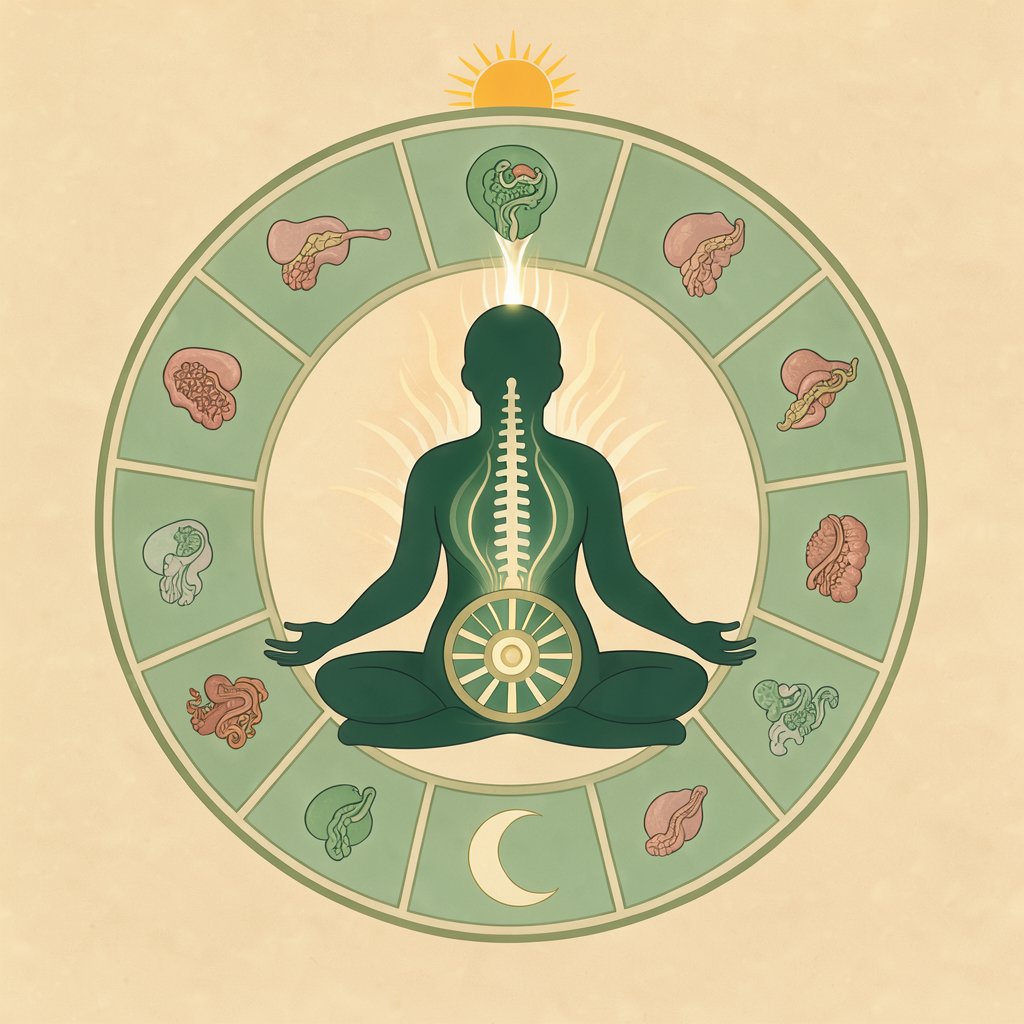
You crash at 2 PM, wake at 4 AM without an alarm, and notice your sharpest hours arrive mid-morning whether you plan for them or not. Traditional Chinese medicine noticed these patterns too and drew a map of the whole day: the Chinese organ body clock, a 24-hour body clock that assigns every two-hour span to a different organ function at its peak.[1][2] The organ clock TCM practitioners still use today divides the day into twelve such windows — and describes qi, the body’s vital energy, as completing one full lap through the organ systems every 24 hours, resting two hours at each station along the way.[2]
This guide walks through the complete clock: the twelve two-hour windows and their traditional functions, the body’s strongest and weakest hours, the four classic practice windows (one of them a lineage secret until about a decade ago), a five-step timing protocol, and the honest limits the tradition sets for itself. Everything here is presented as traditional knowledge for self-observation — not as medical advice and not as a diagnostic tool. If the movement side of this tradition is new to you, our Baduanjin — Eight Pieces of Brocade manual is a gentle first practice to hang the clock onto.
Key Takeaways
- TCM divides the day into twelve two-hour “double hours”; qi is described as completing one full 24-hour circuit through the organ systems, with a different function peaking in each window.[1][2]
- Every window has a maximum-activity phase and a minimum phase exactly twelve hours opposite — the whole day is built as mirrored pairs.[5]
- Four daily periods are classically favored for practice — 23:00–01:00, 05:00–07:00, 11:00–13:00 and 17:00–19:00 — with midnight, the Zi hour, called the best of all.[6]
- The tradition’s own teachers call these timing rules non-strict, and certain situations — pregnancy, chronic psychiatric conditions, severe heart disorders — call for extra care with energy work.[1][11]
What Is the Chinese Organ Body Clock?
The Chinese organ body clock is a traditional Chinese medicine map that assigns each two-hour span of the day to one organ system at maximum activity, with the same function at its minimum exactly twelve hours later.[1][5] The Chinese day was traditionally divided into twelve hours of 120 minutes each, and the daily cycle of qi through the organ systems is said to shift every two hours, following those clocks.[1] In effect, the organ clock is a schedule of twelve shifts, with each organ function taking its turn at the front of the line.
The idea is old. The Huangdi Neijing — the Yellow Emperor’s Inner Classic, dated in our sources to approximately the 3rd century BCE — already described the location of the meridians and the effects of acting on acupuncture points, and compared the meridians to the great rivers of China.[3] That river image matters: in this tradition the organ systems are connected by channels along which qi flows, and the clock simply tracks which stretch of the river is running fullest at any hour.
What the clock is not matters just as much. It is not a diagnostic device, and it makes no promises about curing anything — it is a self-observation map that practitioners have used for generations to time practice, meals, and rest.[5][6] Read it the way you would read a tide table: a description of traditional rhythms you can check against your own day, not a verdict on your health.
How Does the 24-Hour Qi Cycle Work?
The clock has an engine. In the Daoist view, the 24-hour qi cycle is driven by the Lower Dan Tien — the energy center below the navel — which in the majority of people turns only once each day, sending qi on its single daily lap around the organ systems.[2] Advanced Nei Gong training includes a practice called the “small water wheel of Qi,” described as speeding this wheel so that the circuit completes faster and the organs receive more qi over the same day.[2]
Each channel also has its own flow strength, and that strength varies through the day in a regular cycle: at any particular time one channel is strongest — for example, between 11:00 and 13:00 the qi flow in the heart channel is at its peak.[4] The sources are equally clear that this rhythm is not mechanical. Qi strength in the channels is modified by the mind, the weather, the time of day, the food eaten, and mood — anger is said to make liver-channel qi abnormal, and sudden shock to leave bladder qi deficient.[4]
Two images hold the architecture together. The twelve primary channels are compared to rivers, while the eight extraordinary vessels are lakes or reservoirs that regulate those rivers — a Ming-dynasty formulation recorded by the physician Li Shi-Zhen in his Qijing Ba Mai Kao.[4] And the twelve organ channels group into the five phases (Wu Xing), which is why the clock’s windows come in complementary families:[2]
- Fire: Heart, Small Intestine, Pericardium, Triple Heater
- Earth: Spleen, Stomach
- Metal: Lung, Large Intestine
- Water: Kidneys, Bladder
- Wood: Liver, Gallbladder
Keep the river picture in mind as the table below unfolds. Each two-hour window is a stretch of the river running at flood, while the stretch twelve hours across runs at its lowest ebb.[5] The max phase is traditionally read as the window when a system’s work is easiest to support — the same logic behind the book’s rule that substances taken in an organ’s max window are said to act most strongly — while the min phase marks the hours when that function runs lowest.[5]
The Complete 12-Window Organ Clock, Hour by Hour
Here is the whole day on one map. The table below is drawn from a complete twelve-window daily organ-activity chart in the sources, with each window’s traditional function and its quiet mirror twelve hours opposite.[5] One honesty note before you read: in the retrieved source text only two rows carry explicit organ names — the spleen-and-pancreas window (09:00–11:00) and the gallbladder window (23:00–01:00) — and the midday heart window is corroborated by a second author.[4] The remaining rows are presented by their function, exactly as the source gives them, rather than dressed up with organ labels the text does not provide.
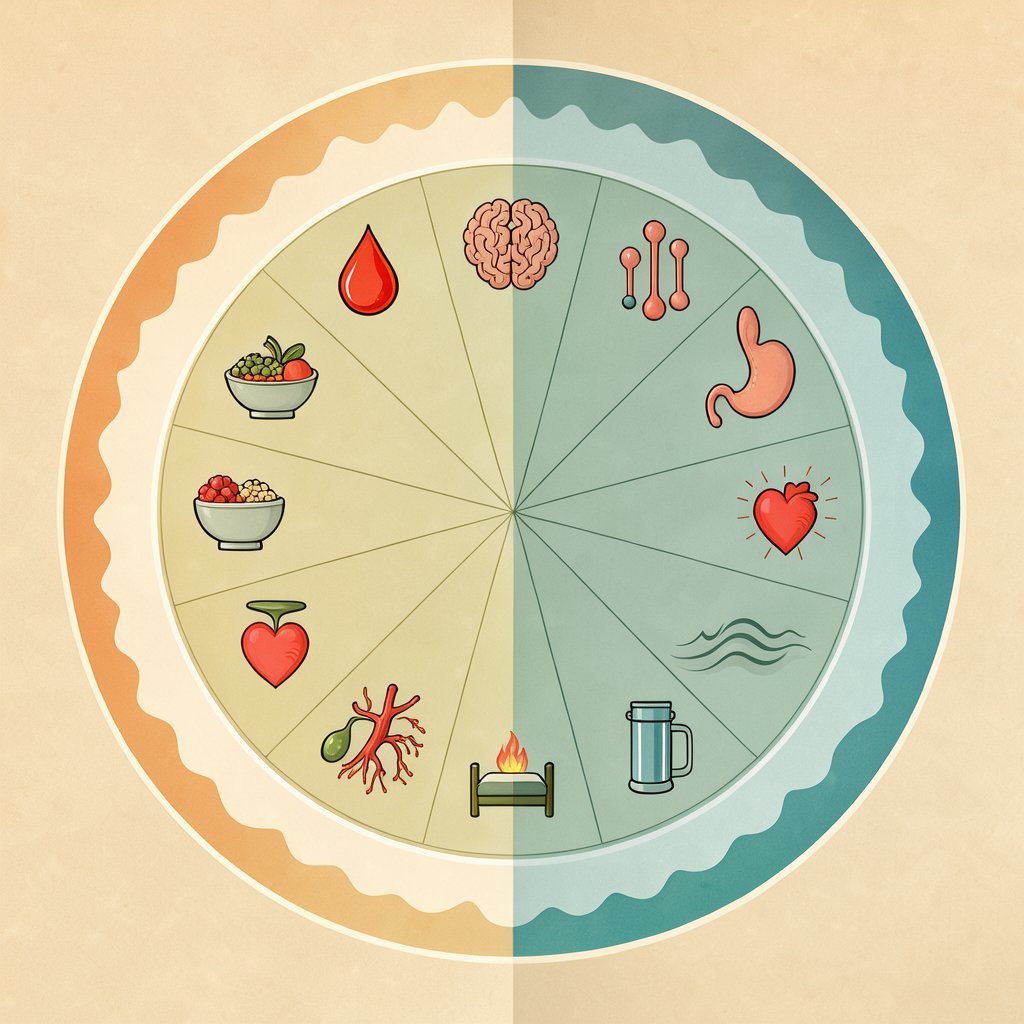
Night: 23:00–05:00
23:00–01:00 (maximum, Yang). The one window the source names explicitly for an organ: the gallbladder, described as “the system of anger, decisiveness and aggression,” with sleep as the recommended activity and possible sexual desire noted.[5] 01:00–03:00 (maximum, Yin). The peak hours of blood and bile regulation, and the window when the emotion of anger is said to be provoked; the source’s instruction is plain — this is a time of sleep and rest, because “all emotions are extinguished by sleep.”[5] Both windows run at their minimum twelve hours later, in the early afternoon.
03:00–05:00 (maximum, Yin). The source describes maximal oxygen uptake, a “recharge of the brain,” and the first wave of self-regulation, with oxygen distributed and excess gas removed — classically while you sleep with a window open, as the book recommends.[5] Its mirror minimum falls at 15:00–17:00. Practically, the night band is why the tradition reads the small hours as work done on you, not by you: the deepest windows belong to sleep.
Morning: 05:00–11:00
05:00–07:00 (maximum, Yang). Endocrine and hormonal regulation switches on, the body prepares for the coming day, water absorption heightens, and the bowels prepare for their morning work.[5] 07:00–09:00 (maximum, Yang). The designated time for food intake and its partial digestion, with defecation expected and the body described as beginning to fight illness and malaise.[5] The morning band’s minimums land in the evening, from 17:00 to 21:00, when the day’s incoming work is done.
09:00–11:00 (maximum, Yin). The second window named for its organs — spleen and pancreas — when the body’s “most important regulators” switch on, food received from the stomach is transformed into a nutritive mixture, and blood regulation and the fight against disease are described as most active.[5] Its minimum sits at 21:00–23:00. Traditional practice treats this as the true breakfast-digestion hour: eat early enough that the spleen window finds work waiting.
Midday: 11:00–17:00
11:00–13:00 (maximum, Yin). The source calls this the period of the greatest emotional and physical loads, with maximal mental focus and the most efficient work of the blood vessels.[5] A second author corroborates the window from the channel side: between 11:00 and 13:00 the qi flow in the heart channel is at its strongest.[4] 13:00–15:00 (maximum, Yang). The load period continues but on the wane — the source calls it the “time of harmonization of the heart,” traditionally a reason to ease off rather than push through the post-lunch dip.[5] The two midday minimums mirror into the small hours, at 23:00–03:00.
15:00–17:00 (maximum, Yang). The second wave of self-regulation, with maximal accumulation of body fluids; the source marks it as a time for rest and contact with friends, and explicitly advises guarding against unpleasantness and stress in this window.[5] Its minimum lies at 03:00–05:00, deep in the night band. Note the contrast with the modern habit of scheduling conflict at 3 PM: read strictly, the table would move hard conversations into the strong morning hours instead — that is a reading of the chart, not a rule.
Evening: 17:00–23:00
17:00–19:00 (maximum, Yin). Deep self-regulation, with a heightened ability to distribute and filter fluids and to accumulate key micro-substances; the tone turns inward, toward friends and rest.[5] 19:00–21:00 (maximum, Yin). The peak of autonomic-vascular nervous regulation and circulation, and the last window of the day when maximal psycho-physical loads are described as permissible again.[5] Their minimums mirror into the morning band, at 05:00–09:00.
21:00–23:00 (maximum, Yang). The “three burners” are active — the source lists lungs, liver, and kidneys as their domain — and the body begins preparing for night rest as energy concentrates.[5] Its minimum sits at 09:00–11:00, right when the spleen takes its turn. With that, the lap closes: the gallbladder window reopens at 23:00, and the circuit starts its next turn around the day.
Your Strongest and Weakest Hours of the Day
Overlay all twelve windows and a second rhythm appears — the whole body has its own daily tide. The source marks two low ebbs, when the body is weakest: 02:00–05:00 and 12:00–14:00; and two high tides, when it is strongest: 08:00–12:00 and 14:00–17:00.[5] The traditional reading is simple scheduling arithmetic: place demanding work inside the strong windows and protect the weak ones with rest, food, or sleep rather than deadlines.[5]

The same book adds a usage rule that deserves careful framing: taking medications or supplements during an organ’s maximum-activity window is said to “achieve maximal effect.”[5] That is the source’s traditional protocol, recorded in a 2014 book — it is not medical advice, and modern medication timing is a question for your physician or pharmacist, not for a two-hour window. Treat the rule as an example of how literally the tradition reads the clock, and check actual dosing schedules with a professional.
There is also a lunar layer in the same source. A waxing moon is described as the time to nourish and build — when introducing health-giving substances is said to be more successful — while a waning moon favors cleansing and unloading, when organ-cleansing measures are said to succeed more easily.[5] Whether or not you keep a lunar calendar, the underlying idea is the same as the daily clock’s: in this tradition, when you do something is half of what you do.
The Four Best Practice Windows and the Secret Zi Hour
Ask the sources when to practice and they converge on four addresses on the dial. Four daily periods are called favorable for practice — 11:00–13:00, 23:00–01:00, 05:00–07:00 and 17:00–19:00 — with 23:00–01:00 named the best of all.[6] A second author agrees on the shape: morning practice is best at 05:00–07:00 (with 11:00–13:00 also fitting), evening practice is usually recommended at 23:00–01:00 with 17:00–19:00 acceptable — and practicing at 13:00–15:00 is expressly not recommended.[7] The same author is refreshingly honest about where the rules come from: they derive from the Chinese calendar and astrology, and if they do not help you, “ignore them.”[7]
The four windows are not arbitrary. In the inner-alchemy tradition the day turns on four pivot hours named after the earthly branches: Zi (23:00–01:00), Wu (11:00–13:00), Mao (05:00–07:00) and You (17:00–19:00).[1] Morning practice at Mao is called “Mao-time practice” and cultivates Yang, while evening practice at You cultivates Yin; the whole day is split along the Zi–Wu axis, and Zi itself is the first of the twelve earthly branches — the start of ancient Chinese time reckoning.[1]
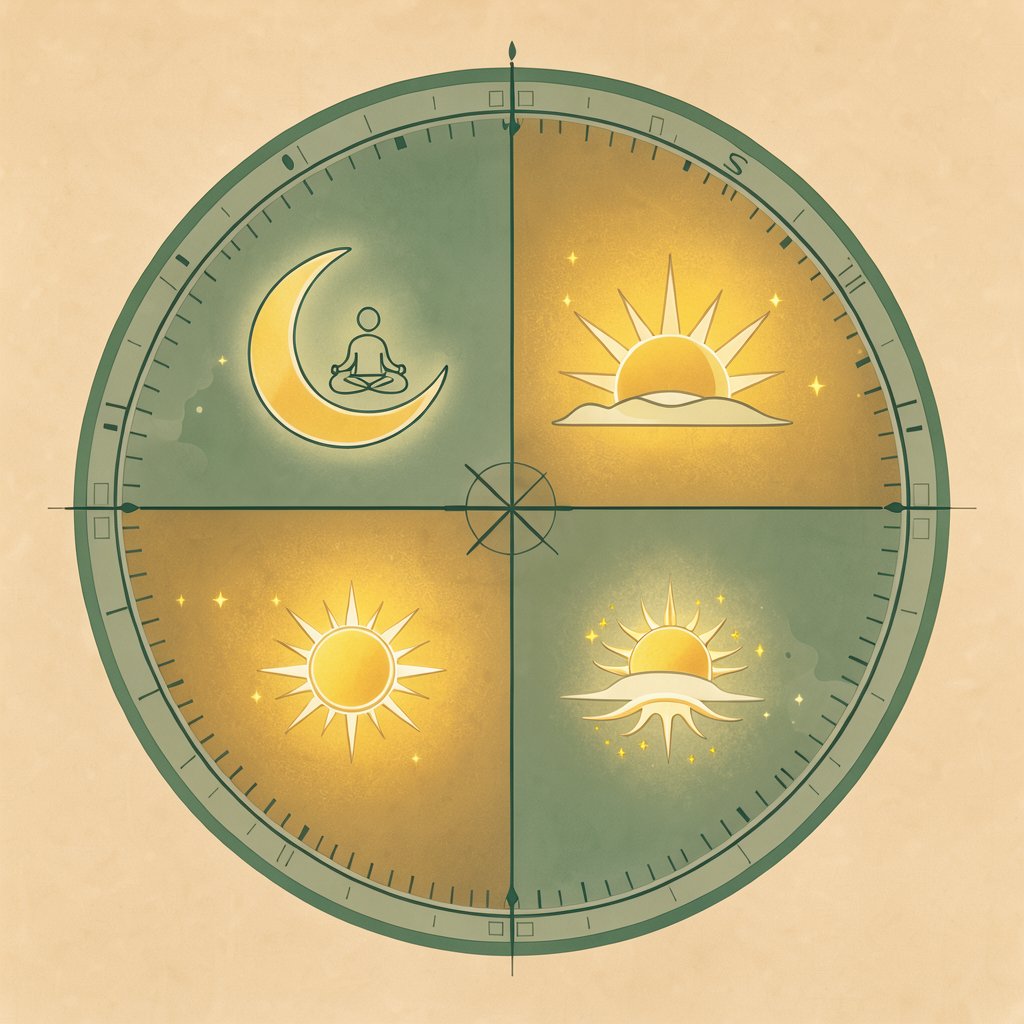
The classic best window carries a story. The “Zi Hour Practice” — the midnight session inside 23:00–01:00 — was kept secret in the Wang Lipin (Dragon Gate) lineage and only permitted to be taught after the death of one of the teachers, around 2015.[1] Secrecy of that kind is a reminder that these windows were once treated as powerful technology, not scheduling trivia.
For balance, there is a named exercise that straddles the morning and evening windows: the “Heavenly Mao–You Circulation,” done twice daily at Mao and You — 36 circles of attention in one direction, then 24 in the reverse, with absolute mental calm and regulated breathing — described as balancing Yin and Yang across the day.[8] A caution from the same source: that author’s organ attributions for Mao and You differ from the standard meridian clock, a useful reminder that lineage tables vary and none of them is uniform across all schools.
And the modern default is the gentlest of all. Classically the best hours are early morning before sunrise and evening before sunset, but a contemporary teacher may train at any time — pick the hour when your mood is calmest, for about 15 minutes a day.[9] That advice and the four-window table are not in conflict; one is the tradition’s ideal, the other its permission slip.
How to Time Your Practice: Meals, Doses, and Sleep
The full protocol fits on a sticky note: one window, two meal buffers, fifteen minutes. The five steps below compile the practice-timing instructions from the sources into one workflow, and every step is traditional guidance rather than medical instruction.[6][7] If you already have a standing or moving practice, the timing simply layers on top of it.
Step 1: Choose your window
Start from the four favorable periods — 23:00–01:00, 05:00–07:00, 11:00–13:00 and 17:00–19:00 — and pick the one your life can actually hold.[6] Within a day, the sources place practice best before sleep or right after waking, with the before-sleep session called slightly preferable.[6] If midnight practice is unrealistic for your household, the Mao-hour morning window is the traditional equal.
Step 2: Respect the meal buffers
Do not practice within 15 minutes before a meal or one hour after it.[6] The buffers are courtesy in the tradition’s own terms: the morning food-intake window (07:00–09:00) and the spleen window (09:00–11:00) have first claim on the body’s attention while digestion runs.[5][6] Schedule your session outside those buffers and the conflict never arises.
Step 3: Dose the session honestly
The optimal session is about 15 minutes; the minimum for busy days is 3–5 minutes; once a day suffices, and morning plus evening sessions complement each other.[6] A second source gives the same 15-minute daily dose as its baseline recommendation.[9] Short and regular beats long and rare in every practice instruction the sources contain.
Step 4: Adjust for illness
When you are ill, drop anything that tires you or raises your temperature — and keep breathing exercises, which the source calls always permissible.[7] This is the tradition’s own moderation rule, and it applies doubly inside the weak body hours (02:00–05:00 and 12:00–14:00).[5] Recovery, not performance, is the goal of a sick-day session.
Step 5: Keep the rules flexible
Try the timing rules for a few weeks and watch what actually changes in your day.[7] The source’s own instruction is to test them and, “if they don’t help, ignore them” — the clock serves your practice, never the reverse.[7] A rule you resent is a practice you quit; flexibility is part of the protocol, not a failure of it.
Why Do You Wake Up at the Same Hour Every Night?
This is the organ clock’s most talked-about application — and its most misread. What the sources actually say is narrower than the internet’s version: 01:00–03:00 is the window of peak blood and bile regulation, the time when the emotion of anger is said to be provoked, and the hours when “all emotions are extinguished by sleep.”[5] The popular claim that waking between 1 and 3 AM “means a liver imbalance” appears nowhere in the retrieved sources — it is a later interpretation built on that anger-and-bile window, and it should be carried as a practitioner’s heuristic, not as a fact.
The diagnostic principle behind the heuristic is broader than one window. In the Eastern diagnosis tradition, a symptom that regularly appears at the same hour, day, or season points toward organs of the same energy category — the source’s example is a problem that shows up in very humid weather, especially in the afternoon of a cloudy day, implicating the spleen and stomach.[10] By that logic, a repeatedly disturbed hour is not a diagnosis; it is a pointer that tells you where to aim your self-observation for a few weeks.
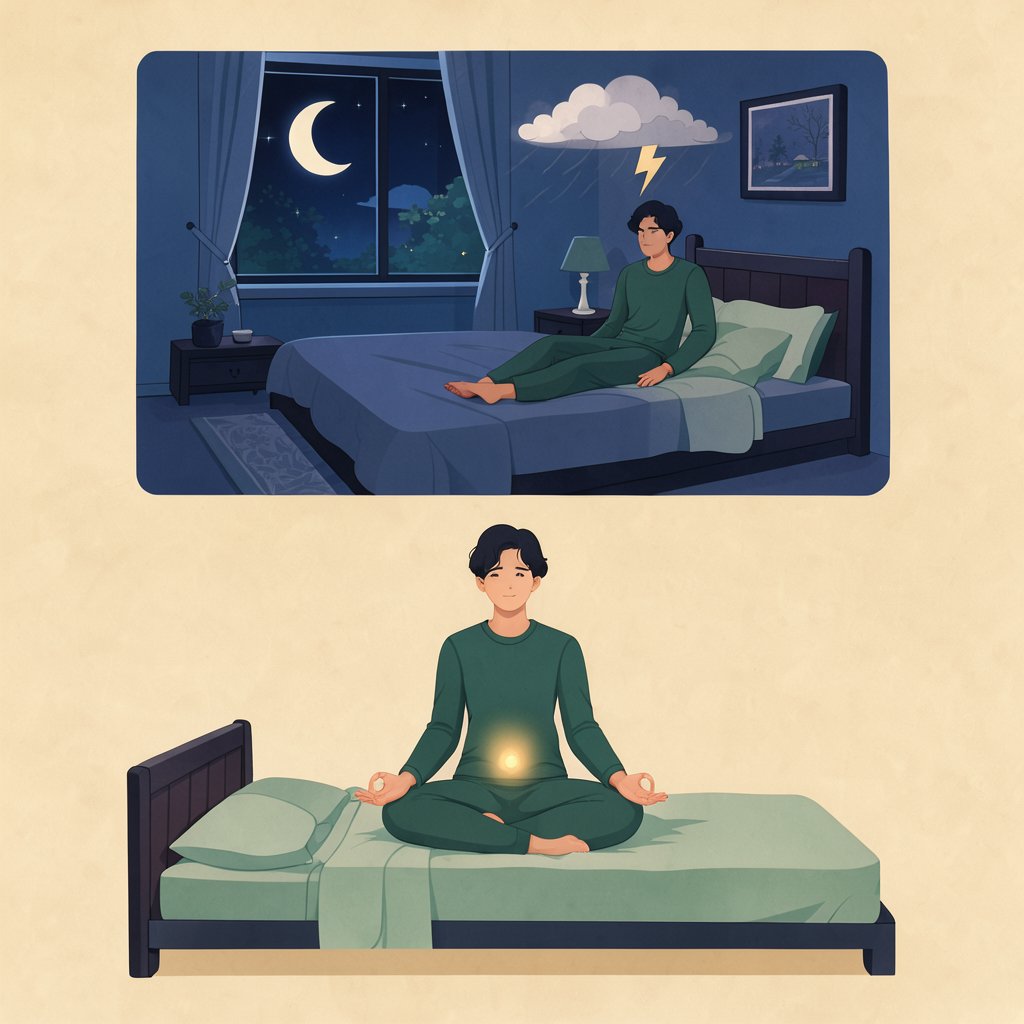
The lineage’s answer to unwanted waking is strikingly practical. If you wake at 4:00 AM and cannot fall back asleep, the instruction is simply to use the time to practice — and not to over-schedule the rest of your day around the clock, because “practice when you feel like it” is the teacher’s own demurrer.[1] A quiet 4 AM session inside the 03:00–05:00 window, followed by an earlier night, is the traditional fix; chronic waking that exhausts you belongs in a conversation with a clinician, not on a timetable.
Safety First: Who Should Be Careful with Energy Practice
Every serious tradition that works with the body’s energy also draws hard lines around who should step lightly, and the Nei Gong sources are explicit. Pregnancy heads the list: no concentration on the Dan Tien during these months — only gentle stretching and breathing.[11] Chronic psychiatric conditions follow, especially conditions swinging between extreme highs and lows or the use of antipsychotic medication: energy practice is contraindicated there, with an elevated risk of what the tradition calls “qigong deviation.”[11]
Severe heart disorders call for caution rather than avoidance. The sources warn that heart rhythm may be disturbed by practicing under heavy stress or chronic exhaustion, drinking too much coffee around practice, grounding the qi poorly, or using excessive force — and they direct students with heart conditions to consult a qualified Chinese-medicine physician and their teacher before continuing.[11] The rule for illness repeats across the books: avoid any practice that tires you or raises your temperature, while breathing practice remains permissible.[7]

For perspective, one qigong manual lists 67 conditions for which qigong therapy is reported as especially effective — gastric ulcers, chronic hepatitis, bronchial asthma, hypertension and neurasthenia among them — and immediately pairs that list with contraindication lists of its own, under the heading that “qigong is not a panacea.”[12] That pairing is the right mental model for this whole article: reported traditional experience on one side, firm limits on the other. This guide is educational, not medical advice; consult a qualified professional about your own situation.
Is the Organ Clock Rigid? Honest Limits and Deeper Layers
Here is the twist: the teachers who guard the Zi hour are the first to say the clock should never become a cage. The lineage instruction quoted in the sources calls the timing rules “not super-strict” and says to “practice when you feel like it.”[1] A Daoist author concedes that “daoists have no single opinion on the best time” for practice,[7] and a modern teacher reduces the whole question to picking the hour when your mood is calmest.[9] Rigid clock-dogma is a modern reading, not a traditional one.
The map also runs deeper than a single day. In the five-phase tradition, the day mirrors the seasons:[10]
- Morning = spring: liver and gallbladder hours
- Noon = summer: heart and small intestine, with pericardium and triple heater at the same band
- Afternoon = late summer: spleen, pancreas and stomach
- Evening = autumn: lungs and large intestine
- Night = winter: kidneys and bladder
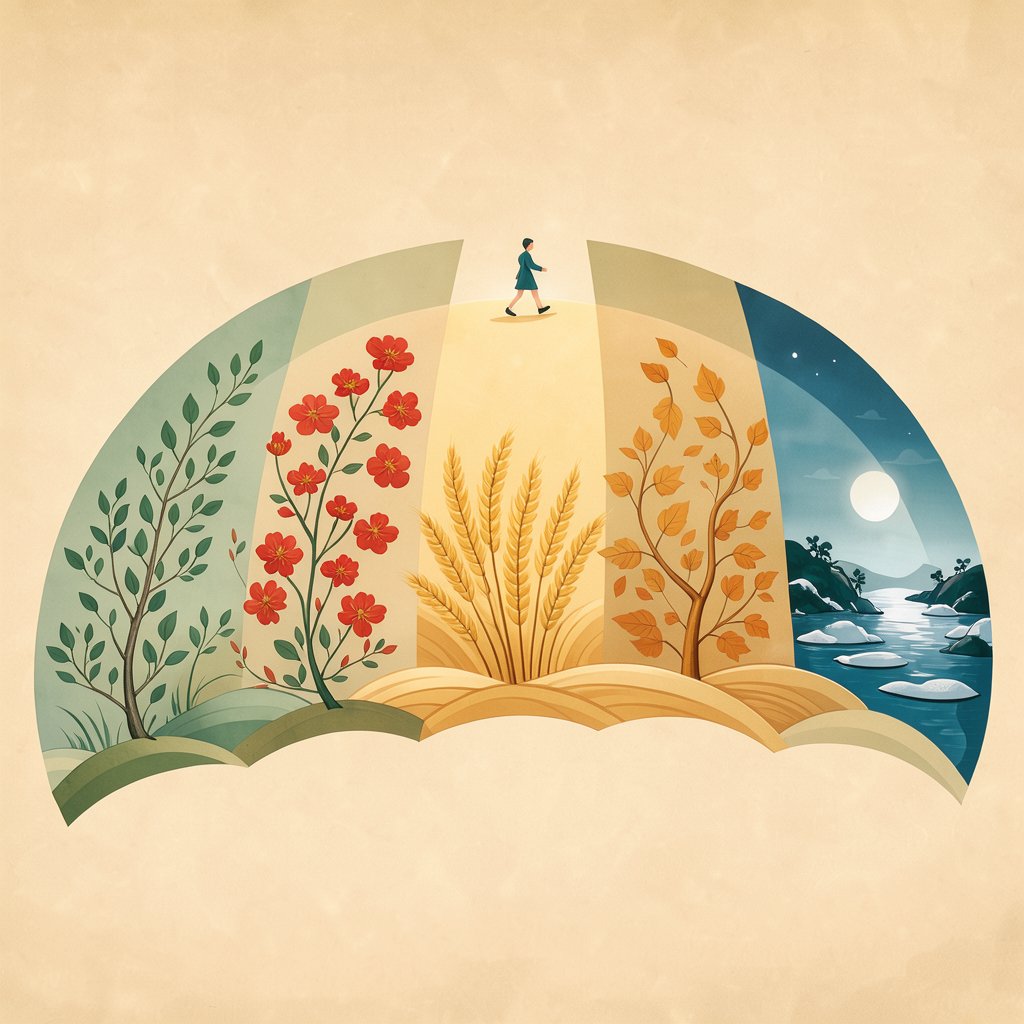
Beneath that sits a seasonal clock: organ strength also follows the seasons, and the sources note it is harder to strengthen an organ in its deficient season and harder to reduce an excess in its dominant season.[13] The historical arc completes the picture. The Huangdi Neijing compared the meridians to China’s great rivers roughly 2,300 years ago;[3] the Internal Classic describes visceral functions and the circulation of qi and blood changing with day and night — Yang-qi reaching its greatest extent at noon and turning inward and dormant at night — with the modern aside that “nowadays we call this chrono-biology.”[14] The heart’s role as monarch of the organs was accepted in China roughly 2,000 years ago, and the Suwen’s “Seven Harms and Eight Benefits” discussion of premature aging belongs to the same classical stratum.[15]
Take the clock for what it is: a self-observation tool with two millennia of notes in the margin — not a rigid schedule, and not a diagnostic device. Use the windows that help, drop the ones that do not, and let your own observations arbitrate. The tradition itself will not mind; its teachers said so first.
Frequently Asked Questions
What is the best time of day to practice qigong according to the organ clock?
The traditional table names four favorable daily periods: 23:00–01:00, 05:00–07:00, 11:00–13:00 and 17:00–19:00, with the midnight Zi hour called the best of all.[6] A second source recommends morning 05:00–07:00 and evening 23:00–01:00, flags 13:00–15:00 as not recommended, and gives you permission to ignore any rule that does not help you.[7] For a first practice to place inside a window, see our Baduanjin manual.
Why do people say waking between 1 and 3 AM matters?
Because 01:00–03:00 is the traditional window of peak blood and bile regulation, when anger is said to be provoked and when “all emotions are extinguished by sleep.”[5] The claim that such waking “means a liver imbalance” is a later interpretation — no source in our base states it directly. If night waking is chronic, treat it as a self-observation pointer and read our guide to circadian light habits.
Is the Chinese organ body clock supported by modern science?
Honestly: our source base — traditional practice books — contains no modern trial data, no cortisol or melatonin measurements, and no chronomedicine studies; the closest touchpoint is a classical-medicine textbook noting that the day-night rhythm of qi resembles what “nowadays we call chrono-biology.”[14] This article therefore stays traditional-knowledge framed rather than borrowing studies it does not have. For how we handle claims, see our editorial policy.
Can I practice qigong right after eating?
Traditionally, no: the instruction is to avoid practicing within 15 minutes before a meal and one hour after it, so digestion keeps first claim on the body’s attention.[6] In this reading, the morning food-intake window (07:00–09:00) and the spleen window (09:00–11:00) are the digestive heart of the day.[5] Our warm breakfast traditions article pairs well with the idea.
How long should a daily session be?
About 15 minutes is the optimal dose, with 3–5 minutes acceptable on busy days; once a day suffices, and morning plus evening sessions complement each other.[6] A second source independently recommends the same 15-minute daily amount.[9] Our morning breathwork ritual is built around exactly that dose.
Who should avoid intensive energy practice?
The contraindication list is short and firm: pregnancy (no Dan Tien concentration — gentle stretching and breathing only), chronic psychiatric conditions — especially with extreme mood swings or antipsychotic medication — and severe heart disorders, which call for a physician’s and teacher’s guidance.[11] When ill, keep only the breathing component.[7] Full framing is in our medical disclaimer.
The Chinese organ body clock, read honestly, is less a timetable than a lens: twelve two-hour windows, four practice hours, two tides of strength, and a standing invitation to check the old map against your own day.[1][5] Keep what helps — a real breakfast window, a protected afternoon, a 15-minute session at dawn — and drop the rest without guilt, exactly as the tradition’s own teachers recommend.[7] A clock this old has survived precisely because it bends.
Sources
- [1] Nathan Brine — Daoist Alchemy from Wang Lipin, Vol. 2, Part 3 (2023) — the twelve double-hours, the Zi–Wu–Mao–You pivot hours, the Zi-hour secrecy story, and the teacher’s “practice when you feel like it” demurrer.
- [2] Damo Mitchell — Daoist Nei Gong: The Philosophical Art of Change (2011) — the 24-hour qi circuit, the Lower Dan Tien as its once-daily drive, the “small water wheel of Qi,” and the Wu Xing grouping of the twelve channels.
- [3] Bian Zhizhong — 5 Elements of Health: 25 Golden Chinese Exercises (2007)
- [4] Yang Jwing-Ming — Qigong Meditation: Embryonic Breathing (2003) — channel strength varying through the day, the heart-channel peak at 11:00–13:00, the modifiers of channel qi, and the Li Shi-Zhen rivers-and-lakes metaphor.
- [5] S. Kashnitsky — Chinese Miracle Methods: How to Live Long and Be Healthy! (2014) — the complete twelve-window organ-activity chart with maximum and minimum phases, the whole-body strongest and weakest hours, the supplement-timing rule, and the lunar layer.
- [6] Bian Zhizhong — Daoist Health-Improving Gymnastics (n.d.) — the four favorable practice periods, the meal buffers of 15 minutes before and one hour after food, and the 15-minute session dose.
- [7] E. Yudlav — 100 Days for Health and Longevity: A Practical Guide to Daoist Yoga and Qigong (2005) — the morning and evening practice windows, the 13:00–15:00 caution, the illness rule, and “if they don’t help, ignore them.”
- [8] A. A. Maslov — Qigong Gymnastics (1992) — the Heavenly Mao–You Circulation of 36 + 24 circles and its twice-daily rhythm.
- [9] Inka Jochum — The Healing Energy of Qigong (2009) — the modern any-calm-hour default and the 15-minute daily dose.
- [10] Michio Kushi — Your Body Never Lies: The Complete Guide to Eastern Diagnosis (2016) — the five-phase map of the day and the same-hour, same-season diagnostic principle with the spleen-and-stomach example.
- [11] Damo Mitchell — The Complete Guide to Daoist Nei Gong (2018) — the contraindications for pregnancy, chronic psychiatric conditions, and severe heart disorders.
- [12] Yang Hengli — Chinese Spiritual Qigong Lianhua (1994) — the 67 reported indications and the “qigong is not a panacea” framing.
- [13] Damo Mitchell — Heavenly Streams: Meridian Theory in Nei Gong (2013) — the seasonal layer of organ strength.
- [14] Liang Liu — Essentials of Chinese Medicine, Vols. 1–3 (2011) — the Internal Classic’s day-night description of qi and the “chrono-biology” remark.
- [15] Jiao Guorui — Foundations of Health Qigong (2013) — the heart as monarch of the organs and the Suwen’s Seven Harms and Eight Benefits.
Where to go next: the Chinese wellness and qigong hub gathers this guide’s sister articles on traditional practice. To put a window on your dial, the Baduanjin — Eight Pieces of Brocade manual is a complete practice that fits the 15-minute dose, and our qigong vs. meditation for stress comparison helps you choose the tool; if night waking is what brought you here, the circadian light habits guide continues the story on the sleep side.
How we researched this: built from a local library of 1,137 wellness books, queried through an offline retrieval system with no internet sources — every factual claim above was checked against the cited book passage before publication. Where the base held gaps — organ names for part of the twelve-window table, any direct “waking 1–3 AM means liver” statement, modern chronomedicine trials — we said so plainly instead of filling them. That is the standard we hold every guide to.
