
Educational content only — not medical advice. See our full Medical Disclaimer and Affiliate Disclosure below.
Walk down a pharmacy aisle today and two very old mushrooms are waiting on the shelf: shiitake and maitake, the names a modern medicinal-mushroom encyclopedia says “have flooded pharmacies worldwide”[1]. Behind the bottles stands a paper trail measured in millennia. Shiitake (Lentinula edodes) has been cultivated in China for at least 3,000 years, long enough for a classical physician to rank it alongside the most celebrated root in East Asian medicine[1]. Maitake (Grifola frondosa) is, in the encyclopedia’s phrasing, the exotic name of the familiar “sheep’s-head mushroom” — a layered forest rosette that Western shoppers mostly know as a powder[1].
This guide reports what the source books actually say about the pair — the tradition with receipts, the named chemistry, the actions described at the books’ own evidentiary level — and stops exactly where the books stop. Where the consulted sources give no doses, no protocols and no interaction data, the guide says so instead of filling the silence. Nothing here is a diagnosis or a treatment claim; for questions about your own situation, check with your healthcare provider.
Key Takeaways
- The Chinese physician Wu Xin, in a treatise covering more than 100 mushroom species of China and Japan, called shiitake “mushroom-ginseng” and stated that the healing properties of mushrooms are much higher than those of medicinal herbs — shiitake has been cultivated in China for at least 3,000 years[1].
- The encyclopedia names the actives: beta-D-glucans from the fruiting bodies plus water-soluble ligno-glycoprotein complexes from deep-mycelium autolysate; it gives no concentrations and never uses the word “lentinan”[1].
- Described actions stay at extract and tissue-system level: influenza inhibition, anti-HIV activity in tissue systems, non-specific interferon induction, blocking of N-nitroso compound formation, and blood-pressure lowering for both mushrooms[1].
- The honest limits are load-bearing: no numeric doses, no lentinan or D-fraction protocols, no mushroom drug-interaction data exist in the corpus — food first, and a healthcare-provider fence before any supplement course[1][3].
What Are Shiitake and Maitake? Two Mushrooms With Big Reputations
Strip the labels off the bottles and two distinct fungi remain. Shiitake is Lentinula edodes, the brown-capped, log-grown mushroom of East Asian kitchens. Maitake is Grifola frondosa — the encyclopedia introduces it as the exotic name of the familiar “sheep’s-head mushroom”, its overlapping grey-brown fronds forming a rosette at the base of trees[1]. Neither name is a brand invention; both were famous long before supplement catalogs existed.
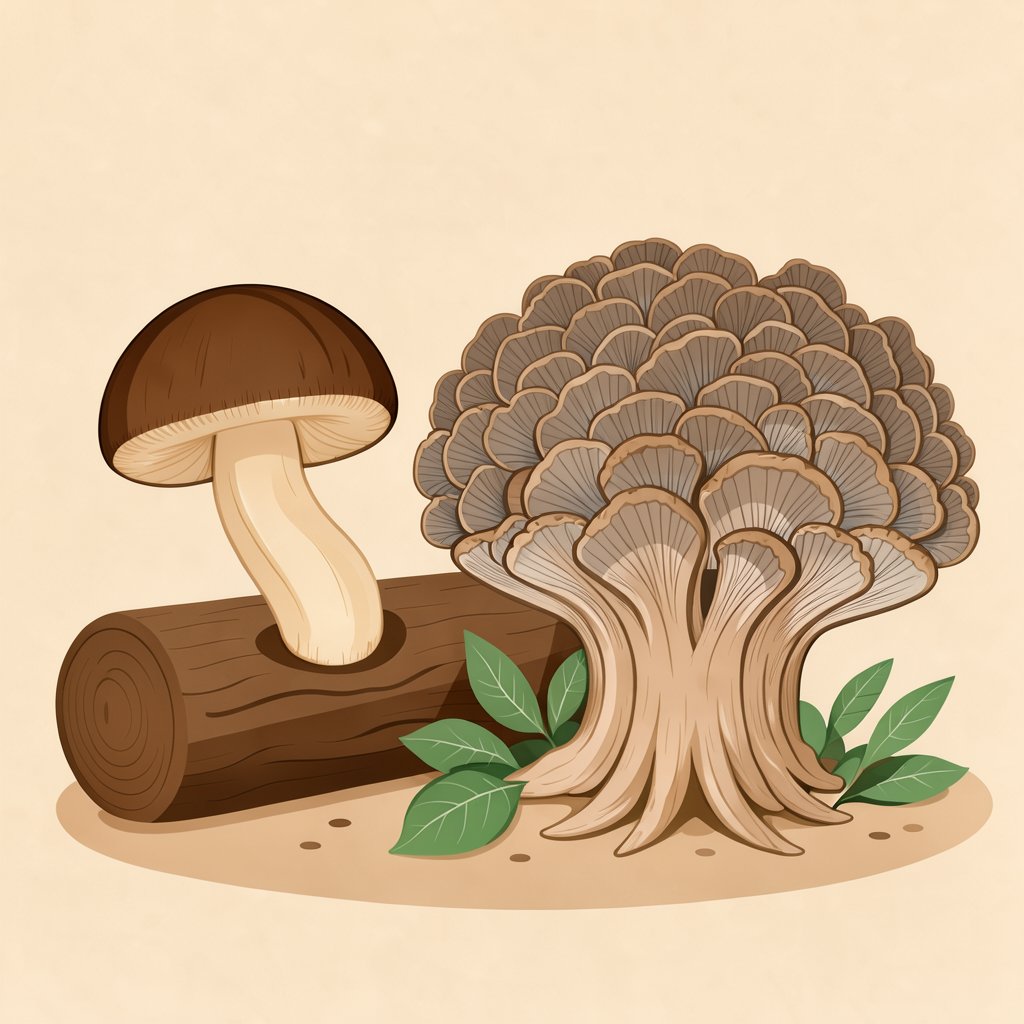
The market frame comes straight from the encyclopedia: preparations from reishi (Ganoderma lucidum), kawaratake, shiitake and maitake have “flooded pharmacies worldwide”, so knowing the four key names is presented as practical knowledge for anyone reading a label[1]. One naming trap matters immediately: kawaratake is Trametes versicolor — turkey tail — a different mushroom named in the same pharmacy list, and it must never be conflated with shiitake or maitake[1]. Four names, four different fungi.
The fourth name deserves its own careful sentence. A modern popular source names reishi the “mushroom of immortality” (lingzhi) and describes it as an immunomodulator whose triterpenes, the ganoderic acids, activate and support immune function[2]. That is a reishi claim from a reishi-focused passage: it names shiitake and maitake only as key mushrooms to know, and none of it transfers to this guide’s two subjects[2]. The reputation that carried shiitake into such company, though, is far older than any modern pharmacy — and it comes with a receipt.
‘Mushroom-Ginseng’: Wu Xin’s Treatise and 3,000 Years of Cultivation
The oldest testimony in the corpus belongs to the Chinese physician Wu Xin. His treatise described the properties of more than 100 mushroom species of China and Japan and carried one sweeping verdict: “the healing properties of mushrooms are much higher than those of medicinal herbs”[1]. Within that ranked world, shiitake received a striking title — “mushroom-ginseng” — placing a cultivated kitchen food in the same sentence as the most celebrated root in the regional materia medica[1].
The receipts continue on the cultivation side. Shiitake has been grown in China for at least 3,000 years — not gathered at random but deliberately cultivated, generation after generation[1]. And the record crossed the sea: the ancient Japanese herbal “Shinno Honsokyo” is described as an adapted translation of the Chinese original, carrying the mushroom knowledge into the Japanese tradition[1]. For the adaptogen-era reader, the classic “Ginseng and Its Brothers” (1979) belongs to the same historical moment that made “ginseng” the benchmark of tonics — the reconnaissance for this guide extracted no facts from it, so it is named here as context only[8].
One honesty note keeps this section true to its sources. All four tradition facts above are reported second-hand by a single modern encyclopedia[1], and maitake has no parallel legend anywhere in the consulted corpus — no treatise, no cultivation history, no folk title. This guide refuses to invent one. What the books do give, for both mushrooms, is chemistry — and that is where the walk from legend to substance begins.
What Is Inside: Beta-D-Glucans and Ligno-Glycoprotein Complexes
Ask the encyclopedia what shiitake is actually made of, and it names two fractions. The first: the anti-viral and anti-cancer agents of shiitake are beta-D-glucans — described in the book as carcinostatics — obtained from the fruiting bodies, the part of the mushroom you can see and hold[1]. The second: water-soluble ligno-glycoprotein complexes, obtained from the deep-mycelium autolysate — the web of fungal threads below the growing surface, broken down by controlled self-digestion[1].
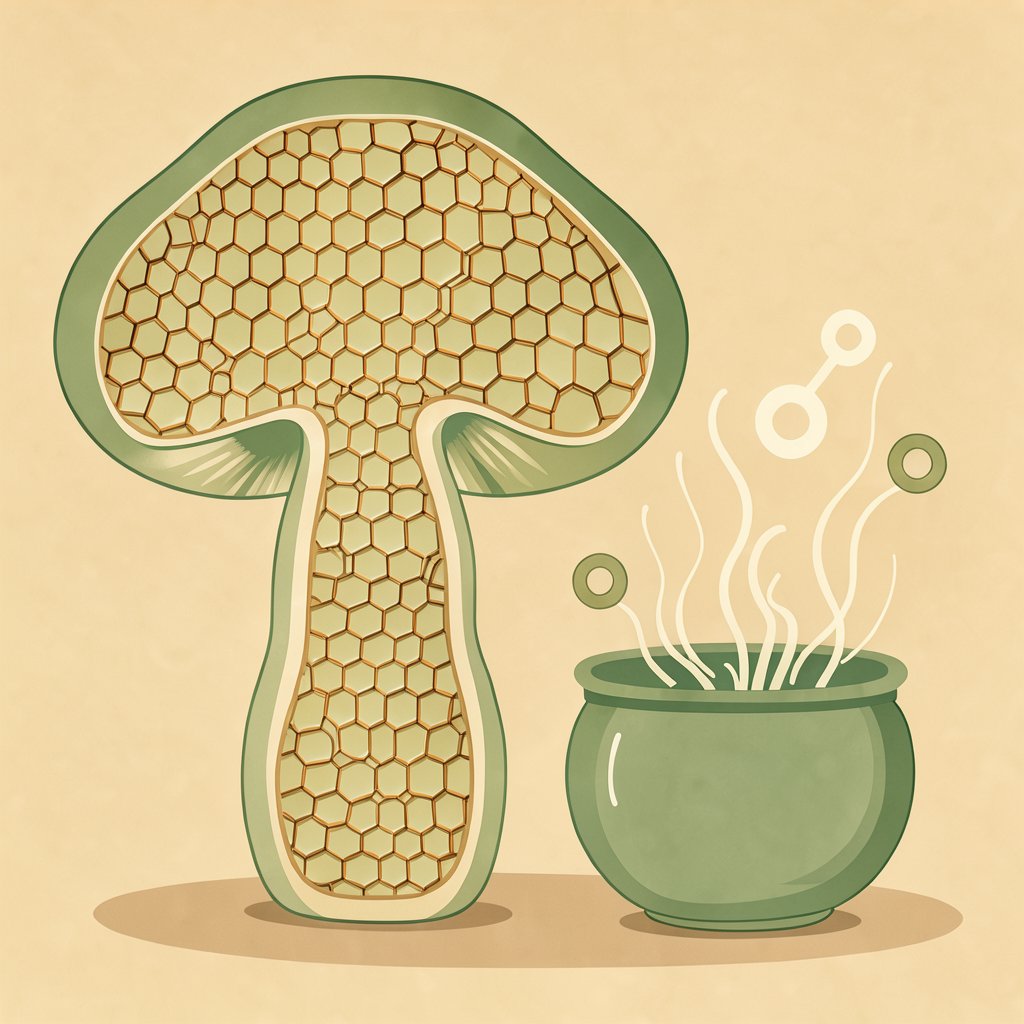
The two fractions are worth holding apart, because a supplement label speaks in exactly these terms. Fruiting-body chemistry is the kitchen mushroom’s chemistry — the classical tradition worked with it for millennia. Deep-mycelium autolysate is a different industrial starting point, and the encyclopedia lists its ligno-glycoprotein complexes as the second named fraction[1]. Both descriptions stop at the naming: the book gives no concentrations, no extract ratios, no standardization percentages for either fraction — a silence this guide reports rather than patches.
One term is conspicuously absent, and the absence is verified rather than assumed. The word “lentinan” appears nowhere in the retrieved corpus — checked twice, by the mechanism query and by a dedicated gap-check query[1]. The books say “beta-D-glucans”; they never say “lentinan”. Any article that attributes lentinan studies to this record is putting words in the books’ mouths. What the named fractions are said to do is the next section’s business — stated at the source’s own evidentiary level.
Interferon, Influenza, and N-Nitroso Compounds: Actions the Books Describe
Here is exactly what the encyclopedia describes, in its own register. Extracts of Lentinula (shiitake) inhibit the development of the influenza virus[1]. Shiitake and maitake extracts showed anti-HIV activity in tissue systems — laboratory tissue preparations, not people[1]. And shiitake’s antiviral action is linked, in the book’s wording, to non-specific induction of interferon synthesis: the compounds are described as prompting the body’s own antiviral signaling rather than attacking viruses directly[1].
A second layer of the record is antimutagenic rather than antiviral. Shiitake fruiting bodies contain a substance with antimutagenic activity that blocks the formation of N-nitroso compounds — the class of mutagens that forms from nitrites in the diet — and shiitake is additionally cited as a source of bio-antioxidants, described as a humic-like complex[1]. The substance doing the blocking is not named beyond that, and this guide does not name it for the book.
Now the evidentiary fence, stated plainly. Every verb above is the source’s own: “extracts”, “in tissue systems”, “is linked to”. No clinical trial numbers, participant counts or effect sizes for shiitake or maitake exist anywhere in the consulted corpus, and none are invented here. Nothing in this section is a treatment or prevention claim for any disease — it is a record of what one encyclopedia states, at laboratory level, about two traditional mushrooms. One more systemic effect is attributed to the pair — and it belongs to circulation, not immunity.
Blood Pressure: The Other Effect Attributed to Both Mushrooms
Beyond the antiviral record, the encyclopedia credits both of this guide’s mushrooms with a cardiovascular ability: lowering elevated blood pressure is described for Grifola frondosa (maitake) and Lentinula edodes (shiitake) — alongside oyster mushrooms (Pleurotus) and Albatrellus confluens in the same passage[1]. Four mushroom species, one described effect, one book.
The named actives in this blood-pressure context are peptideoglucan, fructoglucan, grifolin and neogrifolin — four names a careful label-reader may meet again[1]. A spelling fence is needed here: grifolin and neogrifolin are the compounds the book names; “grifolan” and “D-fraction” are different terms that appear nowhere in the corpus — checked by the gap queries — and must never be substituted for what the book actually says[1].
Two more honest limits shape this section. First, no dose, threshold or protocol attaches to the blood-pressure effect — the book describes an ability, not a regimen, and hypertension is a physician’s territory, not a mushroom’s. Second, maitake’s entire presence in the corpus is list-level: it appears in the blood-pressure list and the anti-HIV list, with no standalone maitake protocol anywhere[1]. Readers managing blood pressure take any supplement question to their healthcare provider first. With the books’ claims mapped, the practical question is how people actually used these mushrooms — and the answer is a fork, not a capsule.
Food First: Japan’s Nine Longevity Dishes and the Kitchen Route
The tradition’s own answer to “how did people use them?” is a dinner table, not a dosage table. Japan included shiitake among its nine national dishes and products that promote health and longevity — one of only nine, chosen for a whole nation’s idea of long life[1]. That single fact carries the culinary weight of this guide: for most of their recorded history, these mushrooms were food first, and the kitchen, not the capsule, is where the tradition lives.
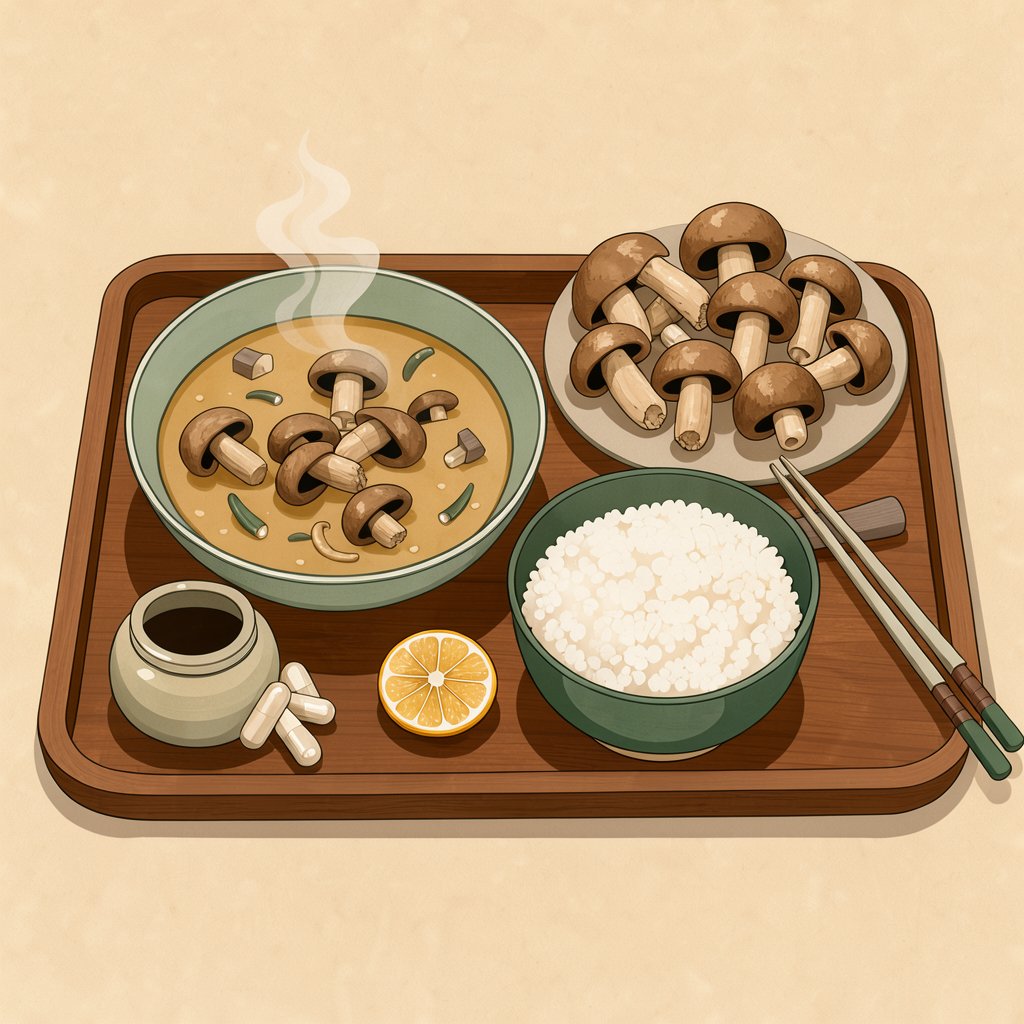
Then the honest pharmacy frame. Mushroom preparations have “flooded pharmacies worldwide”, yet the consulted sources do not dose supplements — not in milligrams, not in grams, not at all[1]. The truthful line is therefore: food first in the tradition’s own footsteps, supplements exist on shelves, and the books behind this guide say nothing about how much. If folk dosing is mentioned at all, the nearest convention in the corpus comes from traditional Chinese plant practice: powder taken two to four times a day “on the tip of a table knife” — a deliberately imprecise folk measure for plants, not a mushroom dose, and never presented as one[4].
Two cautions complete the kitchen route. A foraging handbook warns that some edible herbs and mushrooms resemble poisonous species, so correct, careful collection is essential — the field is where mistakes are permanent[5]. And the category’s dedicated culinary reference, “Wild Plants and Mushrooms in Medicine and Cooking” (1994), is named here as a reference only: its retrieved pages are title and colophon material, with no shiitake or maitake culinary specifics retrievable — so none are claimed[6]. What the books still do not tell a careful reader is the final, load-bearing section.
Honest Limits: No Doses, No Lentinan Data, No Interaction Studies
This is where the guide earns its trust, so the gaps get named in full. The consulted corpus contains: no numeric mushroom dosages of any kind — verified by a dedicated gap-check query; no lentinan or D-fraction protocols — both terms are absent from every retrieved chunk; no mushroom-specific contraindications, drug-interaction data or dermatitis records; and no clinical trial numbers for either mushroom[1]. Every mushroom-specific fact in this article traces to a single modern encyclopedia[1] — a monosourcing this guide declares rather than hides.
The interaction question deserves the most careful paragraph. A pharmacopoeial review of herb–cardiovascular drug interactions covers 43 case reports and 8 clinical trials, with warfarin the most common object and over-anticoagulation reported for boldo, fenugreek, garlic, danshen, dong quai, ginkgo and other herbs[3]. That review contains no shiitake and no maitake rows[3]. The silence cuts both ways and proves neither: this guide therefore writes no mushroom blood-thinner warning — and no “safe with medications” claim either. Anyone taking prescription medication asks their healthcare provider before adding any mushroom supplement.
The one sourced safety move available from the corpus is a skin-test protocol from an herbal first-aid tradition: apply a small amount before use, and if redness, irritation, itch or rash appears, refuse the substance; in multi-component mixes, start with one to two components and add the others gradually[7]. Modest as it is, it is honest — and honesty is the tradition this guide can always keep.
FAQ: Shiitake and Maitake Questions the Books Actually Answer
What does “mushroom-ginseng” mean, and who said it?
It is the honorific the Chinese physician Wu Xin gave shiitake in his treatise on more than 100 mushroom species of China and Japan — the same text that ranked the healing properties of mushrooms above those of medicinal herbs[1]. The title places a cultivated kitchen mushroom beside the most famed tonic root of the region. The tradition’s wider mushroom map is traced in our traditional uses of functional mushrooms guide.
How long has shiitake been cultivated?
At least 3,000 years in China, according to the encyclopedia — with the ancient Japanese herbal “Shinno Honsokyo” described as an adapted translation of the Chinese original[1]. Few cultivated foods anywhere carry a longer continuous record. A neighboring fungus with its own long record is covered in the chaga mushroom guide.
What do the books say shiitake and maitake do for immunity?
At extract and tissue-system level: Lentinula extracts inhibit influenza virus development; shiitake and maitake extracts showed anti-HIV activity in tissue systems; the antiviral action is linked to non-specific interferon induction; and a fruiting-body substance blocks N-nitroso compound formation[1]. No clinical trial numbers exist in the corpus, and none are claimed. The evening counterpart lives in the reishi evening tea ritual.
What about blood pressure?
The encyclopedia describes lowered elevated blood pressure for both Grifola frondosa and Lentinula edodes, naming peptideoglucan, fructoglucan, grifolin and neogrifolin as the actives — with no dose or protocol attached, and maitake’s role list-level only[1]. Blood pressure itself is a physician’s territory. Browse the adaptogens and herbal wisdom category for neighboring guides.
How much shiitake or maitake should I take?
The honest answer is that the sources do not say. Zero numeric mushroom dosages exist in the corpus — confirmed by a dedicated gap-check query — so this guide declines to invent one[1]. The tradition’s own register is food first: shiitake sat among Japan’s nine national longevity dishes[1]. For supplement decisions, check with your healthcare provider, as our medical disclaimer advises.
Are these mushrooms safe with medications?
Not established either way by this guide’s book base. The interaction review it holds covers herbs only — 43 case reports and 8 clinical trials, warfarin most common — with no mushroom rows[3]. That silence is not proof of safety or of danger; it is a gap. The one sourced move is a skin test before first use and gradual introduction of mixes[7]. Start with the manuals library for food-first practice routines.
Shiitake and maitake carry one of the older reputations in the wellness record: a physician’s “mushroom-ginseng”, 3,000 years of cultivation, nine-dish longevity lists, and a modern encyclopedia that names beta-D-glucans and ligno-glycoprotein complexes while attaching not a single milligram to them[1]. The kitchen route is the tradition’s own; the capsule route is the reader’s careful question — asked, honestly, of a healthcare provider rather than of a label.
Sources
- [1] Vishnevsky M.V. — Medicinal Mushrooms: Complete Encyclopedia (2014) — the single source behind every mushroom-specific fact in this guide: the naming list, Wu Xin’s treatise, the cultivation record, both active fractions, the antiviral and antimutagenic actions, the blood-pressure list and Japan’s nine longevity dishes.
- [2] Joseph Mercola — Herbs and Spices (2023) — reishi-focused context only: the “mushroom of immortality” framing and the ganoderic-acid immunomodulator description that must not be transferred to shiitake or maitake.
- [3] Joanne Barnes, Linda Anderson — Herbal Medicines (Pharmacopoeia of Medicinal Plants) — the herb–cardiovascular drug interaction review (43 case reports, 8 clinical trials, warfarin most common) whose silence on mushrooms frames the interaction section.
- [4] V. L. Kochetkov — Medicinal Plants in Traditional Chinese Medicine (2002) — the “tip of a table knife” powder convention, cited strictly as TCM plant practice and never as a mushroom dose.
- [5] G. K. Tavlinova — Herbs for the Table and the Medicine Chest (1992) — the foraging caution about poisonous look-alikes.
- [6] D. T. Zhogolev et al. — Wild Plants and Mushrooms in Medicine and Cooking (1994) — the category’s culinary reference, named as such; no culinary specifics were retrievable from its pages.
- [7] Yu. Nikolaeva — Healing the Body with Herbs (2011) — the skin-test protocol and the one-to-two-component rule for mixes.
- [8] L. A. Vostrikov, A. A. Konstantinov, N. K. Fruentov — Ginseng and Its Brothers (1979) — adaptogen-era context only; no facts were extracted from it for this guide.
Where to go next: the functional mushrooms overview places shiitake and maitake in the wider fungal canon, and the chaga guide plus the reishi evening tea ritual cover the neighboring traditions. For the buying side of the shelf, the adaptogens buyer’s guide applies the same honesty rules to labels.
How we researched this: built from a local library of 1,137 wellness books through an offline retrieval system with no internet sources. Every factual claim was checked against the cited passages, and the knowledge base was searched exhaustively — all 140,675 chunks — before any topic was declared a gap. Where the books are silent, this guide says so instead of filling the space.
