
Educational content only — not medical advice. See our full Medical Disclaimer and Affiliate Disclosure below.
Key Takeaways
- Lion’s mane (Hericium erinaceus) enters the documented story as the neurotropic branch of a 2,000-year East Asian medicinal-mushroom canon that ranked mushrooms above herbs – and reishi above ginseng.[1]
- Exactly one direct species fact exists in our sources: lion’s mane extracts are applied as factors of nerve-cell growth and myelination in vitro – and the qualifier is part of the fact.[1]
- The preparation canon in this guide – knife-tip powders, tablespoon-per-glass infusions, 30-minute decoctions, 14-day tinctures – is species-general tradition from analog plants and chaga, not lion’s mane dosing.[5][6][7][8]
- No lion’s mane dose, preparation form or species-specific contraindication exists anywhere in our knowledge base; the safety section follows the documented analog-tonic pattern, clearly labeled.[10][11]
- Buy by provenance and registration status: unlicensed herbal remedies are not quality-assessed by any authority.[10]
Walk down any supplement aisle in America and the lion’s mane mushroom is hard to miss: capsules, powders and coffee blends, all leaning on the same two words – focus and memory. This guide takes a different route to that promise. Instead of repeating marketing language, it follows the documented record: a 2,000-year East Asian medicinal-mushroom canon, one verified laboratory fact about lion’s mane, nerve cells and the words “in vitro”, and a set of honest boundaries the sources themselves draw. Where the record is silent, we say so plainly.
If you have ever searched for lion’s mane focus advice, you have probably met two extremes – miracle-language on one side and total dismissal on the other. Our answer is built from a local library of 1,137 wellness books, and it lands somewhere more precise: the tradition around medicinal mushrooms is real, rich and well documented, while the species-specific lion’s mane record inside it is remarkably thin. That tension is the story of this article. We will show you exactly what the sources say, what they prepared and cautioned in general, and what they never claim.
What Is Lion’s Mane Mushroom? A Toothed Fungus, Not a Typical Cap
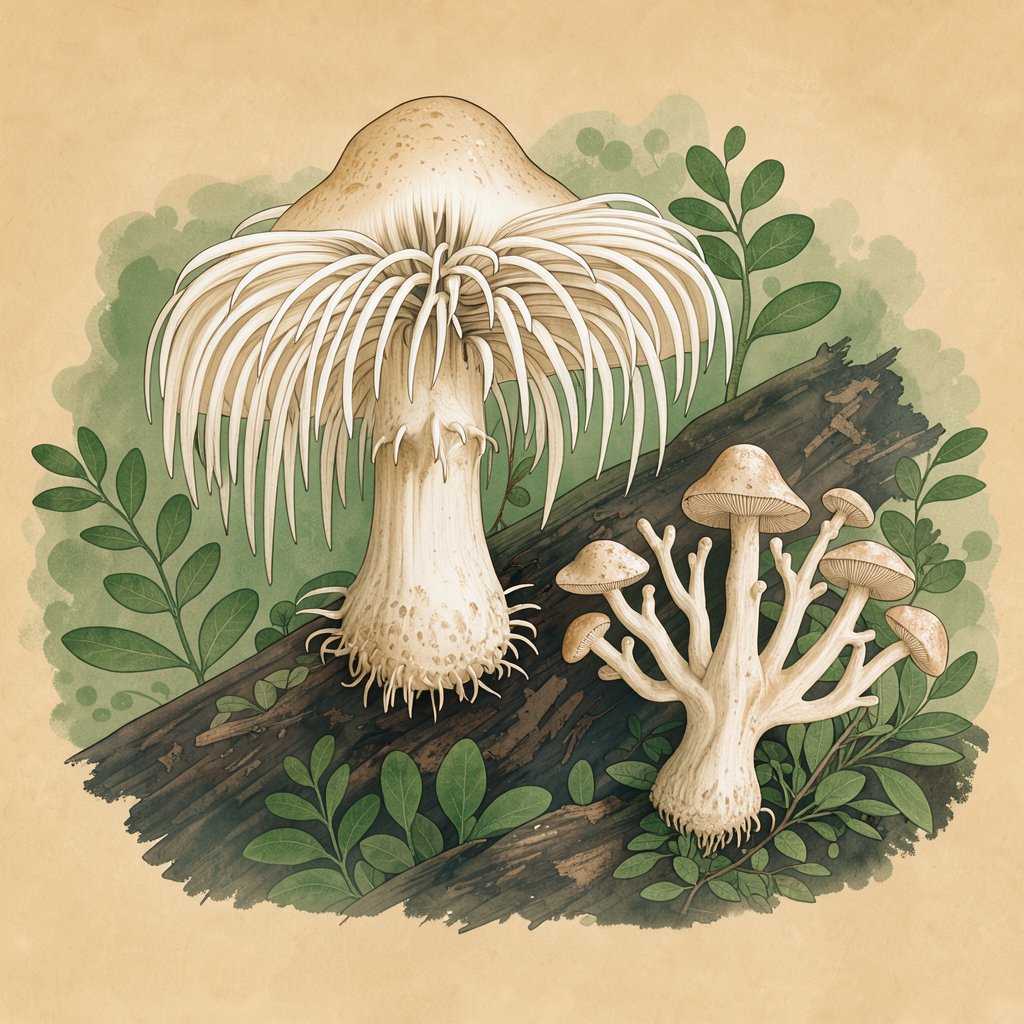
Lion’s mane is Hericium erinaceus: a white, cascading, toothed fungus that fruits on hardwood logs and stumps, known in the Russian-language sources of our library as the comb mushroom. It is a medicinal mushroom of the East Asian tradition rather than a folk remedy of the European woods. Modern supplement culture has simply made it one of the most recognizable fungi on the shelf.
Its most distinctive signature is the spore-bearing layer. A Russian field guide by A.I. Ivanov gives lion’s mane as the textbook example of a mushroom whose spores are born on spines – teeth – rather than on gills or in pores.[2] That single morphological fact is all Ivanov claims for the species; his chapter carries no medicinal content, which is exactly why we cite it first: identity before claims.
In the encyclopedic record, the genus fares better. M. Vishnevsky’s Medicinal Mushrooms: The Great Encyclopedia (2014) lists Hericium among the mushroom genera with documented anti-cancer and immune-stimulating activity, in the company of Ganoderma, Grifola, Lentinula and Trametes.[1] The same book carries dedicated print chapters for Hericium coralloides, Hericium erinaceus and the yellow hedgehog hydnum, and credits a unique Hericium erinaceus photograph to Irina Ukhanova – evidence the species received full visual treatment.[1] A genus standing beside reishi and shiitake invites the obvious question: where does that reputation come from?
Mushrooms Above Herbs: The Shennong Bencao Jing Canon
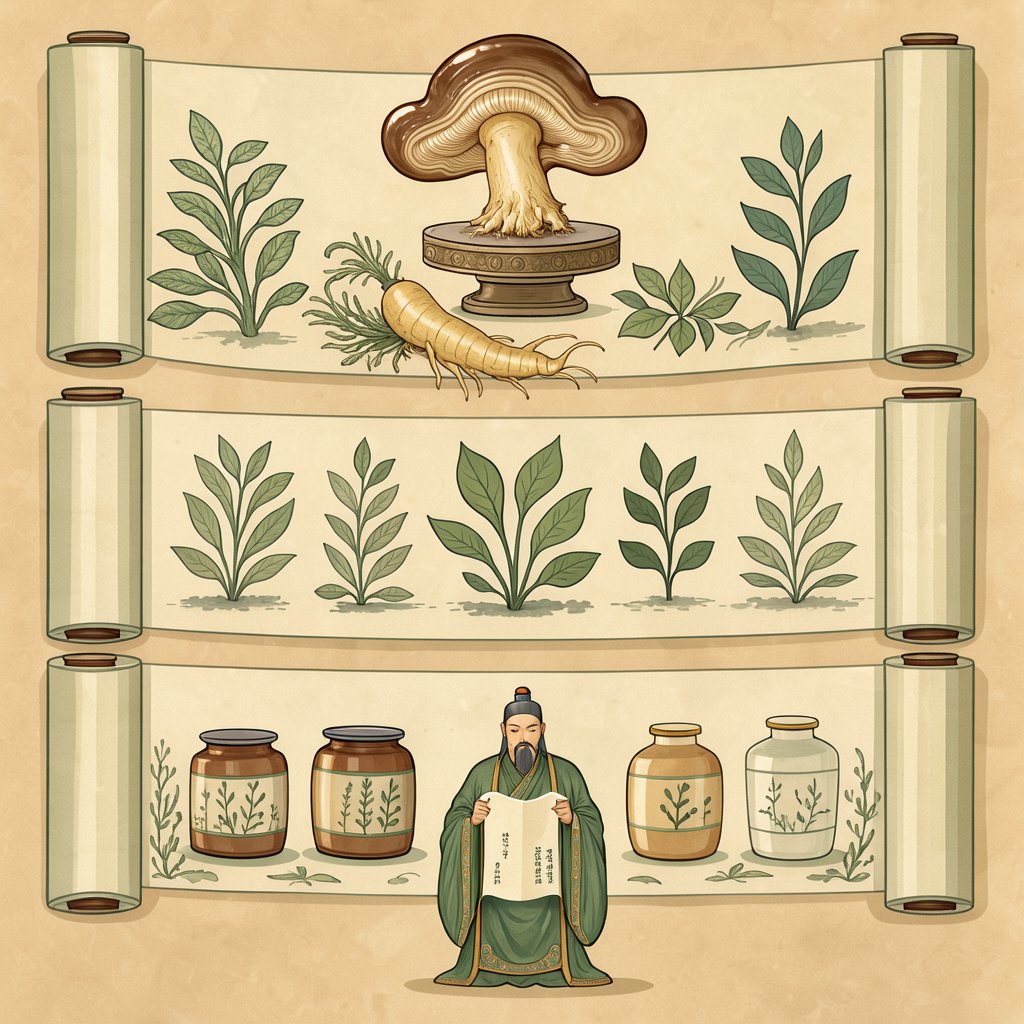
The documented answer is older than most readers expect. The Wu Xing tractate, roughly 2,000 years old, describes the properties of more than 100 medicinal mushroom species of China and Japan and states plainly that the healing properties of mushrooms are much higher than those of medicinal herbs.[1] The same tractate calls shiitake the “ginseng mushroom” – a striking rank for a wood-grown fungus.
The cornerstone of the canon is the Shennong Bencao Jing, known in Japan through the adaptation Shinno Honsokyo. It systematizes 365 herbs and fungi in three classes: 120 “superior” items said to nourish life and prolong youth, 120 “middle” tonic items, and 125 “fair” items kept for use against specific ailments.[1] Reishi (Ganoderma lucidum) stands first among the superior class – ahead of ginseng itself – and the Japanese translator called it the “mushroom of immortality”.[1] When an ancient pharmacopoeia ranks a fungus above the most famous root in East Asian medicine, the tradition’s regard for mushrooms needs no embellishment.
Rarity did the rest. Maitake was sold for its weight in silver, and mushroom-growing sites were kept secret, passed on by inheritance or given as dowry.[1] Avicenna (Ibn Sina) observed that only 10 of 1,000 plum trees will host reishi – the reason reishi preparations were reserved for the imperial family.[1] Shiitake, for its part, has been cultivated in China for at least 3,000 years and appears among Japan’s nine national dishes and products for health and longevity.[1]
One contrast keeps the frame honest. Russian folk medicine used cap mushrooms mostly externally – hemostatic poultices and rheumatism compresses – and its internal list is narrow and recent.[1] Internal use of medicinal mushrooms is an East Asian tradition, not a Slavic-folk one, and lion’s mane enters the story through that East Asian door.
The One Verified Fact: Nerve Growth and Myelination – In Vitro
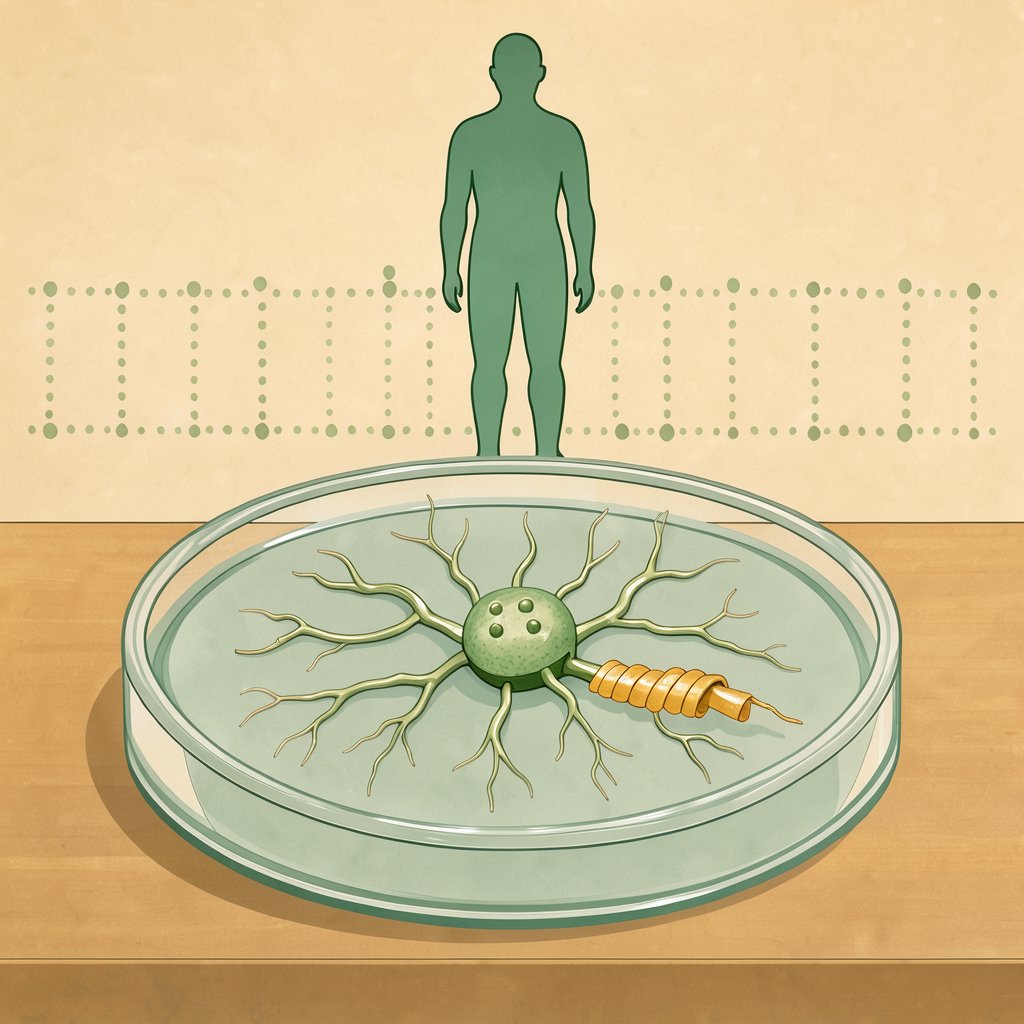
Strip away the marketing and the species-specific record in our sources comes down to a single sentence – worth reading slowly. In his survey of neurotropic mushroom research, Vishnevsky reports that extracts of Hericium erinaceus are applied as factors of nerve-cell growth and myelination – the formation of the myelin sheath – in vitro.[1] Two parts of that sentence matter equally. The subject is nerve cells, which is why lion’s mane is discussed alongside cognition at all; and the qualifier is “in vitro”, meaning in laboratory glassware and cell cultures, not in a living human body.
The book places that finding in the “neurotropic direction” of medicinal-mushroom science, beside a sobering companion set: ergot-derived neurodrugs such as hydergine and nicergoline, named in connection with dementia, and lisuride and bromocriptine, named in connection with Parkinson’s disease.[1] That is the company lion’s mane keeps in the documented research map – laboratory research on the nervous system, not a shelf of memory promises.
Here is the boundary, stated once and carried through the rest of this guide. Every mention of the nerve-growth finding in our sources carries “in vitro”, and no human-memory claim for lion’s mane exists anywhere in the base.[1] The same encyclopedia’s dedicated lion’s mane chapter exists in print at book page 168 – flanked by Hericium coralloides at page 167 and the yellow hedgehog hydnum at page 172 – but was never extracted into our knowledge base, so deeper species detail cannot be cited from it, and we will not pretend otherwise.
Lion’s Mane and Focus: What Tonic Tradition Meant by Mental Clarity
What did “focus” mean before laboratory nerve cells? In the East Asian tonic tradition it meant calm, sustainable capacity for mental work – the scholar’s ideal, not a stimulant spike. The documented tonics for that ideal were roots, and the sources describe them with a precision marketing copy rarely matches. One honest note comes first: this section is the analog frame – ginseng, rhodiola and aralia – and none of it is lion’s mane data.
Ginseng, the reference tonic, raises mental and physical performance after a single dose, especially under prior fatigue – and, the pharmacology text emphasizes, without preventing sleep and without an amphetamine-type crash.[3] That last clause is the traditional definition of a focus tonic in one line: more capacity for work, and no borrowed energy that must be repaid. It is the frame into which modern writing places lion’s mane as the mushroom branch – a placement, not a documented effect.
Two Siberian entries sharpen the picture. The handbook of Sokolov and Zamotaev says rhodiola “slightly improves memory and attention” – modest, measured wording worth noticing next to today’s bolder labels.[4] The same handbook documents aralia tincture at 30-40 drops two to three times a day, contraindicated in epilepsy, hypertension and hyperexcitability, and not taken in the evening.[4] Even for famous tonics, the tradition paired every use with cautions and timing – a standard any modern focus product can be asked to meet. Our rhodiola rosea stress guide covers that plant’s own documented record.

Inside the Fruiting Body: Polysaccharides, Terpenes and Potency Geography
Whatever a mushroom tonic was meant to do, the actives first had to come out of tough fungal tissue – so what is actually inside the fruiting body? Vishnevsky’s answer is a family-level canon. The best-studied class is the polysaccharides – glycans and glycopeptides – described as immunomodulating and antitumor, with Eastern countries producing polysaccharide-based drugs and supplements for a long time.[1] Around them sit enzymes, antibiotics and lipids, plus a terpene fraction: terpenes and sesquiterpenes are described as cancerostatic and adaptogenic – anti-stress – in action.[1]
The encyclopedia also maps where the actives concentrate – a passage best called potency geography. In cap mushrooms the highest concentration sits in the upper part of the cap and the lower part of the stem; polypores yield their inner flesh only; small thin polypores are processed whole.[1] A gatherer or a buyer who knows this reads a product label differently from one who does not.
This chemistry explains the craft that follows. Constituents locked in dense fungal tissue do not surrender to a casual dip in hot water, and different constituents extract – or degrade – at different rates. That is precisely why the tradition evolved distinct preparation forms, each matched to the material and the goal.
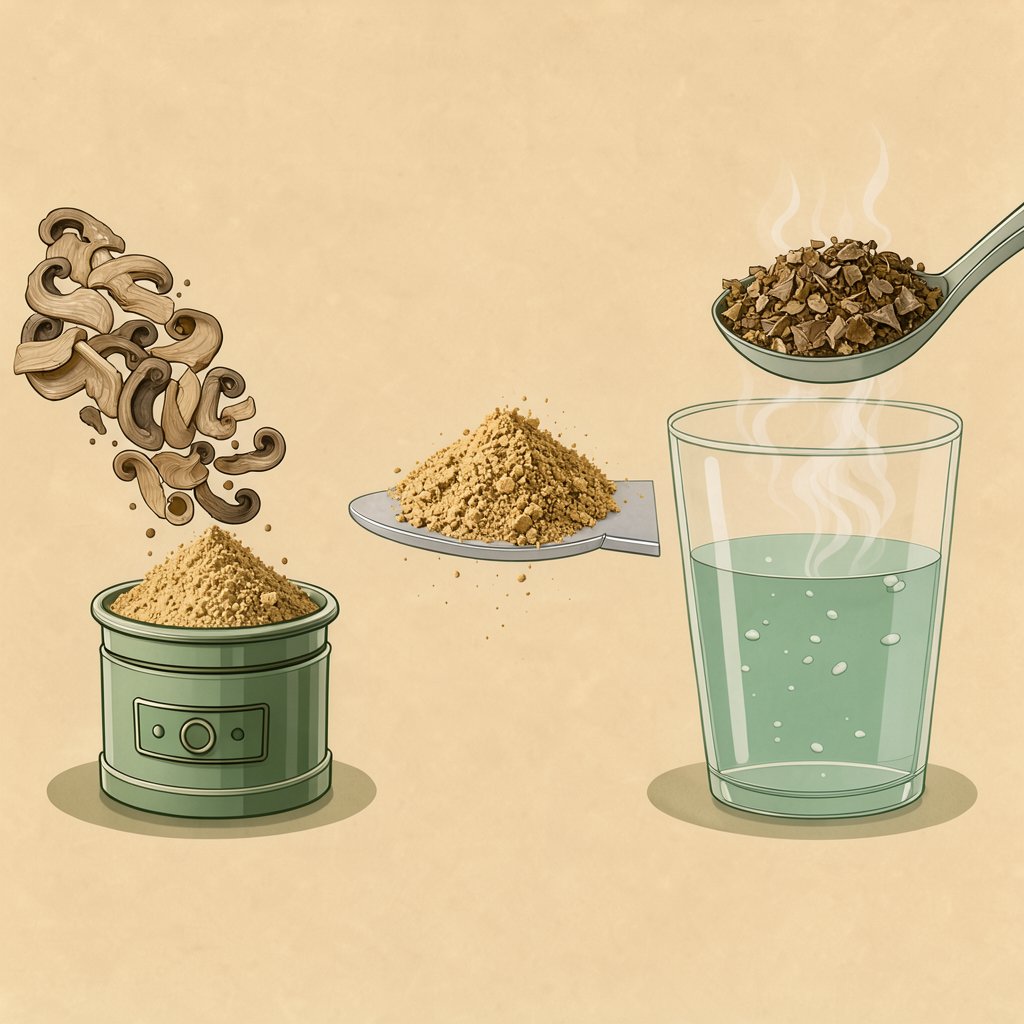
How Tradition Prepared Mushroom Tonics: Powder, Infusion, Decoction
Here is the tradition’s preparation canon – with an honest label that applies to this section and the next: these are species-general standards recorded for analog plants and for chaga, the birch polypore. Our base contains no lion’s mane dose in any form. What it does contain is a precise, cross-referenced set of traditional standards for how Eastern herbalism handled tonic material.
The powder path is the simplest. In the Traditional Chinese Medicine practice described by V.L. Kochetkov, the dried material is ground in a coffee mill and taken two to four times a day at a knife-tip dose.[5] The argument for powder is preservation: grinding keeps the full spectrum of actives intact, while brewing extracts some constituents and degrades others at different rates.[5] Kochetkov adds a market observation that has aged well: today’s producers fill the same powders into capsules and tablets – “sometimes an order more expensive”.[5]
Water extraction had graduated standards. The compendium of Kharchenko and colleagues sets the standard infusion at one tablespoon of dried herb per glass of boiling water, reduced to a teaspoon – even a half-teaspoon – for strong-acting plants, and driven to dilutions of 1:30-1:400 for potent material.[6] The infusion itself is prepared on a water bath for 15 minutes plus 45 minutes of cooling.[6] Tough material – roots, bark, dense fungal tissue – moves to the decoction: 30 minutes of simmering.[6] Factory tinctures, for comparison, were standardized at 1:5, or 1:10 for strong-acting plants.[6]
Read as a system, the canon matches force to material. Delicate herbs get brief warmth; tough tissue gets long simmering; the strongest plants get the smallest doses and the widest dilutions. The decoction, in other words, is not a longer tea – it is a different tool for a different material. Nothing in it is casual, and nothing in it is species-specific: it is the discipline we are showing, not a lion’s mane protocol.
The Mushroom Model: Soaking, Tinctures and the Long-Course Rhythm
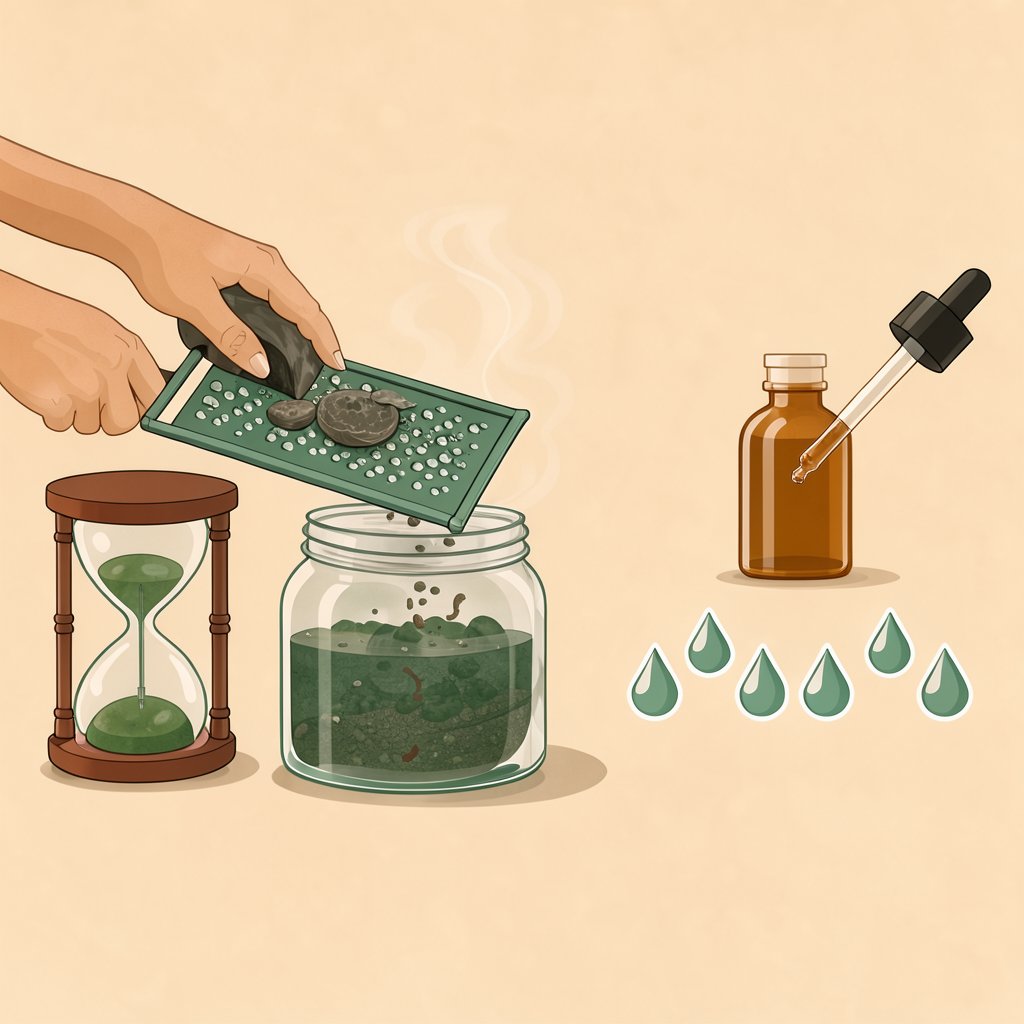
Fungal tissue is the hardest case in the canon, and tradition answered it with time and gentleness rather than force. The mushroom-specific model in our base is chaga, documented by Yu. Nikolaeva: soak the fungus for four to five hours, grate it, then steep at a 1:5 ratio at 122 F (50 C) for two days.[7] Long, moderate-temperature water extraction – that is how the tradition handled material that shrugs off a quick brew. Our chaga mushroom guide walks through that polypore’s own record.
The Austrian herbalist Maria Treben contributes the tea canon. Her standard is one heaped teaspoon per quarter liter; fresh material steeps about 30 seconds, dried about two minutes, and dense rhizomes are started in cold water, brought to a boil and held for three minutes.[8] For heat-sensitive constituents she prescribes cold maceration – eight to 12 hours in cold water – and calls the tea that combines a cold extract with a hot infusion the most complete form.[8]
Alcohol was the tradition’s other solvent. Treben’s tinctures mature in 38-40 percent fruit brandy for 14 days at about 68 F (20 C), shaken through the maceration.[8] The point is patience and reproducibility: fixed ratios, fixed time, fixed strength. A protocol, not a guess.
Finally, rhythm. The folk-practice classic of M.A. Nosal and I.M. Nosal is blunt: herbal treatment is long by nature, run in months-long courses with a 14-day break every two months, and the fresh decoction is prepared daily rather than stored.[9] Long courses, planned breaks, fresh preparation – the third leg of the craft, and still not a lion’s mane schedule anywhere in it. All of this craft also presumes one thing: good raw material.
Sourcing and Quality: From Silver-Weight Maitake to ‘Mushrooms or Plastic’
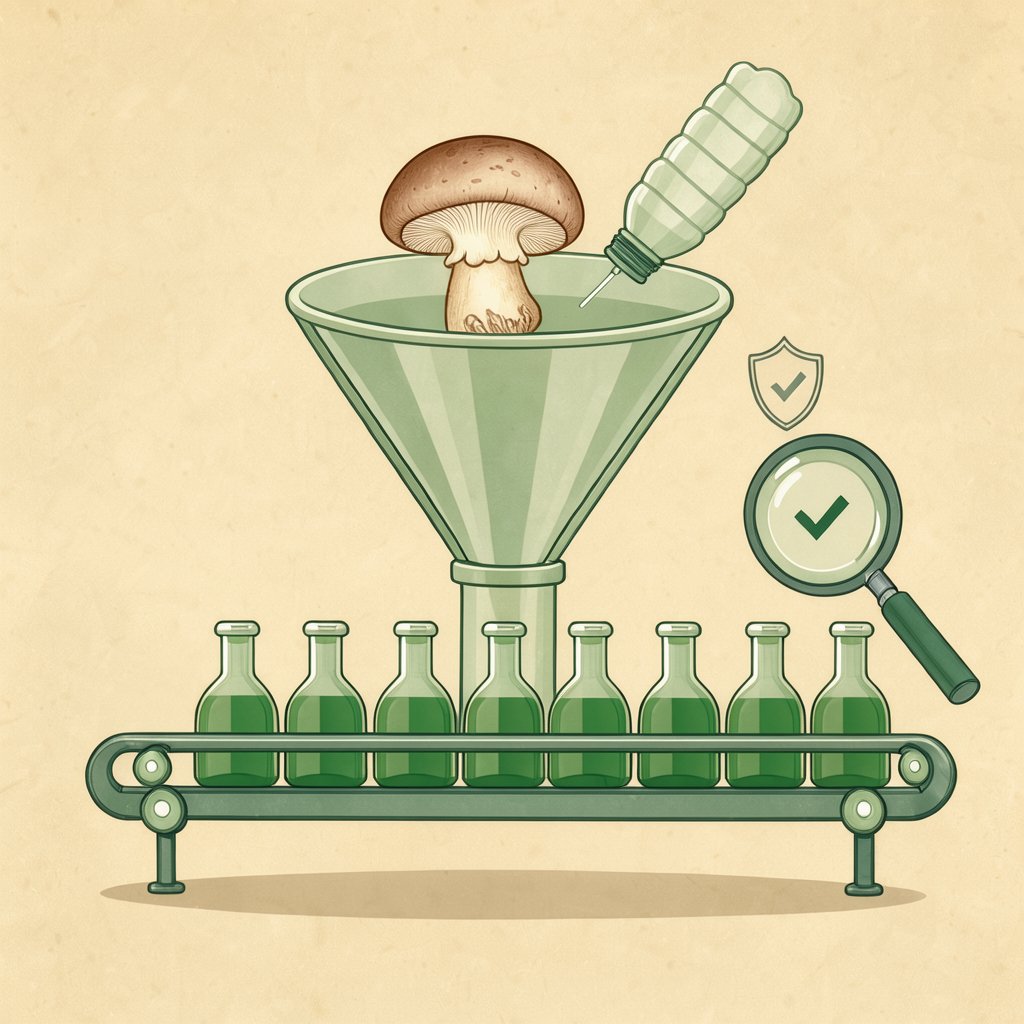
The canon prized its mushrooms in silver; the modern extract market runs on contract factories – and the sources have something sharp to say about the distance between the two. Vishnevsky notes that China’s state corporation Zhejiang Fungi Pharmaceutical Co, about 30 years on the market, supplies semi-finished extracts for most Russian mushroom preparations.[1] Concentration of supply is not a scandal by itself, but it frames the warning that follows.
That warning is quoted here for its bluntness: contract producers will extract or lyophilize “anything – mushrooms or plastic”.[1] The author’s quality humor lands on a serious point. Downstream, a jar, a label and a promise look identical whatever went into the extractor upstream.
The regulatory literature quantifies what quality has to mean. In Herbal Medicines, Joanne Barnes and Linda Anderson report that herbal ingredients commonly carry aerobic bacteria at 102-108 colony-forming units per gram; the European Pharmacopoeia sets mandatory limits for 34 pesticide residues; and the toxic metals lead, cadmium, mercury, thallium and arsenic are documented contaminants requiring limit tests.[10] Their soberest sentence concerns oversight: unlicensed herbal remedies are not quality-assessed by any authority, and the food-supplement-versus-medicine borderline is explicitly blurry.[10]
There is a checkable signal, though. Since November 2005, the UK/EU traditional herbal registration requires labels to read “a traditional herbal remedy for the symptomatic relief of…” and to add “if symptoms persist consult your doctor”.[10] Provenance and registration status are the two things a reader can actually verify before buying any lion’s mane product – the practical takeaway of this section.
Lion’s Mane Safety: The Analog Contraindication Pattern
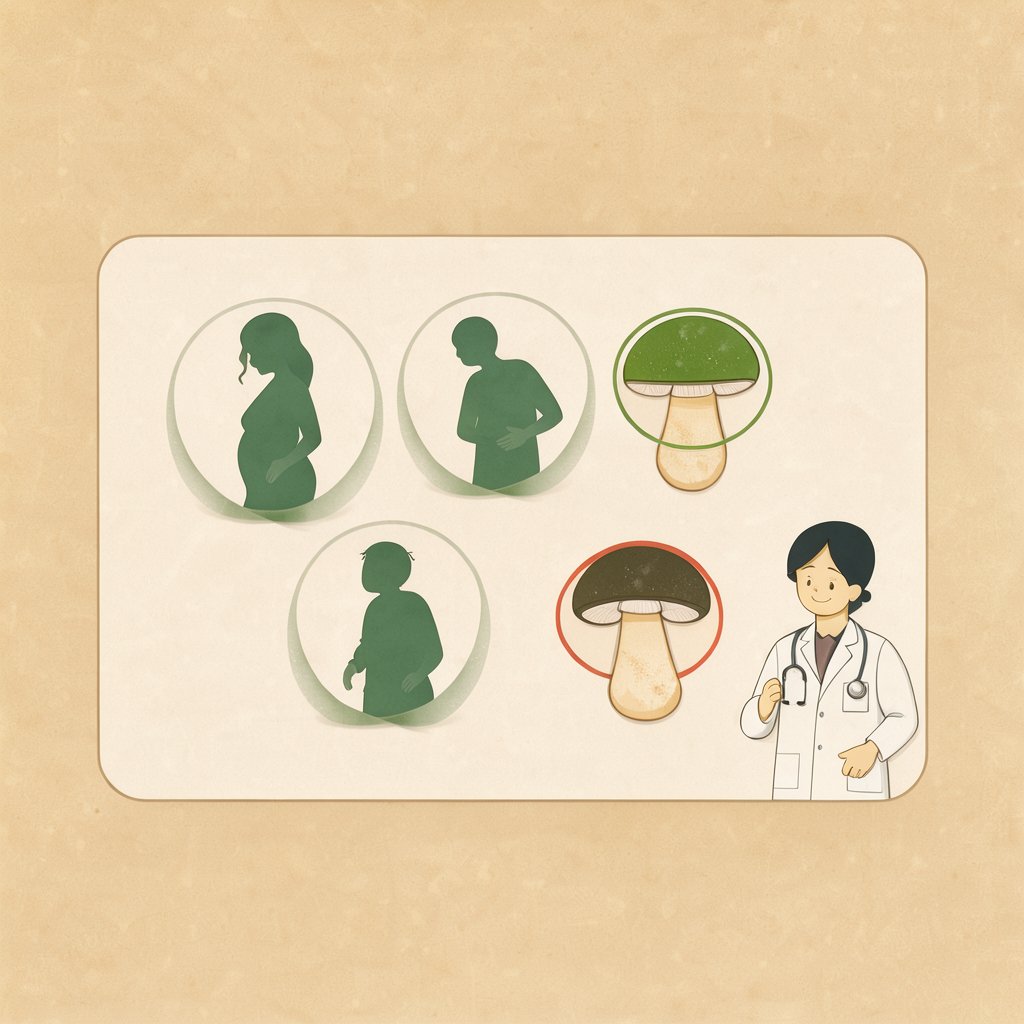
Now the admission that opens every honest safety conversation about this species: our knowledge base contains no lion’s-mane-specific contraindication, side effect, drug interaction or pregnancy note. None exists in the sources we can cite. The careful move – the one the sources themselves model – is to borrow the documented caution pattern of the closest East Asian tonics and label the borrowing.
That pattern, from T. Litvinova’s schisandra monograph, reads like a proper tonic safety sheet: contraindicated in stomach ulcer, chronic liver disease, epilepsy and hypersensitivity, in pregnancy and lactation, and for children under 12.[11] Its side-effect list includes tachycardia, allergic reactions, sleep disturbance, headache and raised blood pressure; in 4 percent of users it records lethargy and central-nervous-system depression; overdose over-excites the nervous and cardiovascular systems; and a doctor’s consultation is required before starting.[11] We present this as the analog pattern – the shape of caution the tradition applied to strong tonics – not as lion’s mane data.
The mushroom canon adds freshness rules of its own. Old fruiting bodies accumulate cholesterol, choline and alkaloids that cause digestive and circulatory upset; the encyclopedia’s advice is to buy fresh, closed-cap specimens, and to remember that metal-can conserves lose vitamins and gain lead and mercury.[1] Yes, that is the edible champignon chapter: the same pages set the mushroom aside for people who need light food and add a folic-acid caution for severe cancer patients – even the supermarket mushroom gets a caution list.
For balance, the book’s general claim, at its true resolution: for preparations from edible and other mushrooms, no adverse effects or toxic action have been identified.[1] Note the two edges of that sentence – it is a general statement about mushroom preparations, and even so the champignon still got its cautions. The reasonable synthesis is to treat lion’s mane with the respect the tradition gave every tonic. This guide is educational; it is not intended to diagnose, cure, treat, or prevent any disease, and it is no substitute for advice from a qualified healthcare professional.
What the Sources Don’t Say: Honest Gaps and FAQ
A trustworthy source tells you what it does not know, and here the not-knowing is documented as carefully as the facts. We verified each silence against the full retrieval base, not just the top search results. Before the frequently asked questions, here is the complete gap list for this species – five silences worth naming.
- No classical TCM record: the Chinese names (hou tou gu, shan hou gu), the temple anecdotes and any dynastic-era lion’s mane citation are absent from the base.
- No dosing: not a single lion’s mane dose, preparation form, timing or course duration exists anywhere in the sources.
- No species-specific safety sheet: no contraindications, side effects, drug interactions or pregnancy data for lion’s mane.
- No modern isolate chemistry: the base carries none of it, so our mechanism wording stays exactly at the book’s “growth and myelination factors in vitro”.[1]
- Two extraction gaps: Vishnevsky’s dedicated chapter (book p. 168) exists in print but not in the base, and the 2009 TCM-mushroom monograph of Li Yu and colleagues is present only as a bibliographic header.
None of these silences makes lion’s mane suspect; they make most shelf copy suspect. What stands is a 2,000-year East Asian mushroom canon, one verified in vitro nerve fact, a fully labeled analog tradition of preparation and caution, and named boundaries. That is the honest picture of the lion’s mane mushroom – and it is enough to ask better questions. Before starting any tonic, lion’s mane included, speak with a healthcare professional – especially in pregnancy or lactation, for children under 12, or alongside any medication.
Frequently Asked Questions
Did ancient Chinese texts mention lion’s mane?
Not in our sources – and we checked the full corpus, not just the top results. The Shennong Bencao Jing canon documents reishi, shiitake and maitake in detail, but no classical TCM record of lion’s mane appears anywhere in the base.[1] The tradition frame is real; this species’ dynastic citation is not documented in it. For the wider record, see our functional mushrooms traditional uses guide.
Is there a traditional lion’s mane dose?
No – the honest answer is that no lion’s mane dose, form, timing or course length exists in our sources. The numbers in this guide are species-general tradition: a knife-tip of powder two to four times a day, one tablespoon per glass for infusions, 30-minute decoctions for tough tissue.[5][6] For choosing a product by its label instead of its dose, see the adaptogens buyer’s guide.
What does the verified lion’s mane fact actually say?
Exactly this: extracts of Hericium erinaceus are applied as factors of nerve-cell growth and myelination in vitro.[1] “In vitro” means in laboratory cell cultures and glassware, not in the human body – and the book itself writes the qualifier in. No human-memory claim for lion’s mane exists anywhere in our base. Browse the adaptogens and herbal wisdom hub for the surrounding tradition.
Is lion’s mane safe?
The base holds no species-specific safety sheet for lion’s mane – no contraindications, side effects or interaction data. The documented analog pattern (schisandra) lists stomach ulcer, liver disease, epilepsy, pregnancy, lactation and children under 12 among its cautions, and requires a doctor’s consultation before starting.[11] Treat that as the shape of caution, and read labels with our best adaptogen supplements guide.
How did tradition prepare mushroom tonics?
With patience matched to the tissue: dried powder at a knife-tip dose two to four times a day, infusions at one tablespoon per glass, 30-minute decoctions for tough material, and for chaga a four-to-five-hour soak followed by two days at 122 F (50 C) at 1:5.[5][6][7] Tinctures matured 14 days in 38-40 percent fruit brandy.[8] The chaga mushroom guide shows the full model.
What should I check before buying a lion’s mane extract?
Two checkable signals: provenance and registration status. The pharmacopoeial literature documents bacterial loads, 34 capped pesticide residues and toxic-metal limits in herbal ingredients, and states plainly that unlicensed remedies are not quality-assessed by any authority.[10] A UK/EU traditional-herbal registration label is the visible marker. Our adaptogens buyer’s guide turns this into a step-by-step audit.
Sources
- [1] Vishnevsky M. — Medicinal Mushrooms: The Great Encyclopedia (2014) — the neurotropic-research survey with the in vitro lion’s mane finding (p. 22), the genera activity list (p. 20), the Wu Xing and Shennong Bencao Jing canon, the rarity economy, the Zhejiang Fungi sourcing note, the champignon freshness rules and the general safety claim.
- [2] Ivanov A.I. — Edible, Poisonous, Medicinal and Cultivated Mushrooms of the Middle Belt of European Russia (2012) — the morphology chapter giving lion’s mane as the textbook example of a spiny, toothed spore-bearing layer, with no medicinal content for the species.
- [3] Vostrikov L.A., Konstantinov A.A., Fruentov N.K. — Ginseng and Its Brothers (1979) — ginseng’s single-dose effect on mental and physical performance under prior fatigue, without preventing sleep and without an amphetamine-type crash.
- [4] Sokolov S.Ya., Zamotaev I.P. — Handbook of Medicinal Plants (1984) — rhodiola’s “slightly improves memory and attention” wording and the aralia tincture entry with its drops, contraindications and not-in-the-evening timing.
- [5] Kochetkov V.L. — Medicinal Plants in Traditional Chinese Medicine (2002) — the powder canon: coffee-mill grinding, knife-tip doses two to four times a day, the full-spectrum argument and the capsule-price observation.
- [6] Kharchenko N.S. et al. — Wild Medicinal, Cereal and Garden Plants and Their Use (1988) — infusion and decoction standards: tablespoon-per-glass dosing, water-bath timing, dilution ratios for potent plants and 1:5 factory tinctures.
- [7] Nikolaeva Yu. — Birch, Fir and Chaga Mushroom (2012) — the tough-fungal-tissue extraction model: a four-to-five-hour soak, grating and a two-day steep at 1:5 at 122 F (50 C).
- [8] Treben M. — Health from God’s Pharmacy (2004) — the tea canon: one heaped teaspoon per quarter liter, cold maceration for heat-sensitive constituents, the mixed cold-and-hot tea and 14-day brandy tinctures.
- [9] Nosal M.A., Nosal I.M. — Medicinal Plants and Ways of Folk Use — the course rhythm: months-long courses with a 14-day break every two months and fresh decoctions prepared daily.
- [10] Barnes J., Anderson L. — Herbal Medicines — the regulatory and quality frame: microbial and pesticide limits, toxic metals, the unlicensed-remedy status and the November 2005 traditional-herbal registration labeling.
- [11] Litvinova T. — The Great Medicine of Chinese Emperors for 1000 Diseases. Schisandra (2012) — the analog tonic caution list: contraindications, side-effect profile, the 4 percent lethargy figure and the required doctor’s consultation.
Where to go next: this lion’s mane guide belongs to our adaptogens and herbal wisdom hub. To keep exploring the medicinal-mushroom family, read the functional mushrooms traditional uses overview and the reishi evening tea ritual; for the sourcing story of a kindred polypore, see the chaga mushroom guide; for a tonic root with documented cautions, the rhodiola rosea stress guide; and before spending money, run any product through the adaptogens buyer’s guide and our best adaptogen supplements of 2026. The reishi supplements versus reishi tea comparison shows the same checklist applied to a sister species.
How we researched this: built from a local library of 1,137 wellness books, queried through an offline retrieval system with no internet sources. Every factual claim above was checked against the cited book passage before publication. Where the base held no answer – a lion’s mane dose, a species safety sheet, a classical citation – we named the gap instead of filling it; the coverage verdict for this topic is medium, with exactly one direct species fact. The dedicated lion’s mane chapter of the key encyclopedia exists in print but was never digitized into the base – one honest reason the species record here stays thin.
