
Educational content only — not medical advice. See our full Medical Disclaimer and Affiliate Disclosure below.
Key Takeaways
- Reishi supplements vs reishi tea is a lifestyle comparison, not a chemical one: the estimated 400 active components belong to the mushroom itself, and no source in our library establishes a dose equivalence between a brewed cup and a capsule.[1]
- The tea tradition exists because of texture, not taste: the fruiting body is woody and corky, reishi was never eaten fresh, and drying, powdering and hot-water preparation became the original delivery format.[2]
- Traditional home protocols were calendared rather than casual — a steeped lingzhi tea twice a week, a powder decoction once daily, and a weekly main dish of lingzhi cooked with tender pork.[6]
- Safety framing from the sources: polysaccharides are described as medically safe, effects depend on course duration, and traditional allergy care ran one to two years — so talk to a clinician before any long course.[2]
The reishi supplements vs reishi tea question looks thoroughly modern, but the mushroom answering it is not: Chinese and Japanese emperors were drinking reishi tea and taking reishi elixirs to restore vitality and promote longevity roughly two thousand years before the first capsule rolled off a production line.[1] Today the same fungus, Ganoderma lucidum, sits on shelves as dried slices, powders, instant coffees, liquid extracts and capsules — and the format you choose changes your daily ritual far more than it changes the mushroom.[1][2] This guide compares the traditional tea route with the modern supplement route, using only what the reference books in our library actually document. Where the sources are silent — on doses, equivalences and formal warnings — we say so plainly instead of filling the gaps.
Here is the short version of what you will find below. The compound story is format-independent: reishi carries an estimated 400 biologically active components in whatever form you buy it, and the reishi extract in a capsule descends from the same hot-water logic that produced the emperor’s cup.[1][2] What actually differs between tea and capsules is preparation effort, cadence, taste and stacking potential — lifestyle trade-offs, not chemical ones. We also cover the two hybrids that sit between the columns: the mushroom latte and reishi coffee. This article is educational content, not medical advice; it is not intended to diagnose, treat, cure or prevent any disease.
What Is Reishi? The ‘Mushroom of Immortality’ Behind Both Formats
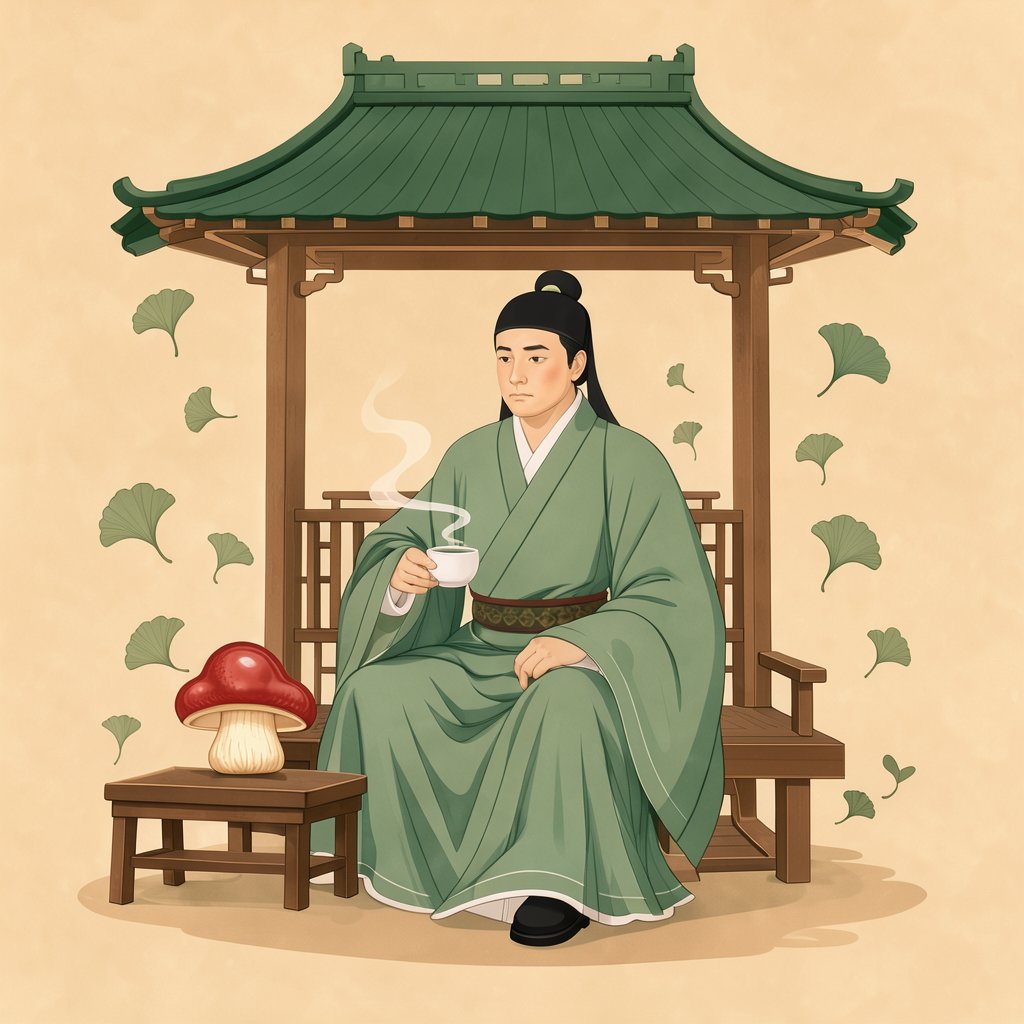
Reishi is the common Western name for Ganoderma lucidum, a red-varnished, kidney-shaped shelf fungus that grows on wood. Too tough for the table, it is one of the most extensively documented medicinal mushrooms in East Asian tradition, with a recorded history of preparations — teas, decoctions, powders and elixirs — stretching back more than two thousand years.[2] Both modern formats, the steeped cup and the capsule, descend directly from that single tradition.
The names map the geography. In China and Korea the mushroom is called lingzhi, the “herb of immortality”; in Japan it is reishi, the “mushroom of spiritual power,” and also mannentake, the “mushroom of ten thousand years.”[2] Eastern tradition adds one more epithet — the “mushroom of happiness” — and the documentary trail is genuinely old: a Chinese medical treatise created roughly two thousand years ago already described the mushroom, and peoples of Southeast Asia have used it medicinally for more than two millennia.[1][2][3] The habit reached the very top of society, with emperors making reishi drinks a regular practice.[1]
The classical ranking was equally emphatic. Traditional Chinese Medicine and Tibetan medicine both placed lingzhi in their highest category — chosen for breadth of action and the absence of side effects — and the TCM record lists six classical properties: cardiovascular support rated an order of magnitude above shiitake, strong antitumor action, mental illnesses (including a seventeenth-century case in which the Mikado’s heir’s epilepsy eased after lingzhi use — the first noted application), allergic diseases such as bronchial asthma and atopic dermatitis, all lung diseases, and an uplift of spirit and mood.[2] In Thailand the mushroom served as everyday “vitamins” for immunity in allergy sufferers, and lingzhi even appears among the classical Chinese cultural symbols as one of the “eight landscapes.”[2][4] Yet the most celebrated medicinal mushroom of the East was never actually eaten fresh — the paradox the next section explains.
Why Reishi Was Never Eaten Fresh — and Why That Created the Tea
The material answer comes before any philosophy: reishi simply cannot be chewed. The fruiting body is woody and corky — Ivanov describes a spongy-cork consistency — which is why the mushroom was never used culinarily and never eaten fresh.[2][3] Home use therefore forces a processing chain: drying the slices, grinding them to a powder, and delivering the result with hot water. The decoction is not a stylistic choice; it is the original delivery format that the mushroom’s own texture demanded.
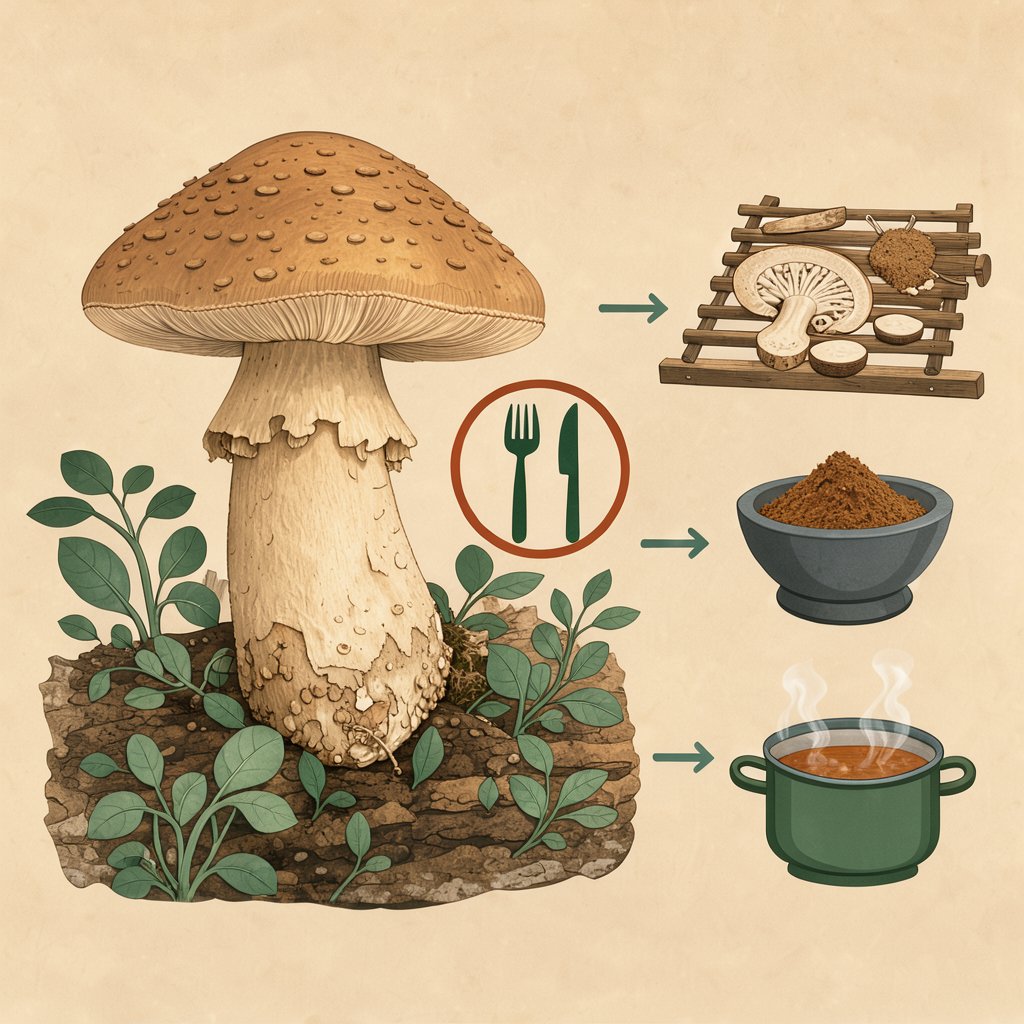
The botanical record explains why few people ever meet it fresh in the wild. In Russia, Ganoderma lucidum is rare enough to be listed in regional Red Books, so no wild-harvesting culture ever formed there.[2] Conifer forests host look-alike species — G. tsugae, G. valesiacum and G. carnosum — and Chinese pharmacists judge G. tsugae “not inferior medicinally” to G. lucidum itself.[2] The hot-water habit extends across the genus: for the sister species Ganoderma applanatum, Eastern medicine documents a hot-water infusion tradition, mushroom tea as the usual form for tonicity and fatigue, and use both in dietary supplements and as an additive to tea and coffee — a same-genus precedent we always cite with precise attribution, never as a lucidum claim.[2]
Once the woody slices are dried and simmered, the container stops being the story and the cargo becomes the question. Processing is not preparation overhead — it is the whole reason a reishi product exists in any recognizable form, from loose slices to capsule powder.[2][3] Whatever shelf the mushroom lands on, the active components inside are the mushroom’s own, and that compound story never changes with the format.
What Stays the Same in Every Format: The Compound Story
Start with the headline number, attributed precisely: reishi contains an estimated 400 biologically active components, by Mercola’s count.[1] The load-bearing fraction is the polysaccharides. Vishnevsky’s encyclopedia describes lingzhi as containing the most active polysaccharides of all medicinal mushrooms and plants — compounds reported to activate macrophages and T-lymphocytes, stimulate interferon production and improve cellular immunity, with, in the encyclopedia’s words, “no toxic effect on the human body” — medically safe.[2] Ganoderic acids, a triterpene group, are reishi’s exclusivity claim: this is the only mushroom source, and their molecular structure resembles that of steroid hormones.[2]
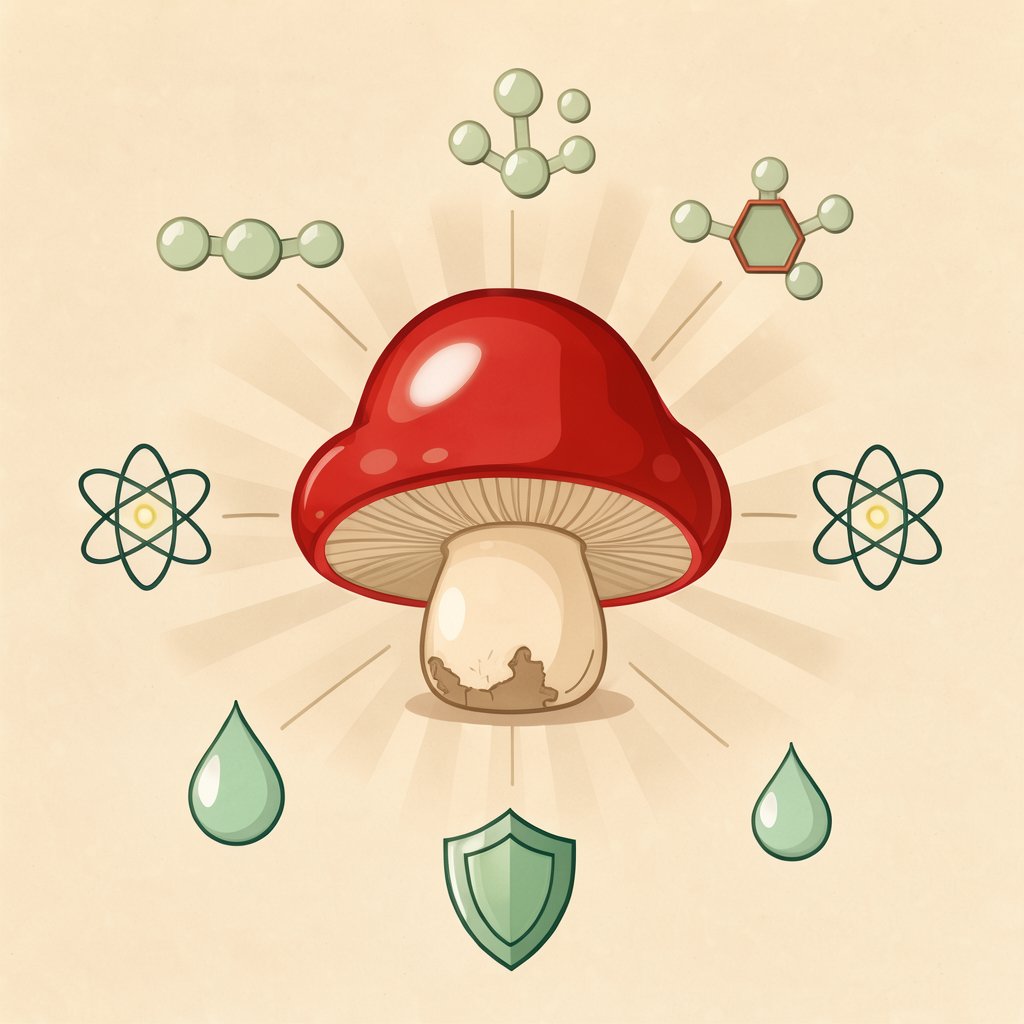
The documented actions radiate from those two families. Mercola describes triterpene-driven activation of macrophages, natural killer cells, T- and B-lymphocytes, with cytokine production and anti-inflammatory activity, plus inhibition of histamine release from mast cells — allergy control aimed at the cause rather than the symptoms.[1] Ganoderic acids isolated by Chinese scientists lowered blood cholesterol and regulated blood pressure in the research Ivanov cites (Li Yu, 2010), and they are credited with anti-allergic action and improved oxygen utilization.[2][3] The spore nucleosides — adenine, adenosine, uracil RNA — add the base’s only clotting-related fact: adenosine actively prevents thrombus formation.[2]
The supporting profile is unusually broad. Organic germanium runs at roughly ten times ginseng levels and is described as helping macrophages envelop tumor cells while stimulating interferon; triterpenoids raise stress resistance, boost superoxide dismutase, lower blood lipids, normalize blood pressure, calm the nervous system and support the liver; and the encyclopedia also records suppression of pneumococcus, group A streptococci, white staphylococcus and the influenza virus, alongside vitamins C and D, a broad mineral spectrum and a full amino-acid profile.[2] Ivanov adds the gentle framing: mushroom polysaccharides provide soft, non-aggressive immunomodulation, a useful complement to chemotherapy that softens its impact — a context in which Kashnitsky’s TCM manual likewise describes herbal support protecting the immune system of cancer patients during chemo- and radiotherapy.[3][5] None of this is a promise; it is the pharmacology summary the reference books themselves record.[1][2]
That breadth is exactly why the format debate stays honest. The compounds belong to the mushroom, not to the delivery system, so a reishi extract, a steeped tea and a simmered decoction all begin from the same cargo.[1][2] What the format changes is delivery, ritual and cadence — the three axes this article compares from here on. The first stop is the original one: the traditional tea route and its documented rhythm.
Reishi Tea and Decoction: The Traditional Route and Its Cadence
The most concrete traditional cadences in our library come from Henry B. Lin’s Chinese Healing Therapies, a collection of home-use recipes verified against the original-language edition. Lin’s protocols are calendared and gentle: steep lingzhi to make a cup of tea and drink it twice per week; take lingzhi powder, boil it as a tea or decoction, and drink that decoction once daily (the recipe sits in a prevention-minded chapter, next to advice that green tea is antimutagenic); and use a little lingzhi powder to cook tender pork as a main dish, where once a week is enough.[6] These are frequencies, not brewing specifications — the book records no steep times, water volumes or gram amounts for a Ganoderma lucidum preparation.[6] One translation warning is worth passing on: the English edition garbles these fragments by merging a neighboring almond-and-pear recipe into the lingzhi line, so the “30 g / 2 pears / 30 minutes” figures circulating from it are not reishi facts.
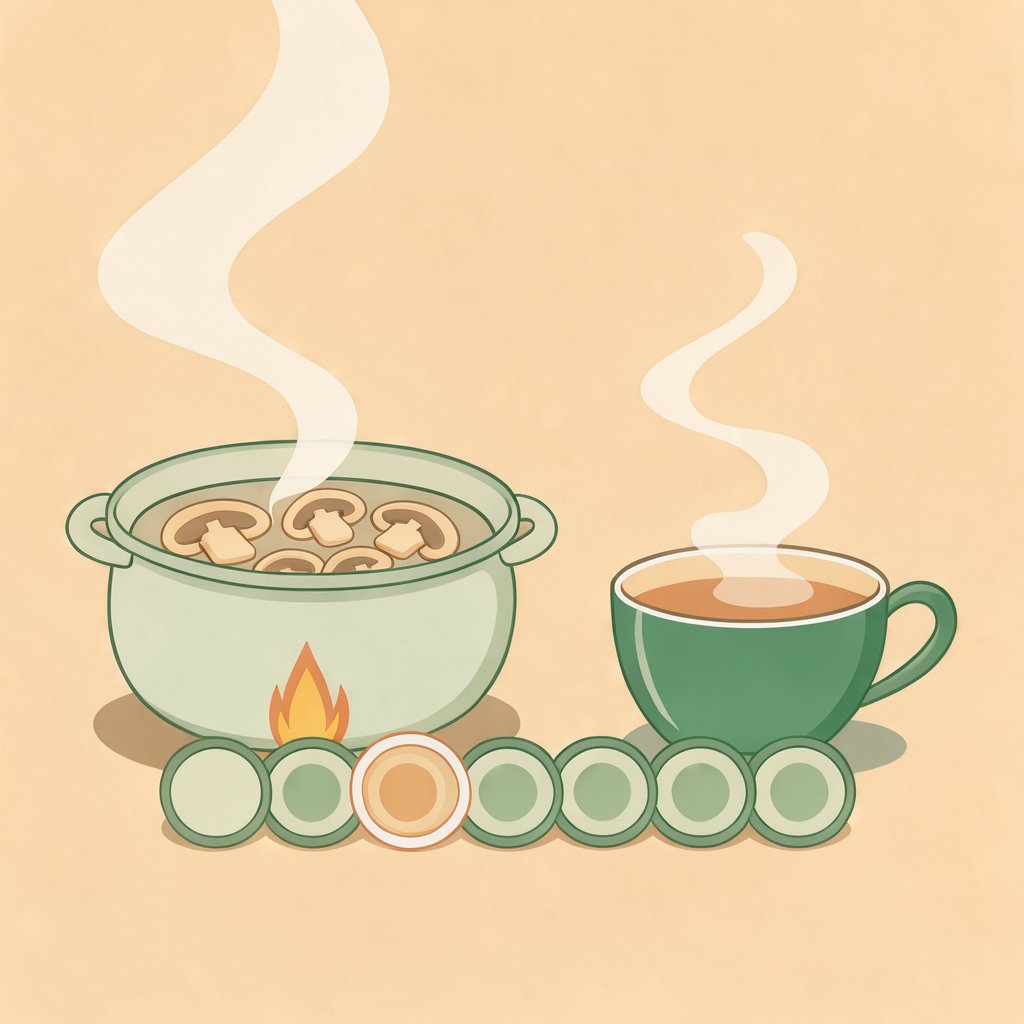
The modern bridge is Joseph Mercola’s. “Following the example of the ancient emperors, I like to make drinks from reishi powder,” he writes in Herbs and Spices — the emperor’s cup, translated into a contemporary kitchen.[1] The only gram-level figure anywhere in our base belongs to the sister species: powdered Ganoderma applanatum fruiting bodies at 2–5 g per day, recorded as an analgesic and antipyretic practice — a same-genus reference point that must never be presented as a G. lucidum dose.[2] For lucidum itself, the honest statement is that the sources give cadences and habits, not milligrams.
Read the traditional protocols as history, not prescription. Lin recorded what TCM households actually did with a mushroom they could not chew; nothing here tells you to adopt a twice-weekly or daily schedule for any health purpose, and long-term herbal routines belong in a conversation with your clinician.[6] With that frame set, the powder in those old decoctions now has a modern descendant that takes one minute and a blender — the mushroom latte.
How to Make a Reishi Latte: The Modern ‘Emperors’ Drink’
Mercola’s mushroom latte is the powder format’s modern ritual — the emperor’s cup with a blender, in his own framing.[1] The recipe, from Herbs and Spices, serves one and doubles as the most approachable entry point to reishi powder. Assemble the ingredients first: one cup of coconut, hemp or nut milk; one teaspoon of mushroom powder — reishi alone, or shiitake, turkey tail, lion’s mane, chaga, or a mix; one teaspoon of cocoa; 1/4 teaspoon of ground cinnamon; and, optionally, half to one teaspoon of manuka honey.[1]
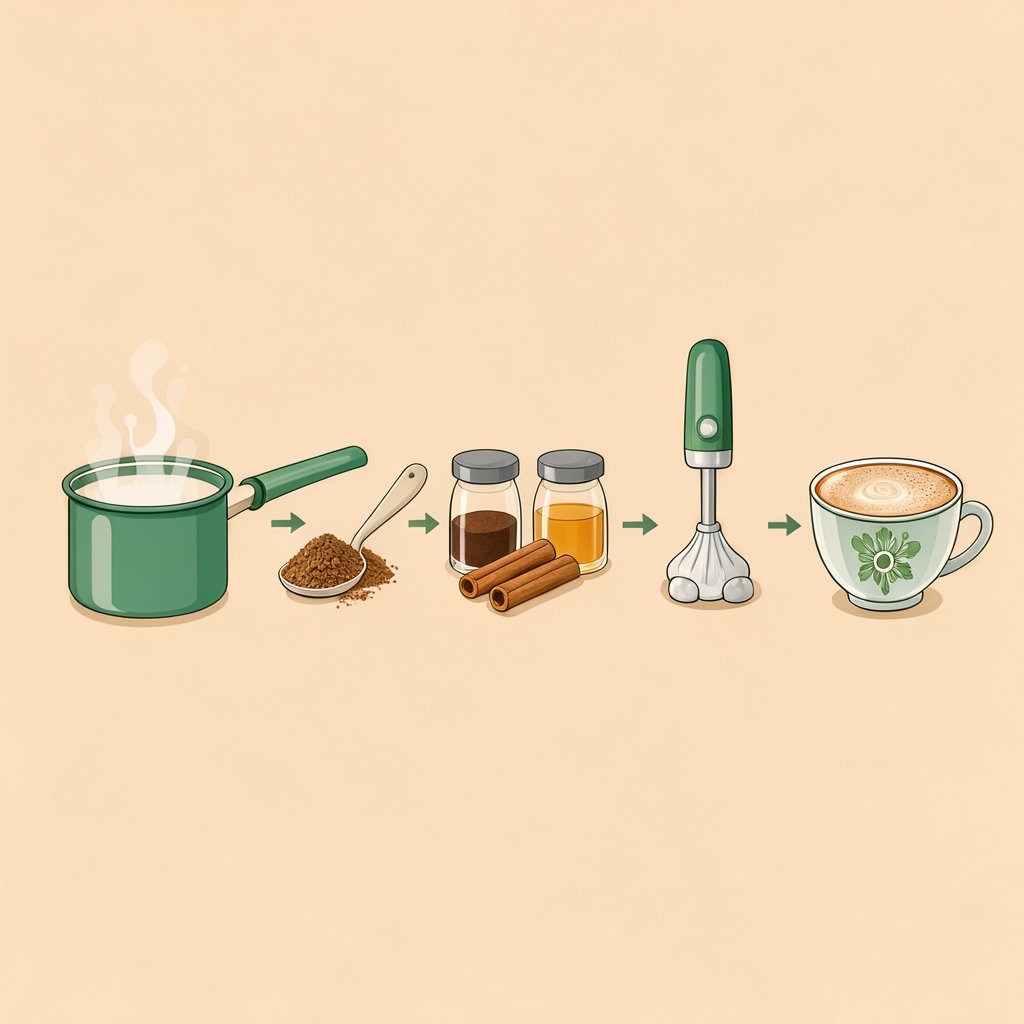
Step 1 — Combine in one pot. Pour the plant milk into a small saucepan and add the mushroom powder, cocoa, cinnamon and honey together rather than in stages. Combining everything before any heat touches the milk lets the powder disperse evenly, which is what keeps the finished drink smooth instead of clumpy. Mercola’s instruction is explicit that everything goes into one pot.[1]
Step 2 — Heat low and slow. Warm the pot over low heat, stirring slowly and steadily — this is a steep-and-sip drink, not a boil. Low, patient heat protects the aroma of the plant milk and cocoa while the mushroom powder infuses into the liquid. This is the step where patience genuinely pays for itself.[1]
Step 3 — Blend one minute, until foamy. Move the mixture to a blender and run it from low to high for one minute, until the latte is foamy, then pour. If the drink comes out too thick, thin it with a little boiling water; if you own a milk frother, it stands in for the blender entirely.[1] The foam is the signature — it is what turns a mushroom drink into a latte.
The numbers per serving stay modest: 65.8 kcal, 5.2 g fat, 4.1 g carbohydrates (of which 2 g fiber and 1 g sugar), and 0.7 g protein.[1] Mercola attaches no standardized reishi dose to the drink — one teaspoon of powder is a recipe measure, not a milligram specification, and we flag that honestly rather than convert it. For readers who love the ritual of a warm cup, this format inherits the tea tradition directly; for readers who will not give up their coffee, a third format makes its case next.
Reishi Coffee: The Case for a Third Format
Boris Skachko’s Coffee, Reishi, Aloe Vera and Your Health is devoted to a single format: instant coffee carrying reishi extract. The book’s arithmetic belongs to it alone — coffee brings roughly 300 active substances to the cup, and the reishi extract adds about 200 more useful components — numbers we keep strictly separate from Mercola’s ~400-component count for the whole mushroom, because the two authors count different things.[7] Skachko also describes 132 ways to prepare the drink, which tells you how developed this corner of the shelf has become.[7] One honest caveat: the book promotes a specific reishi-coffee product, so we cite its figures with attribution rather than as independent evidence.
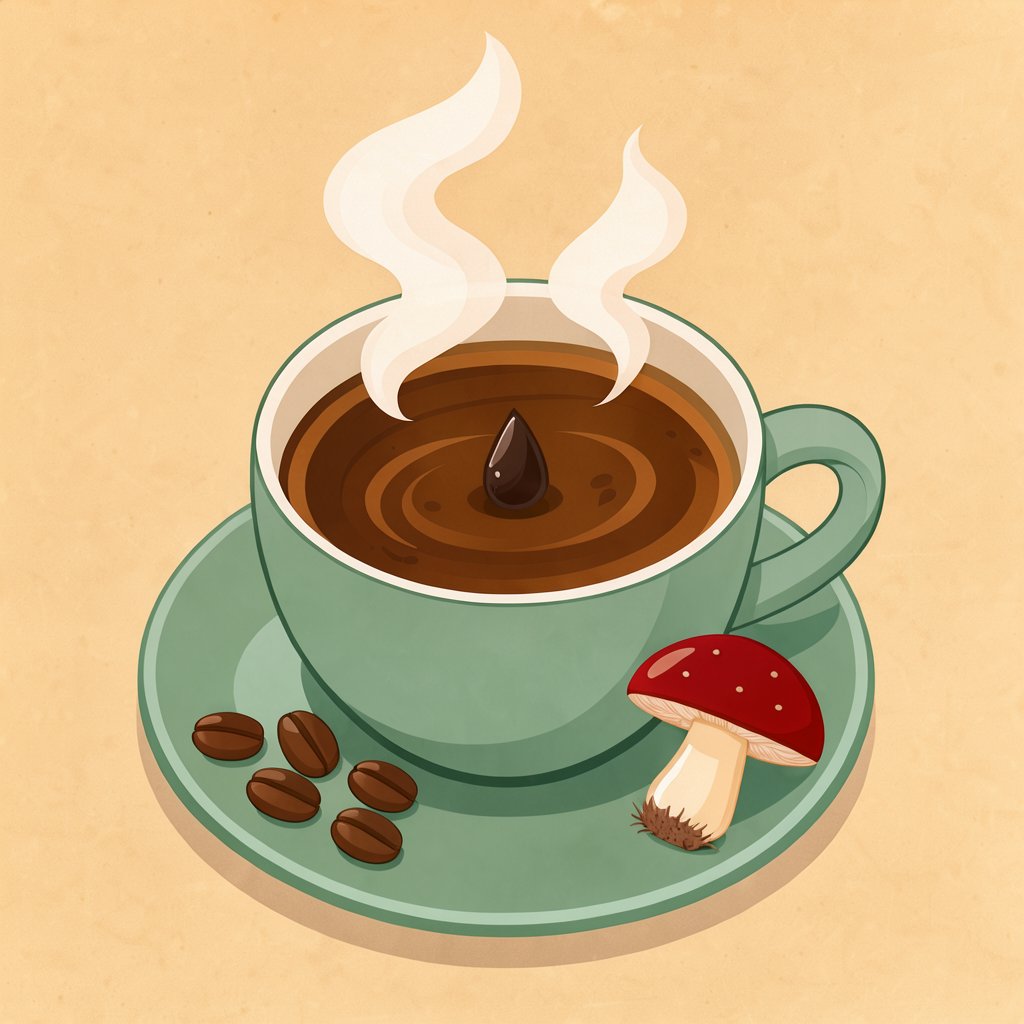
The format itself has older roots than the marketing. Vishnevsky’s encyclopedia notes that in Eastern medicine the related Ganoderma applanatum has long served as an additive to tea and coffee — a same-genus precedent for folding the mushroom into a daily brewed habit.[2] We deliberately leave out Skachko’s blood-pressure observations (110/70 to 120/80 mmHg): they describe his coffee, not reishi, and using them as reishi evidence would be dishonest. Drinks now cover ritual and habit from three directions — steeped, latte-whipped and brewed — which leaves the shelf’s most convenient corner: capsules and extracts.
Capsules, Extracts and Stacks: The Convenience Shelf
Mercola names the two modern options side by side: dried reishi slices and powder for teas, drinks and dishes, and capsules as dietary supplements.[1] The extract economy behind those capsules is older and larger than most shoppers realize. “In Japan and China, extract of the lacquered polypore is used for almost any disease — but each disease has its own dosing methodology,” Vishnevsky writes, describing a practice in which the format is standardized but the dosing is condition-specific and professional.[2] The industry’s raw material is traditionally the fruiting body, less often mycelium from submerged cultivation, grown on wood-processing waste, in a reishi-preparations market he estimates at roughly two billion US dollars per year.[2]
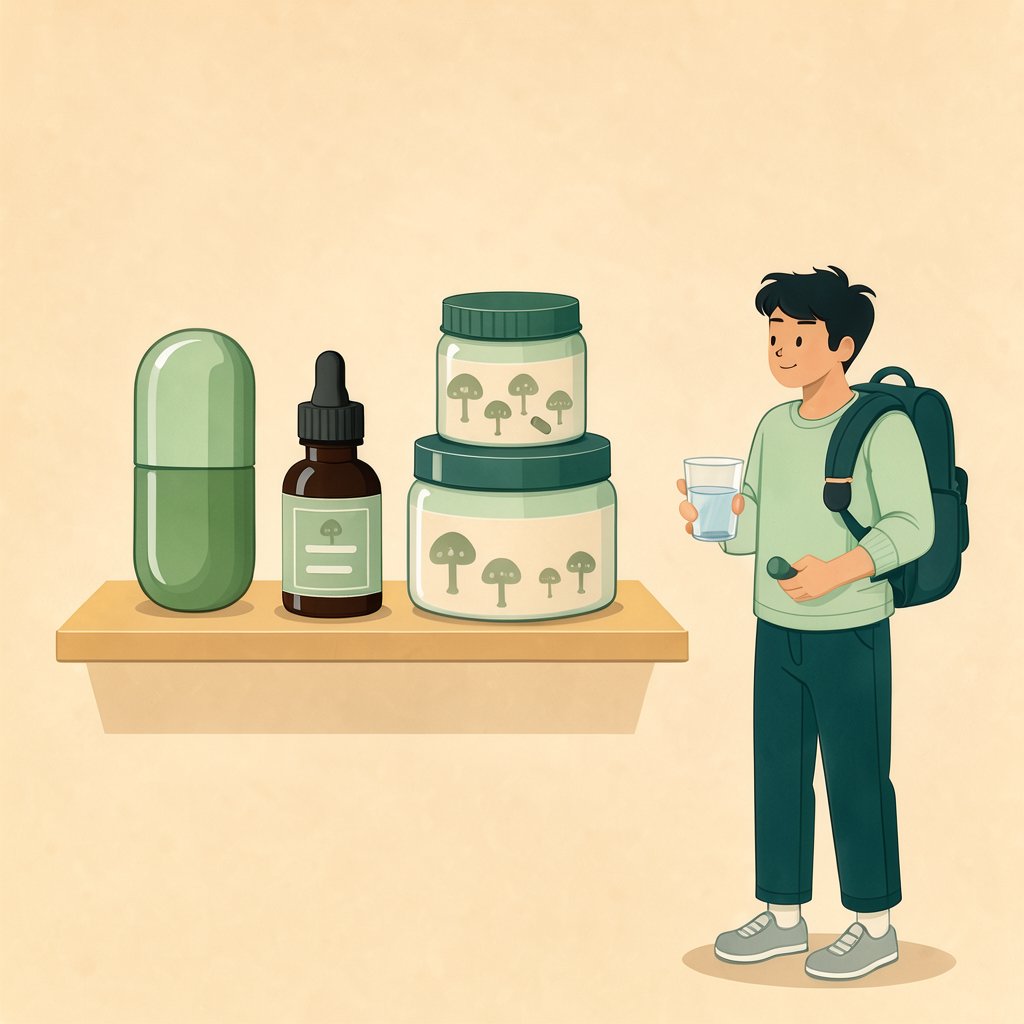
The capsule shelf also runs on stacking culture. Steven Gundry’s personal supplement list in The Longevity Paradox pairs reishi with chaga, lion’s mane, cordyceps, coriolus and turkey tail; the AminoGold catalog sells capsule complexes stacking reishi with shiitake, maitake and cordyceps; and reishi appears in the adaptogen lists of Izabella Wentz’s Hashimoto Protocol and Vasily Novoselov’s Why We Age, alongside ashwagandha, astragalus, ginseng and rhodiola.[8][9][10][11] Anthony William’s Brain Saver simply puts it on a wild-foods list.[12] What none of these sources provides is label arithmetic: no milligrams per capsule, no extract ratio such as 10:1, and no grams-per-day figure for Ganoderma lucidum exists anywhere in the base — a gap we state rather than fill.
Convenience, in other words, is the capsule’s honest selling point, and the stacker’s daily habit is its documented cadence.[8][9] The reishi tea vs capsule choice therefore comes down to questions the next section puts side by side. Those questions are about ritual, effort and habit — because the sources support no dose-for-dose swap between the columns.
Reishi Tea vs Reishi Supplements: Ritual, Effort and Habit Compared
Here is the honest core of the comparison, stated as an explicit editorial note: nowhere in our source library does a capsule-versus-tea dose equivalence exist — no extract ratio, no milligrams per capsule, no grams of dried mushroom per cup for Ganoderma lucidum. The formats are therefore lifestyle trade-offs, not dose-matched substitutes, and the table below compares them only on criteria the sources actually document. The who-fits row is our editorial inference from documented habits, and we label it as such.
| Reishi supplements vs reishi tea | Tea, decoction and drinks | Capsules, extracts and stacks |
|---|---|---|
| Heritage and tradition | The emperors’ regular drink, the highest TCM/Tibetan category, 2,000+ years of records[1][2] | A modern supplement shelf with an old extract economy: standardized reishi extract dosed per condition in Japan and China[2] |
| Preparation effort | Steeping or simmering, straining, cleanup — or the one-pot, one-minute latte below | A capsule and a glass of water; no preparation at all |
| Typical documented cadence | Steeped tea twice a week; powder decoction once daily; a weekly lingzhi dish[6] | A daily supplement habit, as in practitioner stacks[8] |
| Taste and ritual | A woody, bitter brew with a warm-cup ritual; the latte softens it with cocoa and cinnamon[1] | Tasteless; no ritual, nothing to sip |
| Stacking potential | Powder mixes (reishi with shiitake, turkey tail, lion’s mane or chaga) in one drink[1] | Built for stacks: reishi with shiitake, maitake, cordyceps, or a six-mushroom list[8][9] |
| Who it fits (editorial inference) | Ritual and tradition seekers who want the emperors’ lineage in the cup | Convenience seekers and stackers; coffee drinkers can cross to reishi coffee instead[7] |
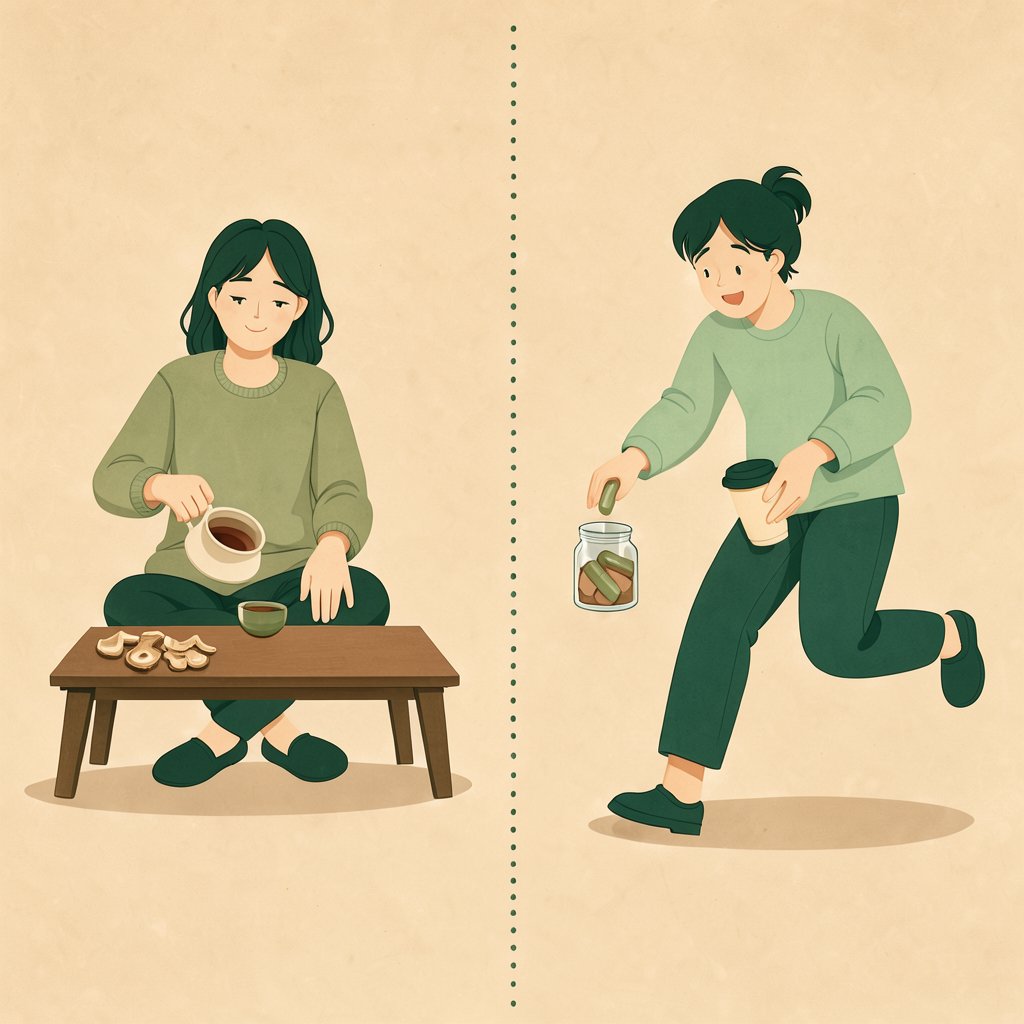
The cadence anchors deserve a cross-reference rather than a re-explanation: Lin’s steeped tea twice a week, the once-daily powder decoction and the weekly lingzhi pork dish come from his home-recipe collection, while the daily-capsule habit comes from Gundry’s supplement list.[6][8] Taste is a genuine differentiator the sources imply but never measure — a woody, bitter brew on one side, a tasteless capsule on the other. Coffee drinkers, meanwhile, have their own column-skipping option in Skachko’s reishi coffee.[7]
One practical footnote while you weigh the columns: readers pairing a reishi routine with broader joint-comfort and mobility goals have two options we have reviewed in depth — Joint Genesis, a daily joint-comfort formula, and Unlock Your Hip Flexors, a follow-along mobility routine. Ready-to-buy readers can jump straight to the current Joint Genesis offer or the hip-flexors program offer. We may earn a commission if you buy through links on this page; these products are not intended to diagnose, treat, cure or prevent any disease.
Safety and Course Length: What the Sources Actually Say
This section stays strictly inside what the sources document. On tolerance, the encyclopedia’s language is unusually direct: the polysaccharides have “no toxic effect on the human body” and are “safe from a medical point of view,” and allergy care with reishi preparations — typically a long course of one to two years — “usually causes no side effects.”[2] Duration is the active variable: the degree of immune restoration and antitumor activity depends on therapy duration, which is why the tradition frames reishi as a slow, long-course mushroom rather than a fast-acting one.[2]
Two cautions follow. First, ours rather than a book’s: because spore adenosine actively prevents thrombus formation, readers taking blood-thinning medication should discuss long reishi courses with their clinician before starting them — an editorial flag we attach to the sources’ clotting fact, not a warning any of the books makes.[2] Second, the gaps: our base contains no pregnancy, breastfeeding, surgery or anticoagulant-interaction warnings, and no clinical-trial numbers or milligram-per-day doses for Ganoderma lucidum — the 2–5 g/day figure belongs to G. applanatum alone.[2] Skachko’s closing dosing principle — everything is poison, and dosage alone decides whether a substance acts as a remedy or a toxin — is the right last word on the subject.[7]
The botanical cautions from earlier apply to every format equally: in Russia the wild mushroom is Red-Book rare and never harvested, the fruiting body is never cooked fresh, and look-alike species on conifers demand expert identification.[2][3] “Traditionally considered safe” is the sources’ verdict, and a clinician conversation before any long course is ours. Those two sentences are the whole safety picture the books support; the questions readers ask most come next.
Frequently Asked Questions
These are the questions readers ask most about the reishi supplement vs tea choice, answered in compressed form from the sections above. Each answer stays inside what the source books document, with no new claims smuggled in. Where a question deserves the full context, the linked guide carries it.
Is reishi tea or reishi capsules better?
Neither is objectively better: the sources describe a lifestyle trade-off, not a ranking. The tea route carries the 2,000-year ritual and documented cadences such as a twice-weekly cup; capsules carry convenience and stacking culture. No source in our library establishes a dose equivalence between the two formats — so choose by ritual and habit, not by assumed strength. The same honest logic runs through our adaptogen buyer’s guide.
How often did traditional home protocols drink reishi tea?
Henry B. Lin’s Chinese Healing Therapies records three home cadences: steeped lingzhi tea twice a week, a lingzhi-powder decoction once daily, and a weekly main dish of lingzhi cooked with tender pork. Presented as historical home practice, these are frequencies rather than brewing specs — the source documents no steep times or gram amounts. For a modern evening version, see our reishi evening tea ritual.
Can you eat reishi fresh?
No. The fruiting body is woody and corky — spongy-cork in texture — which is why reishi was never a culinary mushroom and why the hot-water format exists at all. Home use requires processing: drying, slicing, powdering, then steeping or simmering. That material reality, not fashion, created the tea tradition; see how other functional mushrooms are traditionally prepared.
What makes reishi chemically unique?
Three markers stand out in the reference literature: reishi is the only mushroom source of ganoderic acids (triterpenes with a steroid-hormone-like structure); it carries organic germanium at roughly ten times ginseng levels; and its polysaccharides are described as the most active of any medicinal mushroom or plant. Compare its profile with another shelf fungus in our chaga mushroom guide.
How long do reishi courses run?
The longest documented example is allergy care: courses of one to two years, described as reliable, effective and usually free of side effects. The encyclopedia also notes that the degree of immune restoration and antitumor activity depends on therapy duration — reishi is framed as a slow, long-course tradition, not a quick fix. Any long course deserves a clinician conversation first; our practice manuals keep the same rule.
Does the format change reishi’s compounds?
No — and this is the article’s key framing. The roughly 400 biologically active components belong to the mushroom itself, so tea, latte, coffee and capsules all start from the same cargo. What changes is delivery, ritual and cadence: a simmered cup versus a capsule with water. The choice is about your day, not different chemistry — browse the whole adaptogens and herbal wisdom cluster for more.
The reishi supplements vs reishi tea decision, in the end, is a decision about your day rather than about chemistry. If the twice-weekly steeped cup or the one-minute latte gives you a ritual you will actually keep, the traditional route has two thousand years of company behind it. If your life runs on capsules, water and calendars, the supplement shelf delivers the same mushroom with none of the ceremony. Choose the format you will still be using in six months — duration, every source agrees, is where reishi’s tradition actually lives.
Sources
- [1] Joseph Mercola — Herbs and Spices (2023). The modern herb compendium behind the emperors’ tea habit, the ~400-component overview, the immune-cell and mast-cell mechanism notes, the two modern format options, and the mushroom-latte recipe adapted in this guide.
- [2] Mikhail V. Vishnevsky — Medicinal Mushrooms: The Big Encyclopedia (2014). The central monograph: the name trio, the highest TCM category, the six classical properties, polysaccharide and ganoderic-acid chemistry, organic germanium, adenosine, the extract economy, market size, look-alike species, and the safety quotations.
- [3] Alexander I. Ivanov — Edible, Poisonous, Medicinal and Cultivated Mushrooms of the Middle Zone of European Russia (2012). Field-mycology context: the spongy-cork consistency, the “mushroom of happiness” epithet, the ganoderic-acid research via Li Yu (2010), and the soft-immunomodulation framing of mushroom polysaccharides.
- [4] Ma Jizhen, Mikhail M. Bogachikhin — Qigong: History, Theory, Practice (2004). Cultural history consulted for lingzhi’s place among the classical Chinese symbols, including the “eight landscapes” motif referenced in the opening section.
- [5] Sergey Kashnitsky — Chinese Miracle Methods (2014). The TCM-methods manual supplying the chemo- and radiotherapy context in which herbal support is described as protecting the immune system of cancer patients.
- [6] Henry B. Lin — Chinese Healing Therapies (2005). The home-recipe collection verified against the original-language edition: the twice-weekly steeped lingzhi tea, the once-daily powder decoction, and the weekly lingzhi pork dish; source of the translation-garbling warning.
- [7] Boris Skachko — Coffee, Reishi, Aloe Vera and Your Health (2021). The reishi-coffee book: instant coffee with reishi extract, its attributed ~300-plus-~200 component arithmetic, the 132 preparation methods, and the dosing principle quoted in the safety section.
- [8] Steven Gundry — The Longevity Paradox (2019). The personal supplement list pairing reishi with chaga, lion’s mane, cordyceps, coriolus and turkey tail — the daily-capsule stacking habit used as a cadence anchor in the comparison table.
- [9] Ayurveda Plus — AminoGold Product Catalog. Product-catalog evidence for capsule complexes that stack reishi with shiitake, maitake and cordyceps, cited strictly as documentation of the stacking format and never as product endorsement.
- [10] Izabella Wentz — Hashimoto Protocol (2020). The adaptogen-list appearance of reishi alongside ashwagandha, astragalus, ginseng and rhodiola — documentation of how the mushroom circulates in modern functional-medicine supplement routines and why stack builders meet it there.
- [11] Vasily M. Novoselov — Why We Age (2019). The longevity angle on adaptogens, with reishi named in the same class as the classic herbal adaptogens; consulted for how aging-focused authors position the mushroom among everyday supportive habits.
- [12] Anthony William — Brain Saver (2024). The wild-foods list placement of reishi, showing that the mushroom also circulates in wild-food and foraging contexts rather than only in the supplement aisle.
Where to go next: Put the tea route into practice with our reishi evening tea ritual, compare reishi’s chemistry with another shelf fungus in the chaga mushroom guide, and see the wider traditional context in functional mushrooms: traditional uses. For the supplement-buying side of the comparison, the adaptogen buyer’s guide covers label quality and selection criteria. The whole mushroom shelf lives under adaptogens and herbal wisdom.
How we researched this: This comparison is built from a local library of 1,137 wellness books, queried through an offline retrieval system with no internet sources; for this topic, the key reishi chapters were additionally verified against the original-language editions of the cited books. Every factual claim carries a numbered footnote to its source, and the gaps — doses, equivalences, formal warnings — are stated as gaps rather than filled. This article is educational content and is not intended to diagnose, treat, cure or prevent any disease.
